

208%. That is how far Derive (DRV) rose between its 14 September close of $0.1411 and its 22 September close of $0.4348, measured on CoinGecko's daily 00:00 UTC prints. The date matters because at 05:36 UTC on 14 September a post titled "DIP: Launch Derive V3" appeared on the Derive governance forum. It proposes moving the options exchange off its own OP Stack chain and onto a zero-knowledge program that settles on Ethereum mainnet, migrating every V2 account into a V3 genesis state and winding Derive Chain down. The token then did nothing useful for two days. By the 15 September close it had slipped to $0.1369, 5.3% below where it stood before the post went up. The rally the headlines attach to the proposal started in a different place, at a different hour, on 16 September.
That place was Upbit. On 15 September the exchange's KRW-DRV book traded 0.31 billion won for the whole day. In the single 04:00 UTC hour on 16 September it traded 4.67 billion won, and the day closed at 38.73 billion, roughly 125 times the prior session, according to Upbit's own candle data. The governance post supplied the story; Korean retail supplied the order flow, and the two are not the same thing. The distinction matters for anyone reading the move as a verdict on V3, because the protocol's fee base did not change on 16 September. DefiLlama puts Derive's combined 30-day fees at about $630,000, which funds roughly $220,000 a month of DRV buybacks at the 35% allocation holders approved in April. The token traded $58.9 million in the 24 hours to 07:26 UTC today.
Key facts
- DRV rose 208.1% from $0.1411 (14 Sep close) to $0.4348 (22 Sep close); CoinGecko daily prints, pulled 23 Sep 2026 07:26 UTC.
- "DIP: Launch Derive V3" was posted at 05:36 UTC on 14 Sep and had not reached a Snapshot vote as of 23 Sep; Derive forum and derivexyz.eth Snapshot space, read 23 Sep 2026.
- Upbit KRW-DRV turnover went from 0.31bn won (15 Sep) to 38.73bn won (16 Sep) and 183.44bn won (19 Sep); Upbit daily candles, read 23 Sep 2026.
- Derive took 91.6% of on-chain options premium over 30 days ($81.9M of $89.4M); DefiLlama, 23 Sep 2026.
- Derive's combined 30-day fees were about $629,500 and trailing-year fees about $5.74M; DefiLlama fee dashboards, 23 Sep 2026.
- Market cap $451.6M against a fully diluted value of $677.6M, with 999.7M of 1.5B DRV circulating; CoinGecko, 23 Sep 2026 07:24 UTC.
- Derive's public API listed 15 active perpetuals and no DRV or F contract; Derive
get_all_instrumentsendpoint, 23 Sep 2026 07:37 UTC.
What the V3 proposal actually asks holders to approve
Strip away the architecture diagrams and the proposal is a custody migration with a token-supply clause attached. Derive V3 is described in the post as "a zero-knowledge exchange: a high-performance matching engine paired with a sequencer whose every state transition is executed inside a zkVM and verified on the Ethereum L1." Matching stays off-chain, as it is in V2. Margin, pricing and settlement run inside the zkVM and are proven off-chain; Ethereum only verifies the proof, which the post puts at "a flat ~400–500k gas, whether the batch holds one trade or a million." State diffs go to Celestia for data availability, so a third party could in principle rebuild state and keep withdrawals moving if the operator went dark.
Ownership first. At launch, the V3 contracts would be controlled by a multisig run by Derive Subsidiary (BVI) Ltd, a wholly owned subsidiary of the Derive Foundation, "with timelock protections and a 6-of-8 bypass." That owner can replace the committed state root, swap the verifying key and upgrade the contracts. The DIP says ownership "can be transferred" to on-chain stDRV governance later, in a follow-up proposal. A censorship-resistant escape hatch exists, but its trigger is a two-week window: if the sequencer fails to process a withdrawal within 14 days, anyone may take over batch submission. That is a real protection, and it is also a fortnight.
Then there is the market list. V3 splits today's single risk pool into four "risk universes": Prime (ETH, BTC), Mid cap (HYPE), Alt (eleven assets from SOL to PUMP) and RWA (XAUT). Anything not named is deprecated, and deprecated derivative positions "are force-closed at the mark price." For a venue whose growth story leaned heavily on being first to list HYPE options, isolating each risk bucket is the point: a blow-up in an alt book should no longer eat into BTC margin.
The token clause is the part most coverage skipped. Because DRV lives partly on Derive Chain, and that chain is being switched off, the DIP says "the DRV token will be connected to Robinhood chain, minting new supply equaling the snapshot amount of DRV on Derive Chain (including stDRV balances)." The copy stranded on Derive Chain is "orphaned" and "will no longer form part of the canonical DRV supply." On paper that is supply-neutral: one set of tokens retires as an equal set is minted. In practice it makes the migration snapshot the single most important event for circulating-supply accounting since the September 2025 vote that minted 500 million DRV for the Foundation. Holders will want to see the snapshot numbers reconcile before trusting any post-migration market-cap figure. Staked positions also move: stDRV is redeployed on Ethereum L1, and existing voting delegations "will be cleared."
Timing is open. The post commits to a migration notice "at least 14 days before the migration," published on X, Discord and in-app, and no such notice was visible on 23 September. As of this morning the derivexyz.eth Snapshot space showed no V3 vote; its most recent proposal was July's USDH bridge deprecation. So the 14 September event is a proposal, not an approval and not a launch.
Two quiet days, then 04:00 UTC on 16 September
The table below lines up CoinGecko's daily USD prints against Upbit's KRW-DRV candles. Each CoinGecko 00:00 UTC print is treated as the previous day's close; Upbit's daily candles run 00:00 to 24:00 UTC.
| Day (UTC) | DRV close, USD (CoinGecko) | Upbit KRW-DRV close, won | Upbit turnover, bn won |
|---|---|---|---|
| 13 Sep | $0.1446 | 197 | 0.18 |
| 14 Sep (DIP posted 05:36) | $0.1411 | 190 | 0.35 |
| 15 Sep | $0.1369 | 187 | 0.31 |
| 16 Sep | $0.2445 | 335 | 38.73 |
| 17 Sep | $0.2549 | 351 | 46.40 |
| 18 Sep | $0.2927 | 404 | 22.01 |
| 19 Sep | $0.4407 | 609 | 183.44 |
| 20 Sep | $0.3893 | 537 | 43.80 |
| 21 Sep | $0.4005 | 542 | 13.09 |
| 22 Sep | $0.4348 | 585 | 29.42 |
Read down the right-hand column. For two full sessions after the DIP went live, Upbit barely registered the token. Then Upbit's hourly candles show the 03:00 UTC hour on 16 September trading 129 million won and the 04:00 UTC hour trading 4.67 billion, with price running from 200 to a high of 245 won. That is early afternoon in Seoul. A second, larger wave hit between 22:00 UTC on 16 September and 01:00 UTC on 17 September, when four consecutive hours traded a combined 34.5 billion won and the price touched 417 won.
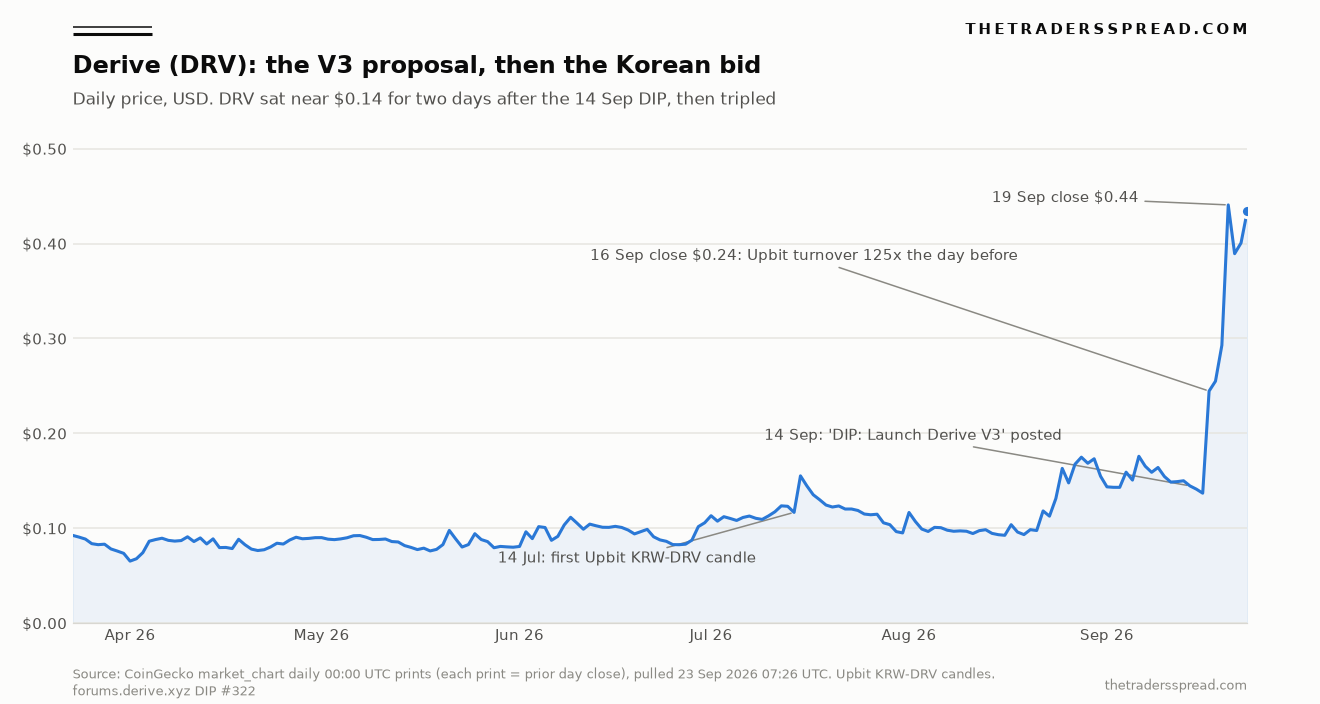
How much of the global tape was Korean? Converting at the ECB reference rate of 1,367.80 won per dollar for 16 September, Upbit's 38.73 billion won is about $28.3 million, roughly a third of the $85.7 million 24-hour volume CoinGecko recorded across all venues at the next midnight print. On 19 September, the day of the $0.4407 peak close, Upbit's 183.44 billion won converts to about $132 million at 1,388.10, or roughly 58% of CoinGecko's $228.2 million. In CoinGecko's live ticker table this morning, Upbit KRW accounted for $30.9 million of $58.9 million, with Bithumb's KRW book a further $5.6 million. Coinbase ($4.6 million) and Kraken ($1.5 million) were minor venues by comparison.
One more detail from Upbit's own market list: its USDT-DRV and BTC-DRV books carried a "global price differences" caution flag when we read the API at 07:37 UTC today, while the KRW book did not. The exchange is warning that its non-won DRV pairs have been trading away from the world price.
A word on the percentages. CoinGecko's own fields put DRV at +214.2% over 30 days and +164.7% over seven days. Recomputed from its own daily closes, the 30-day figure is +243.7% (24 August print of $0.1313 to the live $0.4512 at 07:25 UTC) and the seven-day figure is +229.7% (16 September print of $0.1369 to the same live price). The provider's fields and its price series do not reconcile, which is why every window in this article carries its anchor date.
The Derive side of the story, in its CEO's words
None of this makes the protocol story unimportant. It explains why a governance post could plausibly re-rate a token once someone went looking for a reason. Derive co-founder and chief executive Nick Forster was on the Bankless podcast published the same morning as the DIP. Host David Hoffman, co-founder of Bankless, introduced the venue plainly: "Derive is the largest on-chain options exchange on Ethereum."
Asked what V3 brings, Forster was blunt about the current system's limits: "at the moment we're like an L2. There's a lot of custom work and difficulty integrating and building on top of Derive. We're in a bit of a straitjacket. It takes a while to list new collaterals and new markets." And the target: "We go from all of that until almost like a Ferrari."
On the competitive map he conceded where the volume still sits. "Deribit, I think, is still like 70%, 75% of the market," Forster told Bankless, before describing Derive's own share as having grown from "almost nothing like 0.1, 0.15%" a year to eighteen months earlier. Four days before the DIP went up, Derive's own blog was already framing V3 in grander terms, quoting Forster in a 10 September post: "V2 proved DeFi options could settle billions. V3 is about proving they can settle trillions."
The DefiLlama numbers support the dominance half of that claim within on-chain options. Over the last 30 days Derive Options logged $81.9 million of premium out of $89.4 million across every protocol DefiLlama tracks, a 91.6% share, and $3.67 billion of $4.33 billion in notional volume (84.8%). The DIP itself cited "approximately 95%" of on-chain premium for the 30 days to 7 September, so share has drifted slightly since the post was drafted. It also cites "approximately $2 billion of open options interest against an estimated global total of roughly $40 billion"; we could not independently reproduce the open-interest figure. Against Deribit, on-chain options remain a small pond, and Derive is the dominant fish in it.
Where the fee maths leaves DRV
Here is the number that tempers the chart. DefiLlama's fee dashboards show $466,717 in 30-day fees for Derive Options and $162,790 for Derive V2, about $629,500 combined. Over the trailing year the same two lines total roughly $5.74 million. The April 2026 DIP, which passed on Snapshot with 101.7 million DRV in favour and none against, raised the buyback share of protocol fees from 25% to 35%, cut staking emissions from 250,000 to 100,000 DRV a week and shortened the unstake period from 28 days to seven.
| Measure | Value | Basis |
|---|---|---|
| Market cap | $451.6M | CoinGecko, 23 Sep 07:24 UTC |
| Fully diluted value | $677.6M | 1.5B max supply |
| Trailing-year fees | ~$5.74M | DefiLlama, Options + V2 |
| Market cap / annual fees | ~79x | derived |
| Implied buyback budget | ~$2.0M a year | 35% of trailing fees |
| Staking emissions | 5.2M DRV a year (~$2.3M at $0.45) | 100,000 DRV/week, April DIP |
| 24h traded volume | $58.9M | CoinGecko, 23 Sep |
Two things jump out. At today's price the buyback budget and the staking emissions roughly cancel, so the buyback is not shrinking float in dollar terms. And a single day of DRV trading now exceeds 29 years of buybacks at the current run-rate. The flows that moved this token in September were not protocol flows. DefiLlama fee definitions do not map one-to-one onto Derive's "protocol fees", so treat the buyback line as an order of magnitude, not an audit.
Dilution sits on top of that. The 2025 strategic mint lifted maximum supply from 1 billion to 1.5 billion, with the proposal estimating "at most, dilution of 8.25% per year for 4 years" as Foundation tokens are deployed. The gap between market cap and fully diluted value, about $226 million at this morning's price, is that overhang. DefiLlama's TVL count for Derive rose from $156.8 million on 16 September to $198.0 million today, partly on collateral repricing.
What we checked and could not confirm
Two claims circulating about this move could not be confirmed at a primary source, and a third was left out.
First, the perpetual listing. Crypto Briefing reported on 19 September that Derive "has listed two new perpetual futures contracts: one for its native governance token $DRV, and another for $F", with 5x leverage. Derive's own public API, queried at 07:37 UTC today, returned 15 active perpetuals (BTC, ETH, HYPE, SOL, XRP, ADA, ZEC, LINK, DOGE, BNB, CC, VVV, LIT, PUMP and XAUT) and an "Instrument not found" error for DRV-PERP. The 15 match the four risk universes in the DIP exactly. Either the listing sits on another front end or it has not happened on the core exchange; we could not confirm it.
Second, the trigger for 04:00 UTC on 16 September. We found no Derive forum post, Snapshot proposal, Derive Insights article or Upbit notice timed to that hour. AMBCrypto attributed the move to "a spike in trading sentiment after Derive posted the V3 plan," which is consistent with the sequence but does not explain the 46-hour lag. The Derive team's X account could not be read from our systems this morning.
Third, a weekly buyback total quoted in secondary coverage traces to a Derive post on X we could not load, so it is omitted.
What this changes
The proposal changes the protocol's plumbing if it passes, and the order of events decides how much weight any price should give it. Nothing has been voted, nothing has been scheduled, and the DIP promises at least 14 days' notice before any migration. On-chain, the only thing that has actually happened is a forum post.
RelatedAlgorand (ALGO) Falls 9.0% in a Week as the Feed Stays Loud
What the post does change is the list of dates that now matter for DRV. The first is the Snapshot vote itself: prior Derive DIPs passed with no votes against, but those did not force-close deprecated positions or reset delegations. The second is the migration notice, which starts the 14-day clock. The third is the snapshot of Derive Chain balances used to mint replacement DRV. A clean reconciliation between orphaned and newly minted supply is the difference between a supply-neutral migration and an accounting headache for every aggregator that reports circulating supply.
For the options market, V3's value is the risk isolation and the Ethereum-native custody. If it ships as described, Derive can list a new alt market without exposing BTC and ETH margin to it, which is how it won HYPE options in the first place. That is a real competitive change against Deribit, whose 70% to 75% share Forster himself cites.
For the token, the September move says more about where DRV trades than about what Derive earns. Roughly half of today's volume is in won. Fees of about $630,000 a month have not changed with the price. The rally began 46 hours after the governance post, not with it. Any reading of the 208% as a market verdict on V3 has to account for those three facts first.
What would change this view: a Snapshot vote with a heavy turnout, a migration notice with a firm date, or 30-day fees stepping up alongside the new volume. None had happened as of 07:37 UTC on 23 September.
FAQ
What is the Derive V3 proposal?
"DIP: Launch Derive V3" was posted on the Derive governance forum at 05:36 UTC on 14 September 2026. It proposes deploying a zkVM-based exchange that settles on Ethereum mainnet, migrating all V2 accounts, balances and positions into a V3 genesis state, splitting markets into four isolated risk universes and winding down Derive Chain, the OP Stack network Derive runs today.
Has the V3 upgrade been approved or launched?
No. As of 23 September 2026 the derivexyz.eth Snapshot space showed no V3 vote, and no migration notice had been published. The proposal commits to announcing the migration at least 14 days in advance on X, Discord and in the app, with a view-only tool showing each account before and after.
Why did DRV rise 208%?
The rise from $0.1411 to $0.4348 ran from the 14 September close to the 22 September close. The price fell for two days after the proposal, then turned on 16 September when Upbit's KRW-DRV turnover jumped from 0.31 billion to 38.73 billion won. We found no primary-source announcement timed to that surge, so the specific trigger remains unconfirmed.
Does the migration change DRV's supply?
By design it should not. The DIP mints new DRV equal to the Derive Chain snapshot and declares the stranded Derive Chain copy orphaned and outside canonical supply. Separately, the 2025 strategic mint raised maximum supply to 1.5 billion; about 999.7 million DRV were circulating on 23 September per CoinGecko.
How large is Derive in options?
On DefiLlama data for the 30 days to 23 September 2026, Derive handled 91.6% of on-chain options premium, $81.9 million of $89.4 million, and 84.8% of notional volume. Against all crypto options, including centralised venues, it is far smaller: Nick Forster puts Deribit's share at roughly 70% to 75%.
Disclaimer
This article is analysis and news reporting, not investment advice. Crypto assets are highly volatile and you can lose all of the capital you commit. Figures were read at the times stated and will have changed since.
Related: how the OP Stack's Upgrade 20 moved Optimism, Uniswap's run on new-chain fees, our Ethereum hub and the glossary entry for an option.