

Zama's token, ZAMA, printed $0.0955 at 00:00 UTC on 22 September, up from $0.0467 at the same hour on 15 September, the morning Zama switched on confidential deposits across 16 Morpho vaults. So here is the question the market is actually pricing: is a week-old launch that has pulled roughly $55 million into Zama's confidential-only vaults worth the $118 million of market value ZAMA added over the same seven days? On the protocol's own fee arithmetic, no. Zama charges fractions of a dollar per encrypted operation and burns every token it collects, but it also mints 5% of supply a year to pay operators, and at today's usage the mint is winning. What buyers are paying for is distribution: the wallets, curators, custodians and incentive engines now wiring confidential tokens into rails they already use. That is a real asset. It just doesn't show up in the burn yet, and the gap between the two is where this rally will be tested.
The detail most coverage has skipped is timing. ZAMA barely moved on launch day. The daily prints for 15 and 16 September are identical at $0.0467, and by 18 September the token was up only 7.6%. The move came between 18 and 20 September, when it rose 64% in two days and 24-hour turnover jumped from about $13 million to $147 million, per CoinGecko. A product launch that the market ignores for three days and then chases is a flow story first and a fundamentals story second. The fundamentals are worth examining anyway, because they are better than the price action and weaker than the "shrinking supply" pitch doing the rounds on crypto social media.
Key facts
- ZAMA rose 104.7%, from $0.0467 to $0.0955, between the 00:00 UTC prints of 15 and 22 September 2026 — CoinGecko market_chart, retrieved 22 Sep 2026 06:44 UTC
- Zama opened confidential access to 16 Morpho vaults run by five curators across five assets (USDC, USDT, WBTC, AUSD, TGBP) — Zama blog, 15 Sep 2026
- The four confidential-only vaults held about $54.6 million, $32.8 million of it in Steakhouse Confidential Prime USDC — Morpho public API, read 22 Sep 2026 ~06:50 UTC
- Market capitalisation rose from $116.5 million to $234.7 million over the same window, against a fully diluted value of $1.08 billion — CoinGecko, 22 Sep 2026
- Staking rewards are minted at 5% of total supply a year, while 100% of protocol fees are burned — Zama staking docs and litepaper, read 22 Sep 2026
- The Ethereum ZAMA contract reported a total supply of 11,306,970,172 tokens —
totalSupply()call on 0xa12c…f4f3, 22 Sep 2026 - Bitcoin rose 10.8%, from $78,173 to $86,597, across the same seven daily prints — CoinGecko, 22 Sep 2026
What went live on 15 September
Zama is not a blockchain. It is a confidentiality layer built on fully homomorphic encryption (FHE), a technique that lets a network compute on encrypted numbers without decrypting them. Deployed on Ethereum, it lets a token keep balances and transfer amounts encrypted while anyone can still verify the transaction followed the rules.
The first live use came in June: one Morpho vault, curated by Steakhouse Financial, that accepted Confidential USDC. The launch on 15 September widened that to a menu. Zama's announcement lists 16 vaults from five curators (Steakhouse, Armitage by Wintermute, Flowdesk, RockawayX and Bitwise) across five underlying assets. Four of them are new products with no public twin, including what Zama calls the first confidential-only bitcoin yield vault. The other twelve are existing Morpho vaults that now take confidential deposits alongside public ones. A confidential swap protocol went live the same day, so a depositor can move between confidential assets without showing size or direction.
Dr. Rand Hindi, co-founder and CEO of Zama, framed it as a change of category rather than of product. "Today's expansion is proof of the model at scale," he said in the launch post. "Same vaults, same curators, same liquidity, now with confidential entry. This is how confidential DeFi becomes a category and not an experiment."
Two days later came the piece that DeFi incentive programmes had been missing. Merkl added support for ERC-7984, Zama's confidential token standard, so reward campaigns can run on encrypted balances. A depositor delegates viewing rights to Merkl, rewards are calculated on its usual time-weighted cycle, and payouts arrive as confidential transfers. Claims open "in the weeks following launch", which means nobody has collected a confidential reward yet.
That matters for sequencing. Liquidity mining is how most DeFi venues bootstrap deposits, and until 17 September a confidential vault could not run one without exposing the balances it exists to hide. The Morpho side of this is familiar; our August piece on Morpho's Base deposits covered how curator vaults scale once incentives are in place. What is new is the encrypted wrapper.
Three flat days, then a vertical line
The chart below plots every daily 00:00 UTC print since trading opened on 2 February. For most of the year ZAMA was a slow grinder: from the $0.018 low on 13 February it more than tripled to a $0.0606 print on 29 July, swung through August, faded into mid-September, and was sitting at $0.0467 when the vaults opened.
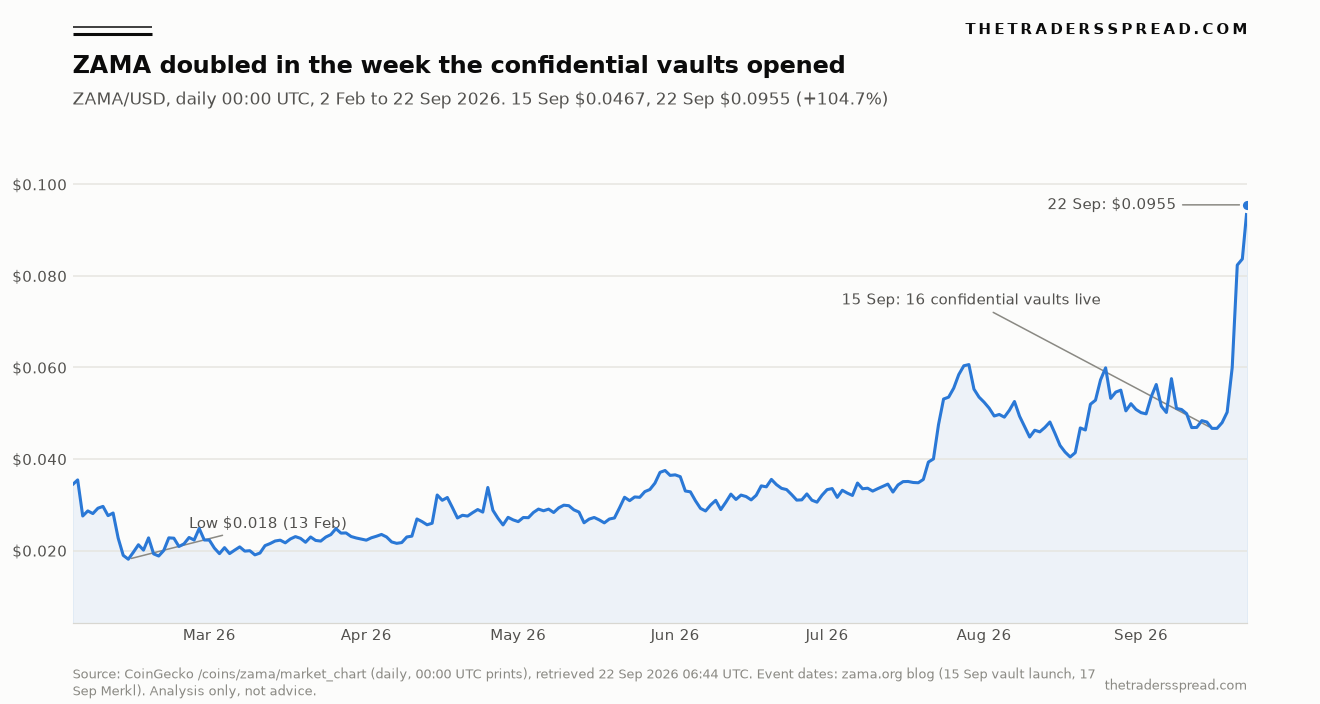
Then nothing happened for three days. The breakout arrived on 19 and 20 September, alongside a bitcoin rally that took BTC through $80,000 and a wider bid for small-cap tokens. Isolating what belongs to Zama and what belongs to the tape is partly guesswork, but the comparison is stark enough to be useful: bitcoin gained 10.8% over the same seven prints, ZAMA gained 104.7%. Roughly ten times the move is not beta alone.
| Measure (00:00 UTC prints) | 15 Sep 2026 | 18 Sep 2026 | 20 Sep 2026 | 22 Sep 2026 |
|---|---|---|---|---|
| ZAMA price | $0.0467 | $0.0502 | $0.0824 | $0.0955 |
| Market cap | $116.5M | $127.4M | $206.1M | $234.7M |
| 24h volume | $8.5M | $12.8M | $146.8M | $108.5M |
| Change vs 15 Sep | 0.0% | +7.6% | +76.4% | +104.7% |
| Bitcoin, change vs 15 Sep | 0.0% | −2.3% | +3.9% | +10.8% |
Source: CoinGecko market_chart for zama and bitcoin, daily 00:00 UTC prints, retrieved 22 Sep 2026 06:44–06:47 UTC. Volume is CoinGecko's trailing 24-hour figure at each stamp.
Volume tells the same story more loudly. August averaged about $15 million a day. The 20 September stamp shows $147 million, nearly ten times that, and the order books doing the work were centralised: Binance's ZAMA/USDT pair carried $39.3 million of the latest 24 hours and Upbit's Korean-won market $13.9 million, against $3.0 million on Coinbase. CoinGecko put the intraday all-time high at $0.1052 at 09:48 UTC on 21 September. At 06:41 UTC today the token was $0.0953, a little under 10% below that peak.
Longer windows put the week in proportion. From 22 August the token is up 83.9%. From the first daily print after its 2 February listing, $0.0344, it is up 177.8%. Very little of that happened before this month.
The burn is real, and still smaller than the mint
The claim circulating with the rally is that ZAMA has a shrinking supply. The protocol design says otherwise, at least for now.
Zama's litepaper sets fees in dollars and collects them in ZAMA through a price oracle. Verifying an encrypted input costs between $0.005 and $0.50, decrypting a value between $0.001 and $0.10, and bridging a ciphertext between $0.01 and $1, with subscription discounts of up to 99% for heavy users. The litepaper's own worked example puts a confidential token transfer at $0.008 to $0.80 in total. Every one of those fees is burned. Separately, the staking documentation says rewards are minted each year at a percentage of current total supply, "currently set to 5%", split 60% to key-management operators and 40% to coprocessors.
Put numbers on that. The Ethereum contract reported 11,306,970,172 ZAMA on 22 September, so a 5% emission is about 565 million tokens a year, or roughly $54 million at this morning's price. For burns to cancel that, confidential activity would have to generate $54 million of fees a year. At the most expensive tier, $0.80 per transfer, that means about 67 million paid transfers. At the one-cent tier heavy users are meant to reach, it means billions. The vaults opened a week ago with about $55 million in their confidential-only products.
The supply figure itself points the same way. Zama's staking documentation uses 11,000,000,000 as its reference total supply in the reward-rate code; the live contract is about 307 million tokens, or 2.8%, above that. We could not reconstruct the full mint-and-burn history from a public node, so treat that gap as indicative rather than audited. What it does not look like is contraction.
Merkl's integration shows why the fee line could grow faster than the vault numbers suggest. Every reward calculation depends on a delegated decryption, and each decryption is a billable event. Pablo Veyrat, CEO of Merkl, put the constraint plainly: "Incentives were the one thing confidential assets could not have, because rewarding a balance meant reading it." Solve that, and every incentive cycle turns into protocol fees. Whether that adds up to tens of millions of dollars a year is the open question, and nobody outside Zama can see the answer yet, because the fee data is not published in a form we could pull.
Who sold into $147 million of volume
A token with 21.8% of its supply circulating behaves differently from one that is fully out. CoinGecko shows 2.46 billion ZAMA in circulation against 11.31 billion total, which is why the $235 million market cap sits next to a $1.08 billion fully diluted value. The difference is tokens that have not yet entered circulation. When a thin float doubles, the holders of the other 78% gain the most from new liquidity, and their release schedule, not the vault count, sets the supply side of the next few months.
On the demand side, the flow looks exchange-led and retail-heavy. Binance and Upbit together accounted for more than half of the latest day's reported volume. Korean won markets have a track record of sharp, short-lived altcoin squeezes, and a market-maker book built for $15 million days has to widen fast at ten times that. None of that is a reason to dismiss the rally. It is a reason to separate the price from the usage data, which moves on a different clock.
The builders see a slower adoption curve than the chart suggests. "Institutions have increasingly been exploring how onchain capital allocation can be made more confidential to fit their requirements," said Merlin Egalite, co-founder of Morpho, in the 15 September release. "Exploring" is the operative word. The distribution partners Zama named (Utila, Zerion and Yield.xyz) will add their entry points "in the weeks following launch", not on day one.
One data point cuts against the hype. Zama's launch post says the original Steakhouse Confidential Prime USDC vault grew to "$40+ million in shielded TVL within 7 weeks." The Morpho API showed $32.8 million in that vault this morning. Some of the difference may sit in the new confidential access routes to other vaults, which the public data does not split out, but on the numbers we can see, the flagship is smaller now than at its summer high.
Where the thesis could break
Three things would make this week look like a top rather than a base.
The first is deposits. If the four confidential-only vaults stall near $55 million while ZAMA holds a market cap above $200 million, the market is paying for a pipeline that is not filling. The second is the claim window for Merkl rewards: if incentive campaigns open and deposits do not respond, the bootstrap story weakens. The third is supply. A tranche of team or investor tokens hitting a thin float after a doubling is the classic way these moves unwind, and Zama has not posted a dated unlock calendar on its own blog that we could verify.
RelatedCosmos (ATOM) Price Prediction: $2.44 Bull vs $1.40 Bear
Against that, the case for staying constructive on the protocol is concrete. Five institutional curators, a Tether-aligned USDT vault, a sterling stablecoin issuer and three distribution partners do not sign up to launches that go nowhere, and confidentiality is one of the few features public chains still lack for regulated money. Demand for onchain privacy is not new; our Zcash analysis tracked the same appetite from the shielded-payments side, and tokenised securities keep pushing the other way, as the SEC's tokenised-stock order showed. Zama is betting that both lines meet in encrypted, compliant DeFi.
What this changes
For the protocol, 15 September moved Zama from a single proof of concept to a working menu: 16 vaults, a swap venue and, as of 17 September, a way to run incentives without leaking balances. That is the most important product week the project has had since its February token launch, and it is dated and verifiable on Zama's own site.
For the token, the week changed the valuation question more than it answered it. At $0.0953 ZAMA prices the network at about $235 million on circulating supply and a little over $1 billion fully diluted. Against that, the confidential-only vaults we could measure hold about $55 million, the burn depends on fees priced in cents, and emissions add roughly $54 million of new tokens a year at today's price. The market is capitalising future distribution, not current fee capture.
The scenarios that follow are about usage, not price. The base case, which we would put at roughly 50%, is that deposits grow steadily as Zerion, Utila and Yield.xyz come online, but not fast enough to shift the burn-mint balance before next year. The stronger case, around 25%, is that Merkl campaigns pull in a step change in deposits and the confidential routes into the twelve existing vaults become visible in Morpho's data. The weaker case, also around 25%, is that the flagship vault keeps shrinking and the price action fades back towards where the launch found it.
What would change our mind: a published fee or burn figure from Zama showing annualised burns at even a quarter of emissions would make the supply argument credible. On the other side, a confidential-only vault total still near $55 million a month from now would suggest that the market got ahead of adoption.
FAQ
What did Zama launch on 15 September 2026?
Zama opened confidential deposits into 16 Morpho vaults run by Steakhouse Financial, Armitage by Wintermute, Flowdesk, RockawayX and Bitwise, covering USDC, USDT, WBTC, AUSD and TGBP. Four of the vaults are confidential-only; twelve are existing public vaults that now accept encrypted deposits. A confidential swap protocol launched the same day, and Merkl added confidential reward campaigns on 17 September.
How much did ZAMA rise after the launch?
Between the 00:00 UTC prints of 15 and 22 September 2026, ZAMA rose from $0.0467 to $0.0955, a gain of 104.7%, according to CoinGecko daily data. Most of the move came on 19 and 20 September rather than on launch day. Bitcoin rose 10.8% over the same window.
Is the ZAMA supply shrinking?
Not on current evidence. All protocol fees are burned, but the staking documentation mints rewards at 5% of total supply a year, about 565 million tokens. The Ethereum contract showed 11.31 billion ZAMA on 22 September, above the 11 billion reference figure in Zama's staking code. Burns would need about $54 million a year in fees to offset emissions at today's price.
How much money is in Zama's confidential vaults?
Morpho's public API showed about $54.6 million across the four confidential-only vaults on the morning of 22 September, led by Steakhouse Confidential Prime USDC at $32.8 million. Confidential deposits into the twelve existing public vaults are not separated in the public data, so the full confidential total is likely higher but cannot be measured directly.
Why does circulating supply matter for ZAMA?
Only about 21.8% of the 11.31 billion total supply circulates, per CoinGecko. That thin float amplifies moves in both directions and leaves a $1.08 billion fully diluted value above the $235 million market cap. Future releases of the non-circulating 78% add supply regardless of how the vaults perform.
Disclaimer
This article is analysis and news reporting, not investment advice. Cryptoassets are highly volatile and you can lose all of the capital you put at risk. Figures are drawn from the sources named and dated in the text; verify them independently before making any financial decision.