

$106.65. That is where Quant (QNT) closed on 3 October 2025, and it is the number the token spent Thursday night failing to reach. On 24 September 2026 The Clearing House, the New York utility that clears and settles more than $2 trillion a day for the US banking system, named Quant as the technology provider for its On-Chain Money Initiative. QNT went from $70.6767 at 00:00 UTC on 24 September to $101.09 at 07:38 UTC on 25 September, a gain of 43.0% measured on CoinGecko daily closes. It was back at $99.56 by 07:48:30 UTC. That is the largest mandate in the company's history by any reasonable measure, and it still has not carried the token past the level a far smaller mandate produced twelve months ago.
Here is the part the price action is quietly ignoring. Read the two primary documents, The Clearing House release and Quant's own version of it, and neither one mentions the QNT token. Not once. The word "token" appears 16 times in the Clearing House text and every single occurrence is "tokenized deposit" or "Token Service". Overledger is absent. PayScript, Quant's payment-scripting language, is absent. No public blockchain is named. What was announced is a commercial contract between a payments utility and a private British software company, Quant Network Limited. What repriced 43% is a fixed-supply asset whose contractual relationship to that contract is stated nowhere in either document.
Key facts
- The Clearing House selected Quant to power the interoperability, orchestration and transaction-management layer of its On-Chain Money Initiative, with connectivity to the RTP and CHIPS networks — The Clearing House press release, 24 September 2026
- The network is expected to become available to participating institutions in the first half of 2027 — The Clearing House press release, 24 September 2026
- The Clearing House clears and settles more than $2 trillion each day and is owned by 25 of the largest US financial institutions — The Clearing House releases of 24 September 2026 and 5 June 2026
- QNT rose 43.0%, from $70.6767 to $101.09, between 00:00 UTC on 24 September and 07:38 UTC on 25 September 2026 — CoinGecko daily close series, retrieved 07:38 UTC 25 September 2026
- QNT remains 6.6% below its 52-week high of $106.65, set on 3 October 2025, seven days after Quant won the UK tokenised sterling deposits mandate — CoinGecko daily closes, retrieved 25 September 2026
- 24-hour volume of $80.0m against a median daily $13.7m over the prior 30 days, a 5.8x expansion — CoinGecko, 07:48:30 UTC 25 September 2026
- 14,544,176 QNT circulate against a hard maximum of 14,612,493, or 99.53% of the cap — CoinGecko coin data, 07:41:30 UTC 25 September 2026
What The Clearing House actually signed
The On-Chain Money Initiative was unveiled on 5 June 2026. It is not a pilot. The Clearing House described a production network that will let banks of any size clear and settle tokenised deposits between themselves inside the existing regulated framework, with a connectivity layer joining that activity to RTP and CHIPS.
Thursday's announcement filled in the one blank the June release left open: who builds it. That blank mattered more than most of the coverage allowed. A clearing utility owned by the largest banks in the country does not put its name on an interbank settlement layer and then hand the build to an unproven vendor, and the June announcement had already committed seventeen institutions to public statements of support, among them Bank of America, BNY, Citi, HSBC, J.P. Morgan, PNC, Santander, TD, Truist, U.S. Bank and Wells Fargo. Whoever won the work was going to inherit a distribution list that no crypto infrastructure company has ever had.
Quant won it. The reasoning offered was operational rather than technological.
"Building interbank infrastructure for tokenized deposits requires proven technology that can scale," said Sal Karakaplan, Chief Strategy Officer at The Clearing House. "The Clearing House has a long history of building and operating trusted payment networks that serve the banking industry. Quant brings the technology and expertise needed to support the network, giving financial institutions of all sizes a path to participate." (The Clearing House, 24 September 2026)
Note what is being bought: a track record, not a chain. The release points to Quant's deployments "in regulated environments, working with central and commercial banks in the UK and around the world." That is the Regulated Liability Network, the Bank of England work, and the tokenised sterling deposits project. Gilbert Verdian, Quant's founder, read the moment in larger terms.
"This marks a defining step in the global transition to programmable money," said Gilbert Verdian, Founder and Chief Executive Officer at Quant. "Tokenized deposits are now the de facto way banks move money on-chain, and The Clearing House sits at the heart of the U.S. banking system, meaning this partnership sets a standard for the rest of the world to follow." (Quant, 24 September 2026)
He is probably right about the standard-setting. The Clearing House traces its operations to 1853, which is a long time to have been the place where American banks square up with each other, and its member institutions are the ones that decide what "normal" looks like in wholesale payments. If tokenised deposits clear through a Quant-built layer at RTP and CHIPS, every other jurisdiction gets a reference implementation for free.
The precedent almost nobody is pricing
Quant has been here before, almost exactly a year ago to the day.
On 26 September 2025, UK Finance and a consortium of Barclays, HSBC, Lloyds, NatWest, Nationwide and Santander selected Quant to provide the programmable money infrastructure for the UK's tokenised sterling deposits project. Jana Mackintosh, Managing Director at UK Finance, called it "a powerful example of industry collaboration to deliver next-generation payments for the benefit of customers and businesses." Three use cases were named: marketplace payments, remortgaging, and wholesale bond settlement with instant delivery-versus-payment.
QNT closed that day at $86.93. It ran to $106.65 by 3 October, a gain of 22.7%. Then it went back. By 11 October 2025, fifteen days after the announcement, it closed at $85.37, below where it had started. It never revisited $106.65 in the following twelve months. On 24 September 2026, the morning of the biggest announcement Quant has ever made, the token opened the day at $70.68, which is 18.7% lower than where it sat on the day it won the UK mandate.
So the honest way to frame Thursday's move is not "QNT breaks out on institutional adoption." It is: a token that gave back a mandate-driven rally in fifteen days last autumn, and then bled for eleven months, has just had a second, larger mandate-driven rally, and is currently 6.6% below the high the first one produced. Both rallies happened on news that was genuinely important to the company. Only one of them has had time to be tested.
What the tape says
The series below runs 365 days of daily closes and carries both mandates.
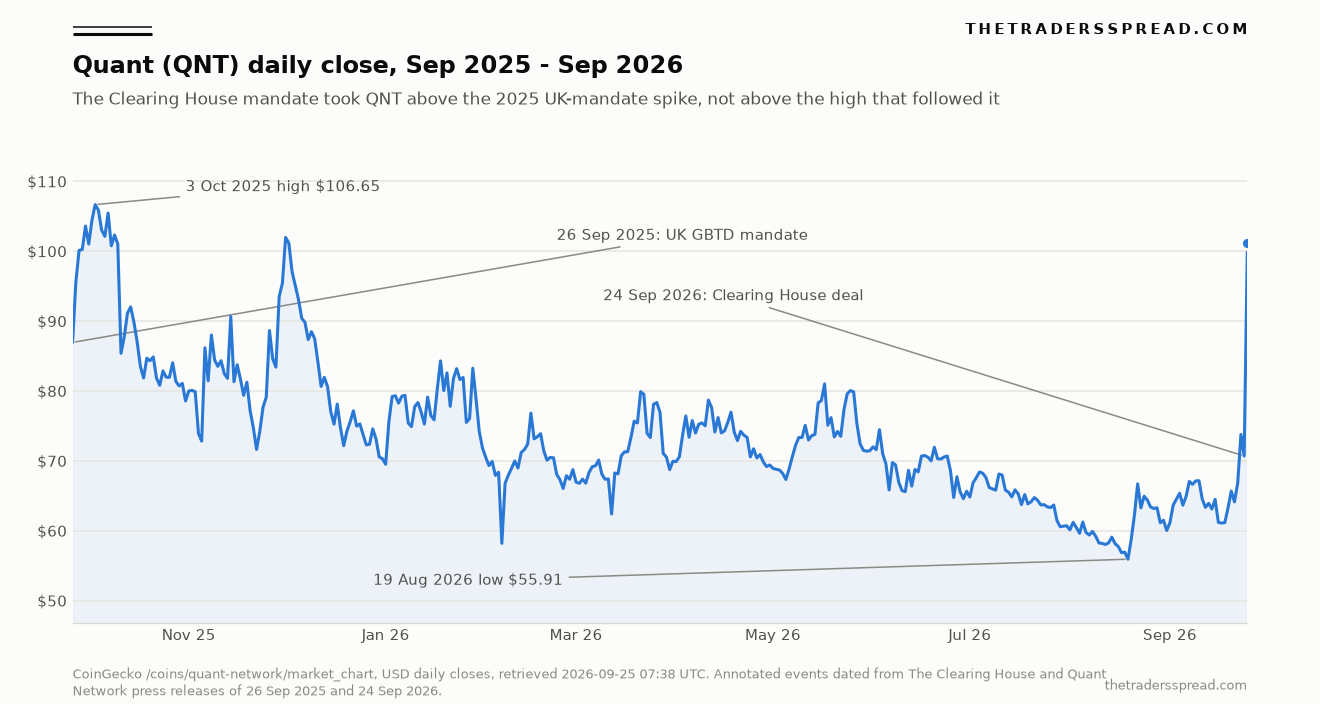
Laid side by side, the two events are more alike than the current enthusiasm suggests.
| UK tokenised sterling deposits | Clearing House On-Chain Money | |
|---|---|---|
| Announced | 26 September 2025 | 24 September 2026 |
| Counterparty | UK Finance and six commercial banks | The Clearing House, owned by 25 US institutions |
| QNT at 00:00 UTC that day | $86.93 | $70.68 |
| Peak after the news | $106.65 on 3 October 2025, +22.7% | $101.09 at 07:38 UTC 25 September 2026, +43.0% |
| Round trip | Below the announcement close by 11 October 2025, 15 days | Untested |
| Position 12 months later | $70.68, or 18.7% lower | Resolves September 2027 |
Volume is the one variable that is meaningfully different in scale. CoinGecko recorded $80.0m of 24-hour turnover at 07:48:30 UTC against a median daily figure of $13.7m across the previous 30 sessions, which is 5.8 times normal. The September 2025 equivalent never got past roughly double. A crowd this size arriving in a fixed-supply asset is what produced the 43%, and it is also what makes the next fortnight informative: mandate rallies fail when the marginal buyer is the last one, and $80m of volume tells you the marginal buyer arrived quickly.
For comparison on how these integration trades have behaved on this desk, Uniswap's 128% run on Robinhood chain fees gave back 18% inside the same coverage window, and Injective's 15.9% governance rally priced an upgrade whose code was not published at the time of the vote.
The gap between the company and the token
QNT is unusual among infrastructure tokens in one respect that cuts both ways.
| Measure | Value | Source and time |
|---|---|---|
| Spot | $99.56 | CoinGecko, 07:48:30 UTC 25 Sep 2026 |
| Market capitalisation | $1.45bn | CoinGecko, 07:48:30 UTC 25 Sep 2026 |
| Market cap rank | 67 | CoinGecko coin data, 07:41:30 UTC 25 Sep 2026 |
| Circulating supply | 14,544,176 of 14,612,493 max (99.53%) | CoinGecko coin data, 07:41:30 UTC 25 Sep 2026 |
| 24h volume | $80.0m | CoinGecko, 07:48:30 UTC 25 Sep 2026 |
| Median daily volume, prior 30 days | $13.7m | Computed from CoinGecko daily series, 25 Sep 2026 |
| Versus all-time high of $427.42 (11 Sep 2021) | −76.7% | CoinGecko coin data, 07:41:30 UTC 25 Sep 2026 |
Almost the entire supply is already outstanding. There is no emissions schedule waiting to dilute holders, no unlock cliff, no treasury drip. That is genuinely rare, and on a day of concentrated buying it is the mechanical reason a $1bn asset can move 43% on $80m of turnover.
The other edge of it is that supply scarcity says nothing about demand linkage. Quant's public materials describe QNT as the licence mechanism for Overledger access, but the Clearing House contract is between two companies, and the fee arrangement behind it has not been disclosed. There is no published figure for what The Clearing House will pay, no statement that any part of it flows through the token, and no disclosure of whether the network's operation requires QNT to be held, locked or consumed at all. A reader who wants to size this correctly has to accept that the revenue mechanism is currently an assumption, not a fact on the record.
This is the same evidentiary problem that showed up when Ondo gained 11% on an SEC order whose actual cap was 0.25%, and when Avalanche fell 7% after the Hanwha tokenisation report turned out to describe something narrower than the headline. Tokenisation announcements are consistently read as token announcements. They are frequently not the same document.
Where this can break
Three things could make the current price wrong, and none of them require the deal to fail.
The first is the calendar. H1 2027 is between six and nine months away, and The Clearing House said additional detail on participation and use cases will come "as development progresses." That is a long stretch with no scheduled catalyst, and it is exactly the stretch in which the 2025 rally decayed.
The second is scope creep in the other direction. The release names an interoperability, orchestration and transaction-management layer. It does not say the layer is exclusive, permanent, or that Quant is the network's only vendor. Payment utilities routinely run multi-vendor architectures, and nothing in the primary text rules out a second provider appearing between now and launch.
The third is that the buyer base for QNT has historically not been the buyer base for enterprise software. Citi's Shahmir Khaliq, Head of Services at Citi, framed the June initiative around a different constituency entirely.
"With solutions like Citi Token Services now live and at scale, and with tokenized securities rapidly gaining momentum, there is a critical need for The Clearing House to establish clearing infrastructure across member banks for both traditional and tokenized deposits," said Shahmir Khaliq, Head of Services at Citi. (The Clearing House, 5 June 2026)
RelatedRender (RENDER) Price Prediction: $3.10 Bull vs $1.40 Bear
Nothing in that sentence is about a $1.45bn liquid token. It is about member banks and clearing infrastructure. The institutions in this initiative are buying a settlement utility; the people who bid QNT up 43% overnight are buying an option on a company whose economics they cannot read from the filings, because there are no filings.
What this changes
Three things are now different, and one thing is not.
The first change is categorical. Until Thursday, Quant's institutional story was a set of central bank pilots and a UK consortium project, which is credible work that never touched live US interbank volume. A named role inside the utility that moves $2 trillion a day is a different class of reference. Even if the network launches late, or launches small, the company's sales position with every other clearing system on earth improved on 24 September. Verdian's line about setting a standard for the rest of the world is self-serving, but it is not wrong about the mechanics of how infrastructure procurement works.
The second change is that the tokenised deposit question has moved from whether to who. The June announcement established that the largest US banks wanted this built. Thursday established that it is being built by a vendor rather than in-house by a consortium, which tells you something about how much the banks want to own the plumbing versus rent it. That is a read-across to every other vendor in the space, and it is more durable than the price move.
The third change is structural for QNT specifically. A token with 99.53% of its supply outstanding, a $1.45bn capitalisation, and a live institutional narrative behaves differently from one with only the narrative. Turnover at 5.8 times its 30-day median is the measurable version of that.
What has not changed is the disclosure gap. The contract's value is unpublished, its duration is unpublished, and its relationship to the token is unpublished. That is not an accusation, it is simply the state of the record on 25 September 2026, and the honest read is that the market has priced a revenue link that the primary documents do not describe. The thing worth watching over the next fortnight is whether $106.65 goes, because that level is where the previous mandate rally died and it is the clearest available test of whether this one is being treated differently. The thing worth watching over the next six months is whether either party publishes commercial terms. Until one of them does, the position is an inference, and the 2025 precedent says inferences of this shape have a half-life measured in weeks. For readers tracking how listed intermediaries have handled the same institutional-crypto flows, Coinbase's 16.5% month is a useful contrast in disclosure quality.
Frequently asked questions
What exactly did The Clearing House announce on 24 September 2026?
It announced the selection of Quant to power the On-Chain Money Initiative, an interoperable payments network for clearing and settling tokenised deposit transactions. Quant supplies the interoperability, orchestration and transaction-management layer, plus connectivity to the RTP and CHIPS networks. The release states the network is expected to reach participating institutions in the first half of 2027.
How much did Quant's token actually move, and over what window?
Measured on CoinGecko daily closes, QNT went from $70.6767 at 00:00 UTC on 24 September 2026 to $101.09 at 07:38 UTC on 25 September, a rise of 43.0% over roughly 32 hours. At 07:48:30 UTC it was quoted at $99.56, up 40.9% on the same starting point. All windows here are computed from the daily close series rather than from CoinGecko's own percentage fields, which do not reconcile with it.
Does the press release say the QNT token is used in the network?
No. Neither The Clearing House release nor Quant's own version mentions QNT, Overledger, PayScript or any public blockchain. Every instance of the word "token" in the Clearing House text refers to tokenised deposits or to its existing Token Service. The commercial terms of the arrangement, including whether the token features in them, have not been published by either party.
Why does the 2025 UK mandate matter to this story?
Because it is the closest available precedent. Quant won the UK tokenised sterling deposits mandate on 26 September 2025. QNT rallied 22.7% to $106.65 by 3 October, then closed below its announcement-day level on 11 October, fifteen days after the news. Twelve months later it was 18.7% lower. That is the base rate this rally is being measured against.
What is the significance of Quant's supply profile?
14,544,176 QNT circulate against a hard cap of 14,612,493, so 99.53% of the maximum supply is already outstanding. There is no meaningful emission overhang, which makes the price more sensitive to demand shocks in both directions. It also means the asset cannot grow its float to meet demand, which is part of why $80.0m of turnover produced a 43% move.
What would confirm the market's read of this deal?
Published commercial terms, a statement from either party describing how the token relates to network operation, or a named launch date inside the stated first half of 2027 window. Any of those would replace inference with disclosure. A sustained close above $106.65, the 3 October 2025 high, would separately indicate the market is treating this mandate as different from the last one.
Disclaimer
This article is analysis and information, not investment advice. It does not recommend any position in Quant or any other asset. Digital assets are volatile and capital is at risk. Figures are stated with their source and retrieval time and were accurate when pulled on 25 September 2026.