

At 19:00 UTC on Tuesday 22 September, a single hourly candle on Binance's Celestia (TIA) spot book opened at $0.4498 and closed at $0.4966. It printed $2.71 million of volume in sixty minutes, when no other hour since midnight had cleared $0.45 million, according to Binance hourly klines. By midnight TIA had closed the day at $0.5207, up 18.7%. Nothing on Celestia mainnet changed that evening. Block 14,430,451, produced at 08:44 UTC on Sunday 27 September, still reports app version 9. The upgrade that carries Fibre, the network's high-throughput data availability layer, is version 10, and the mainnet signal tally for it read zero when we queried a public Celestia REST node on Sunday morning. TIA traded at $0.4989 at 08:40 UTC on CoinGecko, 53.1% above its 15 September close.
So the market has repriced a network whose paying customers barely moved. Over a 47-minute sample of the 1,000 most recent blocks, users paid 5.22 TIA in fees while the protocol minted 2,439.6 TIA in new issuance, according to per-block statistics from the Celenium explorer. Fees covered 0.21% of what inflation added. Blocks ran at an average 4.1% of capacity. Meanwhile, the largest vesting stream in TIA's genesis allocation, the Initial Core Contributors' tranche, finishes on 30 October 2026, which cuts the scheduled daily unlock by roughly 47% in 33 days. That second fact is the one almost nobody is pricing, and it pulls in the opposite direction from the first.
Celestia (TIA): key facts
- TIA spot $0.4989, market cap $486.1m, fully diluted value $588.1m, 973.8m TIA circulating — CoinGecko, 27 Sep 2026 08:40 UTC
- TIA rose 53.1% from the 15 September Binance daily close of $0.3258; it is still 65.3% below its 28 September 2025 close of $1.438 — Binance TIA/USDT daily klines, 27 Sep 2026
- Mainnet runs app version 9; the version 10 (Fibre) signal tally was 0 of 473.85m voting power against a 394.88m threshold — public Celestia REST node, 27 Sep 2026 08:45 UTC
- On-chain inflation rate 2.32%; 473.85m TIA bonded, or 40.2% of the 1,178.34m total supply — Celenium block statistics and Celestia REST staking pool, 27 Sep 2026
- Binance TIAUSDT perpetual open interest rose 65.3% in dollars but only 9.3% in coins between 16 and 27 September — Binance futures data, 27 Sep 2026
- Initial Core Contributors' 17.64% allocation finishes unlocking on 30 October 2026 — Celestia docs, page updated 25 Sep 2026
Fibre runs on testnets, and mainnet has not started voting
Fibre is not a rebrand of the existing chain. It is a second data availability protocol, run by the same validator set, sitting beside the original one. Rollups that need scale encode their blob, push the pieces directly to validators, collect signatures confirming storage, and then post the commitment and pay the Fibre fee on the Celestia L1. The January launch post by co-founder Mustafa Al-Bassam and Rene Lubov described a 256KB minimum blob and a 128MB maximum, against an 8MB ceiling on the classic path, and reported 1 terabit per second of throughput in a networking test across 498 cloud machines (Celestia blog, 13 January 2026).
The code has moved fast since then. The first Corto testnet release of version 10 shipped on 2 September with new x/fibre and x/valaddr modules, and it also made utia the only accepted fee denomination (celestia-app v10.0.0-corto). Mocha testnet builds followed on 17 and 19 September. On 25 September, v10.3.0-corto added object storage for Fibre servers. As of 08:47 UTC on 27 September, the Mocha-5 testnet reported app version 10.
Mainnet is a different story. The last mainnet release, v9.0.8 on 15 September, was a maintenance build: a newer consensus engine, a bounded validation cache, limits on heavy RPC requests. Celestia activates major versions by validator signalling, and the threshold is five-sixths of voting power. At zero signalled, no activation height exists. That does not mean Fibre is far away. It means the date is unknowable from the chain today, and anyone pricing a Q4 mainnet launch is doing so on faith.
The price series, and a data problem inside it
Before drawing any levels we checked the series itself, and it needed checking. CoinGecko's daily market_chart history for TIA contains 67 days, all between 10 January and 27 March 2026, where the printed price sits more than 5% away from Binance's daily open for the same timestamp. The worst are not close calls. CoinGecko shows $0.7252 for 15 January; Binance opened that day at $0.5913 and never traded above $0.593. It shows $0.6946 for 23 February, when Binance's high was $0.3134. Anyone reading a CoinGecko chart of TIA this year sees a volatile plateau between $0.55 and $0.79 through the first quarter that never existed on the largest venue. Outside that window the two sources agree to within a fraction of a cent, because CoinGecko's midnight print tracks the prior day's Binance close.
The chart below therefore uses Binance TIA/USDT daily closes, with CoinGecko's live spot as the final point.
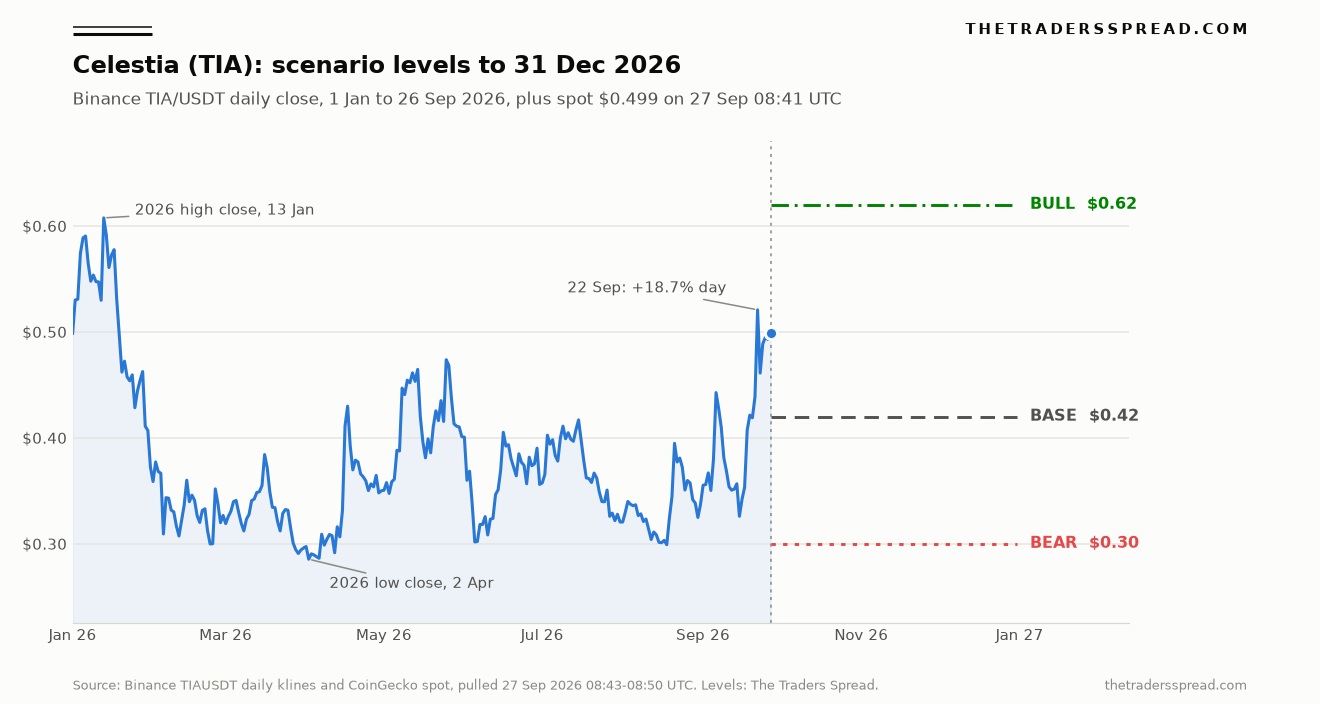
Two structural points stand out. The year's highest daily close was $0.6075 on 13 January, and its lowest was $0.2853 on 2 April. TIA then spent five months inside a $0.29 to $0.47 range before the September break. Each window below is computed from Binance daily closes against the $0.4989 spot, with the anchor date shown.
| Window | Anchor date (Binance close) | Anchor close | Change to spot $0.4989 |
|---|---|---|---|
| 7 days | 20 Sep 2026 | $0.4188 | +19.1% |
| Since the September low | 15 Sep 2026 | $0.3258 | +53.1% |
| 30 days | 27 Aug 2026 | $0.3572 | +39.7% |
| 90 days | 28 Jun 2026 | $0.3753 | +32.9% |
| 180 days | 30 Mar 2026 | $0.2940 | +69.7% |
| 364 days | 28 Sep 2025 | $1.4380 | -65.3% |
The rally has not retaken January. At $0.4989, TIA sits 17.9% below the 13 January close and 97.6% below its $20.85 all-time high from February 2024 (CoinGecko).
Who is carrying the rally
Derivatives data says the move was not a leveraged stampede. Binance's aggregated open interest on the TIAUSDT perpetual stood at 31.49m TIA ($10.25m) on 16 September and 34.42m TIA ($16.94m) on 27 September. In dollars that is a 65.3% rise; in coins, 9.3%. Almost all of the dollar growth came from existing positions being marked up, not from fresh contracts. Funding printed 0.005% at nearly every four-hour settlement from 22 to 27 September, dipping only briefly on 24 September, which is not the signature of a crowded, paying long side.
The account mix tells a different story. Binance's global long/short account ratio for TIAUSDT went from 0.91 on 18 September, when 47.8% of accounts were net long, to 2.16 on 24 September, with 68.4% long. By 27 September it had eased to 1.67 and 62.5%. That is a lot of small accounts leaning one way on a position book that has barely grown. Retail breadth without size tends to be fragile: it adds little fuel on the way up and exits quickly on the way down.
Spot turnover backs this up. Binance's 24-hour TIA/USDT quote volume was $4.9m at 08:49 UTC on Sunday, down from $12.8m on 22 September and $13.5m on 23 September. CoinGecko's aggregated 24-hour volume across venues was $52.2m.
The supply calendar the rally ran into
TIA's float grows from two sources, and neither depends on price. The first is issuance. After the v6 upgrade (CIP-41) in November 2025, the Celestia documentation says inflation fell to about 2.5%, declining 6.7% a year toward a 1.5% floor. Celenium's block statistics show an on-chain rate of 2.3242% on Sunday. On a total supply of 1,178.34m TIA that works out to about 27.4m TIA a year, or 75,000 TIA a day, worth roughly $37,400 a day at spot. Two per cent of block rewards go to the community pool.
The second source is vesting. Using the genesis schedule in the same documentation, before any locked staking rewards, the continuous unlocks now running look like this.
| Stream | Genesis allocation | Schedule | Approx. TIA per day | Ends |
|---|---|---|---|---|
| Initial Core Contributors | 17.64% (176.4m) | 66.67% linear, year 1 to year 3 | 161,100 | 30 Oct 2026 |
| R&D & Ecosystem | 26.79% (267.9m) | 75% linear, year 1 to year 4 | 183,500 | 30 Oct 2027 |
| Issuance (on-chain rate 2.32%) | n/a | Continuous | 75,000 | Ongoing |
Put together, roughly 419,600 TIA a day enters or becomes transferable today, about $209,000 at spot. After 30 October the vesting part drops from about 344,600 to 183,500 TIA a day. Between now and then, roughly 5.3m TIA ($2.65m) of core-contributor tokens still unlocks. Unlocked does not mean sold, and the docs note that locked tokens can already be staked. Still, the step-down is real, it is dated, and it matters more to TIA's supply than anything on the testnets this month. Compare the Filecoin supply-cut trade we covered earlier this month, where the market front-ran a scheduled cut in new tokens.
Now set that against demand. Our 1,000-block sample, 07:58 to 08:45 UTC on 27 September, implies about 158 TIA a day in fees, or $79. Celenium's running total shows 441,028 TIA in fees since genesis in October 2023, about $220,000 at today's price, across 4.62 terabytes of blob data. The daily fee line is about 0.2% of daily issuance. The chain is not short of capacity; blocks averaged 4.1% full.
A proposal with no replies, and a pool it would nearly empty
The one governance document in play is Celestia's "Sustainable Blob Economy" proposal, a forum thread opened on 17 July by a pseudonymous account. Its opening post was last revised at 16:56 UTC on 22 September, about two hours before that 19:00 candle, and now carries the header "Version 2.0 | September 22, 2026". The thread had 679 views, zero replies and zero likes when we read it on Sunday. We can show the timing. We cannot show that anyone traded on it.
The content is more sober than the headlines. It asks for an aggregate planning ceiling of $1.5 million, with a $225,000 first phase, to study paid capacity commitments and bonded data services. It says plainly that "a payment in TIA does not establish a lasting increase in token demand" and that "a refunded bond is not revenue." Forum support, the text adds, "does not execute a community-pool transfer." The community pool held 3.57m TIA on Sunday, about $1.78m at spot. The full ceiling would absorb 84% of it; the first phase alone, about 451,000 TIA at today's price, would take 12.6%.
The bigger strategic shift sits with Celestia Labs, not the forum. In July it bought Sovereign Labs, whose SDK powers app-specific chains. "Internet-scale applications, from agentic payments solutions to global exchanges and prediction markets, require custom infrastructure that only a highly experienced implementation team can provide," said Nick White, CEO at Celestia Labs, in the 15 July announcement. Preston Evans, Sovereign's co-founder, became CTO. "Companies migrating onchain can't build in-house what Celestia Labs' team and tech offers, in terms of reliability or scale," said Preston Evans, Chief Technology Officer at Celestia Labs.
That is a services pitch. It can succeed commercially and still leave TIA holders with little, unless those custom chains post their data to Celestia and pay for it in volume. The same question sits under other modular tokens; our Arbitrum (ARB) price prediction found a licence fee that fell 87% in eight days while vesting continued, and the Optimism upgrade rally showed how quickly a governance vote can be priced before usage follows.
The call: $0.42 base, $0.62 bull, $0.30 bear to 31 December
Base case, $0.42 (45%). TIA gives back most of the September break and settles near the $0.419 to $0.439 closes of 20 and 21 September, the shelf it launched from. The 30 October unlock step-down cushions the fall, and Fibre stays on testnets or reaches a signalling window late in the quarter. That level is 15.8% below spot.
RelatedMonero (XMR) Falls 2.9% Over Seven Days to 15 October
Bull case, $0.62 (25%). Validators begin signalling for version 10 and an activation height appears, the step-down in vesting lands, and fees show a visible jump as the first Fibre users arrive. TIA would then retake the 13 January close of $0.6075. That level is 24.3% above spot.
Bear case, $0.30 (30%). The retail skew unwinds, the core-contributor tail of about 5.3m TIA meets thin books, and Fibre slips into 2027. TIA revisits the $0.299 close of 18 August and the $0.2853 low close from April. That level is 39.9% below spot.
Our bias is mildly bearish, conviction 2 of 5. The reference entry is spot at $0.4989. We treat a daily close above $0.55, which would clear the 23 September high of $0.5382, as the invalidation of the base case.
What would change my mind: a mainnet signal tally that starts moving toward the 394.88m threshold, Binance open interest measured in coins pushing past 40m while price holds, or daily fees rising by an order of magnitude from the sampled $79. Any one of those would suggest demand, not just repricing. On the downside, a daily close below $0.42 with the long/short account ratio still above 1.5 would say the crowd has not left yet, and the bear case moves up the list.
Celestia (TIA): frequently asked questions
What is the Celestia (TIA) price prediction for the end of 2026?
Our base case is $0.42 by 31 December 2026, with a $0.62 bull case and a $0.30 bear case, weighted 45%, 25% and 30%. Spot was $0.4989 at 08:40 UTC on 27 September on CoinGecko. The call rests on Fibre's mainnet timing, the 30 October unlock step-down and whether fees start to grow.
When does the next large TIA unlock finish?
The Initial Core Contributors' allocation, 17.64% of genesis supply, finishes its linear unlock on 30 October 2026, according to Celestia's documentation. That removes about 161,000 TIA a day from the vesting flow. The R&D and Ecosystem allocation keeps unlocking at about 183,500 TIA a day until 30 October 2027.
Is Fibre live on Celestia mainnet?
No. Fibre ships in celestia-app version 10, which is running on the Mocha-5 and Corto testnets. Mainnet reported app version 9 on 27 September, and the validator signal tally for version 10 was zero against a threshold of 394.88m voting power. No activation height has been set.
Why did TIA rise on 22 September?
There is no confirmed single catalyst. Most of the day's 18.7% gain came in one hour from 19:00 UTC on Binance. A revised community proposal on blob economics was posted about two hours earlier, and testnet releases landed the same week, but on-chain usage and fees did not change.
How much does Celestia earn in fees?
Very little today. A 1,000-block sample on 27 September implied about 158 TIA, or $79, a day in fees, against about 75,000 TIA a day of new issuance. Celenium counts 441,028 TIA in total fees since the October 2023 launch, worth about $220,000 at current prices.
Disclaimer
This article is analysis, not investment advice. Price levels and probabilities are scenarios, not recommendations, and figures were accurate at the times stated. Cryptoassets are highly volatile and you can lose all of the capital you commit. Do your own research and consider your circumstances before making any financial decision.