

The story attached to Stacks this month is that institutional Bitcoin staking has finally handed STX a structural buyer. It has not. The Genesis Bond that opened on 10 September is real, it is on-chain, and it does oblige every institution that bonds Bitcoin to lock STX alongside it. The ratio is published: Stacks Labs writes that "STX is locked on Stacks at 5% of the bonded BTC's value." The amount of Bitcoin actually bonded when the programme went live was 250 BTC. Multiply one by the other and the entire institutional Bitcoin-staking programme, the thing credited with the strongest month Stacks has had in two years, requires the market to absorb roughly a million dollars of STX. That is the whole of the mandated demand. Not the first tranche of it, not a conservative estimate of it, but the full obligation created by every institution that has bonded Bitcoin on Stacks to date, priced at this morning's spot.
At the 07:45 UTC CoinGecko print on 20 September, 250 BTC is worth $20.08m, so the 5% STX leg comes to about $1.00m, or 3.17m tokens. Against a market capitalisation of $591.44m that is 0.170%. Against the trailing 24-hour volume of $56.09m it is 1.79%. Even if the programme fills the roughly 3,000 BTC of initial capacity reported by Crypto Briefing on 26 August — a cap Stacks itself has never published — the STX obligation tops out near $12.05m, or 2.04% of the float. The mechanism is genuine. The flow it creates is a rounding error against a token that added $350m of market value in thirty days.
- STX spot $0.3167, market cap $591.44m, 24-hour volume $56.09m — CoinGecko
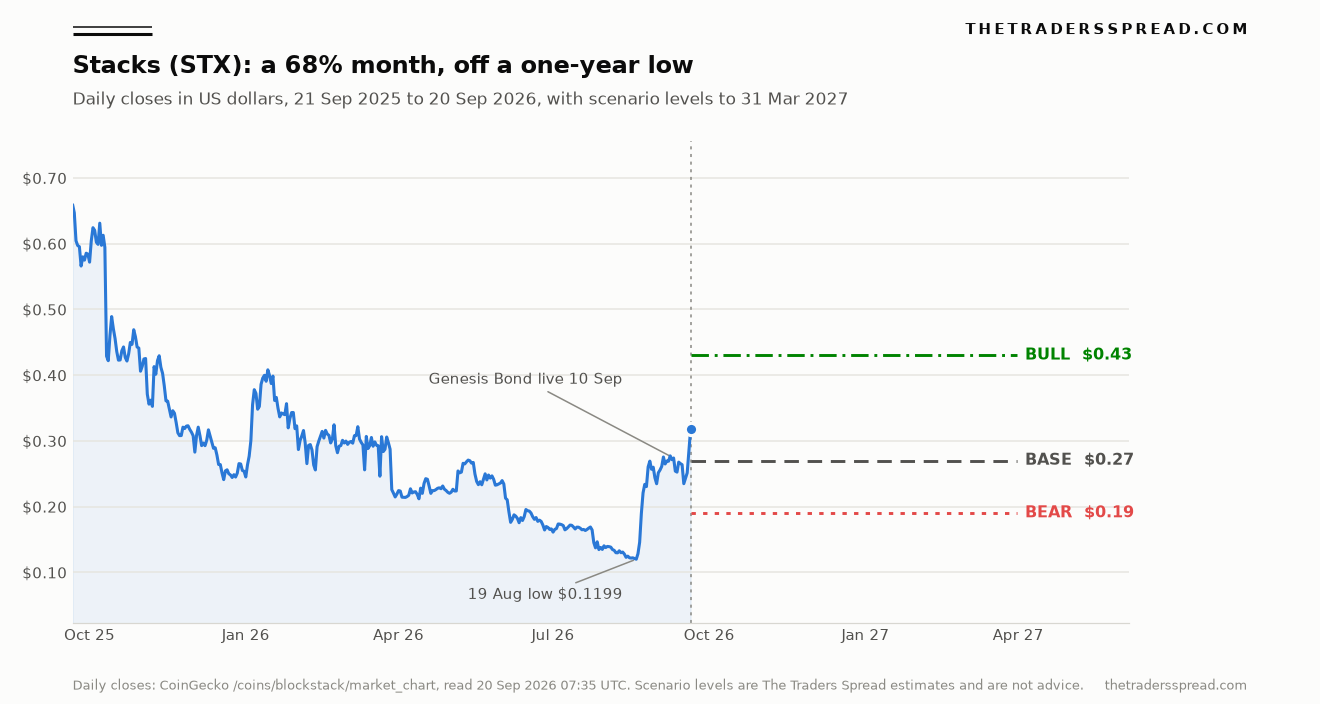
/coins/markets, read 20 Sep 2026 07:45 UTC - +67.6% over 30 days, measured from the 22 August daily close of $0.1893; +164% from the 19 August low of $0.1199 — CoinGecko daily closes, 20 Sep 2026
- Bitcoin locked in the sBTC peg: 2,476.26 BTC, up 0.87% in 30 days and down 38.8% in 180 days — DefiLlama, 20 Sep 2026 07:27 UTC
- Stacks chain TVL $85.21m, up 1.8% in 30 days and down 32.9% year on year — DefiLlama, 20 Sep 2026
- 441,576,024 STX locked in PoX reward cycle 143; 384,558,334 STX committed to cycle 144, 12.9% less — Hiro
/v2/pox, Bitcoin block 967,808, 20 Sep 2026 07:37 UTC - Genesis Bond targets 3% BTC APY over a six-month term, funded by miner bids — Stacks Labs, 2 Sep 2026
- 1,867,916,791 STX outstanding and 100% unlocked, against a 2050 ceiling of 2,318,000,000 — Hiro
/extended/v1/stx_supply, Stacks block 9,030,796
The chain barely moved while the price doubled
The cleanest way to test an adoption story is to ask what the chain did over the same window. Stacks gives a very direct answer, because its headline adoption metric is not an abstraction: sBTC is Bitcoin that has physically left the base layer and entered the Stacks network, held by a signer set that requires 70% consensus to move it. Every satoshi is countable.
On 20 September the peg holds 2,476.26 BTC. Thirty days earlier it held 2,454.82. That is growth of 0.87% over a month in which the token rose 67.6%. Widen the lens and it gets worse for the narrative: the peg held 4,043.46 BTC on 18 March 2026, so almost two-fifths of the Bitcoin that had been bridged into Stacks has since gone home. Stacks' own Q2 2026 ecosystem report, published 23 July, put sBTC supply at 2,949 BTC at quarter end. The peg is 16.0% smaller than it was on 30 June.
Chain TVL tells the same story more quietly. DefiLlama has Stacks at $85.21m today against $83.71m on 21 August, a gain of 1.8%. A year ago it was $126.91m. And because that figure is denominated in dollars while a large share of the collateral is STX itself, a 1.8% dollar gain during a 67.6% token rally means the underlying token quantity fell sharply. The dollars stood still because the price did the work.
| Measure | 30 days ago | Now (20 Sep 2026) | Change |
|---|---|---|---|
| STX price | $0.1893 (22 Aug close) | $0.3167 | +67.6% |
| sBTC in the peg | 2,454.82 BTC | 2,476.26 BTC | +0.87% |
| Stacks chain TVL | $83.71m | $85.21m | +1.8% |
| Zest V2 deposits | $71.26m | $69.20m | -2.9% |
| Zest V2 borrowed | $6.81m | $14.39m | +111% |
One line in that table breaks the pattern, and it is the one worth sitting with. Zest V2, the largest lending market on Stacks, has seen deposits shrink while borrowing more than doubled. Utilisation went from 9.6% to 20.8% in a month. Something real is happening on Stacks. It is leverage, not deposits. Borrowers are paying to be long into a rally; lenders are not adding supply to meet them. That is a perfectly normal thing for a momentum market to do, and it is the opposite of what an institutional adoption story would look like on chain.
Set against the Bitcoin layer-2 cohort, Stacks carries the richest valuation of the group relative to the capital it secures, and by a wide margin over the only peer of comparable size.
| Bitcoin L2 | Chain TVL | Token market cap | Cap / TVL |
|---|---|---|---|
| Stacks (STX) | $85.21m | $591.44m | 6.94x |
| Rootstock (RIF) | $82.44m | $85.16m | 1.03x |
| Merlin Chain (MERL) | $9.18m | $51.88m | 5.65x |
| Core (CORE) | $4.71m | $30.97m | 6.58x |
| BOB (BOB) | $10.29m | $15.24m | 1.48x |
| Bitlayer (BTR) | $0.48m | $12.99m | 26.82x |
Chain TVL and token market caps read from DefiLlama and CoinGecko at 07:39 UTC on 20 September 2026. The comparison is deliberately harsh on Stacks in one respect: DefiLlama books the $198.83m sBTC peg against Bitcoin rather than against Stacks, so counting it lifts the denominator to $284.42m and drops the ratio to 2.08x. Rootstock, which secures almost exactly the same TVL as Stacks on the narrow definition, trades at book. The market is paying nearly seven times more per dollar secured for the Stacks token than for the Rootstock one, on a chain whose secured dollars have fallen by a third in a year.
What the 5% collateral rule can and cannot do
The Genesis Bond is a better-designed instrument than most things that get built to manufacture token demand, which is precisely why its limits matter. An institution timelocks BTC on Bitcoin's own base layer through PoX-5, the hardfork that activated at Bitcoin block 960,230 on 30 July 2026 and is now 7,578 blocks behind us. It posts STX equal to 5% of the bonded Bitcoin's value. In return it receives Bitcoin-denominated yield sourced from Stacks miners, who bid BTC to win the right to produce blocks. There is no custodian and no slashing. The worst case for a participant is a missed reward, not a lost coin.
Crypto Briefing put the targeted return at roughly 3% annualised, equating to about 1.44% of locked BTC across the 24 reward cycles that make up the six-month term. Stacks Labs confirms the 3% APY target and the six-month lock in its own documentation.
Read that structure from the STX holder's side and two things follow. First, the STX requirement scales with the Bitcoin price, not with STX demand, so a falling BTC price shrinks the STX obligation rather than the reverse. Second, and more awkwardly, the bond is a six-month instrument. Whatever STX gets locked in March 2027 becomes free float again, and the institution has no reason to keep holding a token it acquired solely to satisfy a collateral ratio. A collateral rule is not a buyback. It borrows float for a defined period and gives it back.
Compare the scale to something the market already knows how to price. When Aave climbed 50% in a month, the deposit base behind it was above $31bn. The Stacks bond is asking a $591m token to reprice on a million dollars of mandated demand.
Where the selling is coming from instead
PoX stacking is the largest single sink for STX, and it is the number almost nobody checks during a rally. Reward cycle 143 — the cycle the Genesis Bond documentation itself references — has 441,576,024 STX locked, which is 23.64% of the 1,867,916,791 STX outstanding and about $140.0m at today's price.
Cycle 144 currently has 384,558,334 STX committed. That is 20.59% of supply, and 12.9% less than the cycle it replaces.
Two caveats belong here, and both cut in the same direction. Commitments to cycle 144 are still open: the Hiro endpoint reports 542 Bitcoin blocks, a little under four days, before the prepare phase locks the set. Late commitments could close the gap, and in most cycles they partially do. But the gap is 57.0m STX, worth $18.1m at spot, which is eighteen times the size of the entire Genesis Bond obligation. For the bond's demand to matter, the stacking shortfall would have to close almost entirely, and it would have to close during the first rally in over a year that has given locked holders a gain worth realising.
The supply schedule sits behind all of it. Every STX in existence is unlocked, which removes the cliff risk that hangs over tokens like Arbitrum, and that is a genuine structural positive. But Hiro's supply endpoint also reports a 2050 ceiling of 2,318,000,000 STX against 1,867,916,791 outstanding. Another 450.08m tokens, 24.1% of the current supply, still has to be issued to miners and stackers over the next twenty-four years. Emission is slow. It is not zero, and it is paid to the same participants who are currently reducing their locked balances.
The bull case, stated properly
An argument worth answering has to be stated at full strength, so here is the one that survives the arithmetic above.
The Genesis Bond's importance is not the size of the STX it locks. It is that the participants are 21Shares, HashKey Cloud, UTXO Management, Sypher Capital and Fireblocks, and that these firms have now completed operational diligence on timelocking corporate Bitcoin through a permissionless protocol with no counterparty. That diligence is the expensive part, and it is reusable. The second bonding period costs each of them almost nothing to enter at ten times the size. If capacity expands from 250 BTC to 3,000 BTC and then beyond, the STX obligation compounds from $1.0m to $12.0m to something that does register against a $591m float.
There is a second leg. STX is the only way to earn the Bitcoin yield, and that yield is paid in BTC rather than in the protocol's own token, which makes it structurally different from almost every staking product in the market. If Bitcoin holders decide that 3% in BTC is worth holding a volatile altcoin at 5% notional, the addressable demand is not the Genesis Bond. It is the entire corporate Bitcoin treasury complex. Bitcoin at $80,306 means every 1,000 BTC that enters the programme drags roughly $4.0m of STX with it.
That case is coherent. It is also entirely forward-looking, and the on-chain record of the last six months runs against it. sBTC peaked at 4,043 BTC in March and has fallen every month since, through the launch of pooled staking and through the Genesis Bond itself. Capacity has not been the constraint on Bitcoin entering Stacks. Demand has.
The Call
Our base case is $0.27 by 31 March 2027, 14.7% below the 20 September spot of $0.3167, and we put 45% on it. That level is the September congestion band the token spent a fortnight in before the Genesis Bond headlines, and it is where price lands if the bond programme performs exactly as designed at a modestly larger size while sBTC and chain TVL stay flat. The rally was an accurate repricing of a token that had fallen 52% in a year and was trading at $0.1199 in August. It has overshot what the underlying flow justifies, not invented it.
RelatedNumeraire (NMR) Rises 38.7% to $16.59 as Turnover Jumps
The bull case is $0.43, 35.8% above spot, at 25%. It needs the second bonding period to come in materially larger than 250 BTC, and it needs the sBTC peg to turn — a monthly print above 3,000 BTC would be the signal. At $0.43 the token would be back at its November 2025 high and paying 8.9 times chain TVL, which is a demanding multiple but not an unprecedented one for a name with a live institutional narrative.
The bear case is $0.19, 40.0% below spot, at 30%. That is the 22 August close, the point from which this whole move began. It is where price goes if cycle 144 stacking confirms the 12.9% drop, if the Zest borrow build unwinds, and if the second bonding period lands at or below the first. Nothing dramatic has to break. The move simply has to be given back for the reason it happened, which is that positioning moved faster than the chain did.
What would change my mind: an sBTC peg reading above 3,000 BTC, or a cycle 144 stacked balance that finishes above cycle 143's 441.6m STX. Either would mean the demand side is real and my base case is too low. On the other side, a cycle 144 close below 370m STX would take me to the bear case directly.
FAQ
What is the Genesis Bond and why does it matter for Stacks?
It is the first institutional tranche of Bitcoin staking on Stacks, live since 10 September 2026. Institutions timelock BTC on Bitcoin's base layer, post STX worth 5% of that Bitcoin, and receive BTC-denominated yield targeted at 3% annualised over a six-month term. It matters because it is the first mechanism that ties Bitcoin institutional capital to mandated STX demand, but at 250 BTC the demand it creates is about $1.0m.
Has Bitcoin actually moved onto Stacks this year?
Less of it has. The sBTC peg held 4,043 BTC on 18 March 2026 and holds 2,476 BTC today, a fall of 38.8%. Stacks' own Q2 report put the figure at 2,949 BTC on 30 June. The peg has grown 0.87% over the last thirty days, so it has stabilised, but it has not recovered. This is the single metric that decides whether the Bitcoin layer-2 thesis for Stacks is working.
Why is the Stacks market cap so much larger than its TVL?
On DefiLlama's narrow chain definition, Stacks secures $85.21m and its token is worth $591.44m, a ratio of 6.94 times. Rootstock secures a near-identical $82.44m and trades at 1.03 times. Counting the $198.83m sBTC peg, which DefiLlama books against Bitcoin, brings the Stacks ratio down to 2.08 times. Both figures are defensible; neither is cheap.
What does the PoX stacking data say right now?
Reward cycle 143 has 441,576,024 STX locked, 23.64% of supply. Cycle 144, which is still accepting commitments for roughly four more days, has 384,558,334 STX, 12.9% less. If that gap holds it means 57.0m STX, worth $18.1m, returns to circulation. Commitments often arrive late in a cycle, so the final figure may narrow.
Is STX outperforming Bitcoin?
Over one month, decisively: STX has gone from 242 satoshis to 390, a gain of 61.4%. Over six months it is down 9.1% against Bitcoin, and over twelve months it is down 31.8%. A token whose entire thesis is that it makes Bitcoin productive has lost ground to simply holding Bitcoin over every window longer than a quarter. See our Bitcoin price prediction for the denominator's own path.
How liquid is STX for a position of size?
Trailing 24-hour volume is $56.09m against a $591.44m market cap, a turnover ratio just under 10%, which is healthy for a mid-cap altcoin. That said the depth is concentrated in a handful of venues, and the 19 August to 20 September move happened on a market that was thin enough to gap. Our glossary entry on liquid markets covers the distinction between volume and depth, and the yield mechanics resemble those we set out in our Pendle analysis.
Disclaimer
This article is analysis, not investment advice. It sets out how we read publicly available on-chain and market data on Stacks as of 20 September 2026 and does not recommend any course of action. Scenario levels are estimates and are frequently wrong. Cryptoassets are volatile and unregulated in many jurisdictions, and your capital is at risk. Do your own research and consider whether you can afford the loss.