

Binance's ZEC/USDT book turned over $368 million on 21 August, and Zcash closed that session at $734, up 29%. Three days earlier the same book had handled $37 million. The tape has not resembled its old self since. Twenty sessions later the coin changed hands at $1,234.18 on CoinGecko at 05:53 UTC on 10 September 2026, carrying a market capitalisation of $20.88bn and sitting tenth among all crypto assets by value. Measured off the daily closes rather than CoinGecko's headline percentage fields, which do not reconcile with them, Zcash is up 149.4% from the $495.70 close of 11 August, 495.1% from $207.72 on 14 March, and 2,479.6% from $47.92 a year ago. Its market capitalisation is now 2.15 times Monero's. In a category written off as uninvestable for most of a decade, one asset has quietly become a top-ten holding.
What has not happened alongside that move is the part worth paying for. Coin-denominated open interest in Binance's ZEC/USDT perpetual has risen 14.6% over the same 30 days in which the price rose roughly 150%, from 488,679 ZEC on 12 August to 559,841 ZEC this morning. Mean funding across the last 90 eight-hour intervals ran 0.0062%, or 6.81% annualised, with 12 of those 90 prints negative; the most recent was negative, and the perpetual marks at $1,236.37 against an index of $1,236.90. Monero, the obvious sector proxy, rose 30.0% over the identical window. And the amount of ZEC actually sitting in shielded pools is lower than it was in February. Neither a leverage squeeze, nor a sector rotation, nor a surge in private usage explains this.
The facts this call rests on
- Zcash trades at $1,234.18, up 149.4% from the $495.70 close of 11 August 2026 — CoinGecko daily closes, retrieved 10 September 2026, 05:53 UTC
- Market capitalisation $20.88bn at rank 10 against Monero's $9.68bn; the two are 98.1% of the privacy category's $31.1bn — CoinGecko, 10 September 2026
- Coin-denominated open interest on Binance ZEC/USDT perpetuals rose 14.6% in 30 days while notional value rose 196.2%, on mean funding of 6.81% annualised — Binance futures API, 10 September 2026
- The Zcash ETF (ZCSH) listed on NYSE Arca on 25 August 2026 and passed $500m of assets by 8 September, on more than $70m of inflows plus a 85,705 ZEC subscription — SEC 8-K, filed 8 September 2026
- Network Upgrade 6.3 activated at block 3,428,143 on 28 July 2026, sealing the Orchard shielded pool and opening Ironwood — z.cash upgrade page and Zcash Foundation release notes, retrieved 10 September 2026
- Total shielded supply is 4,894,486 ZEC, 28.9% of coins outstanding, down 3.3% from its 5,059,035 peak on 10 February 2026 — zcashexplorer node API, 10 September 2026
- 90-day realised volatility of 108.1% annualised, computed from daily closes — CoinGecko market_chart, 10 September 2026
Three dates did most of the work
The repricing is not a drift. It is three sessions with a lot of quiet in between, and the dates matter because they are what any explanation has to account for.
On 21 August, Zcash opened at $569 and closed at $734 on Binance, a 29.0% session, with $368m of quote volume against $37m on 18 August. Hold that date. Eleven sessions between $752 and $888 followed. On 3 September the coin opened at $816 and closed at $953, a 16.8% session on $234m. Then on 6 September it printed a $1,257 high on $426m of turnover, and on 9 September it set the cycle high at $1,296.02.
That shape, three violent repricings separated by orderly ranges, reads far more like discrete buyers arriving with size than like a crowd chasing. A retail chase leaves a smooth exponential and a funding rate that climbs with it. This left a staircase. Volume corroborates: CoinGecko records $1.63bn of 24-hour turnover against a $20.88bn capitalisation, a ratio of 7.81% that runs 3.6 times Bitcoin's and five times Monero's and leaves Zcash trading more dollars a day than Hyperliquid beneath it in the rankings.
The derivatives book says nobody is crowded long
Start with the cleanest number. Open interest in Binance's ZEC/USDT perpetual stands at 556,859 ZEC this morning, and on the exchange's daily series it has moved from 488,679 ZEC on 12 August to 559,841 today, a rise of 14.6%. Denominated in dollars the same book is up 196.2%, from $235.2m to $696.7m. Almost the entire increase in the notional leverage stack is price, not new contracts. Traders did not pile in as it went; the positions that already existed simply became worth more.
Funding says the same thing from a different angle. In a genuine squeeze the perpetual trades at a premium and longs bleed to hold it. Over the last 90 funding intervals Zcash paid a mean 0.0062% per eight hours, an annualised 6.81%, and 12 of those settlements were negative. The most recent print was minus 0.0009%, and the contract currently marks at a small discount to its own index. Nobody is paying up for exposure.
Positioning needs care, because two Binance metrics point different ways. By account count, 71.17% of the exchange's top futures traders sit short Zcash this morning; weighted by position size the same cohort is 46.09% long against 53.91% short. The reading is not that smart money is short, but that many small accounts lean against the move while the size sits close to flat. Either way, no crowded long position waits to be liquidated.
The relative price says it again. ZEC/BTC sits at 0.015785, a twelve-month high, up 103.5% in 30 days from 0.007757. Bitcoin trades at $78,476, still inside the $62,000 to $96,000 band our Bitcoin scenarios set on 3 September. Zcash is not riding a market beta.
Testing the explanations, one at a time
A move this size attracts stories. Most did not survive a check against the primary source, so here is each candidate and what became of it.
An exchange integration. Real, but the wrong venue and the wrong year. Electric Coin Company recorded on 10 November 2025 that Gemini had begun supporting ZEC withdrawals directly into Orchard, then the newest shielded pool. That sits on the previous leg of this cycle, when Zcash ran from a $74.11 close on 1 October 2025 to $697.25 on 17 November. The venue that matters this time is not a crypto exchange at all.
A surge in private usage. The chain refuses it outright. Querying the node's own value pools this morning returns 3,931,130 ZEC in Ironwood, 514,019 in Sapling, 426,745 in Orchard and 22,591 in Sprout: 4,894,486 ZEC shielded, 28.9% of coins outstanding. Dated archives of that endpoint put the figure at 5,059,035 on 10 February 2026. Shielded supply peaked seven months ago and is 3.3% lower today, while the price has more than doubled in a month.
A company announcement. There could not have been one. Electric Coin Company's blog has carried nothing since 4 December 2025 because ECC effectively ceased to operate: "in January of this year, the entire Electric Coin Company (ECC) team … left ECC and formed a new company", the Zcash Open Development Lab, which said in March it had raised more than $25m from Paradigm, a16z crypto and Winklevoss Capital among others.
A New York listing. This is the one, and it was filed in public. On 21 August 2026, the day of that 29% session, Grayscale Investments Sponsors lodged an 8-K announcing that shares of Grayscale Zcash Trust "were anticipated to begin trading on NYSE Arca Inc. on or about August 25, 2026 … under the trading symbol 'ZCSH'", and that the trust would be renamed The Zcash ETF. NYSE certified the listing on 24 August and the fund began trading on the 25th. A second 8-K, filed on 8 September, put assets above $500m on "cumulative inflows of more than $70 million in the two weeks since launching as an ETP", plus a single subscription in which DCG International Investments contributed 85,705.32563297 ZEC — half a percent of every coin in existence — for roughly $100m of shares. ZCSH options began trading on NYSE Arca that same day. The filing describes the fund as "the only exchange-traded product in the world offering spot exposure to ZEC".
Set the filings against the tape and the three dates stop being mysterious. 21 August: the uplisting announcement, and a 29% session on ten times the prior volume. 25 August: the listing. 8 September: the asset disclosure and the options launch, running into the 9 September high of $1,296.02. This was never an unattributable bid. It was a registration statement working through the SEC in daylight, and the shielded pools shrinking through the same period is exactly what you would expect when the marginal buyer is a custodian holding coin transparently on behalf of shareholders rather than a user moving it into privacy.
And what made the listing thinkable. On 28 July 2026, at block 3,428,143, Zcash activated Network Upgrade 6.3, retiring Orchard and opening a replacement shielded pool named Ironwood. Orchard is now spend-only: no new value can enter, and coins leaving it cross a protocol-enforced turnstile. Its stated purpose is to make "the integrity of its circulating supply independently verifiable" — the answer to a genuine problem, because a soundness bug found in the Orchard circuit in May by the independent researcher Taylor Hornby "could have been exploited to undetectably create an unlimited amount of counterfeit ZEC within Orchard", in a disclosure he co-authored with Zcash founder Zooko Wilcox and Shielded Labs board member Jason McGee. On Ironwood's activation day Sean Bowe, lead cryptographer on Project Tachyon, published a machine-checked proof in Lean running to more than 2,700 theorems: "Ironwood's supply soundness now rests on machine-checked proofs, not just carefully reviewed and audited code."
I cannot prove the two are connected and will not claim it. They sit twenty-four days apart, and a sponsor cannot easily market spot exposure to an asset whose supply integrity is unprovable. Blockchair's Zcash endpoint still answers the circulating-supply question with −532,171,024,812,187, a negative number, because an accounting engine built for transparent ledgers cannot follow value out of the visible set. Zcash spent a decade unable to prove that negative. It can now, and eight weeks later it had a ticker in New York.
What the model pays, and what a live market pays for the same bet
The scenario levels come from realised volatility, not from a view. Ninety days of log returns on CoinGecko's daily closes give an annualised standard deviation of 108.1%. Over the 112 days to 31 December 2026 that is a one-standard-deviation move of 59.9% in log terms, a range from roughly $678 to $2,247 before anything interesting happens.
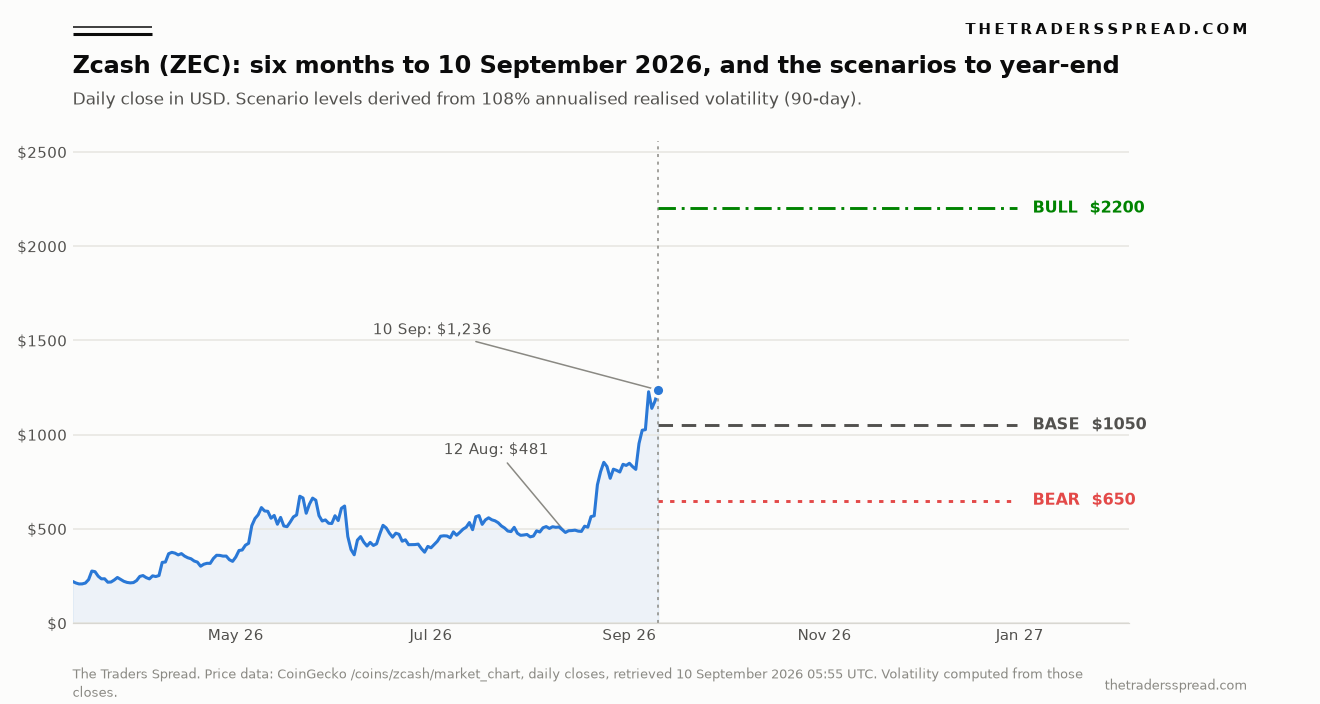
Running the barrier and reflection formulas on that volatility, with drift set to minus half the variance so the process is driftless in price terms, gives a 24.5% chance that Zcash touches $2,200 before year-end and a 10.3% chance it closes above it. Downside: a 38.2% chance of touching $650 and a 22.0% chance of finishing below. The median terminal price is $1,032, which is 16.4% below today's spot. That is not a bearish forecast, it is variance drag. At 108% volatility the median of a driftless lognormal sits well under its starting point even though the mean does not, and any model reporting a base case at spot is quietly ignoring it.
Polymarket runs a ladder of Zcash barrier markets resolving on Binance ZEC/USDT one-minute candles through 31 December, which makes it directly comparable. The event has turned over $557,875 with $32,816 of resting liquidity. Because each rung counts only price action after its own creation, the dates matter: the $2,000, $1,400 and $400 legs opened on 25 August, with a Binance low since of $751.53, and the $100 leg on 24 November 2025, lowest close since $197.12. None has been breached. Links to Polymarket are affiliate links, from which The Traders Spread may earn a commission at no cost to you. Four legs are quoted tightly enough to mean something; the rest carry spreads of 20 to 62 points and are excluded.
| Barrier by 31 Dec 2026 | From spot | Our touch probability | Polymarket bid / ask | Resting liquidity |
|---|---|---|---|---|
| Reach $2,000 | +62.1% | 32.3% | 24.2c / 28.5c | $4,085 |
| Reach $1,400 | +13.4% | 77.7% | 71.0c / 75.0c | $5,247 |
| Dip to $400 | −67.6% | 10.2% | 14.0c / 16.0c | $549 |
| Dip to $100 | −91.9% | 0.01% | 3.2c / 3.7c | $9,779 |
Two disagreements are worth naming. On the $2,000 touch the model sits six points above the offer, the ordinary result of feeding a fat recent volatility into a thin-tailed process. On the $100 dip the disagreement runs the other way and matters more: a lognormal at 108% volatility calls a 92% drawdown in 112 days a one-in-ten-thousand event, and the market has nearly $10,000 of resting liquidity paying three and a half cents for it. That is jump risk no diffusion model can produce, and given what the last four months revealed about this chain, the market is right and the model is wrong. The same caution applies to our Chainlink levels, built on the identical method.
RelatedStellar (XLM) Falls 6.8% in the Week Chainlink Went Live
The call
Base case, $1,050. The driftless median rounded, and a level 14.9% under spot that most readers will find counter-intuitive. It is not a prediction that Zcash falls, but a statement that at this volatility the middle outcome sits below the start while the right tail holds the average up. Two thirds of the terminal distribution, 67.7%, lands between $650 and $2,200.
Bull case, $2,200 (+78.3%). Touch probability 24.5%; probability of closing the year above it, 10.3%. At $2,200 Zcash would carry a $37.2bn capitalisation, eighth on today's table, above TRON. The path does not require a new story. It requires the three-session pattern to repeat twice more while coin-denominated open interest stays flat, because that combination is what distinguishes an absorption of float from a bid that borrowed its way up.
Bear case, $650 (−47.3%). Touch probability 38.2%; probability of closing below, 22.0%, for an $11.0bn capitalisation still above Monero's today. Two mechanisms, neither needing a catalyst to fail. The first is turnover reverting from 7.81% of market capitalisation toward the 1.5% this asset lived at for years, at which point the absence of resting bids does the rest. The second is the tail the prediction market pays for: the Orchard flaw sat undetected in a live circuit and its discoverers decline to certify it went unexploited. A second finding of that class appears nowhere in a volatility model. Note also how mild $650 is against precedent. Zcash ran from $47.92 on 11 September 2025 to $697.25 on 17 November, then gave back 71.7% to $197.12 by 8 March 2026, a round trip of 111 days against the 112 in this forecast. The same percentage from here lands at $350.
What would change my mind. Coin-denominated open interest on Binance above roughly 750,000 ZEC while funding pushes past 30% annualised would mean the marginal buyer had switched from spot to leverage, and would make the $650 touch materially likelier than 38.2%. In the other direction, ZCSH inflows continuing at the pace of its first fortnight, or shielded supply turning back up through its February peak of 5.06m ZEC, would lift the $2,200 touch above 24.5%. A month of flat or negative ETP flows would do the opposite. The nearest scheduled event is the advisory poll on the scope of Network Upgrade 7, which closes on 14 September 2026; NU7 has no activation height set.
Frequently asked questions
Why is the base case below the current Zcash price?
Because at 108% annualised volatility a driftless lognormal has a median well below its starting value. Over 112 days that drag is 16.4%, giving a median of $1,032 from a $1,234.18 spot. The average outcome is still near spot; the middle one is not. A model that sets its base case at today's price has discarded the adjustment.
What is Ironwood, and what happened to Orchard?
Ironwood is the shielded pool introduced by Network Upgrade 6.3, which activated at block 3,428,143 on 28 July 2026. Orchard, the pool it replaced, is now spend-only: no new value can enter, and coins leaving it must pass through a protocol turnstile into Ironwood. The change followed a soundness bug found in Orchard's circuit in May 2026, and Ironwood shipped with a machine-checked proof of supply soundness written in Lean.
Is the Zcash rally driven by leveraged futures buying?
The Binance data says no. Coin-denominated open interest in the ZEC/USDT perpetual rose 14.6% over the 30 days in which price rose roughly 150%, mean funding ran 6.81% annualised with 12 of 90 intervals negative, and the contract currently marks below its index. Those are the readings of a market where spot demand set the price and derivatives followed it.
Is shielded usage of Zcash growing with the price?
No, and this is the most-repeated claim the chain contradicts. Total shielded supply stands at 4,894,486 ZEC, 28.9% of coins outstanding, against a peak of 5,059,035 on 10 February 2026, so it is 3.3% lower than seven months ago. The 3.93m ZEC now in Ironwood is largely migrated Orchard value rather than newly shielded coin, though the chain does not publish the exact split.
Is there a Zcash ETF?
Yes. The Zcash ETF, ticker ZCSH, is the converted Grayscale Zcash Trust and began trading on NYSE Arca on 25 August 2026. Its 8-K of 8 September reported assets above $500m and options trading on the same venue. Its own filing calls it the world's only exchange-traded product offering spot exposure to ZEC.
Disclaimer
This article is analysis and information, not investment advice, and no part of it recommends taking any position. Cryptocurrency prices are highly volatile and capital is at risk. Probabilities quoted here are model outputs conditioned on realised volatility and stated assumptions, not forecasts of certainty. Readers should do their own research and consider their own circumstances before acting on any market information.