

Page one of the Canary Staked SEI ETF prospectus, amended with the SEC on 15 September 2026, still has a blank where the ticker should be. The shares "are expected to be listed for trading ... on the Exchange under the ticker symbol '____'," reads the S-1/A, and the seed investor's name and share count are still bracketed placeholders. Sei (SEI) closed that day on Binance at $0.0421. Thirteen days later it trades at $0.0823 (CoinGecko, 06:53 UTC, 28 September), up 96% from the filing-day close and roughly 2.15 times the $0.0383 all-time low printed on 18 August. Over the same seven days that took SEI up 38.8%, Bitcoin fell about 4%. Nothing about this move came from the tape at large. It came from a document with holes in it, a thin order book and a leveraged crowd that noticed both.
The number almost nobody pricing this rally is quoting sits further into that same prospectus. As of 23 June 2026, Canary writes, the aggregate monthly unlock is approximately 121 million SEI. At today's spot that is $9.96m of new supply every month, and the three tranches due before year-end add up to about 363 million SEI, or $29.9m. That $29.9m is larger than the entire open interest on Binance's SEI perpetual ($20.6m this morning). The fund that would absorb supply does not yet have a ticker. The supply it would have to absorb already has a calendar.
Key facts
- Spot $0.0823, market cap $554m (rank 106), fully diluted value $823m, 24-hour volume $202m — CoinGecko API, 28 Sep 2026, 06:53 UTC
- Returns from Binance daily closes: +4.2% vs 27 Sep, +38.8% vs 21 Sep, +78.2% vs 28 Aug, −70.9% vs 28 Sep 2025 — Binance SEI/USDT klines, retrieved 28 Sep 2026
- Canary Staked SEI ETF S-1/A filed with ticker blank, at least 90% of holdings to be staked, BitGo as custodian, Cboe BZX as listing venue — SEC EDGAR, 15 Sep 2026
- Monthly unlock of about 121m SEI, with 55.55m going to early backers and 42.22m to Sei Labs and core contributors through August 2027 — same filing, figures as of 23 Jun 2026
- Binance SEIUSDT open interest 260.3m SEI ($20.6m), up from 163.0m SEI ($6.85m) on 16 Sep — Binance futures data API, 28 Sep 2026
- Sei chain TVL $41.0m, down 93.5% from its $628m peak of 18 Jul 2025; stablecoins on Sei $306.7m — DefiLlama, 28 Sep 2026
- 4.12bn SEI bonded to validators — Sei staking pool endpoint, 28 Sep 2026
What the prospectus actually commits to
Start with what is on paper, because that is the only part of the ETF story anyone can verify. Canary Capital first filed an S-1 for a staked SEI product on 30 April 2025, amended it on 10 December 2025, and amended it again on 15 September 2026, according to the trust's EDGAR filing history. The trust would list on Cboe BZX. BitGo Trust Company, a South Dakota-chartered trust company, would hold the tokens. U.S. Bank would hold the cash.
The staking language is the part that separates this from a plain spot wrapper. "The Sponsor anticipates that at least 90% of the Trust's SEI will be staked under normal circumstances," the filing states. It also spells out the catch that comes with that: staked SEI "must be undelegated in order to be transferred, a process which takes 21 days." A fund that has to meet redemptions in a day or two while nine-tenths of its inventory is locked on a three-week clock needs a credit line or a liquid buffer, and the prospectus says the sponsor's liquidity policy permits exactly that.
Several things are still blank. The sponsor fee is not in the document. The staking fee split is written as "[__]% of the SEI staking rewards." The seed capital investor is "[________________]". None of that is unusual for an amendment mid-review, but it means the market is pricing a product whose economics nobody outside Canary and the SEC has seen.
Canary is not the only issuer. 21Shares filed its own Sei ETF registration on 28 August 2025 and last amended it on 4 February 2026, per EDGAR. That one has been quiet for almost eight months. Canary, by contrast, filed a staked-token amendment for a different chain on 24 September as well, which reads more like a sponsor moving a batch of applications through the queue than like a signal that the SEI product specifically has a green light.
We have seen what a live wrapper does to a token once the money is real. Our piece on Solana's ETF assets reaching $1.06bn tracked that path. SEI is not there. It is at the stage where a filing is a headline and not yet a bid.
The supply calendar the rally is ignoring
This is where the SEI trade stops being a story about a filing and starts being arithmetic.
The prospectus lays out the unlock schedule in more detail than most token-tracker pages. As of 23 June 2026, approximately 55.55 million SEI per month goes to early backers and private investors through August 2027. Approximately 42.22 million per month goes to Sei Labs and core contributors over the same window, followed by a smaller tranche of about 20 million per month from September 2027 to August 2029. A strategic allocation releases about 8.33 million per month through July 2027. On top of that, a staking-rewards emission from the ecosystem reserve steps down from roughly 15 million per month in mid-2026 toward 6.25 million per month by 2031. Add them up and you get the 121 million figure.
Two data points suggest the schedule is running as written. CoinMarketCap's circulating-supply figure, which Binance republishes in its futures data feed, stepped from 7,460,000,000 to 7,579,861,111 SEI on 17 September, an increase of 119.86 million, within rounding of the monthly total. And the chain's own bank module reports a total of 9.23bn SEI in existence against the 10bn cap. CoinGecko still shows circulating supply at a suspiciously round 6,733,333,333, which is why its $554m market cap is lower than the roughly $624m you get on the CoinMarketCap count. Anyone quoting "67% circulating" is using the stale number; on CoinMarketCap's count the true figure is closer to 76%.
So who holds the new supply? Mostly insiders and early funds. Their incentives after a 115% bounce off the lows are not complicated. Early backers who bought at seed prices are very likely still in profit at $0.08. The 55.55 million SEI they receive each month is worth about $4.6m at spot, roughly a fifth of the $24.1m that Binance's SEI/USDT spot book traded in the past 24 hours. Spread over a month, the pressure is small per day. Concentrated around unlock dates into a rally, it is not.
There is a parallel worth keeping in mind. The Filecoin rally ahead of a 75% cut in new supply was a case where the supply calendar and the price were pulling in the same direction. SEI's calendar pulls the other way, and it keeps pulling until August 2027.
Market data: leverage did more of the lifting than spot
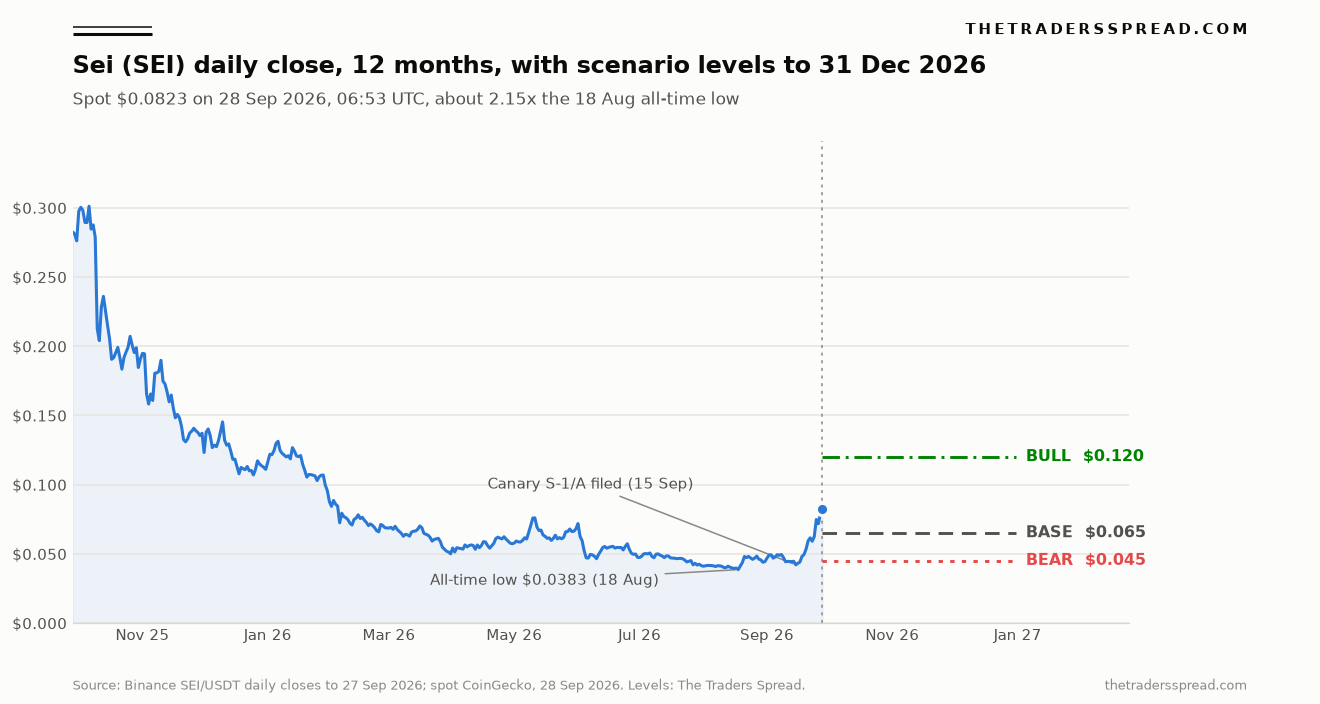
The chart makes the shape of this year plain. SEI closed at $0.2826 on Binance on 28 September 2025. It was at $0.1313 on 6 January, the high close of 2026, then bled for seven months without a single real bounce. The August close of $0.0386 on the 18th was the low. From there to mid-September the token went sideways between $0.042 and $0.050, which is where the bear level in this piece comes from.
Then the perpetual futures book moved first. Binance's SEIUSDT perpetual carried 163.0 million SEI of open interest on 16 September, worth $6.85m. By this morning it was 260.3 million SEI, worth $20.58m. The contract count rose 60% and the dollar value tripled. Funding tells a similar story in a quieter voice: the eight-hour rate printed −0.0354% on 11 September, sat slightly negative through the 17th, and has been pinned at +0.0100% on every interval since 19 September.
A 0.01% eight-hour rate is not euphoric. It is Binance's baseline rate when the perp trades close to spot. But a move from negative to steady positive, alongside a 60% rise in contracts outstanding, says longs are paying to hold a position they opened in the past ten days.
| Measure | 16 Sep 2026 | 28 Sep 2026 | Change |
|---|---|---|---|
| SEI price (Binance close / CoinGecko spot) | $0.0431 | $0.0823 | +91% |
| Binance perp open interest, SEI | 163.0m | 260.3m | +60% |
| Binance perp open interest, USD | $6.85m | $20.58m | 3.0x |
| Sei chain TVL (DefiLlama) | $30.7m | $41.0m | +34% |
| Stablecoins on Sei (DefiLlama) | $298m (15 Sep) | $306.7m | +3% |
Read the bottom two rows together. TVL rose 34%, but most of that is price: much of the value locked on Sei is denominated in SEI, so a token that nearly doubled marks it up automatically. Stablecoins, which do not reprice, barely moved. If new capital were arriving to use the chain, the stablecoin line would show it first. It hasn't.
For context on how far the on-chain economy has shrunk, DefiLlama puts the chain's TVL peak at $628m on 18 July 2025. Today's $41m is 93.5% below that. Fully diluted value is about 20 times TVL. That multiple would be unremarkable for a chain with fee revenue growing into it. For one whose locked value has shrunk by more than nine-tenths while the token fell 71% in a year, it tells you the valuation is carried by expectations, not by usage.
The engineering that is real, and what institutions say they want
None of this makes Sei a dead chain. The engineering pipeline is active and verifiable. Governance proposal 122, the v6.6 software upgrade, passed on 3 August 2026 with roughly 2.38bn SEI voting yes and none voting no. Sei Labs described v6.6 in a 31 July post as "the release where Sei Giga starts touching mainnet," shipping the first pieces of Eidos, a new storage layer, and Ares, a rebuilt execution client that became the default path on upgraded nodes. The third leg, a multi-proposer consensus design called Autobahn, is still ahead. On GitHub, v6.7.0-rc3 was tagged on 25 September, the third release candidate in three weeks, and no v6.7 governance proposal has been filed yet; the latest on-chain proposal is number 123, which passed on 15 August.
The chain's pitch to institutions got a public airing on 26 August, when the Sei Development Foundation published a joint report with Mastercard on how banks and asset managers evaluate blockchains. "From Mastercard's perspective, institutional adoption requires more than innovation," said Christian Rau, SVP Digital Assets and Blockchain APEMEA at Mastercard. Jack Lipstone, Business Development Director at Sei Labs, put the chain's side of it: "At Sei, we see performance becoming non-negotiable. Institutions are prioritizing blockchains that combine throughput, reliability, and interoperability with enterprise-grade expectations."
Both statements are true and neither moves the supply math. A research report co-authored with a card network is a conversation, not a deployment. The fastest way to check whether institutions have shown up is the stablecoin line in the table above, and it is flat at about $300m, some 7% below its 15 May 2026 peak of $331m.
Staking is the one channel where the ETF could matter mechanically. The staking pool shows 4.12bn SEI bonded to validators this morning, about 54% of CoinMarketCap's circulating figure. A fund staking 90% of its holdings adds to that bonded pile and takes tokens off exchanges for at least 21 days at a time. The size of that effect depends on inflows nobody can forecast for a product that has not launched. For a sense of scale, the fund would need to take in roughly $10m a month at today's price just to neutralise the unlock schedule.
Where the bear case could be wrong
Three things would make the bearish tilt here look foolish by December.
The first is an effective registration. If the SEC declares Canary's S-1 effective and the fund lists with a meaningful seed, demand arrives in a lump while supply arrives in a drip. That is a real asymmetry, and it is the reason we do not put the bull case lower than one in five.
The second is a short squeeze. Funding was negative as recently as 17 September. If a portion of the new open interest is short, not long, the book can run further than spot flows justify. We cannot see the long/short split in the aggregate open-interest number, and it would be dishonest to pretend otherwise.
The third is Giga itself. If the Autobahn consensus upgrade ships and on-chain activity follows, the TVL story could reverse. Our look at Injective's rally during a governance vote showed how an upgrade vote can move a token on its own, before any usage shows up.
RelatedMonero (XMR) Falls 2.9% Over Seven Days to 15 October
The call: $0.12 bull, $0.065 base, $0.045 bear to 31 December
Spot is $0.0823. Our horizon is 31 December 2026, which covers three monthly unlock tranches of about 121 million SEI each.
Base case, 50%: $0.065 (−21% from spot). The ETF stays in review through year-end or lists with a small seed. Unlock supply of roughly 363 million SEI meets a futures-heavy rally with no stablecoin inflow behind it, and SEI gives back part of the move, settling inside the March–May 2026 range, when Binance closes ran between $0.050 and $0.076. It holds well above the August lows because the filing keeps a bid under it.
Bull case, 20%: $0.12 (+46%). The registration goes effective before December, the fund lists with a real seed, and open interest keeps building without funding blowing out. SEI reclaims the January 2026 range, when Binance closes ran from $0.088 to $0.131. We put this at one in five because it needs a regulatory date nobody has published and demand large enough to overwhelm $30m of scheduled supply.
Bear case, 30%: $0.045 (−45%). Leverage unwinds. The perp book that tripled in dollar terms in twelve days deleverages into the October unlock, and SEI returns to the $0.042–$0.050 band it held from mid-August to mid-September. That band is the bear level. A break of the $0.0383 all-time low would require a broader crypto decline on top, and we do not assume one.
What would change our mind: a daily close above $0.10, which SEI has not managed on Binance since 28 January, together with a notice of effectiveness on EDGAR. Either alone is noise. Both together would mean the market is absorbing the unlock and the filing has become a product, and we would move the base case to the bull level.
Readers comparing setups across the desk can see how similar unlock-heavy tokens were framed in our Arbitrum price prediction and our Hedera price prediction.
FAQ
Why did Sei (SEI) rise so fast in September 2026?
No single announcement explains it. The verifiable events are Canary's amended S-1 for a staked SEI ETF on 15 September and a jump in Binance perpetual open interest from 163.0m to 260.3m SEI between 16 and 28 September. SEI rose 38.8% in seven days while Bitcoin fell about 4%, so the move was specific to the token rather than the market.
Has the SEC approved a Sei ETF?
No. As of 28 September 2026 EDGAR shows the Canary Staked SEI ETF's latest filing is the 15 September S-1/A, which still leaves the ticker, seed investor and fee split blank. 21Shares' Sei ETF was last amended on 4 February 2026. No notice of effectiveness has been filed for either product.
How much SEI unlocks each month?
About 121 million SEI a month, according to figures as of 23 June 2026 in Canary's prospectus. That breaks down as roughly 55.55m to early backers, 42.22m to Sei Labs and contributors, 8.33m to a strategic allocation and a declining staking-rewards emission starting near 15m. At $0.0823, the monthly total is worth about $9.96m.
What is Sei's circulating supply?
It depends on the tracker. CoinGecko shows 6.73bn SEI, a figure that has not kept pace with unlocks. CoinMarketCap's count, republished by Binance, stood at 7.58bn after a 119.86m step on 17 September. The chain reports 9.23bn SEI in existence against a 10bn maximum. The CoinMarketCap figure matches the unlock schedule most closely.
What is the Sei Giga upgrade?
Giga is a multi-phase rebuild of the Sei chain across storage, execution and consensus. The v6.6 upgrade, approved by governance on 3 August 2026, shipped the first pieces of the Eidos storage layer and the Ares execution client. The Autobahn consensus design comes later, and a v6.7 release candidate was tagged on GitHub on 25 September.
Disclaimer
This article is analysis and commentary, not investment advice. Price levels, scenario probabilities and targets are the author's estimates and can be wrong. Crypto assets are highly volatile and you can lose all of the capital you put at risk. Do your own research and consider your circumstances before making any financial decision.