

Optimism (OP) holders spent the past week asking one question, and it is not whether Upgrade 20 is good engineering. The question the market is pricing is narrower: does a successful protocol upgrade repair the revenue hole that Base left when it walked away from the OP Stack? On the evidence of the tape and the governance record, the answer is no. OP rose from a $0.0957 print at 00:00 UTC on 17 September, the first daily print after the vote closed, to $0.126 at 06:54 UTC on 21 September, a gain of 31.9% by CoinGecko daily data. Over the same window, Arbitrum's ARB, which has no Upgrade 20 and no vote, rose 27.4%. OP's move is mostly a Layer 2 beta trade that happened to land in an upgrade week. The upgrade itself is plumbing for interoperability, and the chain that generated most of the Superchain's revenue is not on the list of chains being upgraded.
Here is the detail the headline percentage hides. Upgrade 20 did not need anyone to vote for it. It ran as an optimistic approval on Agora, which passes automatically unless 20% of votable OP is cast against it. Only 156 addresses voted at all, and the against column held 71,701 OP, or 0.13% of the roughly 55.1 million OP of voting power counted at the start. That is a routine maintenance signature rather than a referendum. The number that should worry holders sits in a different thread: the Optimism Foundation has reported buybacks funded by just three months of 2026 revenue, and the third month, March, bought 925,654 OP with 50.16 ETH, down from 367.9 ETH the month before.
Key facts
- Upgrade 20 cleared Optimism's optimistic vote at 12:26 UTC on 16 September with 0.13% of voting power against, far below the 20% veto line. Agora, 16 Sep 2026
- The Sepolia leg executed at 16:03:48 UTC on 17 September; mainnet execution on OP Mainnet, Ink, Soneium and Unichain is targeted for Thursday 24 September, with the task marked "READY TO SIGN". superchain-ops, read 21 Sep 2026
- OP rose 31.9% from the 17 September 00:00 UTC print ($0.0957) to $0.126 at 06:54 UTC on 21 September; ARB rose 27.4% over the same window. CoinGecko, read 21 Sep 2026 06:56 UTC
- OP is still down 52.9% since the 1 January 2026 print and 83.8% over twelve months; it set an all-time low of $0.0807 on 18 August. CoinGecko, 21 Sep 2026
- Base announced on 18 February that it is moving to a Base-operated stack, and the Foundation later confirmed "the prior Superchain revenue share will not continue". Base, 18 Feb 2026; Optimism Foundation, 26 Feb 2026
- Cumulative buybacks reported to date total 9,451,924 OP, about 0.41% of the 2.30 billion circulating supply. Optimism governance forum, 7 Aug 2026
The chain that did not upgrade rose faster on the big day
Start with the price, because the price is where the upgrade story is supposed to show up. The governance vote closed on Wednesday 16 September. OP's 00:00 UTC print on 16 September was $0.0938 and the print on 17 September was $0.0957, a 2.1% day. Nothing happened. The move came two days later: from $0.1010 at 00:00 UTC on 18 September to $0.1206 on 19 September, OP gained 19.4% in one daily step.
That same step lifted everything with a rollup narrative. ARB gained 24.8% between the same two prints. Starknet's STRK gained 52.7%. Ether, the asset all of these networks settle to, gained 6.8%, and bitcoin 5.9%. If the market were paying for Upgrade 20 specifically, OP should have outrun ARB on the day. It lagged.
The chart below shows why a 32% week reads differently on a nine-month view.
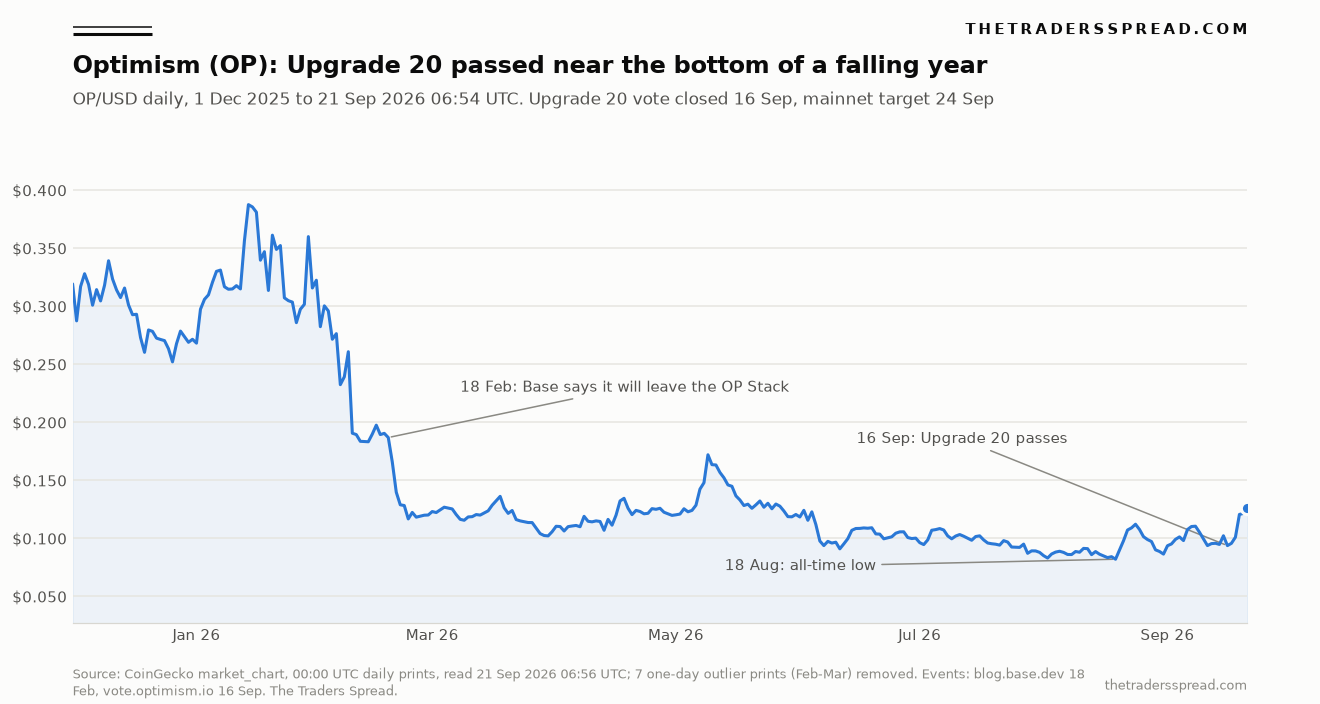
The table compares OP with the peer group across four windows, all computed from CoinGecko's 00:00 UTC daily prints (read 21 September 2026, 06:56 UTC) to the 06:54 UTC spot. We do not use CoinGecko's own percentage fields, which do not reconcile with its price series.
| Asset | Since 17 Sep print | 18 to 19 Sep step | Since 21 Aug print | Since 1 Jan print |
|---|---|---|---|---|
| Optimism (OP) | +31.9% | +19.4% | +28.8% | -52.9% |
| Arbitrum (ARB) | +27.4% | +24.8% | +135.7% | +14.7% |
| Starknet (STRK) | +74.1% | +52.7% | +89.4% | -38.7% |
| Ether (ETH) | +10.1% | +6.8% | +14.4% | -10.4% |
| Bitcoin (BTC) | +7.2% | +5.9% | +11.8% | -6.8% |
Two columns carry the argument. Over thirty days, ARB more than doubled while OP added 28.8%. Year to date, ARB is up and OP has lost more than half its value. Our Arbitrum price prediction from 13 September set out ARB's own drivers; the point here is only that the two best-known optimistic rollup tokens have split apart in 2026, and the split dates from February.
Liquidity did arrive. CoinGecko's 24-hour volume figure for OP stood at $22.9 million at the 13 September print and $132.0 million at the 19 September print. Market capitalisation at the 06:53 UTC read was $290.8 million, rank 150, against a fully diluted value of $543.2 million.
What Upgrade 20 does, and what it leaves alone
Upgrade 20 is an L1 smart contract upgrade. There is no hard fork on the L2 side, no activation timestamp and no expected downtime. Its headline change moves the fault-proof system from Output Root dispute games to Super Root dispute games, a format that commits to state at an L2 timestamp rather than a block number. That format can later carry the state of several chains at once, which is what native interoperability between OP Stack chains needs.
The authors are careful about what it does not do. "This upgrade positions the dispute system for interop but does not enable interop," wrote Andrea Federici, Senior Solutions Engineer at OP Labs, in the proposal posted on 9 September. Each chain keeps its own dispute game factory and anchor registry, and each game still covers one chain's output root.
The rest is housekeeping: an OPCM v8.0.0 contracts manager that enforces upgrade ordering, per-proxy admin resolution, the removal of the ProtocolVersions contract and two redundant SystemConfig write paths. Spearbit and Cantina audited the full diff, and the proposal says that audit workflow closed on 21 August.
Look at the chain list. The mainnet task in the superchain-ops repository upgrades OP Mainnet (chain ID 10), Ink, Soneium and Unichain in one transaction signed by the Foundation Upgrade Safe and the Security Council. Base is not there. Soneium also runs a permissioned proof game and moves to the simplified SUPER_PERMISSIONED type, which resolves in the proposer's favour by design.
For users, the upgrade notice on docs.optimism.io says no action is required, and withdrawal proofs submitted before the cutover remain valid. Application developers using viem's OP Stack helpers need version 2.51.0 or later because proofs now anchor by timestamp.
The revenue hole Base left behind
On 18 February 2026, Base's engineering team announced "a unified, Base-operated stack" and said node operators would follow releases from its own base/base repository "instead of Optimism's releases". The post kept a commercial tie: Base would continue to work with Optimism "as a client of OP Enterprise: Mission-Critical Support". OP's 00:00 UTC print that day was $0.187. Six months later it touched $0.0807.
Why did one chain matter so much? Because the Superchain's economics were built around a revenue share, and Base was the largest payer by a distance. Dane Lund, a core contributor at Alliance DAO, set out the arithmetic in a governance forum post on 20 February, putting Base's 2025 transfers at about 3,765 ETH, more than 70% of all Superchain revenue-share contributions that year. "Base became the engine of Superchain revenue. The departure of that stream is not a marginal event for the Collective," he wrote. We could not reconcile the 3,765 ETH figure against an on-chain ledger ourselves, so treat it as his estimate.
The Foundation's reply on 26 February settled three things. The revenue share ends with the transition. Base is not entitled to the unvested portion of the OP grant it received in 2023, which the original terms sized at up to about 118 million OP, or 2.75% of supply. And, most relevant for the token, money Base now pays as an OP Enterprise customer goes to the Optimism Foundation and falls outside the buyback program, which was scoped to Superchain revenue share. The Foundation said using OP Enterprise revenue for buybacks "will be explored" as part of a legal-entity restructuring. Explored is not approved.
The forfeited grant cuts the other way, and it deserves credit. Tokens Base will no longer earn are tokens that will not reach the market, a modest supply offset that no chart captures.
The buyback ledger has gone quiet
The Foundation opened a buyback communication thread on 28 January, promising monthly execution details for a program that directs up to 50% of 2026 Superchain revenue into OP purchases, executed over the counter until it moves on-chain. The thread has three tranches in it.
| Revenue month | Reported | OP bought | ETH spent | Implied revenue if 50% applied |
|---|---|---|---|---|
| January 2026 | 5 Mar 2026 | 1,574,817 | 95.8 | ~191.6 ETH |
| February 2026 | 7 Aug 2026 | 6,951,453 | 367.905 | ~735.8 ETH |
| March 2026 | 7 Aug 2026 | 925,654 | 50.16 | ~100.3 ETH |
| Total | 9,451,924 | 513.865 |
The last column is our inference, not a Foundation figure. It assumes the full 50% was applied each month; if less was used, revenue was higher. Even so, the March tranche is 86% smaller than February's in ETH terms, and it is the first month after Base's announcement. No tranche for April or later has been posted. On 25 August a forum user asked why updates had stopped when the program was approved for twelve months, and as of our read on 21 September that question has no reply in the thread.
The Foundation's own Year 4 budget update of 6 August adds context that cuts both ways. New commitments fell to roughly 150 million OP from 229.92 million in Year 3, and new OP entering circulation from the Governance Fund fell 53%. OP Mainnet's monthly transactions grew more than 60% over the year. Circulating supply stood at 2,287,994,831 OP, 53.3% of the 4.29 billion total, which leaves a large overhang still to vest.
Put the two tables together. The buyback is small next to supply, and the stream that funded it has thinned. An upgrade that prepares proof games for interoperability does not change either fact before 24 September or after it.
What would prove this reading wrong
A fair counter-case exists. Upgrade 20 is the last dispute-system change needed before an interop-bearing upgrade, so the next upgrade can switch interop on without re-touching proofs. If shared liquidity across OP Mainnet, Unichain, Ink and Soneium produces fee growth, the Superchain can rebuild revenue without Base. OP Enterprise has named customers in Bitpanda's Vision Chain, Ink's move to the Fully Managed tier and an MOU with Dunamu for GIWA Chain, according to the budget update.
Execution risk is the other swing factor, and it runs the wrong way for bulls. Manoj Kumar Desai, an independent Web3 researcher who posts as MconnectDAO, raised it in the Upgrade 20 thread on 16 September: "Given that SUPER_PERMISSIONED games resolve immediately in favor of the defender, additional transparency around Guardian blacklisting and independent monitoring would strengthen community confidence." That applies to permissioned chains such as Soneium rather than OP Mainnet, but a clean mainnet signature on 24 September is the minimum the market has already priced.
Three signals would change our view. A posted buyback tranche for April onwards, showing revenue recovering above the March level. A governance proposal that routes OP Enterprise revenue into buybacks. Or a week in which OP outperforms ARB on an OP-specific catalyst rather than lagging it on a sector day.
RelatedKaspa Price Prediction for KAS: $0.055 Bull, $0.025 Bear
What this changes
For holders, Upgrade 20 changes the technical calendar more than the valuation case. The mainnet execution is scheduled for Thursday 24 September, seven days after the Sepolia soak began. A delay would be news. A clean execution would not, because the vote result made it the expected outcome.
The second-order effect sits with Base. Its exit means every future Superchain upgrade ships to a smaller set of chains, and the chain that paid most of the old revenue share now releases on its own cadence. Base's post targeted six hard forks a year, double its current three. Two release trains will drift, and every piece of shared tooling will have to track both. For OP Mainnet, that raises the bar for interop to matter: shared liquidity across four chains is a thinner pitch than shared liquidity across the Superchain as it looked in 2025.
For the token, the transmission mechanism to watch is the buyback thread, not the upgrade notice. The program was approved for twelve months of 2026 revenue. If the Foundation posts April to August tranches, the size of those purchases will tell the market what the post-Base Superchain earns more clearly than any upgrade can. If the thread stays silent, the gap between the 50% promise and the three reported months becomes the story.
For relative value, the OP versus ARB spread is the cleanest read. Over thirty days ARB has outperformed OP by more than 100 percentage points on our computed closes. A narrowing of that gap on an Optimism-specific catalyst would be the first sign that the market has started paying for the interoperability roadmap. The bigger Base picture is visible in our coverage of Morpho's Base deposits, and Ethereum's own setup is covered in our August Ethereum report and on the Ethereum market hub.
Timing matters for readers following the tape: all prices here are CoinGecko reads at 06:53 to 06:56 UTC on Monday 21 September, and crypto trades around the clock, so the live quote will differ.
FAQ
Did Optimism holders vote to approve Upgrade 20?
Not in the usual sense. Upgrade 20 ran as an optimistic approval on Agora, which passes unless 20% of votable OP votes against it. The vote closed at 12:26 UTC on 16 September with 156 addresses voting and 71,701 OP against, about 0.13% of voting power. Silence counted as consent, which is how routine protocol maintenance normally passes on Optimism.
When does Upgrade 20 go live on OP Mainnet?
The mainnet execution target is Thursday 24 September 2026, after a seven-day soak on Sepolia that began when the testnet transaction executed at 16:03:48 UTC on 17 September. The mainnet task covers OP Mainnet, Ink, Soneium and Unichain in a single transaction and was marked ready to sign when we read the repository on 21 September.
Does Upgrade 20 turn on Superchain interoperability?
No. It moves fault proofs to Super Root dispute games, the format interoperability needs, but OP Labs' proposal states plainly that it does not enable interop. Each chain keeps its own dispute contracts and each game still covers one chain. A later upgrade would have to switch interoperability on, and no date for that has been proposed in the forum thread.
Why is Base not part of Upgrade 20?
Base announced on 18 February 2026 that it is moving to its own Base-operated stack and will publish releases from its own repository rather than follow Optimism's. It remains an OP Enterprise customer, but the Optimism Foundation confirmed the Superchain revenue share ends with the transition and that Base forfeits the unvested part of its 2023 OP grant.
How much OP has the Foundation bought back?
The governance forum shows 9,451,924 OP bought with 513.865 ETH across three tranches funded by January, February and March 2026 revenue. That equals about 0.41% of the 2.30 billion circulating supply. No tranche for April or later revenue had been posted in the thread as of 21 September, although the program was approved for twelve months.
Disclaimer
This article is analysis and information only and is not investment advice or a recommendation to trade any asset. Crypto assets are highly volatile and you can lose all of the capital you commit. Figures are from the named primary sources at the times stated and may have changed since publication. Do your own research and consider your circumstances before making any financial decision.