

What is the market actually pricing when it values Ethereum Classic (ETC), the proof-of-work chain that split from Ethereum in 2016, at about $1.1 billion? The short answer is a security budget: whether a smart-contract chain whose miner subsidy shrinks by a fifth every five million blocks can keep enough paid hashrate to stay expensive to rewrite. CoinGecko's ethereum-classic record, last updated at 06:05 UTC on 6 November 2026, showed ETC at $6.95, a market capitalisation of $1,105,197,907 and a 51.6% fall over twelve months, and the same record dated the coin's all-time low against bitcoin to 30 October 2026.
Put the protocol and the price side by side and the year looks harsher than either alone. A block mined in early November 2025 paid 2.048 ETC, which at CoinGecko's daily print of $14.54 for 7 November 2025 came to roughly $29.78. A block mined on 6 November 2026 paid 1.6384 ETC, worth about $11.39 at $6.95. The dollar subsidy per block fell by around 62%, and the schedule written in 2016 explains only the 20% step in that drop; the market supplied the rest. The eight items below are ranked by how much of ETC's behaviour each one explains, starting with why the chain exists at all.
Updated 6 November 2026.
Key facts
- ETC traded at $6.95 with a market capitalisation of $1.105 billion, ranked 71st by CoinGecko. Source: CoinGecko ethereum-classic API, 06:05 UTC, 6 November 2026.
- Circulating supply stood at 158,935,566 ETC, or 75.4% of the 210.7 million worst-case ceiling set by ECIP-1017. Source: CoinGecko and the ECIP-1017 specification on GitHub, read 6 November 2026.
- The base block reward has been 1.6384 ETC since block 25,000,001, mined at 17:13 UTC on 22 July 2026. Source: Blockscout ETC explorer, read 6 November 2026.
- The 2Miners node reported network hashrate of about 187.8 TH/s at block 25,679,537, with mining epoch 427. Source: 2Miners ETC API, 06:06 UTC, 6 November 2026.
- Blockscout reported an average block time of 14.3 seconds across the chain's latest blocks. Source: Blockscout ETC stats endpoint, 06:06 UTC, 6 November 2026.
- ETC switched its mining algorithm from Ethash to Etchash at block 11,700,000 on 28 November 2020. Source: ECIP-1099 and the ethereumclassic.org history page, read 6 November 2026.
1. It is the unaltered chain from the 2016 DAO split
Ethereum Classic is the original Ethereum ledger, carried forward without the July 2016 bailout fork. The chain's genesis date, as CoinGecko lists it, is 30 July 2015, the same launch day the wider Ethereum network counts from.
The split traces back to The DAO, a crowdfunded investment contract deployed on 30 April 2016. According to the timeline kept on ethereumclassic.org, ether began draining from the contract on 17 June 2016 through a re-entry bug. A proposed soft fork to censor the attacker's transactions was abandoned after denial-of-service flaws surfaced, which left a hard fork as the remaining route. That fork activated at block 1,920,000 on 20 July 2016 and moved the drained funds to a recovery contract. The Ethereum Foundation, as the trademark holder, applied the Ethereum (ETH) brand to the forked chain.
Some miners kept extending the chain that had refused the change. Poloniex listed its coin on 23 July 2016, other exchanges followed, and market participants started calling the unforked ledger Ethereum Classic. The founding argument is captured in the phrase "code is law": a transaction that executed under the rules stands, even when the outcome is ugly. ETC is one of several assets born from a contested split, a lineage it shares with Bitcoin Cash (BCH), which separated from bitcoin a year later over block size.
The project's community-run account, listed on the ethereumclassic.org channels page, marks that 2015 launch date each year, and the post below shows how the chain still frames itself as the original EVM.
🎉 It's our birthday! 🍀
— Ethereum Classic (@ETC_Network) August 5, 2024
July 30, 2015: Thanks to all who contributed to the launch of #EthereumClassic, the original EVM.💚 $ETC #ETC https://t.co/nq4ckUgqLR
A detail worth keeping in mind when reading any ETC material: the footer of ethereumclassic.org says there is "no official anything" in Ethereum Classic. The site, the social accounts and the improvement-proposal repository are community-maintained, and the chain lacks a foundation that speaks for it, so claims on those pages read best as the project's account of itself.
2. Blocks are found by proof of work, using Etchash
ETC uses Nakamoto consensus. Miners compete to find a hash below a difficulty target, the chain with the most accumulated work wins, and the winning miner collects the block reward plus the transaction fees. The ethereumclassic.org mining page describes the algorithm as almost identical to Ethash, which is why the same graphics cards and Ethash ASICs that once secured Ethereum can point at ETC by changing pool settings.
The one deliberate change came with the Thanos upgrade. ECIP-1099 doubled the epoch length used in DAG calculations from 30,000 to 60,000 blocks from block 11,700,000, at epoch 390. The DAG is the large dataset a miner must hold in memory, and it grows every epoch; slowing that growth kept cards with smaller memory able to mine for longer. The proposal's authors framed it as a way to bring DAG growth back in line with commonly used GPUs, and the renamed algorithm became Etchash. On 6 November 2026 the 2Miners node reported epoch 427 and a DAG of 4,655,675,264 bytes, about 4.66 GB.
ETC_Network linked to a primer on the consensus rule in May 2024. It matters here because heaviest-chain selection is the property every later item in this list either protects or tests.
What Is Nakamoto Consensus in Ethereum Classic?https://t.co/BLL4HsPYaO$ETC #ETC 🍀 #EthereumClassic 🍀
— Ethereum Classic (@ETC_Network) May 20, 2024
ETC is the largest smart-contract chain still secured this way, though plenty of payment-focused coins mine too. Kaspa (KAS) runs a different proof-of-work design built around a block DAG, and the comparison shows how varied the remaining mined networks are.
3. ECIP-1017 fixed the supply with a 20% cut every five million blocks
Ethereum Classic began life with the same open-ended issuance as Ethereum: 5 ETC per block, plus uncle rewards, in perpetuity. ECIP-1017, created on 20 November 2016 and now marked Final, replaced that with a schedule the community calls 5M20. An era, in the proposal's terms, is a run of 5,000,000 blocks. Era 1 kept the 5 ETC reward, Era 2 cut it to 4 ETC, and every later era cuts it by another 20%. The proposal also reduced uncle rewards from Era 2 onward to 1/32 of the block reward, which made the total far easier to forecast.
The ceiling is a worst case. If every block from Era 2 onward included the maximum two uncles forever, total supply could reach 210.7 million ETC. ECIP-1017 adds that, at the 5.4% uncle rate seen in Era 1, the total would land at 198.5 million or more. The community reached consensus on the policy on 1 March 2017, and the Gotham upgrade switched it on at block 5,000,000 on 11 December 2017.
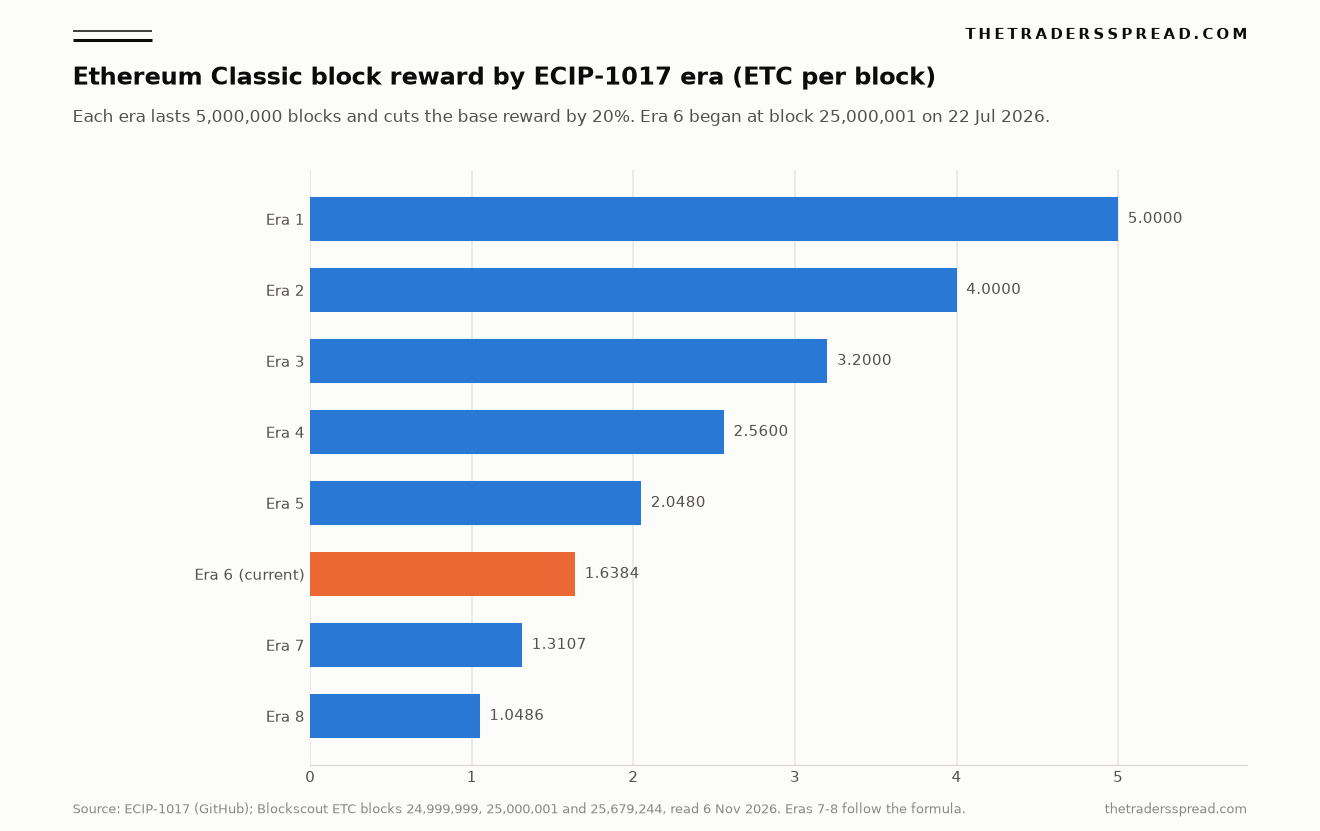
The dated history of the cuts, from the ethereumclassic.org timeline and the Blockscout explorer, runs as follows. Era 2 began on 11 December 2017 at 4 ETC. Era 3 began on 17 March 2020 at 3.2 ETC, Era 4 on 25 April 2022 at 2.56 ETC, and Era 5 on 30 May 2024 at 2.048 ETC. Blockscout shows block 24,999,999 paying 2.048 ETC at 17:12 UTC on 22 July 2026 and block 25,000,001 paying 1.6384 ETC less than a minute later. Era 7, at block 30,000,001, will pay 1.31072 ETC.
The design borrows its logic from bitcoin, and the ECIP's rationale says so. Bitcoin (BTC) halves its subsidy about every four years. ETC cuts by a smaller step more often, which the authors argued would reward early risk-taking while keeping a long tail of issuance to pay miners.
4. Era 6 shrank the miner budget, and price did more of the work
Blockscout's average block time of 14.3 seconds implies about 6,045 blocks a day and about 2.21 million a year. At 1.6384 ETC per block that is roughly 3.62 million new ETC a year, about 2.3% of the 158.9 million in circulation, before uncle rewards. Both figures are estimates from the 6 November 2026 readings.
Measured in dollars, the subsidy at $6.95 comes to about $11.39 per block and roughly $68,800 a day across the network. That number is what miners weigh against electricity and hardware costs, and it is the budget an attacker would have to outbid to rent a majority of the hashrate.
ETC's fee model reinforces the dependence on the subsidy. When ETC adopted Ethereum's London-era changes in the Mystique upgrade, ECIP-1104 marked EIP-1559 and the BASEFEE opcode as omitted. ETC fees are paid in full to the miner, with nothing burned, so every fee helps security, but on a chain whose Blockscout stats showed network utilisation of about 0.37% the fee contribution is small next to the block reward.
The next scheduled cut is about 4.32 million blocks away. At block times between the 13.3 seconds the 2Miners node showed and the 14.3 seconds Blockscout averaged, that is roughly 670 to 715 days, which places Era 7 somewhere in the second half of 2028 on current pacing. Any estimate that far out depends on difficulty and hashrate staying near present levels.
5. Four 51% attacks in two years produced MESS, which was later retired
A low hashrate relative to a neighbouring chain left ETC exposed. The ethereumclassic.org timeline records the first successful chain reorganisation attack on 8 January 2019, followed by three more on 31 July, 6 August and 29 August 2020. In a reorganisation attack, a miner with enough rented or owned hashpower secretly builds a longer private chain and then publishes it, reversing transactions that exchanges had already treated as settled, which makes double spends possible.
The response was ECBP-1100, Modified Exponential Subjective Scoring, or MESS. It sat outside the hard consensus rules as a client-side policy, which the Core-Geth client enabled at block 11,380,000 on 10 October 2020. Its guiding line was that small reorgs are normal and large reorgs are suspicious. Reorganisations shorter than about ten minutes passed as usual, while a long reorg arriving late had to carry an exponentially larger share of difficulty before a node would switch to it. The effect was to make a surprise private chain far more expensive to impose.
MESS was designed as a temporary patch, and ECIP-1110 switched it off by default at block 19,250,000, the Spiral upgrade, which the timeline dates to 5 February 2024. The rationale in that document is the most useful single reading on how ETC's security changed. When ETH still mined, its Ethash hashrate dwarfed ETC's and could be rented against it. After the Merge, the authors estimated the compatible hash economy had shrunk to about 20% of a roughly 1,000 TH/s peak, with ETC accounting for around 85% of what remained. With most of the rentable hash already pointed at ETC, they judged that subjective chain arbitration now carried more risk than it removed.
6. The Merge turned ETC into the main home for Ethash hardware
Ethereum moved to proof of stake on 15 September 2022. The ethereumclassic.org timeline describes the period before and after as the largest miner migration in blockchain history, with ETC's hashrate up 83% between June and August 2022 according to the same page. Hardware that had lost its Ethereum income faced two choices: switch to ETC or a smaller Ethash-family chain, or switch off.
RelatedWhich Flows Actually Move the Chiliz (CHZ) Fan Token?
The 2Miners node reported 187.8 TH/s of network hashrate and a difficulty of about 2.50 quadrillion on 6 November 2026. Against the roughly 1,000 TH/s figure ECIP-1110 used for Ethereum's pre-Merge economy, ETC now carries close to a fifth of that historic hash. That is a large pool of work for a chain valued at $1.1 billion, and it is also capital that will keep reassessing ETC each time the reward steps down.
Concentration deserves a look as well. The same 2Miners endpoint showed its own pool at about 60.2 TH/s with 1,596 miners and 6,990 workers, which works out to roughly a third of the network figure the pool itself reported. Pool shares move daily, and a pool is a coordinator of many independent miners; still, a handful of pools steering most blocks is the practical shape of ETC mining, as it is on most proof-of-work chains.
7. Exchange liquidity is thinner than the market cap suggests
CoinGecko reported $40.1 million of ETC traded over 24 hours on 6 November 2026, about 3.6% of market capitalisation. Its ticker list for the coin, sorted by reported volume, put an ETC/USDT pair on CoinUp.io first at about $26.7 million. Binance's ETC/USDT pair showed $2.54 million, OKX's $1.72 million and Upbit's ETC/KRW market $1.65 million. The 100 listed pairs summed to about $67.5 million, more than the headline 24-hour figure, so the two numbers measure different things and the larger one includes venues CoinGecko weights down.
Quoted spreads on the larger venues were tight. CoinGecko listed OKX's ETC/USDT bid-ask spread at about 0.03% and Binance's at about 0.14%. The trade-off for anyone reading these figures is depth: a top-100 coin by market value with single-venue volumes in the low millions can move sharply on a large order. Over the year, CoinGecko's daily closes ran from a high of $18.02 on 8 November 2025 to a low of $6.08 on 19 August 2026. The all-time high remains $167.09, set on 6 May 2021, and the all-time low $0.615, from 24 July 2016.
8. How Ethereum Classic differs from Ethereum today
The two chains share a history up to block 1,920,000 and still share most of the EVM. They diverged on consensus, monetary policy and fee handling, and their market values have drifted far apart.
| Feature | Ethereum Classic (ETC) | Ethereum (ETH) |
|---|---|---|
| Consensus | Proof of work, Etchash since block 11,700,000 | Proof of stake since 15 September 2022 |
| Supply rule | ECIP-1017, 20% cut every 5M blocks, 210.7M worst-case ceiling | Uncapped; CoinGecko's maximum-supply field is empty |
| Circulating supply (CoinGecko, 6 Nov 2026) | 158.94 million | 122.19 million |
| Price (CoinGecko, about 06:05 UTC, 6 Nov 2026) | $6.95 | $2,218.08 |
| Market capitalisation | $1.105 billion, rank 71 | $271.04 billion, rank 2 |
| Base fee burn (EIP-1559) | Omitted under ECIP-1104; fees go to miners | Active since the London upgrade |
| Block producers | Miners and mining pools | Staking validators |
At those prints one ETC bought about 0.0031 ETH, and Ethereum (ETH) carried roughly 245 times ETC's market value. The protocol relationship is closer than the price ratio implies. ETC's main client, Core-Geth, describes itself as a downstream effort of go-ethereum that merges upstream code at usually every tagged release. Since 2019 ETC has adopted many of Ethereum's execution-layer upgrades for parity, under its own names: Atlantis, Agharta, Phoenix, Magneto, Mystique and Spiral. Shared code carries shared risk, and the timeline records that the Geth bug which split Ethereum's mainnet in August 2021 also split ETC's on 3 September 2021.
The practical result is a chain where most Ethereum smart contracts and wallets behave the same way, priced as a separate monetary asset with its own issuance curve and its own security model. An investor holding each is exposed to entirely different drivers: staking yield and fee burn on one side, mining economics and a fixed reward schedule on the other.
FAQ
What is Ethereum Classic?
Ethereum Classic is the original Ethereum blockchain, launched on 30 July 2015, that kept running without the July 2016 hard fork which reversed The DAO hack. It still uses proof-of-work mining with the Etchash algorithm, runs Ethereum-compatible smart contracts, and issues ETC on a schedule that cuts the block reward by 20% every five million blocks toward a ceiling of about 210.7 million coins.
What moves the Ethereum Classic price?
Several forces show up repeatedly in the data. Broad crypto risk appetite sets the tide, and CoinGecko showed ETC at an all-time low against bitcoin on 30 October 2026. Miner economics matter because each 20% reward cut changes how much new ETC miners must sell. Exchange depth matters because single-venue volumes are modest. Security incidents, such as the 2019 and 2020 reorganisation attacks, have also hit confidence.
Can ETC supply go above 210.7 million?
Under ECIP-1017 as written, 210.7 million is the hard upper bound. That figure assumes two uncle blocks in every block from Era 2 onward, the most generous case possible, and the specification estimates a final total of at least 198.5 million at historic uncle rates. Changing the ceiling would need a new hard fork that node operators and miners chose to adopt, the same kind of change the chain was founded to resist.
The question left open
Ethereum Classic has now cut its block reward five times on schedule, survived four majority-hash attacks, retired the emergency defence those attacks produced, and absorbed most of the Ethash hardware that Ethereum released, and its rules have held throughout. What the protocol leaves to the market is the dollar value of the reward, and over the past year that value fell much faster than the schedule required. By the time Era 7 arrives, sometime around the second half of 2028 at current block times, each block will pay 1.31072 ETC. Will the fees, usage and price behind that smaller reward still buy enough hashrate to keep a $1 billion proof-of-work chain expensive to attack, or will the security budget become the number the market prices above everything else?
Nothing on this page is a recommendation to buy, sell or hold ETC or any other asset.