
Seventy-nine dollars. That is the premium a tonne of zinc for immediate delivery commanded over the same tonne three months forward at the London Metal Exchange official close on Thursday 17 September 2026, with cash settling at $3,941.00 and three-month metal at $3,862.00. Three weeks earlier, on 27 August, the same gap was $217.00. Cash zinc has come off a 2026 high of $4,186.00 struck on 9 September, a fall of 5.85% in six sessions, and LME warehouse stocks have gone the other way, rebuilding from 86,525 tonnes on 18 August to 114,250 tonnes. Most of the commentary through late August read the widening cash premium as proof that physical zinc had run out. The refined-metal statistics published while that premium was at its widest say the opposite, and they say it without ambiguity.
The International Lead and Zinc Study Group reported on 26 August that the global market for refined zinc ran a surplus of 120,000 tonnes in the first half of 2026, with total reported inventories rising by 92,000 tonnes. There was no shortage of zinc metal. What there is a shortage of sits one layer upstream: Fastmarkets assessed the spot zinc concentrate treatment charge into China at minus $100 to minus $135 a tonne on 28 August, meaning smelters are now paying miners for the privilege of taking their concentrate, against a positive $10 to $50 a tonne as recently as 27 February. Zinc's curve spent August pricing a concentrate squeeze as though it were a metal squeeze. When the spread offered enough, the metal appeared, because the metal was always there.
Key facts
- LME zinc cash settled at $3,941.00/t on 17 September 2026 against $3,862.00/t three-month, a backwardation of $79.00/t, down 63.6% from the $217.00/t peak of 27 August (LME official prices via Westmetall, retrieved 18 September 2026).
- Refined zinc ran a 120,000-tonne surplus in H1 2026 and reported inventories rose 92,000 tonnes (ILZSG press release, 26 August 2026).
- Spot zinc concentrate treatment charges CIF China stood at minus $100 to minus $135 per tonne on 28 August 2026, from positive $10 to $50 per tonne on 27 February (Fastmarkets, published 8 September 2026).
- LME stocks rose 27,725 tonnes, or 32.04%, between 18 August and 17 September 2026, with 18,500 tonnes of that warranted on just two days (calculated from LME stock totals via Westmetall, 18 September 2026).
- World zinc mine production fell 2.6% in H1 2026, with refined output up 1.3% globally but down 3.4% outside China (ILZSG, 26 August 2026).
- The 2026 annual benchmark treatment charge was settled at $85 per tonne between Teck Resources and Korea Zinc, against an all-time low of $80 in 2025 and $165 in 2024 (Fastmarkets, 11 March 2026).
- Zinc cash is up 28.64% from its 31 December 2025 close of $3,063.50/t and 33.2% year on year, having traded as low as $3,010.00/t on 19 March 2026 (LME official prices via Westmetall, 18 September 2026).
What a $217 backwardation actually pays for
The cash-to-three-month spread on the LME is not a forecast. It is the cost of time. In an unstressed market the forward price sits above cash by roughly what it costs to store, insure and finance metal for the period, which produces the familiar contango. When cash trades above forward, the exchange is telling anyone holding unwarranted metal that they can sell today, buy it back in three months, and pocket the difference for the inconvenience.
On 27 August the inducement was extraordinary. A $217.00 premium against a $4,107.00 cash price is 5.28% over a quarter, or 21.13% annualised, on a trade carrying no directional exposure to zinc whatsoever. Set against three-month financing and LME warrant storage costs, that is not a marginal calculation. It is the kind of number that pulls metal out of consumer sheds, out of off-warrant storage in Singapore and Rotterdam, and onto exchange warrant. Doing exactly that is what the spread is for.
A backwardation can also persist because metal genuinely is not available at any price. That is what happened to nickel in 2022. Telling the two situations apart is not a matter of judgement; you watch what the stock series does after the spread widens. Stocks that keep falling while cash keeps paying more mean the shortage is real. Stocks that rebuild mean the spread has been answered.
The metal arrived, and the spread stood down
Zinc's stock series answered emphatically.
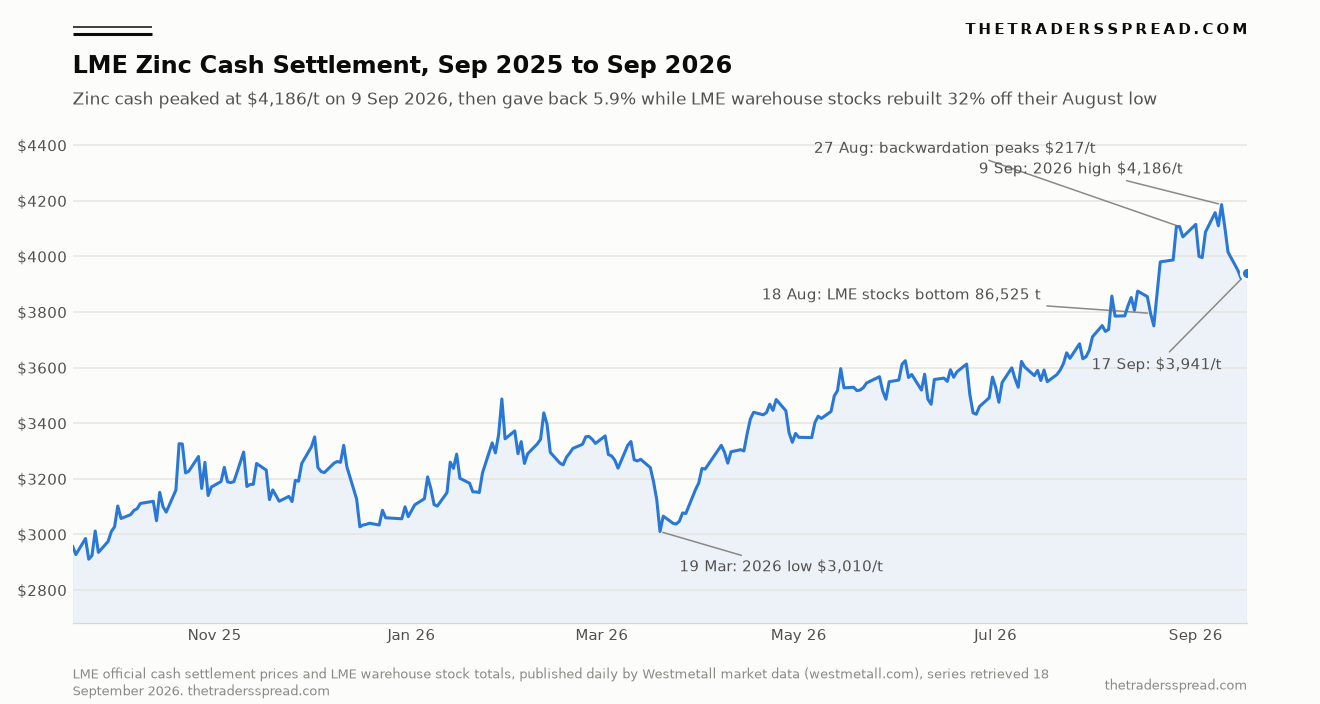
Nearly two-thirds of the rebuild landed on two days. Some 8,525 tonnes were warranted on 19 August and 9,975 tonnes on 3 September, both inside the window when the cash premium was widest. Single-day increases of that size do not represent new production; a roaster cannot respond in three weeks. They represent metal that already existed off-warrant being mobilised by a price. The month-end sequence below shows the mechanism unfolding rather than the aggregate result.
| Date | LME zinc cash | LME zinc 3-month | Cash less 3-month | LME stocks (t) |
|---|---|---|---|---|
| 31 Mar 2026 | $3,184.50 | $3,186.00 | -$1.50 | 114,500 |
| 30 Apr 2026 | $3,363.00 | $3,367.00 | -$4.00 | 98,650 |
| 29 May 2026 | $3,549.00 | $3,556.00 | -$7.00 | 113,800 |
| 30 Jun 2026 | $3,565.50 | $3,546.00 | +$19.50 | 119,825 |
| 31 Jul 2026 | $3,710.50 | $3,631.00 | +$79.50 | 99,800 |
| 28 Aug 2026 | $4,070.00 | $3,930.00 | +$140.00 | 97,950 |
| 17 Sep 2026 | $3,941.00 | $3,862.00 | +$79.00 | 114,250 |
Source: LME official cash settlement and three-month prices with LME warehouse stock totals, published daily by Westmetall, series retrieved 18 September 2026. Rows use the last LME trading day of each month.
Two details there deserve more attention than they get. June's 119,825-tonne stock total sat alongside a positive spread, so the backwardation appeared before the drain did rather than after it. And the 31 July and 17 September rows carry an identical $79.00 spread on very different inventories, 99,800 tonnes against 114,250 tonnes. The same premium is being paid by a market holding 14.5% more visible metal. Anyone reading the spread without the stock series alongside it cannot see that deterioration at all.
The shortage is in concentrate, not in metal
Refined zinc comes out of smelters that buy concentrate from miners under a treatment charge, the per-tonne fee the miner pays the smelter for turning ore into metal. That fee is the smelter's revenue line. When it goes negative, the arithmetic inverts: the smelter pays the miner, and processing capacity becomes a cost centre that only by-product credits and free metal can rescue.
Zinc crossed that line during 2026 and kept going. Fastmarkets' fortnightly assessment moved from positive $10 to $50 per tonne on 27 February to minus $50 to minus $80 by 12 June, minus $70 to minus $120 by 26 June, and minus $100 to minus $135 per tonne on 28 August. On that date the agency also split its assessment into separate smelter-purchase and trader-purchase series, at minus $100 to minus $125 and minus $125 to minus $140 respectively. Splitting a benchmark is itself a signal; it happens when a single number stops describing one market.
The annual benchmark tells the same story more slowly. Teck Resources and Korea Zinc settled 2026 at $85 per tonne, barely above 2025's all-time low of $80 and roughly half the $165 struck for 2024. Miners have had the whip hand in that negotiation for three consecutive years.
The reason is ordinary geology and one closure. World zinc mine production fell 2.6% in the first half, the ILZSG found, on reductions at Antamina in Peru, Garpenberg in Sweden and Red Dog in Alaska, plus the closure of Australia's Lady Loretta at the end of 2025. Glencore's own-sourced zinc fell 21% year on year to 365,600 tonnes in H1 2026, which the company's half-year production report of 29 July attributes principally to Lady Loretta's end of mine life and lower Antamina grades. Teck's second-quarter results guide Red Dog down to 375,000–415,000 tonnes this year and 230,000–270,000 tonnes by 2028, citing depletion of the Qanaiyaq pit and fault slippage at Aqqaluk. None of that reverses on a twelve-month view.
Ignacio Rosado, Chief Executive Officer at Nexa Resources, put the split plainly in the company's second-quarter results release of 5 August 2026: "The zinc concentrate market remains tight, with spot TCs in China deep in negative territory. The same conditions that pressure merchant smelters support our mining segment, and our own feed and by-product credits cushion the rest." A miner with its own smelters is describing a transfer of margin, not a shortage of metal.
Where the pressure actually lands
Smelters without captive mines absorb it. Glencore's custom smelting operations produced 446,700 tonnes of zinc metal in H1 2026, 4% below the prior year, which the same production report puts down to operational disruptions and power curtailments. Its Kazzinc unit was explicitly feed-constrained: own-sourced output fell 12%, the report says, "primarily reflecting limited availability of high-quality third-party concentrates for blending, which in turn restricted the smelters' rate of processing own sourced material." A smelter idling for want of blend stock while refined zinc sits in surplus is the whole dislocation in one sentence.
The geography of it shows in the ILZSG numbers. Refined zinc production rose 1.3% globally in H1 but fell 3.4% outside China, where output grew 5.9%. Chinese imports of zinc contained in concentrate rose 8.3% to 1,324,000 tonnes over the same period. China is bidding concentrate away from everyone else and running its smelters harder, which is why the treatment charge is negative and why European, Japanese, Kazakh and Peruvian refined output is falling.
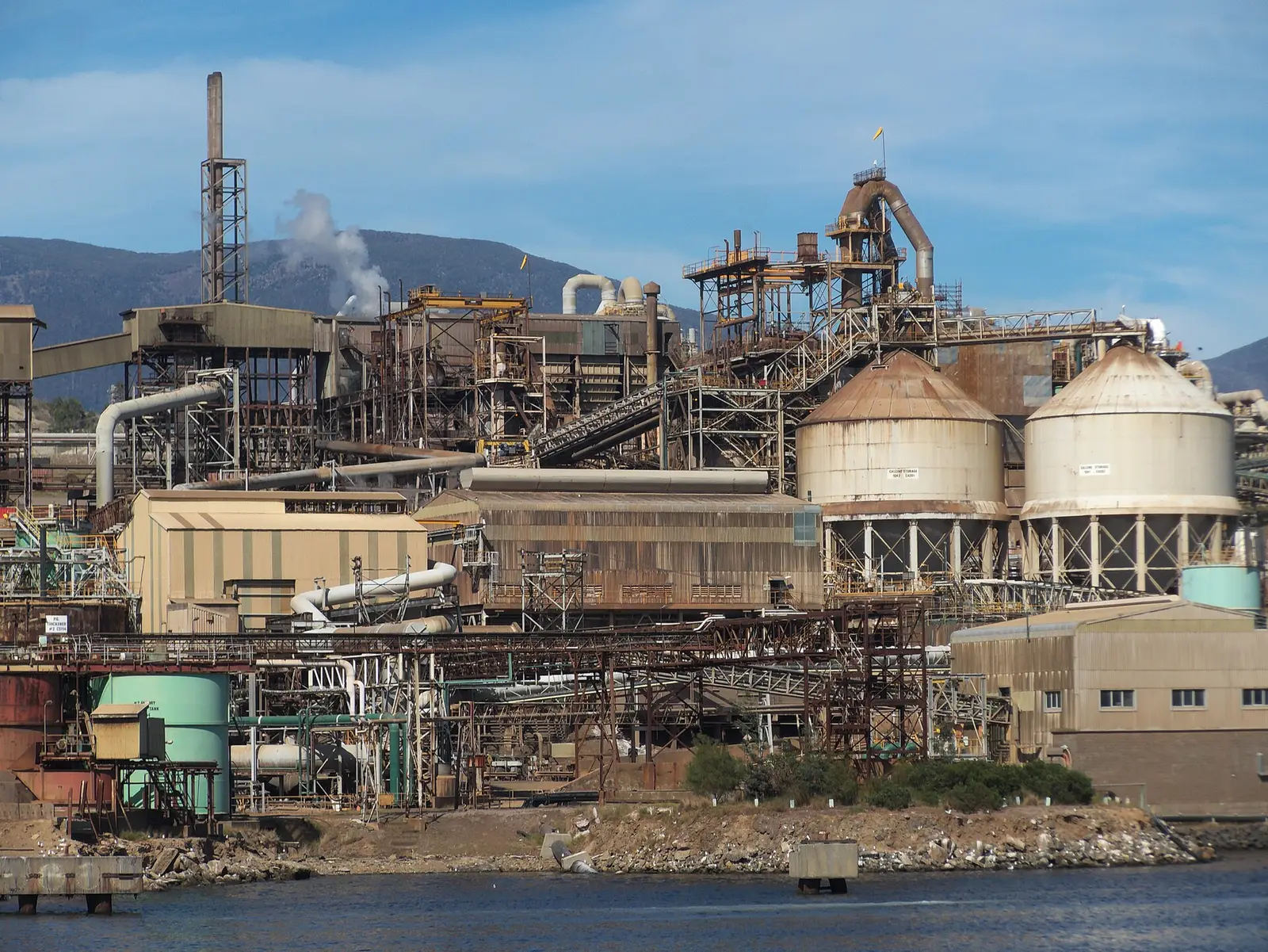
Western smelters have been living on government support and by-product economics. Nyrstar's Australian operations, the Hobart zinc smelter pictured above among them, secured an A$105 million transitionary funding package from the Australian, South Australian and Tasmanian governments on 10 June 2026 for modernisation feasibility work. Guido Janssen, Global Chief Executive Officer at Nyrstar, framed it as "a critical step in finalising the scope of major upgrades needed and pinpointing the investment required to ensure a long-term future for our assets in Port Pirie and Hobart." Hobart has been running about a quarter below capacity since a cut announced in March 2025, and nothing published this year reverses it.
The forecast of record is already wrong
In April, at its spring session in Lisbon, the ILZSG forecast that refined zinc demand would exceed supply in 2026 by 19,000 tonnes. Four months later the group's own preliminary data showed a 120,000-tonne surplus for the first half alone. That is not a rounding error, and the group does not meet again until 14 October, so the April number remains the forecast of record for another month.
The gap is instructive rather than embarrassing. Forecasts of a balanced market assumed smelters would convert available concentrate into metal at normal rates. What happened instead is that Chinese smelters ran harder than expected while everyone else's output shrank, and the composition of supply shifted without the total collapsing. A balance forecast cannot capture that. The surplus is real and the concentrate tightness is real, and they coexist because they describe different products.
This is also why zinc's spreads behave less like iron ore, where seaborne supply responds within a quarter, and more like nickel, where the marginal tonne sits behind a processing decision. It contrasts sharply with aluminium, whose LME stock drain this year has been persistent and one-way. Zinc's was sharp, shallow and has already reversed. Roughly half of refined zinc goes into galvanizing steel, a construction-led demand stream that never attracted the electrification premium repricing copper, and a large share of the marginal tonne is mined in Australia, Peru and Kazakhstan, which ties producer discipline to the dollar cross as much as to the metal price — a relationship set out in our AUD/USD analysis.
What this changes
The first change is to what the LME curve can be used for. Through late August a $217 backwardation was legitimate evidence of prompt tightness, because stocks were still falling as it widened. That evidential value is now spent. The same $79 that looked like scarcity on 31 July against 99,800 tonnes describes a market holding 114,250 tonnes today. Treating the two as equivalent is the specific error the stock series exists to prevent.
RelatedLead Price Prediction: $2,100 Bull Case vs $1,720 Bear Case
The second change is to where the burden of proof sits. Zinc has settled in backwardation on 54 of the 56 LME sessions since 1 July, averaging $115.10 a tonne since 1 August, so something structural is keeping prompt metal bid. But that case can no longer be made on the curve. It has to be made on concentrate: on treatment charges, on mine grades at Red Dog and Antamina, on whether Chinese smelters keep outbidding everyone for feed. Anyone still arguing acute scarcity of refined zinc owes an explanation for 27,725 tonnes appearing in a month and a 120,000-tonne half-year surplus.
The third change is to who carries the risk. A negative treatment charge moves margin from smelters to miners, and the companies most exposed are merchant smelters without captive concentrate. That is a credit and capacity story before it is a price story. Every western smelter that closes tightens refined metal a year later, which is the mechanism by which today's surplus becomes tomorrow's deficit. Votorantim and Boliden confirmed talks in July over Votorantim's controlling stake in Nexa, and consolidation of integrated miner-smelters is the rational response to exactly this squeeze.
What would change this reading? A resumption of the stock drain would do it fastest. If 114,250 tonnes starts falling again while the cash premium holds near $79, the August delivery emptied a finite off-warrant pool rather than proving its depth, and the scarcity case returns with more force. A move back above $200 on the spread with stocks flat or rising would say something different: that the premium is being paid for reasons unconnected to physical availability. Treatment charges turning back toward zero would signal the upstream squeeze resolving. All three are visible in published data well before they reach the price.
Frequently asked questions
What is a backwardation in zinc, in plain terms?
Zinc for immediate delivery costs more than zinc for delivery in three months. At the LME close on 17 September 2026 cash was $3,941.00 a tonne against $3,862.00 three-month, so cash carried a $79.00 premium. The normal state is the reverse, because holding metal costs money. A backwardation inverts that and pays holders to give metal up now.
How can zinc be in surplus and backwardated at the same time?
Because surplus and backwardation describe different things. The ILZSG surplus of 120,000 tonnes for H1 2026 measures refined metal produced against refined metal consumed over six months. A backwardation measures how badly someone wants metal in a specific warehouse this week. Metal sitting off-warrant or in the wrong location counts toward the surplus but cannot settle a prompt LME position.
What is a negative treatment charge?
A treatment charge is the fee a miner pays a smelter to convert concentrate into refined metal, normally quoted in dollars per dry tonne of concentrate. When concentrate is scarce enough that smelters compete for it, the fee can fall below zero, at which point the smelter effectively pays the miner. Fastmarkets assessed the spot charge into China at minus $100 to minus $135 per tonne on 28 August 2026.
How much zinc is actually in LME warehouses?
114,250 tonnes as at 17 September 2026, up from a 2026 low of 86,525 tonnes on 18 August and below the 124,550-tonne high of 16 June. That total counts only metal on exchange warrant. Consumer stocks, producer inventory and bonded material in China sit outside it, so the figure understates how much zinc exists in total.
Does a narrowing backwardation mean the zinc price will fall?
Not mechanically. The spread and the outright price are separate variables that have moved together and apart at different points this year. A narrowing spread says the prompt-delivery pressure supporting cash relative to forward has eased. Zinc did fall 5.85% from its 9 September high as the spread came in, but the two are related rather than causal.
Where do these figures come from?
Price and stock data are LME official cash settlement prices, three-month prices and warehouse stock totals from the daily series published by Westmetall, retrieved 18 September 2026. Balance and production data come from the ILZSG press releases of 26 August and 23 April 2026. Treatment charges come from Fastmarkets assessments dated 28 August and 11 March 2026. The LME's own site could not be reached during this analysis, so the price series could not be corroborated against a second independent publisher.
This article is analysis and information, not investment advice. Commodity futures and metal exposure carry substantial risk, and capital is at risk. Prices, treatment charges and warehouse figures cited are accurate as at the retrieval dates stated and may have changed since publication. Readers should carry out their own research and consider their own circumstances before acting on any market information.