

278,790 tonnes. That is how much nickel sat in London Metal Exchange warehouses at the close of business on 16 September 2026, the highest reading since 26 May, and it arrived on the same day the LME official cash settlement price fell to $16,090 a tonne. The three-month contract settled at $16,250. Put those two numbers side by side and you get the whole problem for anyone building a bullish case on Indonesian supply policy: the exchange is getting fuller while the headlines out of Jakarta keep promising scarcity. Cash sits just $25 above the 2026 closing low of $16,065 printed on 6 July, and 17.3% below the 6 May peak of $19,450. The six weeks since 6 August added 14,346 tonnes to LME stock while the price slipped 3.0%. None of that looks like a market short of metal. It looks like a market holding a policy premium it has not yet been asked to justify.
Here is what most nickel coverage skips. The LME contract settles on Class 1 primary nickel of at least 99.8% purity, while the bulk of Indonesia's output is nickel pig iron, ferronickel, mixed hydroxide precipitate and matte. Jakarta's quota cuts squeeze the ore that feeds those Class 2 products. They do not, on their own, remove a single tonne from an LME shed. The proof sits in the warrant data: when cash spiked to $18,450 on 7 January 2026 on the quota story, LME stock jumped 20,088 tonnes that same session and another 8,490 tonnes on 9 January. No rally since has come with a lasting drawdown either. Metal shows up.
- LME nickel cash settlement $16,090/t and three-month $16,250/t on 16 September 2026, a $160 contango — LME official prices via Westmetall, retrieved 17 September 2026
- LME nickel stock 278,790t on 16 September 2026, up 23.1% from 226,434t a year earlier, while cash is up only 5.6% over the same 12 months — Westmetall LME data, 17 September 2026
- Cash is 17.3% below the 6 May 2026 high of $19,450 and 2.4% below the 31 December 2025 settlement of $16,485 — Westmetall LME data, 17 September 2026
- Indonesia's approved 2026 nickel ore quota is around 260-270 million tonnes, against a 379 million tonne target in 2025 — Petromindo, citing ESDM, 13 July 2026
- Indonesia mined an estimated 2.6 million of the world's 3.9 million tonnes of nickel in 2025, about 67% — USGS Mineral Commodity Summaries 2026
- Nickel Industries' Excelsior HPAL plant may run at roughly 30% of nameplate until water supply normalises, after less than 4mm of August rain against a 222mm average — Nickel Industries ASX operating update, 15 September 2026
- Cancelled warrants were 13,692t on 11 September, leaving 95.0% of LME stock available — LME Insight weekly review, 7-11 September 2026
Why a quota in Sulawesi doesn't empty an LME shed
Start with what the contract actually is. LME Insight's September analysis of Indonesia's benchmark ambitions lays it out plainly: LME Nickel settles on high-purity primary nickel in six-tonne lots, and most Indonesian production is intermediate material that the contract does not reference. The deliverable grade is the hinge on which this entire forecast turns.
Indonesia's supply policy works on ore. The Ministry of Energy and Mineral Resources shrank the annual mining plan, known as the RKAB, and moved approvals back from three-year to one-year cycles. That tightens feed for the rotary kilns and high-pressure acid leach plants of Morowali and Weda Bay. A tighter ore market lifts the cost of NPI and MHP, and that cost pressure does leak into the LME price through sentiment and substitution. It leaks slowly, though, and incompletely.
Refined Class 1 metal comes from a different set of plants, including new Indonesian cathode lines covered below. If those keep running, London gets its metal regardless of how many wet tonnes of ore Jakarta permits.
Jakarta wants to change the pricing map as well. The Cabinet Secretariat said on 14 August 2026 that President Prabowo Subianto plans a Strategic Mineral and Commodity Exchange from 1 January 2027, supervised by the Financial Services Authority (OJK), to set an "Indonesia Reference Price" for export commodities including nickel. LME Insight's view is that such a venue would more likely create an Indonesia-London basis than replace the London contract, and it points to thin liquidity in Indonesia's earlier tin exchange as the cautionary case. For a price forecast running to March 2027, the practical consequence is small but real: a second reference price could make the gap between ore-market tightness and refined-metal abundance visible in a single spread, rather than hidden inside one London number.
The warehouse ledger since the December low
The chart below plots every LME official cash settlement from September 2025 to 16 September 2026, with our three scenario levels projected to 31 March 2027.
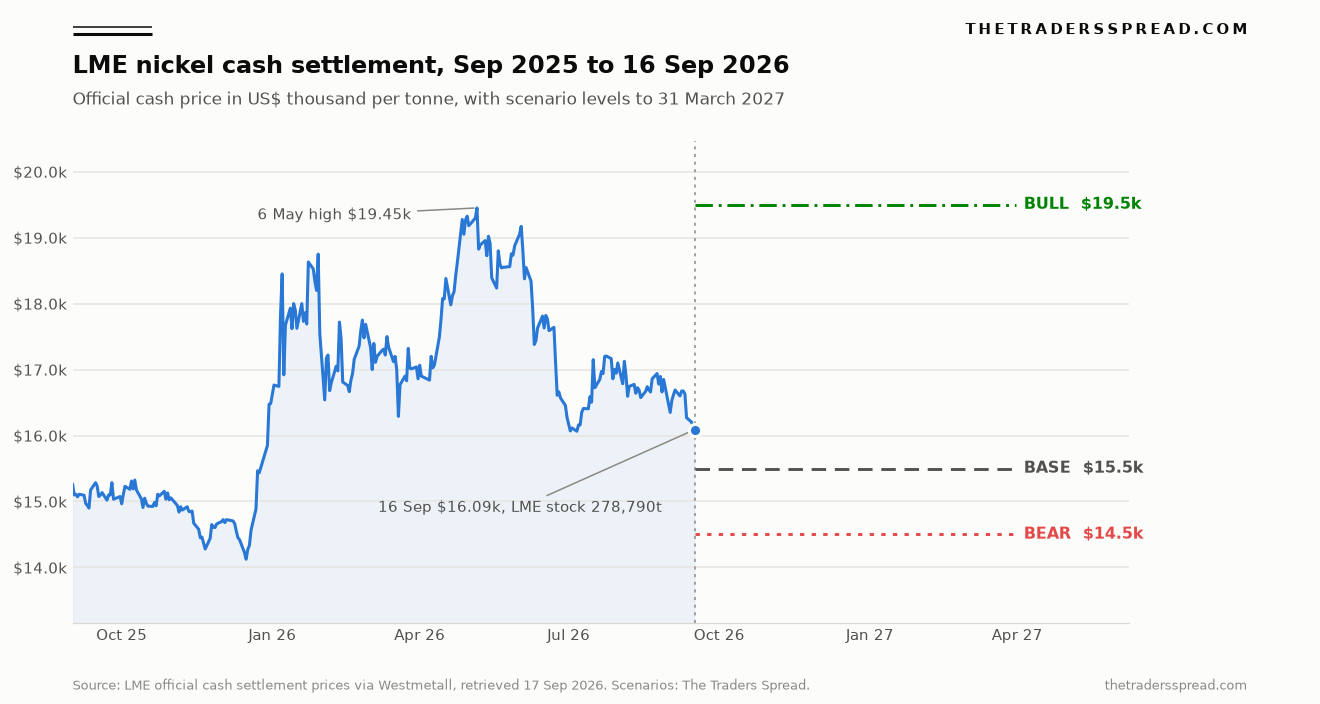
Read the price line against stock and the pattern jumps out. The rally that began at $14,125 on 16 December 2025 was a policy rally: a 30.6% move to $18,450 in three weeks as the market priced a smaller Indonesian quota. Stock did not fall to confirm it. It rose.
| Date | LME cash ($/t) | LME 3-month ($/t) | LME stock (t) | What happened |
|---|---|---|---|---|
| 16 Sep 2025 | 15,235 | 15,420 | 226,434 | Year-ago reference |
| 16 Dec 2025 | 14,125 | 14,325 | 253,308 | Cycle low before quota rally |
| 7 Jan 2026 | 18,450 | 18,650 | 275,634 | Spike; stock +20,088t in a day |
| 6 May 2026 | 19,450 | 19,675 | 276,864 | 2026 high |
| 6 Jul 2026 | 16,065 | 16,250 | 274,620 | 2026 closing low |
| 6 Aug 2026 | 16,595 | 16,775 | 264,444 | Lowest stock since January |
| 16 Sep 2026 | 16,090 | 16,250 | 278,790 | Latest settlement |
Source: LME official settlement prices and stock via Westmetall, retrieved 17 September 2026.
Two things stand out. First, the 6 May high came with stock almost exactly where it had been in January, so the second leg of the rally was never backed by a drawdown. Second, the slide from February's 289,506-tonne peak to 264,444 tonnes on 6 August took more than five months, and 57% of it has been undone in six weeks. The aluminium market, where LME stocks halved this year, shows what a genuine physical squeeze looks like on the same exchange. Nickel is the opposite picture.
Averages tell the same story from further back. The 2025 daily mean for LME cash was about $15,160, which squares with the USGS estimate of roughly $15,000. The 2026 year-to-date daily mean is about $17,404. So the market has paid, on average, around $2,240 a tonne more this year for a metal it holds 23% more of.
Jakarta has two dials, and only one of them is turning tighter
The quota dial is loosening at the margin. ESDM's Director General of Minerals and Coal, Tri Winarno, told reporters in July that any revision would be modest. "We're still calculating the smelters' total requirements, comparing them with the RKAB volumes that have already been approved, and then there may be only a slight increase," he said, according to Petromindo on 13 July 2026. On 19 August, Mysteel reported that Tri confirmed roughly a dozen nickel companies had received approval for revised 2026 plans, though he declined to give volumes and said some mines shut by RKAB issues could resume.
Miners are asking for more, not less. Nickel Industries told the ASX on 15 September that its Hengjaya Mine sold a record 1.6 million wet tonnes of ore in August, is on track to use all of its 14.3 million tonne 2026 quota, and has applied to raise it.
The weather dial is the one pointing tighter. The same Nickel Industries update said dry conditions in Central Sulawesi had constrained water to its Excelsior Nickel Cobalt (ENC) high-pressure acid leach plant, which had reached about 50% of nameplate within four weeks of commissioning. If the shortage persists, ENC runs at about 30%. Managing Director Justin Werner framed it as a timing problem: "The dry conditions in Central Sulawesi are an unusual and temporary constraint on water supply, and we expect availability to normalise with the onset of the wet season," he said in the company's ASX announcement. The company's base case has the wet season arriving by December 2026.
Add the unconfirmed talk, reported in LME Insight's review of 1-4 September, that Chinese-controlled Indonesian HPAL operators were weighing coordinated MHP cuts of up to 30%. No agreement had been reached. And lower battery-feed output, as that review noted, does not translate directly into tighter LME-deliverable nickel.
Ewa Manthey, Commodities Strategist at ING, put the market's habit bluntly back in June. "For now, expectations around Indonesian policy remain a bigger driver of the market than physical supply changes," she wrote in an ING THINK note on 30 June 2026. The warehouse numbers since then suggest that driver is losing torque.
What consensus misses: Indonesia is building London-grade supply
The standard bull argument treats Indonesia as a brake on supply. Part of Indonesia's expansion is aimed squarely at the LME, though. Nickel Industries announced on 11 August 2026 that ENC, inside the Indonesia Morowali Industrial Park, had produced its first nickel cathode and that data collection could begin for brand registration on the LME. Once registered, the company said, ENC cathode "will be deliverable against LME contracts."
That matters for the second half of the forecast window. ENC is designed to produce more than 72,000 tonnes of nickel metal a year, per the company's 15 September filing. Not all of that will be cathode, and the water constraint delays it. Still, the direction is clear: an ore quota that squeezes Class 2 feed can coexist with rising Class 1 capacity sited in the same industrial parks. Anyone reading an RKAB headline as a proxy for LME tightness is reading the wrong ledger.
The balance data backs the caution. The USGS summary cites International Nickel Study Group estimates of surpluses of 98,500 tonnes in 2022, 170,000 tonnes in 2023 and 182,000 tonnes in 2024, with 189,000 tonnes in the first nine months of 2025 alone. ING's June note cited an INSG forecast of a "relatively modest" 32,000-tonne primary deficit for 2026. A deficit that small is easily erased by one approved quota revision or one refinery restart, and the exchange stock trend says it has not shown up in London so far.
Readers following the battery chain will recognise the pattern from lithium carbonate's stop-start restart story: policy and project headlines move price faster than they move physical balances.
Spreads and warrants: the market's own vote
Two exchange signals do the work that commentary cannot. The first is the cash-to-three-month spread. A $160 contango on 16 September means the market pays holders to store metal, which is the cost-of-carry structure of a comfortably supplied market. LME Insight's closing-price data had it at $148 on 11 September and $160 on 4 September. A squeeze would show the spread collapsing toward flat or flipping into backwardation first.
The second is cancelled warrants, metal that owners have earmarked for removal. At 13,692 tonnes on 11 September, cancellations were rising but still left 95.0% of stock available. The same two gauges are worth watching in our copper price prediction, where they tell a different story for a different contract.
Neither signal points tighter today. That is why our base case sits below spot rather than above it, despite a genuine weather risk in Sulawesi.
The call: $15,500 base, $19,500 bull, $14,500 bear to 31 March 2027
All levels are LME official cash settlement prices, measured against the 16 September 2026 settlement of $16,090. Probabilities are ours.
RelatedLumber Price Prediction: $640 Bull Case vs $470 Bear
Base case, $15,500 (3.7% below spot), 50%. ESDM's revised approvals add modest ore, the wet season arrives around December and ENC climbs back toward its ramp-up path, and LME stock stays above 260,000 tonnes with contango intact. The policy premium over the 2025 average of about $15,160 compresses but does not vanish, because the January 2027 annual RKAB round keeps traders nervous.
Bull case, $19,500 (21.2% above spot), 20%. This needs the physical ledger to move, not a headline. It requires a failed wet season extending HPAL outages, confirmed coordinated MHP cuts, a 2027 RKAB set below 2026 levels, and, critically, LME stock falling below 240,000 tonnes with cash-3s flipping to backwardation. That combination would retest the 6 May high of $19,450.
Bear case, $14,500 (9.9% below spot), 30%. Revised quotas turn out larger than ESDM signalled, new Class 1 brands add deliverable supply, and stock climbs past the February peak of 289,506 tonnes. Price revisits the December 2025 zone around $14,125-$14,550, where the quota rally began.
Tracker fields: entry reference $16,090, base target $15,500, invalidation $17,800. A settlement above $17,800, back inside the June range, would mean the premium is being rebuilt and our lean is wrong.
What would change my mind. Three prints, in order of weight: LME stock below 255,000 tonnes, the cash-3s spread at or above zero, and an ESDM statement that the 2027 RKAB will come in below 260 million tonnes. Any two together would move the bull probability above the bear. A 2027 quota headline alone would not.
Readers comparing this with other bulk and base metals can see how the same stock-versus-policy framing played out in our iron ore price prediction.
Nickel price FAQ
What is the nickel price today?
The LME official cash settlement for nickel was $16,090 per tonne on 16 September 2026, with the three-month contract at $16,250, according to LME data published via Westmetall and retrieved on 17 September. That leaves cash 17.3% below the 6 May 2026 high of $19,450 and about $25 above the 2026 closing low of $16,065 from 6 July.
Why is nickel falling when Indonesia cut its mining quota?
The quota restricts nickel ore, which mostly becomes Class 2 products such as nickel pig iron and MHP. The LME contract settles on Class 1 metal of at least 99.8% purity. LME stock has risen to 278,790 tonnes, up 23.1% in a year, so London-deliverable metal remains plentiful even as Indonesian ore gets tighter.
What is Indonesia's 2026 nickel RKAB quota?
ESDM's approved 2026 nickel ore production quota is around 260-270 million tonnes, compared with a 379 million tonne target for 2025, as reported by Petromindo on 13 July 2026. The ministry began approving revisions for about a dozen nickel companies in August without disclosing the extra volumes.
What would push nickel back toward $19,500?
A sustained fall in LME stock below roughly 240,000 tonnes, a switch from contango to backwardation in the cash-to-three-month spread, confirmed HPAL output cuts in Indonesia and a smaller 2027 RKAB. Supply headlines on their own have not held rallies in 2026 because exchange inventory kept rising.
Does the Sulawesi drought matter for the nickel price?
It matters for Indonesian battery-grade output. Nickel Industries said its Excelsior HPAL plant could run near 30% of nameplate until water normalises, likely with the wet season by December 2026. The effect on LME prices is indirect unless the shortfall spreads widely and starts drawing down exchange stock.
Disclaimer
This nickel price prediction is analysis and commentary, not investment advice or a recommendation to trade any instrument. Commodity futures and CFDs are leveraged and volatile, and capital is at risk. Scenario probabilities are the author's estimates and can be wrong. Do your own research and consider independent advice before making financial decisions.