

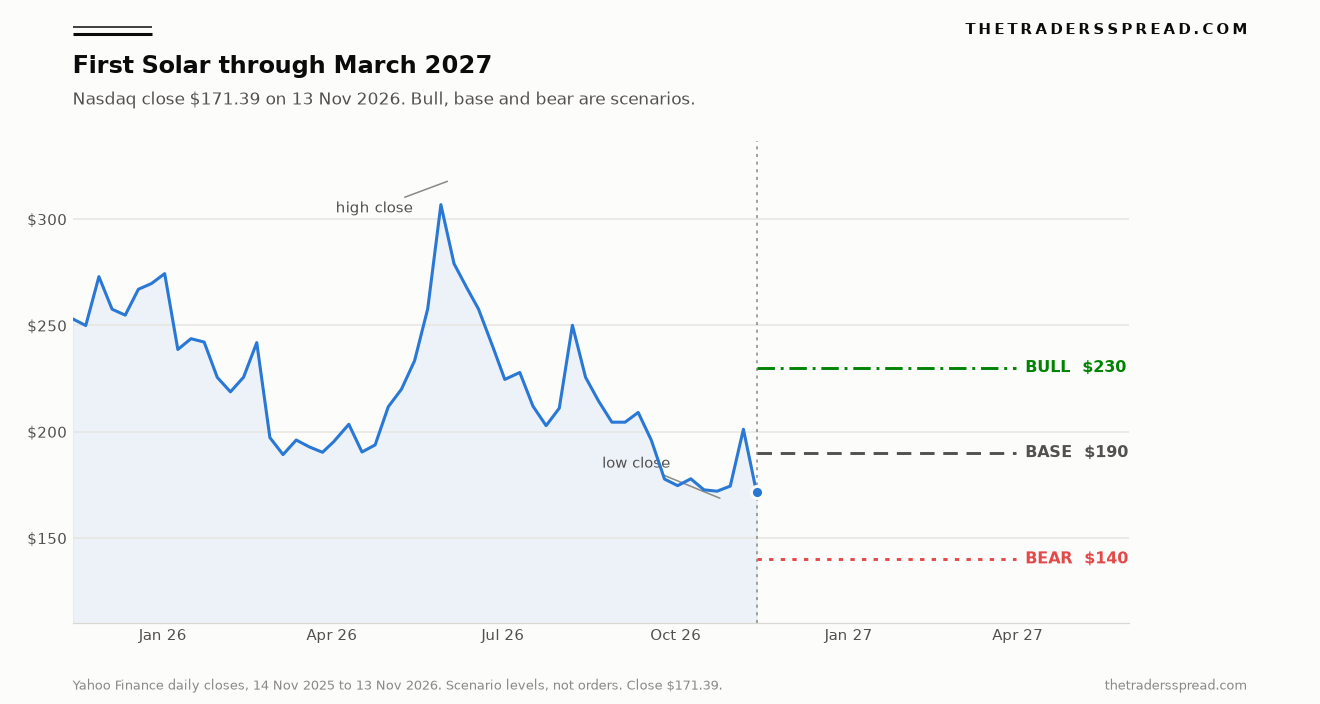
Mark Widmar, chief executive officer of First Solar, said in the 29 October 2026 earnings release that Section 232 "represents a structural change in how the United States approaches solar manufacturing," and that "we believe we are structurally positioned to benefit from this environment." The Nasdaq close on 13 November 2026 was $171.39 on the Stock Analysis quote endpoint at 4:00 pm Eastern and on the Yahoo Finance daily series. After-hours trading on that feed was $170.50 at 7:57 pm Eastern. From that close, the bull case is $230, the base case is $190, and the bear case is $140, through 31 March 2027. The driver is the module book and the US factory ramp.
The Form 10-Q for the quarter ended 30 September 2026, filed the same day, records contracts for 44.0 gigawatts at an aggregate transaction price of $13.5 billion, to be recognised through 2030. Nine-month net income is $1,340 million, and operating activities used $403 million of cash. A multi-year book beside a cash-flow statement that consumed cash while profit rose is what the three prices have to absorb. The ServiceNow and Salesforce contract backlog is a different industry, and the exclusions in a backlog footnote decide how firm the dollars are.
Key figures around the 13 November 2026 close
- Close of $171.39 on 13 November 2026, down $0.91 from $172.30, session range $166.70 to $172.51, volume 2,478,347 shares. Source: Stock Analysis quote endpoint, retrieved 16 November 2026, matching the Yahoo Finance close.
- High close $318.25 on 3 June 2026 and low close $168.15 on 26 October 2026, across 251 daily closes from 14 November 2025. Source: Yahoo Finance daily chart, retrieved 16 November 2026.
- Contracts for 44.0 gigawatts at $13.5 billion through 2030, with India kept out until payment is fully secured. Source: Form 10-Q, filed 29 October 2026.
- Third-quarter net sales of $1,231 million, down 22.8 percent, diluted earnings of $5.30 a share, gross margin 57.9 percent against 38.3 percent. Source: Form 10-Q and Exhibit 99.1, 29 October 2026.
- Nine-month net income of $1,340 million, with operating activities using $403 million, including a $1,286 million rise in government grants receivable. Source: Form 10-Q cash-flow statement, filed 29 October 2026.
- 2026 volume sold cut to 16.0 to 17.0 gigawatts and net sales to $4.6 billion to $4.9 billion, with gross profit held at $2.4 billion to $2.6 billion. Source: Exhibit 99.1, 29 October 2026.
1. What the 10-Q counts as the book
The revenue note is narrower than a headline gigawatt figure. As of 30 September 2026 the contracts covered 44.0 gigawatts at $13.5 billion, recognised through 2030 as control of the modules transfers. India stays outside until payment is fully secured. The price excludes variable consideration for technology improvements, freight above set thresholds, commodity prices, committed wattage, US domestic-content volume, and tariff changes inside a defined band. Later revenue can rise or fall, and the parties can amend volume or dates.
Imported-module contracts generally include clauses meant to soften trade-policy changes such as tariffs. A termination on those clauses cancels the contract, leaves both sides free of liability, and returns any customer deposit. Divide $13.5 billion by 44.0 gigawatts and the average is about 30.7 cents a watt before those excluded items, a reader division running through 2030. In the third quarter the company produced 4.3 gigawatts and sold 4.1, against 3.6 produced and 5.3 sold a year earlier. Net sales fell 22.8 percent to $1,231 million on a 22.0 percent drop in third-party volume and lower termination revenue, and finished goods were $726 million against $439 million at 31 December 2025.
2. Gaffney, phase by phase
On 28 October 2026 First Solar inaugurated the first phase of its Gaffney, South Carolina plant, the sixth US manufacturing site. The inauguration release says the plant finishes Series 6 Plus modules that the international fleet has already started. Phase two is forecast for mid-2027. The site, put at about $330 million, is then expected to double nameplate capacity to 3.4 gigawatts, run the CuRe technology, and support nearly 700 jobs, of which about 500 were already filled. The 10-Q says commercial production at phase one began in September 2026.
"Less than a year after we selected Gaffney, this facility is ready to produce American solar technology, built by South Carolinian workers," Widmar said in that release. "That pace reflects what is possible when sound policy, strong state and local partners, and a committed workforce align. Every module that leaves this facility is made without dependence on Chinese crystalline silicon supply chains, and it strengthens our ability to deliver the certainty our customers need as American electricity demand grows." Henry McMaster, governor of South Carolina, said the investment comes "with nearly 700 good-paying jobs expected to support this critical work." Howard Lutnick, US secretary of commerce, said the company has "invented their own technology" and is "building it in South Carolina."
The 10-Q puts a Section 45X credit at up to about 17 cents a watt for a fully US-made module and about 7 cents a watt when production starts abroad and finishes in the United States. Phase one matches the 7-cent case, and the release stops short of assigning 17 cents to phase two. The company expects more than $5 billion invested in US manufacturing and research since 2019 by the end of 2026, and about 17 gigawatts of US nameplate by 2027 with Chinese crystalline silicon kept out of that capacity. A study commissioned from the University of Louisiana at Lafayette projects more than 39,000 US jobs and about $7.8 billion of GDP by 2027, after about 30,000 jobs and $5.8 billion of GDP in 2025.
Series 6 output at international plants has been reduced, the 10-Q says, citing European prices near or below manufacturing cost, an Indian market effectively closed to Southeast Asian product, and US import tariffs. Gaffney finishes part of what that fleet still starts.
3. Where profit and cash part company
Third-quarter gross profit was $713 million, 57.9 percent of net sales, against $611 million and 38.3 percent a year earlier. The management discussion credits more modules qualifying for Section 45X and a higher sales price per watt, partly offset by costlier US production and lower termination revenue. Nine-month gross profit was $1,804 million on sales of $3,331 million, about 54.2 percent. Nine-month net income was $1,340 million, or $12.45 diluted, against $1,007 million and $9.37, and third-quarter diluted earnings were $5.30 against $4.24.
Operating cash moved the other way. Net cash used in operating activities was $403 million for the nine months, against $815 million provided a year earlier. Government grants receivable absorbed $1,286 million, trade receivables $291 million and inventories $349 million. Depreciation of $443 million left a gap of about $1.74 billion between profit of $1,340 million and cash used of $403 million. Current grants receivable fell to $287 million from $500 million at year-end 2025, while non-current grants receivable rose to $1,588 million from $126 million.
Cash and equivalents were $1,576 million, down from $2,804 million, with cash plus restricted cash at $1,593 million after $435 million of equipment purchases. Debt principal was about $108 million and entirely current, against about $499 million a year earlier, and long-term debt was zero. Equity of $10,881 million on 107,481,151 shares at 23 October 2026 is about $101 a share, so the $171.39 close is about 1.69 times book, or about $18.42 billion of market value. Exhibit 99.1 puts net cash at $1.5 billion, down from $2.4 billion, after working capital and US plant spending, partly offset by Section 45X receipts and IEEPA tariff refunds. The Lam Research earnings comparison is a reminder to keep a credit, a receivable, and a later cash receipt apart.
4. Guidance that moved, and the lines that stayed
The earnings release cut 2026 volume sold and net sales, lowered adjusted EBITDA and capital expenditure, and left gross profit, operating expenses and year-end net cash unchanged. Fourth-quarter module sales sit outside the annual table, at 4.3 to 5.3 gigawatts including 3.4 to 4.3 gigawatts from US plants, with adjusted EBITDA of $643 million to $843 million.
| Line | Prior range | Range at 29 October 2026 |
|---|---|---|
| Volume sold | 17.0 to 18.2 GW | 16.0 to 17.0 GW |
| Net sales | $4.9 billion to $5.2 billion | $4.6 billion to $4.9 billion |
| Gross profit | $2.4 billion to $2.6 billion | Unchanged |
| Operating expenses | $610 million to $635 million | Unchanged |
| Adjusted EBITDA | $2.6 billion to $2.8 billion | $2.55 billion to $2.75 billion |
| Capital expenditures | $0.8 billion to $1.0 billion | $0.6 billion to $0.8 billion |
| Net cash, year end | $1.7 billion to $2.3 billion | Unchanged |
Subtract nine-month sales of $3,331 million from the new full-year range and about $1.27 billion to $1.57 billion of fourth-quarter net sales remain. The subtraction is a reader step. The company guided the year and the fourth-quarter gigawatts, and left the quarter's net-sales dollars unpublished. The gross-profit footnote assumes $2.07 billion to $2.19 billion of Section 45X credits and underutilization of $110 million to $120 million. Beside gross profit of $2.4 billion to $2.6 billion, that credit assumption is large, and the filing treats the credit as a reduction of cost of sales.
The release withholds a GAAP net-income range because share-based pay, Section 45X discounts, contingencies and tax items are too uncertain to predict. A reader bridge takes third-quarter net income of $571 million, 76.7 percent of adjusted EBITDA of $744 million, and applies that ratio to the fourth-quarter EBITDA band, giving about $493 million to $647 million. Added to nine-month diluted earnings of $12.45, the sum is about $17.00 to $18.50, a band absent from the guidance table. At $171.39 the close is about 10.1 times the low end and about 9.3 times the high end.
The board authorised repurchases of up to $500 million on 29 October 2026 and left the authorisation open-ended and free of any duty to buy a set number of shares. At the 13 November close, $500 million is about 2.9 million shares, or about 2.7 percent of the 23 October count. The papers are silent on purchases under the new programme. A margin record beside a sales cut is the pattern in the Jabil earnings reaction.
5. Three prices through March 2027
The bull case is $230, 34 percent above the close and about 28 percent under the $318.25 high close of 3 June 2026, at about 13.5 to 12.4 times the reader bridge. It needs the sales range met, the 44.0 gigawatt book held, and Gaffney phase two still aimed at mid-2027. The 10-Q says US module prices are generally expected to rise after the Section 232 polysilicon inquiry, the setting Widmar's line describes.
The base case is $190, 11 percent above the close and near the $191.61 Yahoo close on 9 November 2026, at about 11.2 to 10.3 times the bridge. The multiple stays near 9 to 10 times, and year-end net cash lands inside $1.7 billion to $2.3 billion. The book is assumed to hold rather than to refill in a rush, and the path stops short of a new high.
RelatedSnowflake SNOW Product Revenue Is a Filing Line to Audit
The bear case is $140, 18 percent under the close, under the $168.15 low close of 26 October 2026 and the $165.86 52-week low. Terminations would shrink the book, India would stay outside the $13.5 billion, and the credit would sit in a receivable. At about 8.2 to 7.6 times the bridge, market value would be about $15.0 billion, and the October low would break.
| Case | Price | Change from the close | Multiple on the bridge | What has to be true |
|---|---|---|---|---|
| Bull | $230 | Up 34 percent | About 13.5x to 12.4x | Sales guide met, 44 GW book held, Gaffney phase two on time |
| Base | $190 | Up 11 percent | About 11.2x to 10.3x | Ranges met, multiple steady, cash inside the year-end guide |
| Bear | $140 | Down 18 percent | About 8.2x to 7.6x | Book shrinks, credit cash lags, price breaks the October low |
FAQ
What close is the First Solar stock forecast using?
The Nasdaq close is $171.39 on 13 November 2026, stamped 4:00 pm Eastern on Stock Analysis and matched on the Yahoo Finance daily series, after a prior close of $172.30. After-hours trading was $170.50 later that evening. A regular-session print for 16 November was absent from both feeds when the figures were pulled, so the spot remains Friday's close.
What does the 44-gigawatt figure leave out?
The Form 10-Q keeps India contracts outside the $13.5 billion and the 44.0 gigawatts until payment is fully secured, and it excludes variable consideration for technology, freight, commodities, wattage, domestic content and certain tariffs. Amendments can change volume and dates. A trade-policy termination can cancel an imported-module contract, free both sides of liability, and return a deposit.
Why did profit rise while operating cash was used?
Nine-month net income was $1,340 million and operating activities used $403 million. Government grants receivable absorbed $1,286 million, with inventories and trade receivables also higher. Section 45X credits reduce cost of sales when modules are sold, and the cash arrives later, so the two statements diverge.
What does the Gaffney factory add by mid-2027?
Phase one, inaugurated on 28 October 2026, finishes Series 6 Plus modules started abroad, and commercial production began in September 2026. The release forecasts a second phase by mid-2027 that doubles nameplate to 3.4 gigawatts, adds CuRe, and supports nearly 700 jobs at a site of about $330 million. About 17 gigawatts of US nameplate by 2027 is still ahead of completion.
How were $230, $190 and $140 chosen?
$230 is a partial retracement toward the June 2026 high close, about 12 to 14 times a reader earnings bridge of $17 to $18.50. $190 sits near the early-November closes, and $140 sits under the October low and the Stock Analysis 52-week low. All three run to 31 March 2027 as scenarios carried forward from the third quarter.
The call
The base case is $190, the bull case is $230, and the bear case is $140, each from the $171.39 close on 13 November 2026 and each aimed at 31 March 2027. The base path is a modest recovery if the cut sales range is met and the multiple stays near 10 times the earnings bridge. The bull path needs the book held and Gaffney's second phase on its mid-2027 timing. The bear path is a break under the October low if terminations shrink the book and the credit remains a receivable. Selecting among them stays outside the close. Entry beside the forecast is $171.39, the neutral target is the $190 base, and the level that retires the base is $140.
Markets move, and these scenario prices organise the filing and the 13 November close for readers who make their own decisions.