

Is the Shanghai steel rebar contract pricing a turn in new Chinese housing starts, or a cost stack that cheapened while the order book stayed thin? The mid-October prints point to the cost stack, with housing starts acting as the ceiling. Between late September and mid-October 2026, the National Bureau of Statistics recorded a dealer price of 3,187.8 yuan a tonne for 20mm HRB400E rebar, up 11.9 yuan, or 0.4%. In that same window main coking coal fell 237.9 yuan, or 9.6%, to 2,232.1 yuan a tonne, and quasi-primary metallurgical coke fell 200 yuan, or 9.5%, to 1,896.4.
That split sits inside one survey, which is the useful part of the steel rebar price. Wire rod in the same mid-October reading was 3,386.9 yuan a tonne, up 15.9 yuan, or 0.5%. Ordinary hot-rolled coil was 3,268.1 yuan, down 29.0 yuan, or 0.9%. Bulk ordinary Portland cement 42.5 was 267.0 yuan a tonne, up 4.7 yuan, or 1.8%. Over January to September, floor space of buildings newly started was 340.31 million square metres, down 24.9% on a comparable basis. A cheaper furnace bill and a thinner pour can share a month, and the contract has to put one number on both.
Five drivers follow, in the order these prints support: coking coal and coke, iron ore, the mill run-rate, property starts, and exchange warrants. The Friday line further down is the settlement of whichever rebar month held the most open interest, so a switch of lead month can step the line even when the spot bar has barely budged.
Updated 2 November 2026.
Key facts
- Dealer HRB400E rebar, 20mm, was 3,187.8 yuan a tonne in mid-October 2026, up 11.9 yuan, or 0.4%, from late September. National Bureau of Statistics, 24 October 2026.
- Main coking coal was 2,232.1 yuan a tonne, down 237.9 yuan, or 9.6%, and quasi-primary metallurgical coke was 1,896.4, down 200 yuan, or 9.5%, in the same survey. National Bureau of Statistics, 24 October 2026.
- Floor space newly started in January to September 2026 was 340.31 million square metres, down 24.9%, with residential starts down 25.4%. National Bureau of Statistics, 20 October 2026.
- Construction and installation investment fell 10.0% in the first nine months, while purchases of equipment and instruments rose 9.7%. National Bureau of Statistics, 20 October 2026.
- CISA member mills averaged 1.89 million tonnes a day of crude steel on 11 to 20 October, down 2.3%, or 45,000 tonnes a day, from the first ten days of the month, and 6% below the same ten days of 2025. Mysteel, citing the association release of 24 October, 26 October 2026.
- On 30 October 2026 the Shanghai Futures Exchange showed 34,425 tonnes of rebar on warrant in exchange warehouses and 22,800 tonnes in factory warehouses. SHFE daily warrant report, volume 2026-198, dated 30 October 2026.
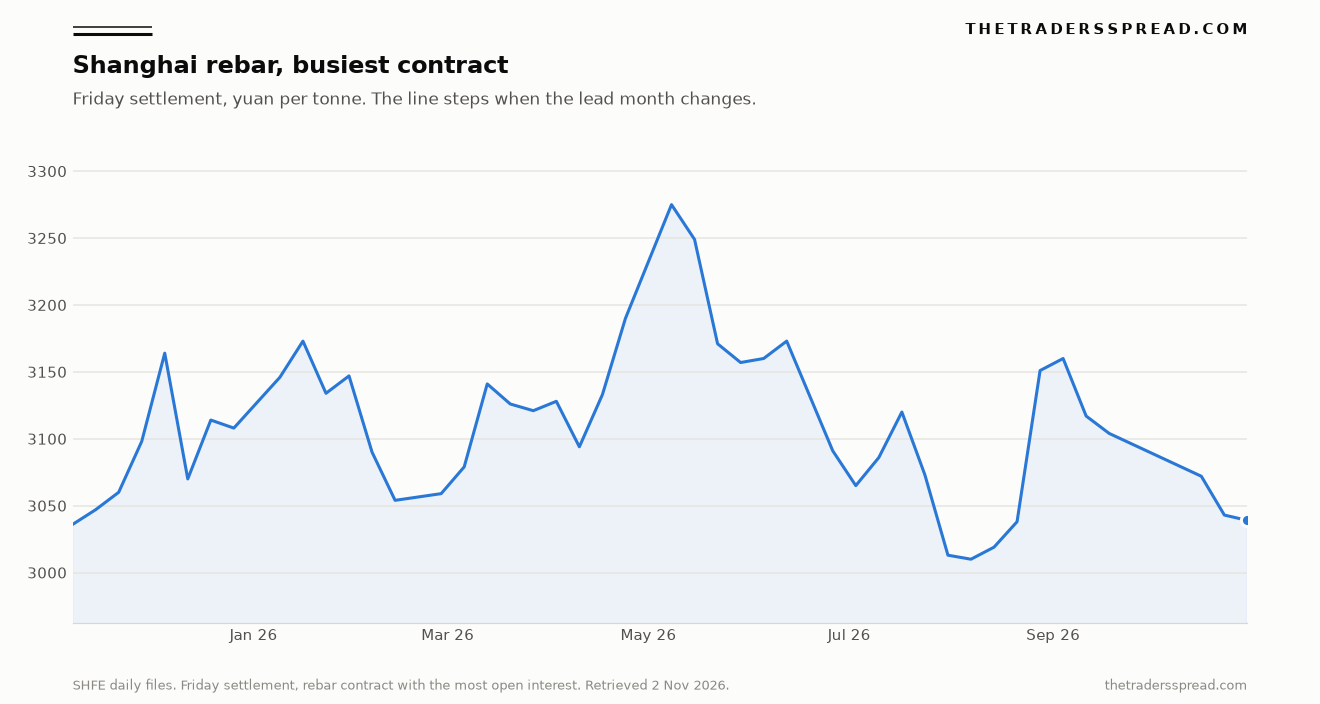
The chart is a year of Friday settlements from the exchange's own daily files. On 7 November 2025 the busiest month, rb2601, settled at 3,036 yuan a tonne. On 30 October 2026 the busiest month was rb2701, at 3,039, three yuan from that start. Between them the line reached 3,275 on 8 May 2026, on rb2610, and 3,010 on 7 August, still on rb2610. On 28 August the lead month became rb2701 and the settlement printed 3,151, against 3,038 on rb2610 the Friday before. That step is a change of contract.
1 Coking coal and coke, the sharpest input
A rebar furnace in China is still, in the main, a blast furnace. The coal that becomes coke is the input a mill can feel inside a few weeks. The National Bureau of Statistics price report for mid-October, published at 09:30 on 24 October 2026 with the China Statistical Information Service Center and Sci99, compared the basket with late September. The early-October ten-day report was cancelled for the National Day holiday, so the step is longer than a normal ten days. Twenty-two products rose, 25 fell, and three were unchanged.
Main coking coal, coal with sulphur under 1%, dropped 237.9 yuan a tonne to 2,232.1. Quasi-primary metallurgical coke, with ash between 12.01% and 13.50%, dropped 200 yuan to 1,896.4. Rebar's move was 11.9 yuan, to 3,187.8. The monitored price is a wholesale and sales price at distributors, drawn from nearly 2,000 firms across more than 300 markets in 31 provinces. It includes the ex-works price plus circulation cost, the distributor's profit and tax, so it lags the mill gate.
A separate note on this desk already follows the 9.6% coking-coal decline, and that page carries the coal tape. When coke cheapens faster than the bar, the cost floor under the steel rebar price has moved, and mills can pocket the difference, compete for orders, or keep the furnace full. Wire rod rose 15.9 yuan in the same window, while seamless pipe fell 8.4 yuan to 4,012.2 and plate, coil and angle fell with it.
2 Why iron ore still sits second
Coke can move faster. Ore is still the larger mass in a tonne of hot metal, so a quiet ore tape can matter more over a quarter than a noisy coal week. In the third quarter of 2026 Vale produced 88.4 million tonnes of iron ore, down 6% from a year earlier, largely because run-of-mine availability was lower at Serra Norte, with part of the gap offset at Serra Sul, Capanema and VGR1. Sales of iron ore still rose 0.3%, or 0.3 million tonnes. Pellets were 8.6 million tonnes, up 7% year on year. The average realized price for iron ore fines was US$85.1 a tonne, down 10% from the previous quarter and from a year earlier.
Gustavo Pimenta, chief executive of Vale, put the operating point this way in the 30 October 2026 results statement: "In iron ore, we are building a more flexible and competitive operating platform." The production total and the pellet figure sit on the Portuguese results page posted with that quarter. Vale said it was confident of the lower end of iron-ore guidance, 335 million to 345 million tonnes for 2026, and of the midpoint of pellet guidance at 30 million to 34 million tonnes.
Cost at the mine moved the other way. Vale's C1 cash cost was US$23.1 a tonne, up 12% year on year. All-in cost reached US$60.4 a tonne, up 21%, with freight adding pressure. A Chinese mill pays a delivered price that mixes an index, a freight bill and the tonnes at the port. Freight has its own explainer in what the Baltic Dry Index measures across ship classes, and the ore cases on this desk live on the iron ore page. Ore's realized price fell a tenth across a full quarter while the tonnes kept moving, which is why it sits second to the coal move.
3 Where the mill margin shows up
The place the coal move and the ore move meet is the decision to run the furnace. Early in October, member mills of the China Iron and Steel Association averaged 1.94 million tonnes a day of crude steel, up 3.1%, or 58,000 tonnes a day, from late September, and 4.6% below the same ten days of 2025. Mysteel's account of the 15 October release, dated 16 October, put the national estimate at 2.43 million tonnes a day and said that figure was rising along with the member figure. The rest of the article sits behind a trial wall.
Mysteel posted the early-October run-rate on 19 October, the lift the following ten-day report then gave back.
📢 CISA Mills Raise Crude Steel Output in Early October
— Mysteel (@MysteelGlobal) October 19, 2026
CISA member mills produced 1.94 million t/d of crude steel during October 1-10, up 3.1% from late September but still 4.6% below the same period last year, according to the association's October 15 release. Estimated… pic.twitter.com/fpw5pxgAu7
The next ten days reversed the lift. On 11 to 20 October, member mills averaged 1.89 million tonnes a day, down 2.3%, or 45,000 tonnes a day, from the first ten days, and 6% below the same ten days a year earlier, according to Mysteel's report of the 24 October release, published at 18:00 on 26 October. The public lede puts the national estimate at 2.37 million tonnes a day for that middle period. A sector that added 58,000 tonnes a day and then cut 45,000, while the surveyed bar rose 11.9 yuan and coke fell 200, is managing a spread around a base lower than last year.
On the World Steel Association count published in Brussels on 23 October, China produced 73.6 million tonnes in September, up 0.1% on the year, and 724.8 million tonnes from January to September, down 2.9%. The 70 countries in the table, about 98% of 2025 world crude steel, produced 142.4 million tonnes in September, down 0.2%. China's September share of that 70-country total is 51.7%, the ratio of the two published figures. On 30 October the lead contract, rb2701, settled at 3,039 yuan a tonne after a close of 3,030, beside a mid-October dealer survey of 3,187.8 that includes circulation cost.
4 Housing starts set the ceiling
Housing starts explain why a cheaper cost stack has left the bar close to where the year of Fridays began. The National Bureau of Statistics release of 20 October 2026, at 10:00, put January-to-September real-estate investment at 5,336.4 billion yuan, down 20.6% on a comparable basis. Residential investment was 4,112.5 billion yuan, down 20.5%. Floor space under construction was 5,652.21 million square metres, down 12.8%. Newly started floor space was 340.31 million square metres, down 24.9%, and residential starts were 247.74 million square metres, down 25.4%. Completions were 232.71 million square metres, down 25.1%.
Sales of newly built commercial buildings were 564.83 million square metres, down 13.2%, with homes down 13.8%, and the sales value was 5,379.9 billion yuan, down 13.9%. Second-hand online transactions, on Ministry of Housing and Urban-Rural Development figures in the same release, rose 10.7% to 617.46 million square metres. Unsold new space at the end of September was 748.25 million square metres, down 1.5%. Developer funds in hand were 5,681.3 billion yuan, down 21.6%, with domestic loans at 762.4 billion yuan, down 33.1%, and individual mortgages at 767.8 billion yuan, down 22.1%.
Fixed-asset investment excluding rural households was 33,411.5 billion yuan in the nine months, down 7.2%, with infrastructure down 4.2%, construction and installation down 10.0%, equipment purchases up 9.7% and non-governmental investment down 10.4%. September's month-on-month change was a rise of 0.07%. The building-work line is the one that consumes rebar, and it is the line still contracting, while equipment purchases rose.
Alfonso Hidalgo de Calcerrada, chair of the economics committee at the World Steel Association, set the demand revision in one sentence in the 12 October 2026 Short Range Outlook, released in New Delhi: "Almost the whole of that revision is a China story." Chinese steel demand is expected to contract 2.0% in 2026, a downgrade from April, narrowing to 1.0% in 2027. Global finished-steel demand is forecast at 1,722 million tonnes in 2026 and 1,752 million tonnes in 2027, up 1.7%. Outside China, demand is up 1.5% in 2026 and 4.0% in 2027, and India is up 7.9% to 172.4 million tonnes in 2026, on figures as of early September 2026. The release says the property downturn kept a pace April had looked to see slow.
Worldsteel posted those global totals the morning of the New Delhi release, the association's own demand figure in tonnes of steel use.
worldsteel’s Short Range Outlook - Global steel demand will remain essentially unchanged in 2026 at 1,722 Mt, before returning to growth of 1.7% in 2027 to reach 1,752 Mt. https://t.co/8NE4PZx5Ky#worldsteel #steelOutlook #steelDemand pic.twitter.com/7BaSByXP2V
RelatedWhy Flake Graphite Prices Split From Synthetic Anodes
— worldsteel (@worldsteel) October 12, 2026
A 24.9% drop in new starts is why the steel rebar price rose 0.4% while coking coal fell 9.6% in the same survey window, and why a Friday path that reached 3,275 in May finished within three yuan of its November start.
5 The warrant sheet, counted in two columns
The Shanghai Futures Exchange daily warrant report for 30 October 2026, volume 2026-198, counts rebar on warrant in exchange warehouses and rebar on warrant in factory warehouses as separate lines, both in tonnes. Exchange warehouses held 34,425 tonnes, all of it in Jiangsu, with 24,367 tonnes at Weilong Port and 10,058 tonnes at CMST Nanjing. Factory warehouses held 22,800 tonnes, of which Hanggang Iron and Steel held 18,900 and Binxin Steel Group 3,900. Both change columns were zero that day. The two published lines sum to 57,225 tonnes. Wire rod in exchange warehouses on the same report was zero tonnes.
The path is the earlier reports on the same template. On 28 November 2025 exchange warehouses held 37,919 tonnes and factory warehouses 21,600, a combined 59,519 tonnes. On 24 April 2026 the two lines were 87,203 and 35,100, a combined 122,303. On 31 July exchange warehouses were 28,390 tonnes while factory warehouses had risen to 61,200, a combined 89,590. Warehouse metal swelled into the spring and then drained, and factory warrants rose into July before draining as well, so the late-October sum sat near the previous November.
The May settlement peak of 3,275 sits just after the April warrant high, and the August low of 3,010 sits just after July, when exchange warehouses were the tightest of the four dates and factory warrants held the larger block. On 30 October, rb2701 carried 597,934 lots of volume and 1,780,849 lots of open interest, out of 729,968 lots of volume and 2,570,009 lots of open interest summed across every rebar month. The count stays in lots, the unit of that daily file.
FAQ
What does the Shanghai steel rebar price actually refer to?
In the futures market it is the settlement of an SHFE rebar month, in yuan a tonne, with the busiest month chosen here by open interest. On 30 October 2026 that month was rb2701 at 3,039 yuan. In the official survey it is the dealer price of 20mm HRB400E bar, 3,187.8 yuan in mid-October, a wholesale price that includes circulation cost, distributor profit and tax.
Why can coking coal fall faster than the steel rebar price?
The bar is priced off the order book as well as off the coke oven. In the mid-October survey, main coking coal fell 9.6% and metallurgical coke fell 9.5%, while HRB400E rebar rose 0.4%. Mills can hold the cheaper coal bill as a wider spread or keep selling into a soft site at nearly the same offer, and the October run-rate shows which path they took.
How do China property starts reach the rebar contract?
New floor space is the pour that uses the bar. In January to September 2026, buildings newly started were down 24.9% and residential starts were down 25.4%, while second-hand housing transactions rose 10.7%. A sale of an existing home leaves the steel already in the building. Construction and installation investment fell 10.0% over the same nine months, while equipment purchases rose 9.7%. Starts reach the contract as a ceiling on demand, usually across a quarter.
What is on the SHFE rebar warrant report?
The daily report lists rebar on warrant in exchange warehouses separately from factory warehouses, both in tonnes. On 30 October 2026 the figures were 34,425 tonnes and 22,800 tonnes. On 24 April exchange warehouses held 87,203 tonnes, and on 31 July they held 28,390 while factory warrants were 61,200. Both columns are needed to tell a shuffle from a drain.
Does a lower iron ore price widen a mill margin on its own?
Coke, freight and the bar's selling price have to hold steady while the ore bill falls, and those pieces rarely move as one. Vale's realized fines price in the third quarter of 2026 was US$85.1 a tonne, down 10% on the quarter and the year, while all-in cost rose 21% to US$60.4. The visible trace of the October gap is the mill run-rate.
If the next ten-day survey still shows coke easing, and the next starts release still shows new floor space shrinking, which of those two numbers will the lead rebar month be answering?
This page explains drivers behind the steel rebar price. It is not a forecast, a price target, or a recommendation to trade.