

On the West Australia to Qingdao run in the week to 16 October 2026, the Baltic Exchange's C5 assessment moved from $13.40 at the start of the week to $11.25 by Thursday and closed Friday at $11.70 after two miners returned, and that voyage rate is one of the prints people fold into the Baltic Dry Index. The same Friday report put the Capesize 182 timecharter average at $29,464, down from $37,618 on the Monday, while the Supramax section of that report recorded slow gains, driven mainly by the Asian market.
C5 is the voyage the week discusses, and it sits outside the five-route average that produces the Capesize hire number. The heaviest weight inside that average is C10, the China to Japan transpacific round, at 35 percent. A reader who treats the Baltic Dry Index as the Australia to China freight rate is watching a voyage the Capesize formula keeps beside the average, while the composite also folds in Panamax and Supramax hire that, in this particular week, moved the other way. The indices page states the blend in one sentence: "The Baltic Dry Index (BD) is a composite of the dry bulk timecharter averages of the Capesize (40%), Panamax (30%) and Supramax (30%) indices."
Updated 23 October 2026.
Key facts
- The Baltic Dry Index is a composite of Capesize 40 percent, Panamax 30 percent and Supramax 30 percent timecharter averages (Baltic Exchange indices page, retrieved 23 October 2026).
- From 1 March 2018 the exchange set those shares on timecharter assessments, removed Handysize from the blend, and applied a 0.1 multiplier to the calculation (Baltic Exchange Circular 08/18, 28 February 2018).
- Inside the Capesize 5TC the route weights are C8 at 15 percent, C9 at 12.5 percent, C10 at 35 percent, C14 at 25 percent and C16 at 12.5 percent (Baltic Exchange dry-services page, retrieved 23 October 2026).
- In the week to 16 October 2026 the Capesize 182 5TC moved from $37,618 on Monday to $29,464 on Friday, down $8,154, or 21.7 percent of the Monday print on those two figures (Baltic Exchange bulk report, week 42, 16 October 2026).
- That week's C5 assessment closed Friday at $11.70, and C3 index-date business slipped towards $30 a tonne (same report, 16 October 2026).
- Rio Tinto's Pilbara iron ore sales were 85.7 million tonnes in the third quarter of 2026, up 2 percent on the year and flat on the quarter (Rio Tinto third-quarter operations review, 14 October 2026).
Hire shares, and the multipliers on the class indexes
The dry-services page describes the Baltic Dry Index as a composite of dry bulk timecharter averages, published continuously since 1985. The standard ships are a 182,000-tonne non-scrubber Capesize, an 82,500-tonne Panamax and a 63,500-tonne Supramax with four 30-tonne cranes.
The Capesize 5TC_182 adds five timecharter routes to 1, led by the China to Japan transpacific round at 0.35. The Panamax five and the Supramax eleven add to 1 on the same page. The table below carries the coefficients, including the other four Capesize routes.
The class indexes take a further step, and the factors differ. On the indices page the Baltic Capesize Index is the rounded weighted route sum multiplied by 0.11026, and the Baltic Supramax Index is the eleven-route weighted sum multiplied by 0.079112625. P1A_82 enters the Panamax index at 0.027777775, against a 0.25 weight inside the Panamax timecharter average, so 40 percent of a Capesize index point is a different object from 40 percent of Capesize hire.
Circular 08/18, issued on 28 February 2018, set the composite from 1 March 2018 at those three timecharter shares, took Handysize out of the blend, and described a multiplier of 0.1 on the calculation. Multiplying three hire prints by 0.4, 0.3, 0.3 and then by 0.1 is a private reconstruction. The published composite is the exchange's own figure.
Mark Jackson, the Baltic Exchange chief executive, traced the series in the release of 1 February 2018 to 1985, when it began as the Baltic Freight Index. His account of the reweighting was specific: "In our case this means ensuring that the BDI broadly reflects dry bulk global trading patterns. The new weightings are simply the next phase of development in this process."
On 12 October 2026 the Baltic Exchange account posted that chief executive Mark Jackson had joined industry leaders at the SGX Commodities Forum in London, on geopolitical disruption, changing trade routes and supply chains in freight.
Baltic Exchange CEO Mark Jackson joined industry leaders at the SGX Commodities Forum in London to discuss how geopolitical disruption, changing trade routes and increasingly complex supply chains are reshaping freight markets.
— Baltic Exchange (@BalticExchange) October 12, 2026
Read more: https://t.co/9DWbCBEGBR#BalticExchange pic.twitter.com/mCOuNZLPLu
Stefan Albertijn, chair of the Baltic Index Council, said in that release that the index would "remain an accurate general measure of the health of the dry bulk shipping markets." The same note put researched deadweight utilisation near 40 percent Capesize, 25 percent Panamax, 25 percent Supramax and 10 percent Handysize, said removing Handysize made no statistical difference on those weightings, and left the weights for a yearly review. The line to reopen is on the indices page.
| Class | Share of the composite | Standard ship | What enters the timecharter average | Class-index factor |
|---|---|---|---|---|
| Capesize | 40 percent | 182,000 dwt, non-scrubber, max age 10 | C8 15%, C9 12.5%, C10 35%, C14 25%, C16 12.5% | Weighted route sum times 0.11026 |
| Panamax | 30 percent | 82,500 dwt, max age 12 | P1A 25%, P2A 10%, P3A 25%, P4 10%, P6 30% | Smaller coefficients; P1A_82 at 0.027777775 |
| Supramax | 30 percent | 63,500 dwt, four 30-tonne cranes, max age 15 | Eleven routes whose coefficients add to 1 | Weighted sum times 0.079112625 |
| Handysize | Outside the composite | 38,200 dwt | A published 7TC of its own | Separate from the Baltic Dry Index |
The voyage the weekly leads with
The ore trades live on the voyage list, beside the timecharter routes. C5 (West Australia to Qingdao), C3 (Tubarao to Qingdao), C2, C7 and C17 are assessed on the dry-services page, and the Capesize 5TC draws its weights from the five timecharter rounds instead. P7 and P8, the 66,000-tonne grain voyages to Qingdao, sit in the same relation to the Panamax average. A move in wheat and a move in that average can share a week and still describe different things.
Week 40, reported on 2 October 2026, puts the units side by side. The Capesize 182 5TC closed that Friday at $45,731. C3 declined from $40.659 to $37.65 a tonne, which the report said equated to earnings of about $41,814 on the China to Brazil or West Africa round. A voyage in dollars a tonne, a translated daily earning, and a five-route average are three numbers from one class in one week. C14 sits inside the 5TC at 25 percent.
| Route | What the page is pricing | Relation to the class timecharter average |
|---|---|---|
| C5 West Australia to Qingdao | Voyage, dollars a tonne | Assessed, outside the Capesize 5TC |
| C3 Tubarao to Qingdao | Voyage, dollars a tonne | Assessed, outside the Capesize 5TC |
| C2, C7 and C17 | Tubarao to Rotterdam, Bolivar to Rotterdam, Saldanha Bay to Qingdao | Assessed, outside the Capesize 5TC |
| C10 China to Japan round | Timecharter | 35 percent of the Capesize 5TC |
| P5 South China to Indonesia | Timecharter | Assessed, outside the Panamax 5TC |
| P7 and P8 grain to Qingdao | 66,000-tonne voyages from the US Gulf and from Santos | Assessed, outside the Panamax 5TC |
A week when the classes diverged
The week of 16 October 2026 is the clean illustration, because one document carries three class notes that refuse to match. Capesize hire fell from Monday's $37,618 to Friday's $29,464, while C5 closed at $11.70 and C3 index-date business slipped towards $30. Panamax timecharter rates declined through the week except on the Monday. The Supramax paragraph said the index saw slow gains throughout the week, driven mainly by the Asian market. Handysize sat outside the weights. One fixture from each note is in the table.
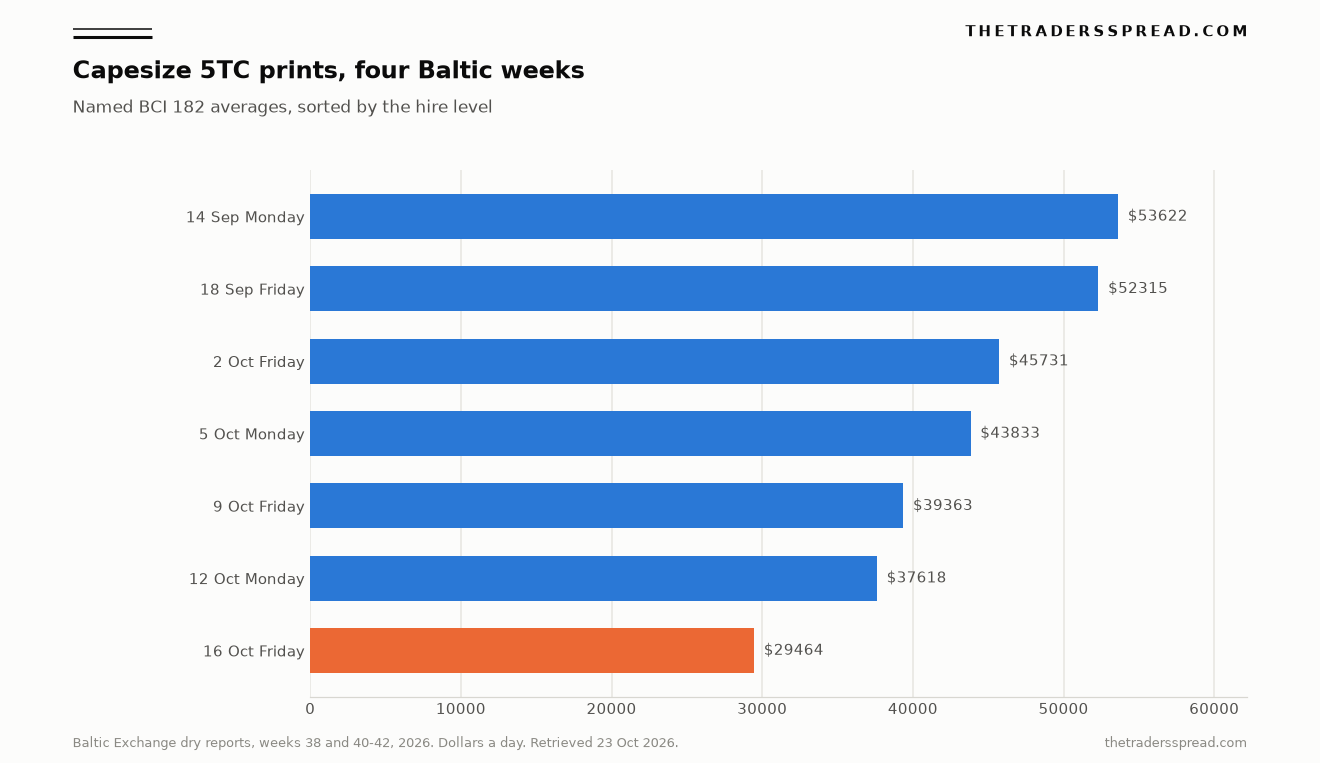
The bars are those named prints, sorted by hire. Friday closes in the opened reports were $52,315 on 18 September, $45,731 on 2 October, $39,363 on 9 October and $29,464 on 16 October, a fall of $22,851 from the first of those Fridays to the last, or 43.7 percent of the September figure. The Monday prints beside them are $53,622, $43,833 and $37,618. The set skips week 39 and every session a weekly leaves unnamed.
On 9 October the split was already visible in a milder form: the Capesize 5TC went from $43,833 to $39,363 while Panamax rates ended the week higher. A 64,000-tonne coal cargo to India paid $38,000 a day for at least 60 days. That fixture prices the ship, and the API2 coal price is the cargo. The 18 September report is the contrasting week, with Supramax slow steady gains beside a softer Cape.
| Class, week to 16 October 2026 | What the Friday report recorded | One fixture from that report |
|---|---|---|
| Capesize | 182 5TC from $37,618 Monday to $29,464 Friday | C5 closed Friday at $11.70 a tonne |
| Panamax | Timecharter rates declined through the week except Monday | 82,000 dwt Australia round at $19,000 a day |
| Supramax | Slow gains, mainly from the Asian market | 63,000 dwt Santos sugar to Ain Sukhna at $36,000 a day |
| Handysize | Mixed, and outside the composite | 39,000 dwt east coast South America to the Continent at $32,000 a day |
Tonnes and hire on different clocks
Simon Trott, chief executive of Rio Tinto, said in the 14 October 2026 operations review that the company "delivered strong operational performance in the third quarter" and that "global iron ore sales are up 3% year-to-date." He added: "The Simandou iron ore mine hit an annualised production run-rate of ~10 Mtpa (100% basis) in the quarter as the project continues to ramp up." Pilbara sales were 85.7 million tonnes.
The review keeps the ore price and the freight bill on separate lines. "During Q3, iron ore prices were sustained in a narrow band around their $97/dmt 61% delivered (CFR) average. Higher seaborne freight costs compressed producer netbacks, particularly for longer haul Atlantic supply." The iron ore figure is a delivered ore benchmark, and the Baltic Dry Index is a hire composite. Rio's sentence covers the quarter's Atlantic netbacks. October's C3 and C5 assessments are a later tape, with C3 lower in the weeks of 2, 9 and 16 October.
Albertijn's "general measure of the health of the dry bulk shipping markets" describes the shipping markets the index was rebuilt to track. Circular 08/18 attaches the calculation to timecharter assessments. A share-price index has its own constituents, and so does the Pilbara tonne. Treating Friday's composite as a forecast for either one brings a mapping the circular leaves with the reader.
RelatedLean hogs: national negotiated base fell to $65.94
What would make the single-rate reading true
The single-rate reading would become a fair description on the day the Baltic published one hire, for one standard ship, on one route, and the Friday notes for the other classes moved with it. The iron-ore reading would become a fair description if the composite were a price of ore, or if the heaviest route inside the Capesize average were the West Australia to Qingdao voyage and the tonnes and the hire were struck on the same clock. The equity reading would become a fair description if the circular mapped the calculation to a share benchmark. The indices page, the dry-services page and Circular 08/18 set out three hire averages, with voyage rates assessed beside them.
A reader in April 2027 can rerun the check on the live pages. The indices page either still states the 40, 30 and 30 timecharter split and the factors 0.11026 and 0.079112625, or it states something newer. The dry-services page shows whether C5 is still outside the Capesize 5TC and whether C10 is still the 35 percent weight. That Friday's bulk report, the successor to the week of 16 October 2026, shows whether the three class notes moved together. Where those pages have changed, their wording replaces the description above.
Frequently asked questions
What does the Baltic Dry Index measure?
The Baltic Dry Index measures a weighted blend of dry bulk timecharter averages: Capesize at 40 percent, Panamax at 30 percent and Supramax at 30 percent, as the Baltic Exchange states on its indices page. The standard ships are a 182,000-tonne Capesize, an 82,500-tonne Panamax and a 63,500-tonne Supramax. It is a shipping-hire composite the exchange has published, in changing forms, since 1985, when it began as the Baltic Freight Index.
Why is the split 40 percent Capesize, 30 percent Panamax and 30 percent Supramax?
Circular 08/18, dated 28 February 2018, set those shares from 1 March 2018 on the timecharter assessments, took Handysize out of the blend, and applied a 0.1 multiplier. The 1 February 2018 release cited research putting deadweight utilisation near 40 percent Capesize, 25 percent Panamax, 25 percent Supramax and 10 percent Handysize. Mark Jackson called the new weights the next phase in tracking dry bulk trading patterns, and the release said they would be reviewed each year.
Does the West Australia to Qingdao rate set the index?
C5, West Australia to Qingdao, is assessed on the dry-services page and sits outside the Capesize 5TC. That average weights the China to Japan transpacific round at 35 percent, ahead of the other four timecharter routes. In the week to 16 October 2026, C5 closed at $11.70 on Friday after $11.25 on Thursday, while the Capesize 5TC fell from $37,618 on Monday to $29,464 on Friday. The voyage rate and the hire average remain different numbers.
Where does Handysize sit in the published set?
The Baltic publishes a Handysize 7TC for a standard ship of about 38,200 tonnes deadweight, and that average sits outside the Baltic Dry Index. The composite on the indices page stops at Capesize, Panamax and Supramax. In the week to 16 October 2026 the notes were mixed, including $32,000 a day on a 39,000-tonne east coast South America to Continent trip and $11,000 a day via Iskenderun. Those prints belong to the weekly, and the composite gives them no weight.
How can the weights be rechecked later?
Open the indices page and read the Capesize, Panamax and Supramax shares. Then open the dry-services page and see which routes sit inside each class average, and whether C5 is still a voyage beside the Capesize 5TC. For a later week, read the three class notes and see whether they moved together. Where the shares or the route list have changed, the wording on those pages is the one to use.
This is analysis of how the Baltic Dry Index is assembled, not a recommendation to trade freight, iron ore or equities, and capital is at risk.