

We opened pnpr4726.txt, the National Agricultural Statistics Service text file for Peanut Prices, and read the price table from the first row downward. That first price row is Runner for the week ending 17 October 2026, printed at 0.218 dollars per pound. The All row in the same table, for the week ending 14 November 2026, is 0.246 dollars per pound. The Runner row for that later week is 0.194 dollars per pound.
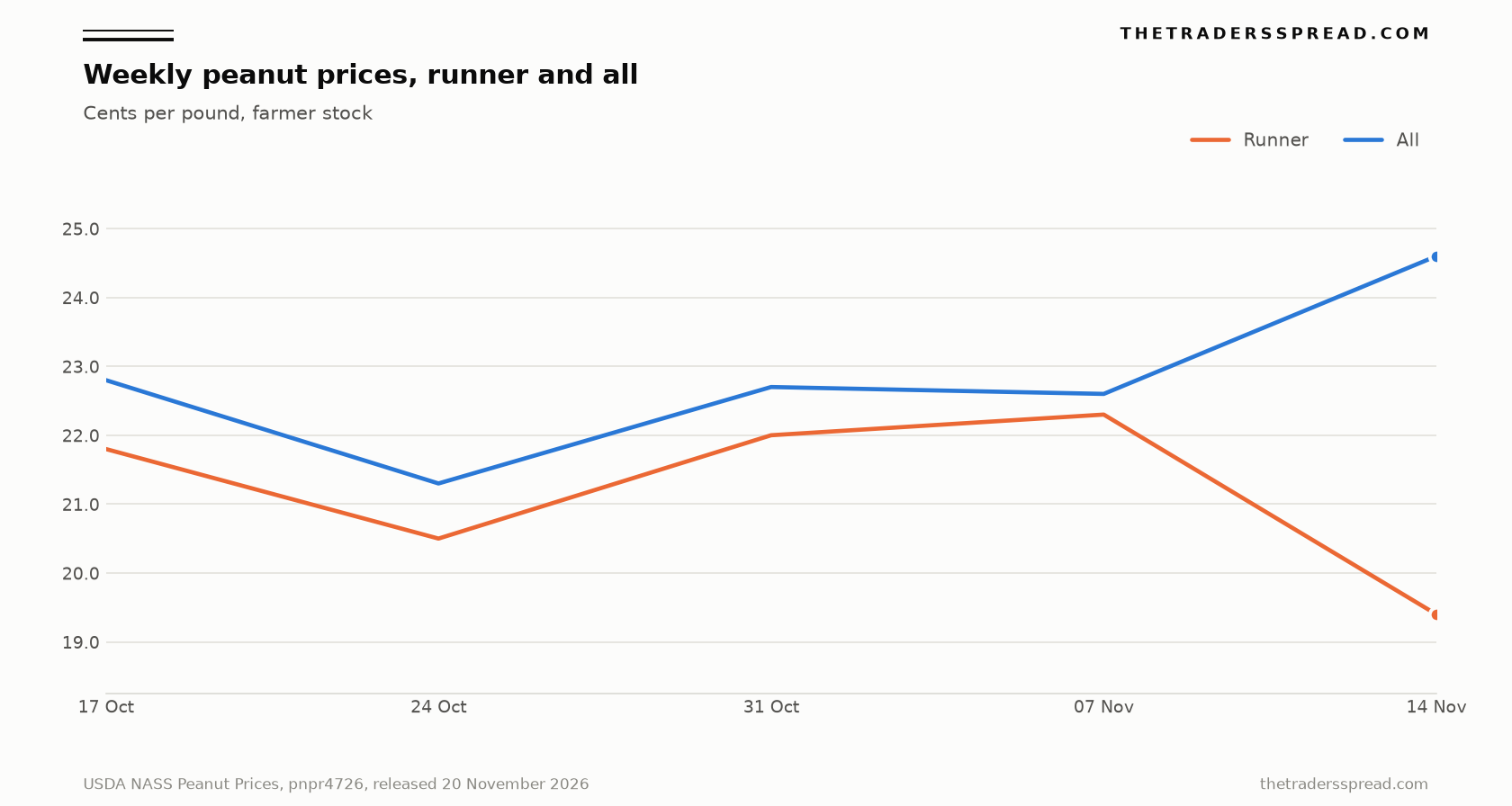
The record here is that file, and the split inside its own columns. From the week ending 7 November to the week ending 14 November, the all-type price rose from 0.226 to 0.246 dollars per pound, a gain of 0.020 dollars, while runner-type fell from 0.223 to 0.194 dollars per pound, a drop of 0.029 dollars. Runner-type was still the bulk of the pounds in both weeks: 61,543 thousand pounds out of 71,544 thousand on 7 November, and 21,145 thousand out of 29,190 thousand on 14 November. No futures settlement page for a peanut contract was opened for this record, so the farmer-stock cash table in pnpr4726 carries every price and every marketing figure below.
Key facts
- All farmer-stock peanuts averaged 24.6 cents per pound for the week ending 14 November, up 2.0 cents from the previous week, in the highlight at the top of pnpr4726.
- Runner-type averaged 19.4 cents per pound that week, down 2.9 cents. Runner marketings totaled 21.1 million pounds, down 40.4 million pounds.
- Marketings of all farmer stock totaled 29.2 million pounds, down 42.4 million pounds. The table prints the same week as 29,190 thousand pounds, against 71,544 thousand the week before.
- Valencia prices are marked (X) in every week the file prints. Valencia marketings are a hyphen in every week. The footnotes say (X) means not applicable and a hyphen means zero.
- The November NASS calendar lists this Peanut Prices release at 3:00 pm ET on 20 November 2026.
The Friday release
Data as of 20 November 2026. The first lines of pnpr4726 say the report was released that day by the National Agricultural Statistics Service, Agricultural Statistics Board, United States Department of Agriculture, and they print ISSN 1949-1891. On the November 2026 NASS calendar, Peanut Prices sits at 3:00 pm ET on Friday 20 November. The same calendar lists the report at 3:00 pm ET on 6 November, 13 November and 27 November as well. The text file, the PDF and the zip on the ESMIS release page are the 20 November issue. The weeks inside the table run from the week ending 17 October through the week ending 14 November.
The National Agricultural Statistics Service account posted at 20:01 UTC on 20 November 2026 that the weekly Peanut Prices report was available, one minute after the 3:00 pm ET calendar slot. The post points at the publication page and leaves the cents and the pounds in the text file, which is where the table below was read.
The weekly Peanut Prices report is available ➡️ https://t.co/p9IEkqjH82
— National Agricultural Statistics Service (@usda_nass) November 20, 2026
The file is a weekly cash average for farmer stock, by type, built from pounds purchased and dollars paid, and the pages below stay on that table.
The highlight, then the columns
Under the heading Peanut Price Highlights, the Board prints four sentences. They are the only narrative in the file, and they match the last two columns once the table's dollars per pound are read as cents and the table's thousand-pound cells are read as million pounds.
Peanut prices received by farmers for all farmer stock peanuts averaged 24.6 cents per pound for the week ending November 14, up 2.0 cents from the previous week. Marketings of all farmer stock peanuts for the week ending November 14 totaled 29.2 million pounds, down 42.4 million pounds from the previous week.
Runner-type peanut prices averaged 19.4 cents per pound for the week ending November 14, down 2.9 cents from the previous week. Marketings of runner-type peanuts totaled 21.1 million pounds, down 40.4 million pounds from the previous week.
The price cells convert exactly: 0.246 dollars per pound is 24.6 cents, and 0.246 minus 0.226 is 2.0 cents. The cell 0.194 is 19.4 cents, and 0.194 minus 0.223 is 2.9 cents down, with marketing lines rounded in the highlight. The cell 29,190 thousand pounds is 29.190 million, stated as 29.2 million, and the drop of 42,354 thousand pounds is stated as 42.4 million. Runner marketings of 21,145 thousand pounds are stated as 21.1 million, and the drop of 40,398 thousand pounds is stated as 40.4 million.
Prices by type across the five weeks
The price block is labeled dollars per pound. Five week-ending columns run left to right. Four type rows sit above an All row. We copied each cell as printed, including the Valencia marks, and we did not fill a blank the file left marked.
| Type | 17 Oct | 24 Oct | 31 Oct | 7 Nov | 14 Nov |
|---|---|---|---|---|---|
| Runner | 0.218 | 0.205 | 0.220 | 0.223 | 0.194 |
| Spanish | 0.271 | 0.243 | 0.459 | 0.482 | 0.484 |
| Valencia | (X) | (X) | (X) | (X) | (X) |
| Virginia | 0.241 | 0.242 | 0.261 | 0.239 | 0.230 |
| All | 0.228 | 0.213 | 0.227 | 0.226 | 0.246 |
Runner-type ends at 0.194 after printing 0.223 in the week ending 7 November, the high of its five cells, while the All row ends at 0.246, the high of its five cells. Spanish moves from 0.271 and 0.243 in the first two weeks to 0.459, 0.482 and 0.484 after that, and the file attaches no cause to the jump. Virginia's latest cell is 0.230, which is 0.9 cents under the 0.239 printed for the week ending 7 November. Valencia stays (X) in every price column, and the footnote says (X) means not applicable. Valencia marketings are a hyphen in every column, and the footnote says a hyphen represents zero.
The average rose while the bulk of the pounds fell
The All price is the Board's weighted average, and the methodology section says the expanded pounds and the expanded dollars, by type, are what produce it. We recomputed that weight from the printed cells for the two weeks the highlight compares. For the week ending 14 November, 21,145 times 0.194, plus 4,826 times 0.484, plus 3,219 times 0.230, equals 7,178.284. Divided by 29,190 thousand pounds, that is 0.245915 dollars per pound, which the file prints as 0.246. For the week ending 7 November, 61,543 times 0.223, plus 161 times 0.482, plus 9,840 times 0.239, equals 16,153.451. Divided by 71,544, that is 0.225783, which the file prints as 0.226. The type pounds also add to the All pounds in both weeks: 21,145 plus 4,826 plus 3,219 equals 29,190, and 61,543 plus 161 plus 9,840 equals 71,544.
The share of those pounds moved. In the week ending 7 November, runner-type was 61,543 divided by 71,544, or 86.0 percent of the pounds. Spanish was 161 divided by 71,544, or 0.2 percent. Virginia was 9,840 divided by 71,544, or 13.8 percent. In the week ending 14 November, runner-type was 21,145 divided by 29,190, or 72.4 percent. Spanish was 4,826 divided by 29,190, or 16.5 percent. Virginia was 3,219 divided by 29,190, or 11.0 percent.
Two further calculations, made from those same cells and not printed by NASS, separate the mix from the type prices. Holding the 7 November shares and applying the 14 November prices produces 0.1996 dollars per pound, about 19.96 cents. Holding the 7 November prices and applying the 14 November shares produces 0.2676 dollars per pound, about 26.76 cents. The printed move, from 0.226 to 0.246, sits between those paths: the mix did the lifting, while the lower runner price and the lower Virginia price pulled the other way. Feed barley and malt are another cash pair where the classes clear apart and a single headline can move with the mix.
Marketings by type
The marketing block is labeled 1,000 pounds, and the footnote says the quantity is pounds purchased from farmers.
| Type | 17 Oct | 24 Oct | 31 Oct | 7 Nov | 14 Nov |
|---|---|---|---|---|---|
| Runner | 53,973 | 80,799 | 247,328 | 61,543 | 21,145 |
| Spanish | 2,775 | 19 | 2,736 | 161 | 4,826 |
| Valencia | - | - | - | - | - |
| Virginia | 30,845 | 23,749 | 27,853 | 9,840 | 3,219 |
| All | 87,593 | 104,567 | 277,917 | 71,544 | 29,190 |
The week ending 31 October is the heavy week: All marketings print 277,917 thousand pounds, 9.5 times the 29,190 thousand in the latest week, with runner-type at 247,328 thousand that heavy week. Spanish marketings are 19 thousand pounds in the week ending 24 October, the smallest Spanish cell, and 4,826 thousand in the latest week, the largest, at 0.484 dollars per pound. Virginia steps from 30,845 thousand pounds in the first column to 3,219 thousand in the last. The highlight's "down 42.4 million pounds" is only the last step, from 71,544 thousand to 29,190 thousand, after the late-October peak.
The record soybean crop in the September USDA print is a supply estimate beside a futures settlement. This file is first buyers reporting one week of pounds and dollars. Canada's oat crop estimate is an official crop size next to a cash price, not a weekly average of farmer-stock purchases.
Week against week, all versus runner
The third table keeps only the comparison the highlight makes: the week ending 14 November against the week ending 7 November, all-type against runner-type. Price changes in cents are the dollar changes times 100. Marketing changes stay in the file's 1,000-pound unit so the cells can be checked by subtraction.
| Item | Week ending 7 Nov | Week ending 14 Nov | Change |
|---|---|---|---|
| All price, dollars per pound | 0.226 | 0.246 | +0.020 |
| All price, cents per pound | 22.6 | 24.6 | +2.0 |
| Runner price, dollars per pound | 0.223 | 0.194 | -0.029 |
| Runner price, cents per pound | 22.3 | 19.4 | -2.9 |
| All marketings, 1,000 pounds | 71,544 | 29,190 | -42,354 |
| Runner marketings, 1,000 pounds | 61,543 | 21,145 | -40,398 |
Runner-type accounts for 40,398 thousand of the 42,354 thousand-pound drop in the All row. Virginia fell another 6,621 thousand pounds, and Spanish rose 4,665 thousand, which together net to the other 1,956 thousand pounds of the All decline. The price rows diverge by 4.9 cents in the change column: all-type up 2.0, runner-type down 2.9. That gap is the mix described above, concentrated in a week when total purchases were the smallest of the five weeks on the page.
How the Board builds the average
pnpr4726 says first buyers report, at the start of each week, total pounds purchased from farmers and total dollars paid, by type, for the previous week. The four types named are Runners, Spanish, Valencias and Virginias. The data are to include all qualities and grades and exclude seed. Collection is by telephone, fax and internet, as an enumeration of all known first buyers.
RelatedTellurium price: copper slime, solar and trade rules
Where a complete report is missing, quantities and dollars for each type are expanded for non-response, and those expanded figures feed the weighted average. The Board reviews the estimates against recent history and across types. The reliability note names non-sampling error, including omission, duplication, imputation and processing mistakes, and says those errors cannot be measured directly.
The three weeks that can still move
The revision policy is one sentence and then a marketing-year rule. "Price and marketing estimates for the prior three weeks are subject to revision based on late reports." After that, at the end of the marketing year, buyers may update or provide late data for any week, and revised weekly estimates are published for the entire year.
Applied to this file, the new week ends 14 November, so the prior three weeks are the columns ending 7 November, 31 October and 24 October. The column ending 17 October sits outside that three-week sentence and inside the marketing-year rule, which can reopen every week. The 2.0 cent rise and the 2.9 cent runner decline are the current print, and the Board can still revise the week they are measured against.
Names printed on the release
The file names Estimation Branch contacts and supplies no spoken comment from them. Anthony Prillaman is printed as Associate Deputy Administrator at (202) 720-2127. Julie Weber, section chief at (202) 317-0165, is the contact whose crop list includes peanuts. Questions also go to nass@usda.gov, to the hotline at (800) 727-9540 from 7:30 am to 4:00 pm ET, and to the Ask a Specialist page.
Darin Jantzi at (701) 412-5953, Jeff Lemmons at (202) 973-3272 and Tiffany Byrne at (651) 440-7789 are the other section chiefs on the same block. Their printed crop lists cover soybeans, wheat, corn and other crops, and peanuts appear on Weber's list.
FAQ
What is the latest all-type peanut price in the cash table?
pnpr4726 prints all farmer stock at 0.246 dollars per pound for the week ending 14 November, stated in the highlight as 24.6 cents, up 2.0 cents from 0.226 the week before. Marketings in that latest week are 29,190 thousand pounds, stated as 29.2 million.
Why did the all-type peanut average rise while runner-type fell?
Runner-type fell from 0.223 to 0.194 dollars per pound, and its share of pounds fell from 86.0 percent to 72.4 percent, while Spanish pounds rose from 161 thousand to 4,826 thousand, or from 0.2 percent of the mix to 16.5 percent, at 0.484 dollars per pound. Keeping the old shares with the new prices yields about 19.96 cents. Keeping the old prices with the new shares yields about 26.76 cents. Both side figures are our arithmetic from the cells, and the printed result is 24.6 cents.
Which weeks in the peanut price table can still be revised?
Estimates for the prior three weeks are subject to revision on late reports. In this issue that window is the weeks ending 24 October, 31 October and 7 November. The marketing-year rule can reopen any week after that, including the week ending 17 October. The week ending 14 November is the new estimate in this release.
Checklist
- Opened pnpr4726.txt. First price row: Runner, week ending 17 October 2026, 0.218 dollars per pound.
- All farmer stock, week ending 14 November: 0.246 dollars per pound, 24.6 cents, up 2.0 cents from 0.226.
- Runner-type that week: 0.194 dollars per pound, 19.4 cents, down 2.9 cents, on 21,145 thousand pounds.
- All marketings: 29,190 thousand pounds, stated as 29.2 million, down 42,354 thousand from 71,544 thousand.
- Valencia prices are (X) in every column. Valencia marketings are a hyphen in every column. Spanish latest week: 0.484 dollars on 4,826 thousand pounds.
- The prior three weeks can be revised on late reports. No futures settlement was opened, and no price target is set.
This is analysis, not advice. Capital is at risk.