

Is the 9.6% fall in coking coal an answer to a question about Chinese steel demand, or an answer to a narrower question about one low-sulphur grade over a holiday gap? The National Bureau of Statistics, in the mid-October circulation survey published at 09:30 on 24 October 2026, put primary coking coal at 2,232.1 yuan a tonne. That is 237.9 yuan, or 9.6%, under the late-September reading of 2,470.0 yuan. The grade on the form is main coking coal with sulphur under 1%. The price is a wholesale and selling price from trading firms, so it already includes distribution cost, profit and tax, and the bureau's own note says this circulation series can part company with the ex-factory price for a while.
The same page refuses the wide reading. The Shanxi premium blend at 5,500 kilocalories rose 31.3 yuan, or 3.2%, to 1,019.0 yuan a tonne, while washed medium anthracite fell 55.1 yuan, or 3.6%, to 1,496.7. Quasi-primary metallurgical coke fell 200.0 yuan, or 9.5%, to 1,896.4, and rebar, the 20mm HRB400E bar, rose 11.9 yuan, or 0.4%, to 3,187.8. Divide the coking-coal print by the coke print and the ratio is 1.177, against 1.178 in late September, when the same division was 2,470.0 over 2,096.4. Coal and coke were marked down together, and the relationship between them barely moved. Across the 50-product monitor, 22 prices rose, 25 fell and three were flat. Liquefied natural gas rose 9.1% to 6,749.4 yuan a tonne, and lithium iron phosphate fell 10.2% to 46,005.9, so coking coal was one weak row on a split tape.
A longer look at the same series changes the level again. Late June, published on 4 July, had this grade at 1,925.0 yuan, and mid-October is 307.1 yuan above that print, or 16.0%. Late July, published on 4 August, had it at 1,875.0, and mid-October is 357.1 yuan above that print, or 19.0%. The 9.6% drop gives back part of a late-summer spike and leaves the grade 139.3 yuan, or 5.9%, under the late-August reading of 2,371.4.
24 October, and the survey that skipped a ten-day
The release is the change in market prices of important means of production in circulation for the middle ten days of October. The footnote changes the arithmetic, because the previous period is late September, 21–30 September, and the early-October ten-day report was cancelled for the National Day holiday. The 9.6% and the 237.9 yuan are a comparison across a gap, a holiday-gapped comparison, not a single ten-day.
China Statistical Information Service Center and SCI International, the English name these releases use for 卓创资讯, compile the monitor from nearly 2,000 wholesalers, agents and dealers in more than 300 trading markets across 31 provinces. The specification sheet fixes the coking row as main coking coal with sulphur under 1%, and the coke row as quasi-primary metallurgical coke with ash from 12.01% to 13.50%. The Shanxi 5,500 kcal blend on the same page is a thermal mix sold on heat content, and it rose, while anthracite eased by about a third of the coking-coal percentage, so the low-sulphur furnace grade is a poor stand-in for coal as a single thing.
The indicator note says the circulation price and the producer price influence each other with a lag and can diverge for a stretch. Taking 2,232.1 yuan as a mine-gate price, or as a Dalian settlement, reads past the column the page prints. The Dalian Commodity Exchange settlement board failed to open in this session, so the record stays with the bureau's row and secondary futures screens are left out.
From 1,925 yuan in late June
The path into the mid-October row is a rally, then a stall, then this giveback, plotted from five period-end prints.
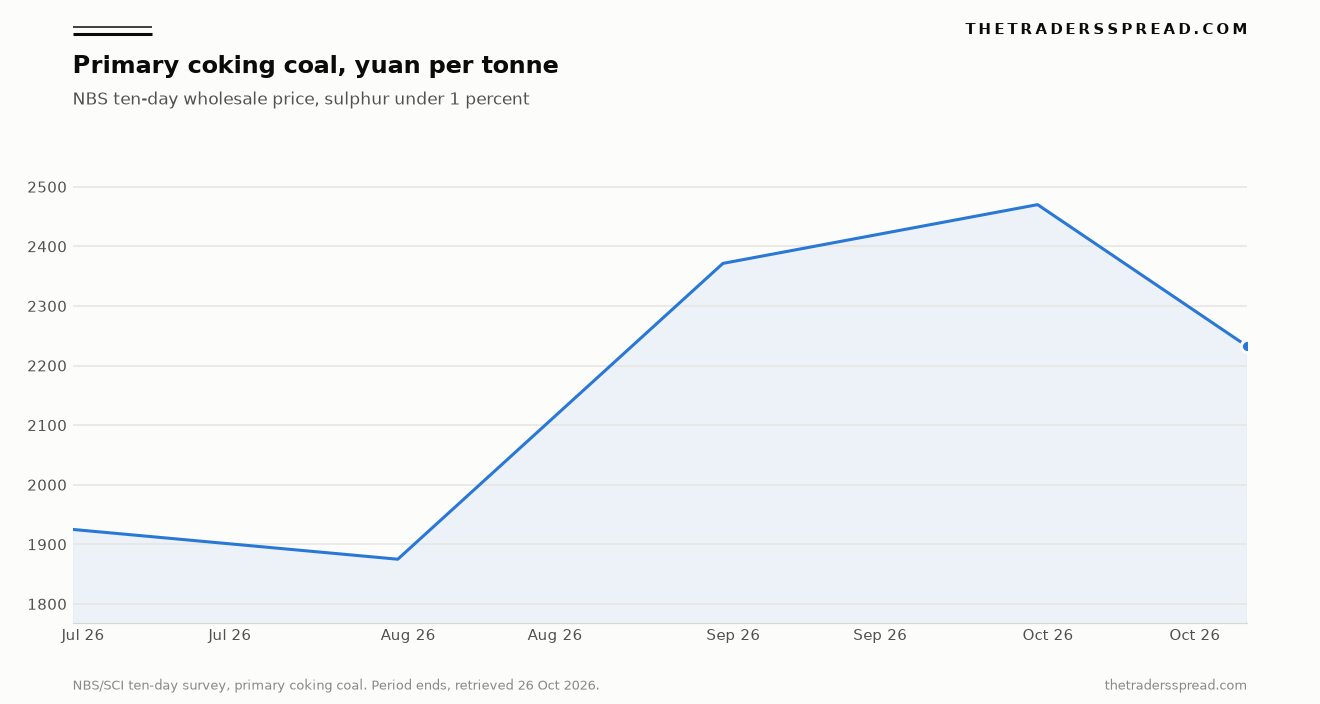
Late June, the 4 July release covering 21–30 June, printed 1,925.0 yuan, up 12.5 yuan or 0.7% on mid-June, with coke at 1,746.4 yuan, up 66.7 yuan or 4.0%, and a coal-to-coke ratio of 1.102. Rebar was 3,172.1 yuan, the Shanxi blend was 854.6 yuan after a 0.9% dip, and anthracite was 1,200.3 yuan. Late July, published 4 August for 21–31 July, took coking coal to 1,875.0 yuan, down 33.3 yuan or 1.7%, and coke to 1,740.2, down 56.2 yuan or 3.1%, so the ratio slipped to 1.077, the lowest of these five prints. Rebar was 3,123.4 and the Shanxi blend was 824.8, while anthracite had already turned up to 1,321.9, a 5.0% rise on its prior ten-day.
Late August is where the series jumps. The 4 September release, covering 21–31 August, put coking coal at 2,371.4 yuan, up 328.3 yuan or 16.1% on mid-August, in a period when 34 of the 50 products rose, 14 fell and two were flat. Coke rose 114.3 yuan or 6.9% to 1,760.7, and the ratio blew out to 1.347, because coal ran ahead and the oven price followed only part of the way. Rebar was 3,130.3, up 67.4 yuan or 2.2%. The Shanxi blend was 870.1, up 0.9%, and anthracite was 1,477.1, up 9.1%, so the coal rally carried a coking-grade spike while the bar barely left 3,130.
Late September, published 9 October for 21–30 September, put coking coal at 2,470.0 yuan, down 79.3 yuan or 3.1% on mid-September. Adding that 79.3 yuan back to the printed level puts the mid-September reading at 2,549.3, the high implied by the late-September page. Coke was unchanged at 2,096.4 yuan after the step up from 1,760.7 in late August, and the ratio compressed from 1.347 to 1.178, so the coal-specific premium had already given back most of its August excess before October began. Rebar was 3,175.9, up 0.3%, the Shanxi blend was 987.7, up 0.5% on the ten-day and far above August, and anthracite was 1,551.8, down 2.6%.
Four coals in the same release
The five prints, in yuan per tonne, come from the releases dated 4 July, 4 August, 4 September, 9 October and 24 October 2026.
| Product | Late June | Late July | Late Aug | Late Sep | Mid-Oct | Mid-Oct vs late Sep |
|---|---|---|---|---|---|---|
| Primary coking coal | 1,925.0 | 1,875.0 | 2,371.4 | 2,470.0 | 2,232.1 | −237.9 (−9.6%) |
| Quasi-primary met coke | 1,746.4 | 1,740.2 | 1,760.7 | 2,096.4 | 1,896.4 | −200.0 (−9.5%) |
| Anthracite, washed medium | 1,200.3 | 1,321.9 | 1,477.1 | 1,551.8 | 1,496.7 | −55.1 (−3.6%) |
| Shanxi blend, 5,500 kcal | 854.6 | 824.8 | 870.1 | 987.7 | 1,019.0 | +31.3 (+3.2%) |
| Rebar, HRB400E 20mm | 3,172.1 | 3,123.4 | 3,130.3 | 3,175.9 | 3,187.8 | +11.9 (+0.4%) |
From late August to mid-October the paths split, because coking coal fell 5.9% while coke rose 7.7%, and 1,896.4 is still 135.7 yuan above the late-August coke print of 1,760.7. The Shanxi blend rose from 854.6 in late June to 1,019.0, a gain of 164.4 yuan, or 19.2%, and the latest window was still up. Anthracite rose from 1,200.3 to 1,496.7 over those months, with the latest window trimming 3.6%. Seaborne thermal coal on the API2 contract is a different market, a delivered European power-coal assessment covered in a separate API2 note.
Rebar sat still while the coal price travelled
Rebar is the awkward number for a demand-collapse reading. The late-June print was 3,172.1 yuan and the mid-October print was 3,187.8, a difference of 15.7 yuan, or 0.5%, across a stretch in which primary coking coal rose to 2,470.0 and then fell to 2,232.1. The bar absorbed little of the coal rally and little of the coal giveback. In the latest window, wire rod of 8–10mm HPB300 rose 15.9 yuan, or 0.5%, to 3,386.9, while ordinary medium plate fell 27.5 yuan, or 0.8%, to 3,509.9, and hot-rolled coil of 4.75–11.5mm Q235 fell 29.0 yuan, or 0.9%, to 3,268.1. Long products edged up and flat products edged down, a split of a few tenths of a percent beside a coking grade that moved by nearly a tenth.
Over the longer window hot-rolled coil fell from 3,325.2 yuan in late June to 3,268.1, a drop of 57.1 yuan, or 1.7%, while plate moved from 3,502.5 to 3,509.9. Ordinary cement, P.O 42.5 in bulk, rose 4.7 yuan, or 1.8%, to 267.0 from 262.3 in late September. Iron ore, the other blast-furnace bulk, is tracked on its own in the iron ore piece. A demand reading would be the simple one if ore, coal and the finished bar all fell together, and here the bar rose a fraction while coking coal fell hard. Coke moved with the coal only in the latest window. From late July to late August, coking coal rose 496.4 yuan, or 26.5%, comparing those period-ends directly, while coke rose from 1,740.2 to 1,760.7, about 1.2%, and only later caught up to 2,096.4 in late September.
September tonnes were already lower
The production release makes a supply-flood reading hard to square with September. Industrial output of enterprises above the designated size, the English release dated 20 October 2026, put September coke at 39.04 million tonnes, down 8.2% from a year earlier, with January to September at 373.16 million tonnes, down 0.7%. Pig iron was 65.34 million tonnes, down 1.4%, and 628.44 million tonnes for January to September, down 3.0%. Crude steel was 73.59 million tonnes, up 0.1% on the year and down 2.9% for January to September. Rolled steel was 118.17 million tonnes, down 3.8%. Raw coal was 385.13 million tonnes, down 6.8%, and 3,449.05 million tonnes for January to September, down 3.5%.
The energy bulletin published on 19 October puts September raw coal at 390 million tonnes, down 6.8%, a daily average of 12.84 million tonnes, and a year-to-date decline of 3.5% on 3.45 billion tonnes. That daily figure matches 385.13 million tonnes divided by 30 days. Value added in mining and washing of coal fell 3.3% in September, while value added in smelting and pressing of ferrous metals rose 1.6%. A price falling after a month of lower coke and raw-coal output is a poor cartoon of a glut, and the window also includes the National Day break, inside a year-to-date coke decline of only 0.7%.
The producer-price note of 14 October, by Dong Lijuan, chief statistician of the urban survey department at the National Bureau of Statistics, is about September and points the other way for coal as a mining industry. She put coal mining and washing up 9.5% on the month and 35.3% on the year, and coal processing up 13.6% on the month, tying the rise to winter heating stockpiles, a temporary tightness at major mines, and expectations for international coal prices. Headline producer prices rose 1.2% on the month and 5.0% on the year. Those are ex-factory prices for September versus August, a different concept from the mid-October circulation quote, and her reasons line up with the Shanxi blend, which kept rising, while primary coking coal fell.
The manufacturing purchasing managers' index, published on 1 October for September, was 50.1, up 0.3 points, with production at 51.7, up 1.3 points, and new orders at 50.5, down 0.1 point. The main raw-materials purchase price index was 60.8, up from 56.6 in August, which matches the producer-price rise and sits badly with a claim that factories had already stopped paying up for inputs that month. Construction business activity rose 3.4 points to 50.3, while construction new orders were 45.7, up 3.3 points and still under 50, so a building-work worry can sit beside firmer cement and rebar. Polypropylene rose 7.8% to 10,666.4 yuan a tonne and methanol fell 6.2% to 3,570.8 in the same mid-October table. A separate note on naphtha follows a petrochemical feedstock moving with crude.
What this changes
The fact that changed on 24 October is a parallel markdown inside one lane. Primary coking coal fell 237.9 yuan a tonne against late September and quasi-primary coke fell 200 yuan, leaving the coal-to-coke ratio near 1.18 after September had already closed most of August's coal-over-coke gap. The grade is still 16.0% above late June and 19.0% above late July, and 5.9% under late August. The missing early-October survey means the percentage covers a holiday as well as a trading fortnight.
Left standing are the thermal blend, the rebar price, and the September tonne count. The Shanxi 5,500 kcal mix rose 3.2% in the comparison window and 19.2% from late June, and rebar rose 0.4% in the window. September coke output fell 8.2% on the year and September raw coal fell 6.8%, so the price drop arrived after a month in which the physical counts were already lower. Dong Lijuan's September note still describes producer prices for coal mining, up 9.5% on the month and 35.3% on the year, and the PMI purchase-price index at 60.8 still describes manufacturing input costs that month.
RelatedCaustic soda futures fell 3.89% to 1,632 yuan a tonne
The open question is the next ten-day survey, with early October a hole and mid-October only one side of it. If the following print stabilises near 2,232 yuan while the Shanxi blend stays firm and rebar stays near 3,190, the holiday-gap reading gets stronger. If coking coal keeps falling and coke, rebar and the thermal blend start to fall with it, the demand reading gets the company it lacked on 24 October. A blast-furnace story that needs ore, coke and the bar to agree still has to consult the ore series on its own.
Verdict: the mid-month survey marks down primary coking coal and quasi-primary coke together, and it leaves rebar and the Shanxi thermal blend higher.
Questions the release leaves open
What coking coal price did the mid-month survey print?
Primary coking coal, specified as main coking coal with sulphur under 1%, was 2,232.1 yuan a tonne for the middle of October. The National Bureau of Statistics published that row at 09:30 on 24 October 2026, down 237.9 yuan, or 9.6%, from the late-September level of 2,470.0 yuan. The figure is a wholesale and selling price from trading firms, collected with SCI International across more than 300 markets, and it includes distribution cost, profit and tax.
Why does the 9.6% cover more than ten days?
The early-October circulation report was cancelled because of the National Day holiday, which the 24 October release states in its notes. The comparison on the page is therefore mid-October against late September, 21–30 September, rather than against 1–10 October. The 237.9 yuan decline spans that missing ten-day as well as the middle ten days of October, so the percentage includes a holiday the survey skipped.
Did metallurgical coke fall by the same amount?
Quasi-primary metallurgical coke, with ash between 12.01% and 13.50%, fell 200.0 yuan, or 9.5%, to 1,896.4 yuan a tonne. Primary coking coal divided by that coke price is 1.177, against 1.178 in late September, so the pair was marked down in parallel. Coke at 1,896.4 is still 135.7 yuan, or 7.7%, above the late-August print of 1,760.7, while coal at 2,232.1 is 5.9% under its own late-August print.
How did the other coals on the form behave?
The Shanxi premium blend at 5,500 kilocalories rose 31.3 yuan, or 3.2%, to 1,019.0 yuan a tonne, and it is 19.2% above its late-June print of 854.6. Washed medium anthracite fell 55.1 yuan, or 3.6%, to 1,496.7, and it remains well above the late-June print of 1,200.3. The coking grade was the weak coal and the thermal blend was the firm one. API2 thermal coal is a separate seaborne contract and a separate market from this domestic grade.
What were September coke and steel tonnes doing before this price?
The industrial production release dated 20 October put September coke at 39.04 million tonnes, down 8.2% on the year, with January to September down 0.7%. Pig iron fell 1.4% to 65.34 million tonnes, crude steel rose 0.1% to 73.59 million tonnes, and rolled steel fell 3.8% to 118.17 million tonnes. Raw coal fell 6.8% to 385.13 million tonnes. The mid-October price drop came after a month in which coke and raw-coal tonnes were already lower.
How does this sit next to September producer prices?
Dong Lijuan, chief statistician of the National Bureau of Statistics urban survey department, wrote on 14 October that coal mining and washing producer prices rose 9.5% on the month and 35.3% on the year. She tied the rise to winter heating stockpiles, temporary tightness at major mines, and expectations for international coal prices. That ex-factory reading lines up with the thermal blend, while the circulation drop is a later print for one low-sulphur grade.
This is analysis and information only, and it is not a recommendation to trade coking coal, coke, iron ore or steel.