

Methanol for January 2027 delivery settled at 3,553 yuan a tonne on the Zhengzhou Commodity Exchange on 2 November 2026. The contract, coded MA701, was the busiest methanol future on the sheet that session, and the settlement was 90 yuan above the previous settlement of 3,463 yuan. Volume was 3,228,791 lots and open interest was 908,240 lots, up 27,035 lots on the day. The exchange file carrying those prints was last modified at 07:52 UTC on 2 November 2026.
| Contract | Settlement, yuan/t | Change, yuan | Volume, lots | Open interest, lots |
|---|---|---|---|---|
| MA611, Nov 2026 | 3,687 | +48 | 1,892 | 1,432 |
| MA612, Dec 2026 | 3,652 | +83 | 456,847 | 176,265 |
| MA701, Jan 2027 | 3,553 | +90 | 3,228,791 | 908,240 |
| MA703, Mar 2027 | 3,357 | +75 | 349,687 | 328,707 |
| MA705, May 2027 | 3,198 | +40 | 155,055 | 171,212 |
| MA710, Oct 2027 | 3,018 | +50 | 883 | 424 |
Settlements from the Zhengzhou Commodity Exchange daily sheet for 2 November 2026. Change is the exchange's settlement-to-settlement figure.
The same sheet is a backwardation, and every listed contract rose with it. November settled 134 yuan above January, January settled 355 yuan above May, and November settled 669 yuan above October 2027, an 18.1 percent slope from the front of the board to the far month. January rose more than May, so the January-May gap widened, from 305 yuan on the previous settlements (3,463 against 3,158) to 355 yuan, with the nearby months paid up more than spring.
That shape disagrees with itself, which is the useful part. A backwardated board says nearby material is scarce relative to later material, and a rally that steepens the backwardation says the scarcity got a higher price on the day. May under 3,200 yuan, and October 2027 barely over 3,000 yuan, price that scarcity as temporary. LME zinc showed the other ending when a cash premium that had looked like a physical shortage collapsed once warehouse stocks rebuilt. Methanol's premium is still on the sheet.
Cash sat hundreds of yuan above the board
On the morning of 2 November, Longzhong Information reported Jiangsu Taicang methanol business through Mysteel. Small ex-tank spot deals, spot exchange, traded at 3,940 to 3,990 yuan a tonne, with the basis quoted at plus 410 to plus 430 yuan. Early-month cargo traded at 3,920 to 3,940 yuan, basis plus 380 to plus 400. Late-month business was quoted at a basis of plus 350. The low of that early-month range, 3,920 yuan, is the bull case in this reading, taken from the Longzhong morning note published at 11:59 that day.
Set 3,920 against the 3,553 settlement and the gap is 367 yuan. Set the top of the small-lot range, 3,990, against the same settlement and the gap is 437 yuan. The morning basis of 410 to 430 yuan was struck against the futures screen at the time of the deals, inside a session whose later range ran from 3,491 to 3,615 and whose settlement was 3,553.
Ten days earlier the stock picture and the basis picture were already out of step. Huatai Futures, in a note by Chen Li published through Sina Finance at 09:46 on 30 October 2026, cited Longzhong port inventory of 353,800 tonnes, down 9,950 tonnes. In the same Huatai note Taicang methanol was 3,915 yuan a tonne, down 110, and the Taicang basis was 502 yuan, down 59. Subtract that basis from that Taicang price and the result is 3,413 yuan, which is the MA701 close on 29 October. Stocks in the national port sample were still falling while the premium over futures was already narrowing, and the 90 yuan settlement rally on 2 November arrived after that narrowing.
Where the January contract has already traded
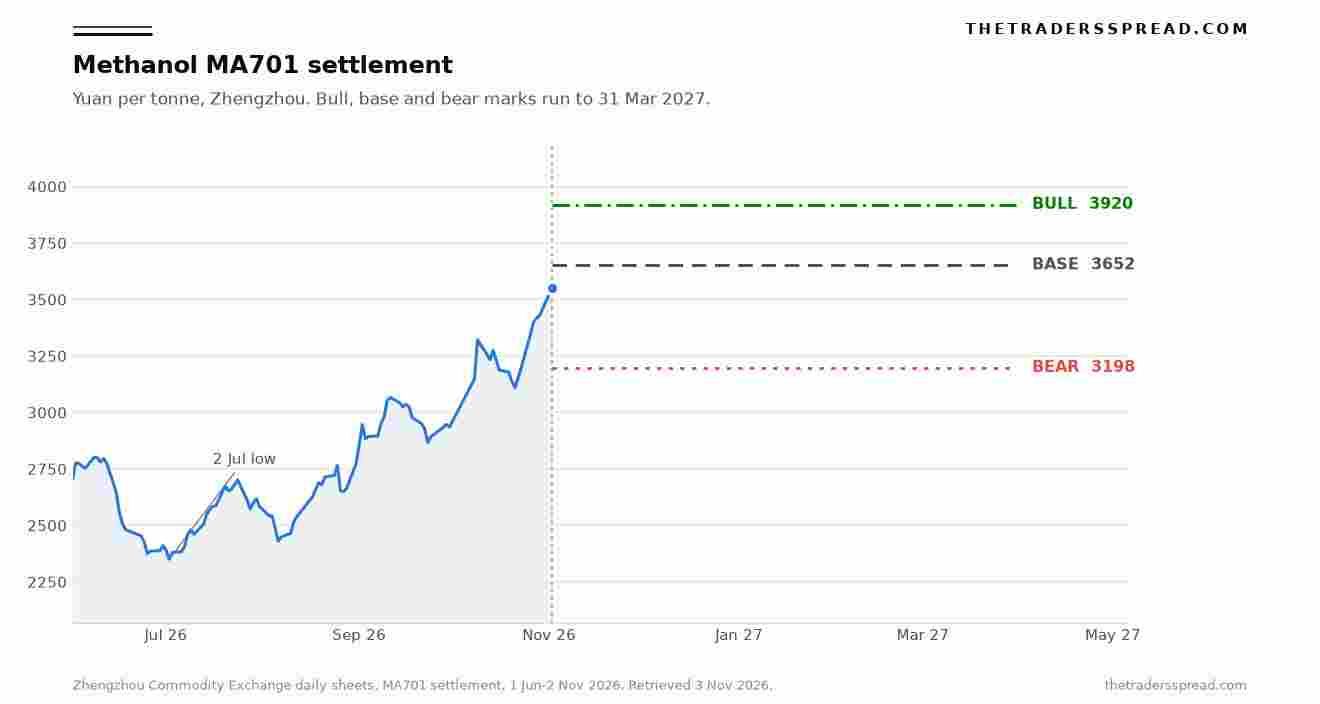
The line in the chart is the MA701 settlement on each Zhengzhou daily sheet from 1 June 2026 through 2 November 2026, 104 sessions. Eight weekdays in that window lacked a daily file. The lowest settlement in the files that did publish was 2,350 yuan on 2 July 2026. From that print to the 3,553 settlement is 1,203 yuan, or 51.2 percent. The path bent several times: the contract settled at 2,429 yuan on 6 August, reached 3,066 on 11 September, and printed 2,977 on 18 September. From that 18 September settlement to 2 November is 576 yuan, or 19.3 percent.
October did the violent stretch of the move. The 9 October settlement was 3,321 yuan, with a session high of 3,402. By 21 October the settlement was 3,110 yuan, a drop of 211 yuan, or 6.4 percent. Open interest peaked at 952,582 lots on 26 October, beside a 3,346 settlement and volume of 3,322,801 lots, then stood at 908,240 on 2 November, 44,342 lots, or 4.7 percent, under that peak.
The forward marks run to 31 March 2027 so the dashes stay visible. Bull is 3,920, the Taicang early-month low. Base is 3,652, the MA612 settlement. Bear is 3,198, the MA705 settlement. The levels read the curve and the cash market printed together on 2 November.
Jiangsu rebuilt while the national sample fell
Port inventory is the figure the bull case has to keep, and China's ports are separate tanks. The samples below are the ones opened for this reading.
| Reading | Figure | Move | As of |
|---|---|---|---|
| National port sample | 363,800 tonnes | down 3,400 tonnes | 21 October 2026 |
| National port sample | 353,800 tonnes | down 9,950 tonnes | cited 30 October 2026 |
| Jiangsu ports | 184,800 tonnes | up 20,800 tonnes | cited 30 October 2026 |
| Zhejiang ports | 55,500 tonnes | down 14,450 tonnes | cited 30 October 2026 |
| Guangdong ports | 54,000 tonnes | down 11,000 tonnes | cited 30 October 2026 |
| Producer stocks | 325,044 tonnes | down 16,401 tonnes | 28 October 2026 |
| Unfilled orders | 239,631 tonnes | up 36,671 tonnes | 28 October 2026 |
Port rows are Longzhong samples. The 21 October row is the Mysteel write-up. The 30 October rows are the figures Huatai Futures cited from Longzhong. Producer rows are the unrounded Longzhong tonnes in that same Huatai note.
Longzhong's port sample, written up by Lu Xiangqian and published on Mysteel at 15:42 on 21 October 2026, was down 0.93 percent on the week, with 49,300 tonnes of foreign vessels counted. The port note said Jiangsu had seen a clear increase in domestic ship parcels and truck arrivals, and that a major downstream plant along the river had formally stopped, so the regional stock only edged down. Zhejiang had one foreign ship and domestic vessel supply against ordinary demand.
The week-on-week decline of 9,950 tonnes implies a prior reading of 363,750, within 50 tonnes of the 21 October sample. Jiangsu, Zhejiang and Guangdong sum to 294,300 tonnes, leaving 59,500 tonnes in ports the note left unnamed, and the Zhejiang and Guangdong declines add to 25,450 tonnes. Huatai's wording was that an inflection had appeared and that only a small part of the total had risen, and Jiangsu was that part, while the national sum was still lower.
Producer tanks fell while olefin units sat idle
Longzhong's sample of methanol producers, written up by Zhang Xiaoyan and published on Mysteel at 17:33 on 28 October 2026, showed inventory of 325,000 tonnes as of 11:30 that day, down 16,400 tonnes, or 4.80 percent, from the prior sample. Unfilled orders were 239,600 tonnes, up 36,700 tonnes, or 18.07 percent. Northwest plant inventory in the Huatai note was 200,500 tonnes, down 9,200, and northwest unfilled orders were 128,700 tonnes, up 24,000. Unrounded orders of 239,631 equalled 73.7 percent of that 325,044 tonne stock. The rounded print is the Zhang Xiaoyan page.
Huatai's note names the olefin plants beside that draw. Nanjing Chengzhi's first and second phases stopped on 19 October. Tianjin Bohua and Lianhong Gerun stopped on 10 October. Ningbo Funde stopped on 19 September, and Hengtong stopped on 18 September. Luxi, Xingxing and Sirbang were described as still stopped. The methanol-to-olefins operating rate in the same note was 70.60 percent, up 0.10 of a percentage point. The note said the market was watching a possible Funde restart, and that a restart looked less likely while import arrivals stayed thin.
The stock draw has more than one cause. Tanks can fall when ships stay away, when plants run and ship, or while methanol-to-olefins units sit idle, if the missing imports exceed the missing consumption. Huatai's account of Iranian supply is the import half of that sentence: most Iranian methanol units were still shut, Kaveh had joined the shutdowns, October loadings out of Iran were still low, and a near-term pickup in arrivals into China would still leave the total small. Those claims stay inside that note.
Low stocks and a softer basis can be true together when part of the olefin demand is absent. The Taicang basis fell 59 yuan inside the 30 October note, then stood at 410 to 430 yuan on the morning of 2 November against the earlier 502, while early-month cargo was still at 3,920 yuan and above.
Inland methanol is the cheaper chemical
The coast and the cost base are different places. Huatai's 30 October note put Q5500 thermal coal at Ordos at 820 yuan a tonne, down 10, and the production margin on Inner Mongolia coal-to-methanol at 1,123 yuan a tonne, down 38. Inland methanol itself was far under the port. North-line Inner Mongolia was 3,238 yuan, down 58, with a basis of 425 yuan, down 7. South-line Inner Mongolia was 3,200 yuan, down 90. Linyi in Shandong was 3,640 yuan, down 55, and the south-Shandong basis was 427 yuan, down 4. Henan was 3,510 yuan, down 25, basis 297 yuan, up 26. Hebei was 3,480 yuan, down 30, basis 327 yuan, up 21. Changzhou, on the same list, was 3,890 yuan.
On those prints, Taicang at 3,915 yuan sat 677 yuan above north-line Inner Mongolia at 3,238. The note's own Taicang-versus-Inner-Mongolia spread, after the 550 yuan adjustment in its label, was 128 yuan, down 53. Guangdong methanol was 4,055 yuan, down 35, with a basis of 642 yuan, up 16, so the south coast was richer than East China even as the East China basis slipped. CFR China was 478 dollars a tonne, up 3, and the East China import spread was 160 yuan a tonne, down 34.
The 1,123 yuan margin on Inner Mongolia coal-based methanol says the inland producer was clear of a loss on that day's coal and methanol prices. Huatai said coal-based units were waiting on a further recovery and were already running harder than through the autumn maintenance, beside a plant stock that was still falling on 28 October.
Natural gas has the same split between a comfortable national storage figure and a regional line that is strained. Methanol's version is a national port sample that is still down, a Jiangsu subset that has started to refill, and an inland margin that leaves production running.
Where 3,920 and 3,198 come from
| Case | Level, yuan/t | The print it is | What has to keep being true |
|---|---|---|---|
| Bull | 3,920 | Low of early-month Taicang ex-tank deals, morning of 2 November 2026, Longzhong via Mysteel | The national port sample and the producer sample keep falling, and January closes part of the gap up to the port |
| Base | 3,652 | MA612 settlement, Zhengzhou daily sheet, 2 November 2026 | January catches the December contract and stalls, with the port premium only partly closed |
| Bear | 3,198 | MA705 settlement, Zhengzhou daily sheet, 2 November 2026 | The Jiangsu rebuild becomes the national total, import arrivals return, and January falls to the May print |
The reference point is the MA701 settlement of 3,553 yuan. Bull sits 367 yuan above it, base 99 yuan above it, and bear 355 yuan below it. December already trades at 3,652 on 456,847 lots, and the session high on 2 November was 3,615, still 37 yuan under that December settlement, so the base case is a shelf the rally has yet to clear.
RelatedWhy Butter Futures Split From the Cash Butter Print
The bull case asks the stock trends to survive the Jiangsu uptick, with January still under the 3,920 yuan Taicang low. Lithium carbonate's move to 161,000 yuan priced a supply interruption the deferred months had only partly accepted, and methanol's version, on Huatai's account, is ships and olefin units. Conviction is 3 out of 5: the port sample and the plant sample agree on a draw, while Jiangsu, the 70.60 percent olefin rate, and the May discount sit on the other side.
The print that would hand it to the bear case
The bear case is already trading in May, and it becomes the January story if Jiangsu becomes the national line. A port sample that rises against the 9,950 tonne decline, or a producer sample that rises against the 16,401 tonne decline, would make 3,198 the relevant neighbour. A restart of the olefin units Huatai listed, together with a return of Iranian arrivals, would turn the low stock figure into a faster refill than the basis can hold.
A quieter path leaves January near 3,553 while the port stays expensive and the basis keeps giving up ground, as it did from 502 yuan on 30 October to 410-430 yuan on the morning of 2 November. In that version the settlement stays between 3,198 and 3,920, and 3,652 is the level it has to clear or reject.
Key facts
- MA701 settled at 3,553 yuan a tonne on 2 November 2026, up 90 yuan, on volume of 3,228,791 lots and open interest of 908,240 lots. Source: Zhengzhou Commodity Exchange daily sheet, file last modified 2 November 2026, 07:52 UTC.
- On the same sheet MA611 settled at 3,687 yuan and MA705 settled at 3,198 yuan, leaving January 355 yuan above May. Source: Zhengzhou Commodity Exchange, 2 November 2026.
- The lowest MA701 settlement in the exchange daily files from 1 June through 2 November 2026 was 2,350 yuan on 2 July, which is 1,203 yuan under the 2 November settlement. Source: Zhengzhou Commodity Exchange daily sheets, retrieved 3 November 2026.
- Taicang early-month ex-tank deals were 3,920 to 3,940 yuan a tonne on the morning of 2 November, and small-lot deals were 3,940 to 3,990, with the basis at plus 410 to plus 430 yuan. Source: Longzhong Information, Zhao Chengcheng, Mysteel, 2 November 2026, 11:59.
- The Longzhong port sample was 363,800 tonnes on 21 October, down 3,400 tonnes on the week, and Huatai Futures cited a later Longzhong port total of 353,800 tonnes, down 9,950, with Jiangsu up 20,800 tonnes. Source: Longzhong via Mysteel, 21 October 2026, and Huatai Futures, Chen Li, 30 October 2026.
- Producer sample stocks were 325,044 tonnes on 28 October, down 16,401 tonnes, and unfilled orders were 239,631 tonnes, up 36,671 tonnes. The methanol-to-olefins operating rate in the Huatai note was 70.60 percent. Source: Longzhong via Mysteel, Zhang Xiaoyan, 28 October 2026, and Huatai Futures, 30 October 2026.
Questions readers ask
What methanol price is this prediction anchored to?
The anchor is the Zhengzhou MA701 settlement of 3,553 yuan a tonne on 2 November 2026, from the exchange daily sheet last modified at 07:52 UTC that day. MA701 was the volume leader, with 3,228,791 lots. The bull, base and bear levels are other prints from the same morning and the same sheet, and Taicang cash that morning was still above 3,900 yuan.
Why is the bull case 3,920 yuan?
Because 3,920 yuan is the low of the early-month Taicang ex-tank range Longzhong reported on the morning of 2 November, under the 3,940 to 3,990 small-lot range and 367 yuan above the 3,553 settlement. It is a dealt port price. The bull case is January closing part of that gap if the national port sample and the producer sample keep falling.
Why is the bear case under the current settlement?
The bear case is 3,198 yuan, the MA705 settlement on 2 November, 355 yuan under MA701, and a bear case has to sit below the live settlement. May already trades there, on 155,055 lots that day. The path to it is a national stock rebuild, led by the Jiangsu increase of 20,800 tonnes if that increase spreads, plus the return of import arrivals the late-October note still described as thin.
Were methanol stocks rising or falling in the latest prints?
The national port sample and the producer sample were falling. Ports were 363,800 tonnes on 21 October, down 3,400 tonnes on the week, and 353,800 tonnes in the 30 October citation, down 9,950. Producer stocks were 325,044 tonnes on 28 October, down 16,401. Jiangsu ports were the exception, up 20,800 tonnes to 184,800, so one province had turned up while the national total was still lower.
What does a methanol-to-olefins outage change in the tanks?
Huatai's 30 October note put the methanol-to-olefins operating rate at 70.60 percent and listed stoppages at Nanjing Chengzhi, Tianjin Bohua, Lianhong Gerun, Ningbo Funde, Hengtong, Luxi, Xingxing and Sirbang, with dates from 18 September through 19 October. Demand from that chain is partly absent, which can narrow basis even while tanks fall, if missing imports are the larger hole.
How far has January methanol already moved?
From the 2 July settlement of 2,350 yuan to the 2 November settlement of 3,553 yuan is 1,203 yuan, or 51.2 percent, across the 104 Zhengzhou sessions with a published MA701 line between 1 June and 2 November. From the 18 September settlement of 2,977 yuan the rise is 576 yuan, or 19.3 percent, after October's drop from 3,321 to 3,110.
Verdict
The inventory data supports the bull case, because the latest national port sample and the latest producer sample were both still falling, and that support fails if the Jiangsu rebuild becomes the national total.
Prices, stocks and plant status change after publication. The bull, base and bear levels are a reading of the settlements and inventory prints cited above. They are not a solicitation to buy or sell methanol, the futures or the physical chemical.