

Feeder cattle futures rose after the US Department of Agriculture printed the lowest September placement total since its Cattle on Feed series began in 1996, and the lots were still nearly as full on 1 October as they had been a year earlier. Those two facts cannot both be comfortable. The placement line, for lots with room for 1,000 head or more, is what the trade treats as missing calves, while the inventory line counts animals already standing there. September arrivals and the 1 October stock sit at different points on the feeding clock.
November 2026 feeder cattle on the Chicago Mercantile Exchange settled on Tuesday 27 October at 350.025 cents a pound, up 1.475 cents, in the Reuters tally carried by The Cattle Site, while December 2026 live cattle settled at 230.750 cents, down 0.350 cent. The gap is 119.275 cents, against 117.000 cents on Friday 23 October, when November was 348.125 and December live cattle were unchanged at 231.125. Two sessions added 1.900 cents on the feeder month and took 0.375 cent off the live month. Placements, marketings, and that gap are three different facts, so a live-cattle headline is the wrong contract. August on this desk followed the live side, when placements fell 9 percent to 1.62 million head, and September's steeper drop still left the October yard nearly full.
Key facts
- November 2026 feeder cattle settled at 350.025 cents a pound on 27 October, up 1.475 cents on the day. Reuters, via The Cattle Site, 28 October 2026.
- December 2026 live cattle settled at 230.750 cents the same session, down 0.350 cent, a 119.275-cent gap over November feeders. Reuters, via The Cattle Site, 28 October 2026.
- September placements on lots of 1,000 head or more were 1,777,000 head, against 2,021,000, the lowest September since the series began in 1996. USDA NASS Cattle on Feed, released 23 October 2026.
- September marketings were 1,524,000 head, against 1,632,000, also the lowest September in that series. USDA NASS Cattle on Feed, released 23 October 2026.
- Cattle on feed on 1 October totaled 11,372,000 head, against 11,418,000. NASS printed the comparison as 100 percent and called the inventory slightly below a year earlier. USDA NASS Cattle on Feed, released 23 October 2026.
- Heifers on feed were 4,300,000 head, down 1 percent and 38 percent of the yard. Steers were 7,072,000, up slightly and 62 percent. USDA NASS Cattle on Feed, released 23 October 2026.
The yard stayed full
USDA's National Agricultural Statistics Service released Cattle on Feed on 23 October 2026. The prose says placements during September totaled 1.78 million head, 12 percent below 2025, the lowest September since the series began in 1996. The table is stricter: 1,777,000 head against 2,021,000, with the percent column rounded to 88. The gap is 244,000 head, and 244,000 divided by 2,021,000 is 12.1 percent, which the prose rounds to 12 and the column rounds to an index of 88. Net placements were 1.73 million head. The same release puts the usual on-feed rewrite, over 24 months, at an average of 1,000 head inside a range of 0 to 20,000, with a root mean square error of 0.0 percent.
On feed on 1 October was 11,372,000 head against 11,418,000, which is 46,000 fewer, or 0.4 percent, while the percent column prints 100 and the lead sentence says the inventory was slightly below a year earlier. The comfortable reading takes the 12 percent placement line and skips that 100. Marketings close the identity: 1,524,000 head against 1,632,000, a gap of 108,000, which NASS calls 7 percent below, with the column at 93, and also the lowest September since 1996. Other disappearance was 49,000 against 51,000. The yard absorbed a 244,000-head placement drop because it shipped 108,000 fewer finished cattle.
This October release is also the quarterly class table, so the steer and heifer split is in the document rather than carried forward from July.
| Item | 2025, 1,000 head | 2026, 1,000 head | NASS percent of previous year |
|---|---|---|---|
| On feed 1 September | 11,080 | 11,168 | 101 |
| Placed during September | 2,021 | 1,777 | 88 |
| Marketed during September | 1,632 | 1,524 | 93 |
| Other disappearance, September | 51 | 49 | 96 |
| On feed 1 October | 11,418 | 11,372 | 100 |
Monday was a miss against estimates, which is smaller than an empty yard. November feeders finished up 0.425 cent at 348.550, and December live cattle finished up 0.075 cent at 231.200. The Reuters copy said on-feed cattle were 100 percent of last year, under a poll at 100.3 percent, and that placements at 88 percent sat under a 92.6 percent trade estimate. Karl Setzer, co-founder of Consus Ag Consulting, said in an analyst note that the report drew buyers even with futures leaning toward overbought, which is a response to a poll while the 11.372 million head were still on feed.
Two boards and one report
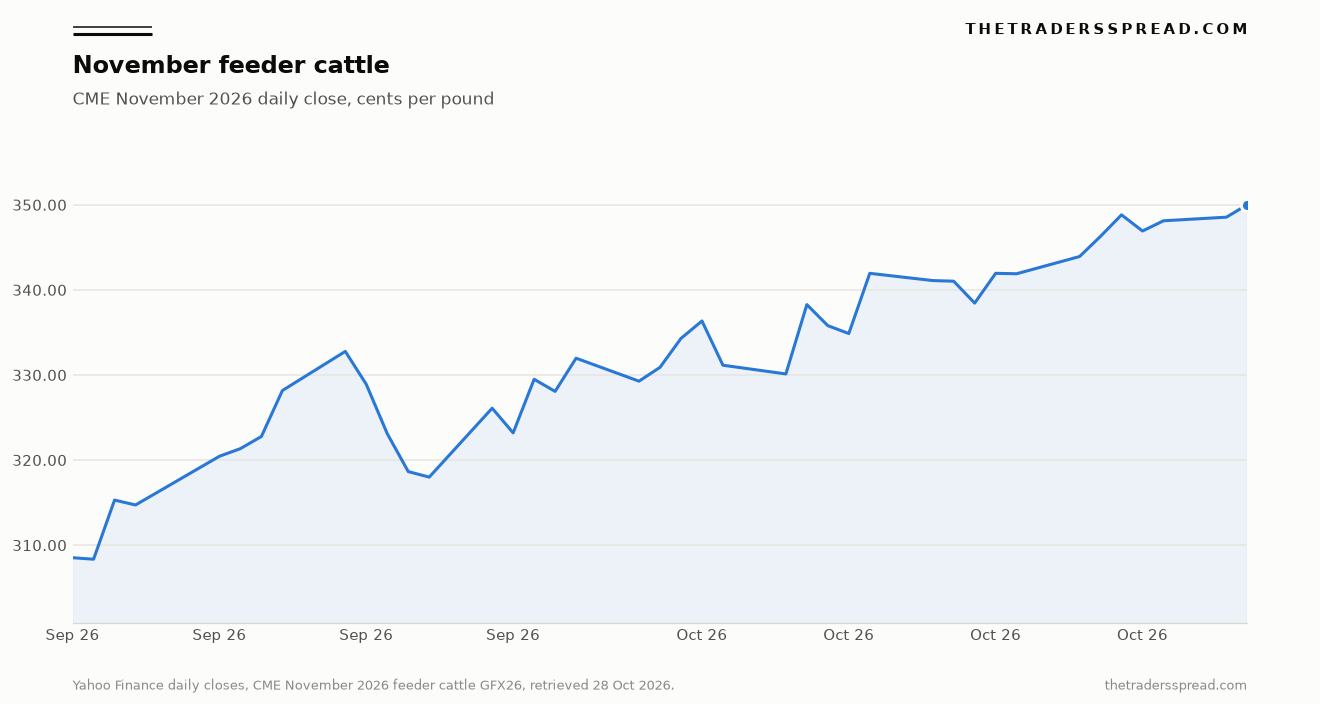
The chart is the November daily close from Yahoo Finance for that contract, retrieved on 28 October, ending at 350.025 cents. The low on the plotted window was 308.350 cents on 2 September, so Tuesday's 1.475 cent gain is the last step on a board that had already climbed out of the low 310s.
| Contract | Friday 23 October | Monday 26 October | Tuesday 27 October | Tuesday change |
|---|---|---|---|---|
| October 2026 feeder | 348.325 | 349.900 | 352.800 | +2.900 |
| November 2026 feeder | 348.125 | 348.550 | 350.025 | +1.475 |
| January 2027 feeder | 345.350 | 346.000 | 347.100 | +1.100 |
| December 2026 live cattle | 231.125 | 231.200 | 230.750 | -0.350 |
Closes are in cents per pound. Reuters, via The Cattle Site, supplies the November and January Tuesday settlements and the December live row. Yahoo Finance daily closes, retrieved 28 October 2026, supply the October row and the Friday and Monday January closes, and Tuesday's November and January prints match on both. The Yahoo continuous symbol tracked October, so it stays off the November row.
January 2027, which the Tuesday note called the most-active feeder month, settled at 347.100 cents, up 1.100, so November finished 2.925 cents above it, and October's Yahoo close of 352.800 sat 2.775 cents above November. Three feeder months rose while December live cattle moved from 231.125 on Friday to 230.750 on Tuesday.
Reuters attributed Tuesday's feeder strength to weaker grains and the live-cattle dip to concern about consumer demand. That note printed no corn settlement, so the grain line stays an attribution beside the two cattle closes. Feed still has its own market: feed barley already clears apart from malt.
Where the 244,000 head went missing
The widest placement gap is 800 to 899 pounds, 422,000 head against 486,000, down 64,000, and the other five brackets in the table make up the rest of the 244,000. A grass story that only quotes the lightest calves leaves that bracket out.
| Placement weight | September 2025, 1,000 head | September 2026, 1,000 head | Change, 1,000 head |
|---|---|---|---|
| Under 600 lb | 405 | 360 | -45 |
| 600 to 699 lb | 310 | 260 | -50 |
| 700 to 799 lb | 435 | 385 | -50 |
| 800 to 899 lb | 486 | 422 | -64 |
| 900 to 999 lb | 285 | 255 | -30 |
| 1,000 lb and over | 100 | 95 | -5 |
| Total placements | 2,021 | 1,777 | -244 |
Four states account for 225,000 of those 244,000 head: Nebraska placed 490,000 against 585,000, Texas 330,000 against 390,000, Kansas 420,000 against 465,000, and Colorado 130,000 against 155,000. The inventory holes are smaller than those placement holes. Nebraska's 1 October count was 2,550,000 against 2,560,000, so a 95,000-head placement drop left a yard only 10,000 head lighter, while Nebraska marketings were 400,000 against 445,000. The flow fell on the way in and on the way out, and the stock absorbed both.
Commodity and Ingredient Hedging's cattle desk made the geographic point on 26 October, on a three-month tally of its own rather than on this September table alone.
🗺️ The slowdown in feedlot placements isn't isolated to one state.
— CIH Cattle Team (@CIHCattleTeam) October 26, 2026
Over the last three months, 9 of 11 reporting states placed fewer cattle than a year ago.
📉 South Dakota: -22%
📉 Colorado: -19%
📉 Nebraska: -15%
📉 Kansas: -10%
📉 Texas: -8%#cattle #beef #CattleOnFeed pic.twitter.com/cf28wUUbFF
Heifers on feed were 4,300,000 head against 4,355,000, a decline of 55,000, printed as 99 percent of last year and 38 percent of the yard. Steers were 7,072,000 against 7,063,000, up 9,000, and the two classes add to 11,372,000. The Livestock Marketing Information Center's 23 October letter put the heifer share at 37.8 percent, against 38.1 percent a year earlier and a 32 to 34 percent range it cites for the rebuilding years of the middle of the last decade, with placements 12.1 percent under last year against an average pre-report guess of an 8.3 percent decline.
What this changes
September placements become marketings only after a feeding period, while September marketings are cattle that have already left the yard. An on-feed total that rounds to last year says the near-term pool of finished cattle was intact on 1 October, and the feeder board traded the forward hole while the December live board spent Tuesday going the other way.
Wholesale beef on Tuesday morning also moved apart from December live cattle. Choice boxed beef was $373.59 per hundredweight, up $4.15, and select was $360.11, up $2.55, in that Reuters note, while LMIC's weekly choice average for the week ending 24 October was $370.55 against $374.70 a week earlier. A morning bounce and a softer weekly average sit in the same record.
Packers were losing money on the finished animal while the feeder months rose. HedgersEdge, cited in the Tuesday note, put the average loss at $39.75 a head, against a loss of $33.30 on Monday and a profit of $34.50 a week earlier. The Friday note had the loss at $4.10 a head, down from a Thursday profit of $32.15, with slaughter at 96,000 cattle against 102,000 a week earlier. A feeder rally beside that widening loss is a cost on the feedyard's customer, which is a reason the live contract can fall on a day the feeder contract rises.
Cash auctions stepped up on the week and stayed well under last year. LMIC's Oklahoma City feeder steers at 600 to 700 pounds averaged $365.38 per hundredweight in the week ending 24 October, against $364.13 a week earlier and $400.82 a year earlier, a gap of $35.44. The November close of 350.025 cents a pound uses the same numeral as dollars per hundredweight, on a futures month rather than that auction bracket. Weekly slaughter was 546,000 head against 573,000 a year earlier, and the negotiated live-steer cell was blank against a week-ago average of $224.19.
RelatedRapeseed price myths break on the Paris seed contract
Logic Ag Marketing posted a separate caution on 28 October: later feeder-cattle crossings still have to clear inspection, and keep doing so, before they change the fed-cattle pool.
More feeder cattle crossing could eventually add to fed-cattle availability, but timing, rejection rates, and sustained weekly movement all matter.#cattle
— Logic Ag Marketing (@logicagmarket) October 28, 2026
Hogs are the control for a headline that says livestock futures rose. December lean hogs settled Tuesday down 2.650 cents at 62.025 cents, a fresh contract low in that note, on a market outside this Cattle on Feed release, and the cash side of that break is a separate record in the fall in the national negotiated hog base.
What to watch
- The next monthly placement and marketing lines, and whether both can print lows again while the on-feed cell stays near last year.
- The November 2026 feeder settlement against December 2026 live cattle. The gap was 119.275 cents a pound on 27 October, up from 117.000 cents on 23 October.
- Heifers at the next quarterly class table. On 1 October they were 4,300,000 head, 38 percent of the yard in NASS's share column.
- Oklahoma City 600 to 700 pound steers against the $365.38 weekly average for the week ending 24 October, and against $400.82 a year earlier.
- Packer margins on the HedgersEdge series Reuters cited. The Tuesday reading was a loss of $39.75 a head.
- October 2026 feeders against November into the front month's last sessions. On 27 October those prints were 352.800 and 350.025 cents.
FAQ
Which feeder cattle contract settled at 350.025 cents?
The 350.025 cent settlement is the November 2026 CME feeder cattle contract on Tuesday 27 October, up 1.475 cents on the day, in the Reuters report carried by The Cattle Site. January 2027 feeders, called the most-active month in that note, settled at 347.100 cents, up 1.100. The October 2026 month's Yahoo Finance daily close the same day was 352.800 cents. December live cattle, a different contract, settled at 230.750 cents.
Did the placement drop empty American feedlots?
September placements of 1,777,000 head were 244,000 below September 2025, and NASS calls that 12 percent lower, the lowest September since 1996. Cattle on feed on 1 October were 11,372,000 against 11,418,000, which is 46,000 fewer, and the comparison still printed as 100 percent. Marketings fell by 108,000 head, to 1,524,000. The placement hole shows up in the flow, while the stock of cattle already on feed held up because shipments fell too.
How is this different from the live-cattle placement story?
Feeder cattle futures follow animals moving toward the feedlot. Live cattle futures follow animals leaving it, finished for slaughter. On 27 October the November feeder month rose 1.475 cents to 350.025 and the December live month fell 0.350 cent to 230.750. This desk's August note followed the live side of an earlier release, when placements fell 9 percent. Swapping that live print for the November feeder close swaps the animal and the month.
Why did the feeder-to-live gap widen after the report?
Friday 23 October had November feeders at 348.125 cents and December live cattle at 231.125, a gap of 117.000 cents, before the report was out. Tuesday's closes were 350.025 and 230.750, a gap of 119.275 cents. The feeder month rose 1.900 cents over those two sessions and the live month fell 0.375 cent. The wider gap separates a smaller placement flow from a yard that also shipped fewer cattle.
Do the heifer counts show herd rebuilding?
Heifers on feed were 4,300,000 head on 1 October, down from 4,355,000. NASS prints that as 99 percent of last year and 38 percent of the yard. Steers were 7,072,000, up from 7,063,000. A rebuild would show heifers leaving feedlots in size. A decline of 55,000 head, with steers slightly higher, leaves the mix close to last October. LMIC put the share at 37.8 percent, against the low-30s shares it cites from the middle of the last decade.
Settlements and USDA counts record what those sources printed. They are a poor basis for a decision to buy or sell cattle, futures, or feed.