

The idea that manganese turned scarce when China's September ore imports rose misses the booking calendar, because those cargoes were ordered for a peak season that failed to show up and the tonnes are still sitting at the ports. The manganese price in this call is the northern China portside tape, and the four rows below are the whole view before any story is hung on them.
| Case | USD per mtu, VAT excluded | Where it sits against the 29 October print |
|---|---|---|
| Live print | 4.43 | Jupiter's VAT-excluded dollar equivalent of the SMM north China print |
| Bull | 5.00 | Above the print, level with the VAT-included dollar column on the same page |
| Base | 4.40 | A few cents under the print |
| Bear | 3.80 | Below the print |
Read the rows in that order. On 29 October 2026 the live print is 4.43 dollars per metric tonne unit with value-added tax taken out. The bull at 5.00 sits above that print. The bear at 3.80 sits below it. The base at 4.40 is a few cents under the print, which is why the bias is neutral and the target is the base. The chart horizon is 31 March 2027.
The useful contrast is already in the same week, on a different benchmark. Eramet's 29 October release says the market consensus for high-grade manganese ore, CIF China at 44 percent manganese, stands at around 4.95 dollars per dry metric tonne unit for the fourth quarter, against a CRU third-quarter average of 4.94. The high-grade seaborne index is being marked almost flat. The semi-carbonate portside print, on the tax-excluded dollar column, is 4.43. Those are different grades and different delivery points, and the gap between a flat 44 percent consensus and a portside price that has already round-tripped is the information in the first screen.
One metric tonne unit, the dmtu the producers quote, is one percent of manganese contained in a metric tonne, which is 10 kilograms of metal. Jupiter's quarterly for the three months to 30 June 2026 walks the conversion with a 4 dollar per dmtu price equalling 400 dollars per tonne of ore. The call, the chart and the three levels are all in dollars per tonne unit, tax excluded.
The traded quote Jupiter republishes from Shanghai Metals Market was 33.45 yuan per tonne unit, down 0.20 yuan, or 0.6 percent, on the week, and that yuan figure includes 13 percent VAT. The same page prints 5.00 dollars with the tax included, down 0.02 or 0.4 percent, and 4.43 dollars with the tax excluded. The two dollar columns are one observation with the tax in and the tax out. The VAT-excluded week-on-week line prints 0.02 beside a minus 0.4 percent, so the sign on those two cents is ambiguous and the prior-week dollar print is left unread. The prior-week yuan print is the safe one: 33.45 plus 0.20 is 33.65.
The page header titles the series Mn Ore South Africa (Mn 38 percent Fe 5 percent) - North and attaches a CIF tag. The note under the print is the definition this call follows. Jupiter says the figure is the traded price for ore of 36 to 37 percent manganese in northern China, that most imported ore arrives through Tianjin, and that the domestic yuan quote includes VAT at 13 percent. Jupiter sells before the ore leaves South Africa and stays out of the Chinese portside market, so 4.43 is the port tape, a separate number from the price Jupiter books on its own sales.
What the yuan path looks like in dollars
The chart converts the opened yuan path at the 29 October cross, 33.45 yuan divided by 4.43 dollars, and then pins the last point to the published 4.43. Earlier points are a constant-exchange translation of yuan ranges, history restated at today's cross.
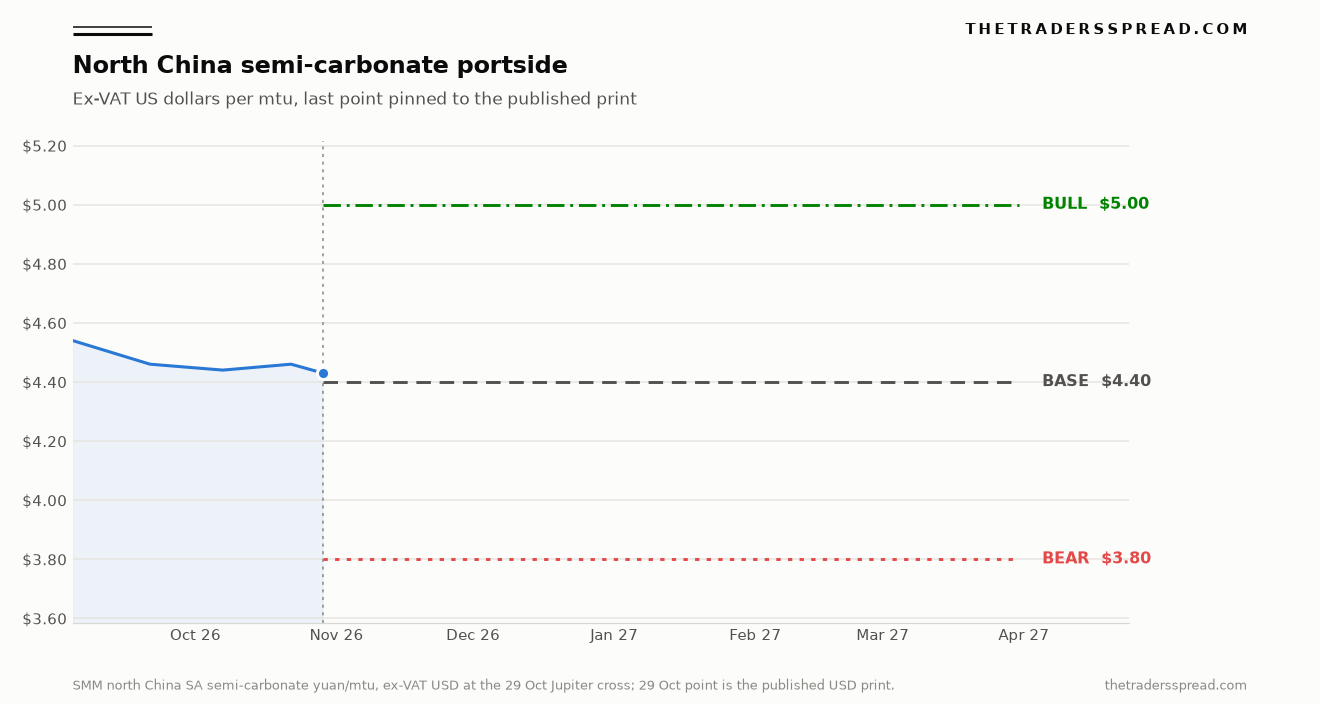
On 4 September, SMM put northern ports' South African semi-carbonate at 34 to 34.5 yuan per tonne unit, and the midpoint of 34.25 converts to 4.54 dollars. The weekly published 18 September, whose body dates the prices as 21 September news, had the same northern grade at 33.5 to 33.8 yuan, a midpoint that converts to 4.46. On 7 October, SMM described Tianjin semi-carbonate as roughly 33.5 yuan per manganese unit, about 4.44 on the same cross, with northern ports still carrying high inventory. Adding the 0.20 yuan decline back onto 33.45 gives a 22 October yuan print of 33.65, which converts to 4.46, and the series ends at the published 4.43. From 4.54 to 4.43 is a drift of about eleven cents, and a flat line at 4.40 carries that drift to the end of March.
Tonnes up, trucked sales down
Matt Daley, chief executive officer of South32, opened the September 2026 quarterly with a line about the group and then a line about manganese. "We've made a positive start to FY27, maintaining production guidance across all our operations and achieving key development milestones for our copper and zinc growth projects." The manganese sentence collides with the sales rows: "Manganese had a strong start to the year, with production increasing by 14 per cent as Australia Manganese benefitted from improved operating conditions following the wet season and South Africa Manganese lifted underground productivity at Wessels."
On South32's share, Australia Manganese, the 60 percent interest, produced 902,000 wet metric tonnes, up 15 percent on the June quarter's 782,000, while sales were 861,000, down 7 percent on 921,000. South Africa Manganese, the 54.6 percent interest, produced 588,000, up 11 percent on 528,000, with the lift at Wessels, while sales were 460,000, down 22 percent on 586,000, because trucked volumes were reduced and a shipment slipped into the December quarter. The report says the company continues to monitor market conditions and optimise the use of higher-cost trucking. Daley's "strong start" is a production sentence, and the same document then cuts the tonnes that had to move by truck. Reading the stock beside the headline tonne is the same habit as the zinc spread in Zinc Backwardation Fell From $217 to $79 as LME Stocks Rose.
A flat high-grade consensus
Christel Bories, Eramet group chair and chief executive, put the quarter in one sentence in the 29 October release from Paris. "In a market environment that remains complex and volatile, the improvement in our operational performance is confirmed, and the strengthening of our financial structure is ongoing."
In Gabon, Moanda production was stable at 1.9 million tonnes, and Setrag transported 1.7 million tonnes for Comilog, up 7 percent on the year-earlier quarter. External ore sales were 1.4 million tonnes, up 15 percent, and the realised selling price rose 18 percent, ahead of the CIF China 44 percent reference on mix. FOB cash cost, excluding mining taxes and royalties, averaged 2.2 dollars per dmtu. Royalties were 0.3 and sea transport was 0.9. Adding those three published pieces gives about 3.4 dollars per dmtu, arithmetic on the page, because the cash-cost definition leaves sea transport and the royalties outside. Full-year FOB cash-cost guidance of 2.4 to 2.6 dollars per dmtu was confirmed.
The price table, footnoted as the CRU CIF China 44 percent spot, prints a nine-month 2026 average of 5.14 dollars per dmtu and a third-quarter average of 4.94. The assumptions block sets the fourth quarter at about 4.95, and the outlook says that consensus "appears consistent" with the market. Eramet expects Chinese demand to keep declining, partly offset by India, and expects South African lower-grade exports to feel record diesel prices and higher sea freight around the Strait of Hormuz. That 4.95 is a higher-grade CIF consensus. The levels in the title are the 36 to 37 percent portside call.
Where the cost curve sits
The second table is the Fastmarkets path Jupiter published for the quarter ended 30 June 2026, released 31 July. It is a 36.5 percent CIF Tianjin index and a 37 percent FOB Port Elizabeth index, plus freight the prose quotes in dollars per tonne of ore. The PDF puts a per-dmtu label on the freight row. The sentences say dollars per tonne, and the freight column follows the sentences.
| Date | 36.5% Mn CIF Tianjin, USD/dmtu | 37% Mn FOB Port Elizabeth, USD/dmtu | Freight Port Elizabeth to Tianjin, USD per tonne |
|---|---|---|---|
| 27 March 2026 | 5.16 | 4.14 | 36.90 |
| 26 June 2026 | 4.64 | 3.71 | 33.80 |
| End of July 2026 | 4.38 | 3.34 | 38.70 |
The commentary around that table has the four-year average FOB index at 3.34 dollars per dmtu, and the end-July CIF spot at 4.38, about 5 percent above that average and 6 percent under the 30 June spot of 4.64. Dividing the end-July freight of 38.70 dollars per tonne by 36.5 percent gives about 1.06 dollars per dmtu, close to the 1.04 dollar gap between the 4.38 CIF print and the 3.34 FOB print. FerroAlloyNet port stocks in the same report were 5.013 million tonnes at 31 March, 5.612 million at 30 June and 5.865 million at the end of July.
Tshipi, on a 100 percent basis, sold 943,740 tonnes in the June quarter and 3,488,925 tonnes in the financial year, with quarterly production of 966,183 tonnes. FOB cost was 2.48 dollars per dmtu, against a full-year cost of 2.40, and average realised CIF for high-grade lump was 4.95 in the quarter and 4.38 for the year, a mine realisation beside the portside series. Take 3.80 on the portside, subtract about 1.06 dollars of that July freight, and the implied FOB is about 2.74, roughly a quarter of a dollar over the 2.48 cost. The sketch mixes July freight, an October portside level and a June cost, and the bear level itself stays 3.80.
Ian Murray, Jupiter's chair, was talking about succession in the 11 September announcement, in a sentence that still names the mine: "The Board would like to thank Brad for his valuable contribution to our business over the last four years. During this period, Jupiter has continued to provide strong investment returns for shareholders, while working in partnership with Tshipi and our joint venture partners to define and pursue pathways to optimise value for all stakeholders." Brad Rogers, managing director through the end of November 2026, said: "It has been an honour to lead the talented team at Jupiter over the last four years." He also thanked "the high performing management team at Tshipi, who have been a pleasure to work alongside, and our partners – Ntsimbintle Holdings and now Exxaro Resources."
Steel is the buyer
Worldsteel's 23 October release, covering 70 countries and about 98 percent of 2025 world output, put September crude steel at 142.4 million tonnes, down 0.2 percent on the year. China produced 724.8 million tonnes in nine months, down 2.9 percent, and India produced 130.0 million tonnes in nine months, up 5.6 percent. That Chinese decline is the demand anchor, with India the offset Eramet names.
SMM's 20 October note puts September manganese ore imports at 2.8114 million tonnes, up 9.55 percent on the month and down 8.86 percent on the year. South Africa shipped 1.3864 million tonnes of that, down 18.55 percent on the month, while January-to-September imports of 25.9544 million tonnes were up 9.17 percent on the year. Major-port inventories stayed above 5.9 million tonnes, above the 5.865 million at the end of July, which is why a higher import month still left the ports full.
SMM's unbylined forward line is that if steel misses the peak season and silicomanganese cuts broaden, the market can shift from import restocking toward slow port destocking. The portside dollars here are narrower than that chain. Another bulk that clears through the same mills is already on this desk in Iron Ore Price Prediction: $125 Bull Case vs $72 Bear Case, and a sister metal with its own cost curve is in Nickel Price Prediction: $19,500 Bull Case vs $14,500 Bear Case.
Key facts
Related9.6% coking coal price fall on China's mid-month survey
- Northern China South African semi-carbonate traded at 33.45 yuan per tonne unit on 29 October 2026, down 0.20 yuan on the week, with a VAT-included dollar equivalent of 5.00 and a VAT-excluded equivalent of 4.43. Source: Jupiter Mines manganese price page, citing Shanghai Metals Market, 29 October 2026.
- China imported 2.8114 million tonnes of manganese ore in September 2026, up 9.55 percent on the month and down 8.86 percent on the year, and major-port inventories stayed above 5.9 million tonnes. Source: Shanghai Metals Market, 20 October 2026.
- South32's South Africa Manganese sales were 460,000 wet metric tonnes in the September 2026 quarter, down 22 percent on the prior quarter, after trucked volumes were reduced. Source: South32 September 2026 quarterly report.
- Eramet put the fourth-quarter market consensus for CIF China 44 percent ore at around 4.95 dollars per dmtu, against a CRU third-quarter average of 4.94. Source: Eramet Q3 2026 press release, 29 October 2026.
- Tshipi's FOB cost of production was 2.48 dollars per dmtu in the quarter ended 30 June 2026, and the end-July Fastmarkets 36.5 percent CIF Tianjin print was 4.38. Source: Jupiter Mines Q4 FY2026 quarterly, 31 July 2026.
- Crude steel output in 70 countries was 142.4 million tonnes in September 2026, down 0.2 percent on the year, and China's January-to-September output was 724.8 million tonnes, down 2.9 percent, source: worldsteel, 23 October 2026.
Base, bull, and bear
The base is 4.40 dollars per tonne unit, tax excluded, through 31 March 2027, a few cents under the 4.43 print and close to the end-July Fastmarkets 36.5 percent CIF print of 4.38, a neighbouring benchmark. A neutral bias frames the next five months as a hold near that print, with Chinese nine-month steel output down 2.9 percent, port stocks above 5.9 million tonnes, and the trucked South African tonnes already pulled. Conviction is three on a five-point scale: the dollar history before 29 October is a translation, and a wet season in northern Australia or a faster Indian melt can move a thin market by more than three cents.
The bull at 5.00 is the VAT-included dollar column on the 29 October page, so the case asks the tax-excluded portside price to rise until it matches that same-day column. It is also a partial retracement toward the 27 March Fastmarkets high of 5.16, and it stops short of that high. Getting there would need the ports to start clearing and the idled trucks to be wanted again, while the high-grade CIF consensus near 4.95 stops acting as a ceiling.
The bear at 3.80 sits below the live print and, on the freight sketch, implies an FOB near 2.74, about a quarter of a dollar over Tshipi's 2.48 cost. A print there would mean the cost curve had stopped holding the portside price near the base, which is why 3.80 is the invalidation as well as the bear. The entry is 4.43 and the target is 4.40, so a weekly SMM print through 3.80, tax excluded, on this northern semi-carbonate series, retires the hold.
FAQ
Which manganese price is the call using?
The call uses the northern China portside print Jupiter republished from Shanghai Metals Market on 29 October 2026. Traders dealt at 33.45 yuan per metric tonne unit, a quote that includes 13 percent VAT, and the tax-excluded dollar equivalent on that page is 4.43. Jupiter's note describes ore of 36 to 37 percent manganese, mostly through Tianjin. The series is separate from Jupiter's own FOB sales and from the CRU 44 percent CIF China index Eramet quotes near 4.95.
Why is the bull case 5.00 when March printed 5.16?
The 5.16 figure is the Fastmarkets 36.5 percent CIF Tianjin index on 27 March 2026, from Jupiter's July quarterly. The bull here is 5.00 because that number already sits on the 29 October page as the tax-included dollar equivalent. Reaching it on a tax-excluded basis would lift the print from 4.43 and still finish short of the March high. The title uses 5.00 as the level above today's print that the same source already shows.
How does a tonne unit convert to a tonne of ore?
One metric tonne unit, or dmtu, is one percent of manganese in a metric tonne, equal to 10 kilograms of metal. Jupiter's June-quarter report shows a 4 dollar per dmtu price as 400 dollars per tonne of ore, so 4.43 is about 443 dollars a tonne and 5.00 is about 500. The chart stays in dollars per tonne unit so the live print and the call share one unit.
What would retire the base case?
A tax-excluded print of 3.80 dollars per tonne unit on this northern semi-carbonate series retires the view that the portside price holds near 4.40. After about 1.06 dollars of the end-July freight, that level sketches an FOB near 2.74, close to Tshipi's June-quarter cost of 2.48. Until a weekly print goes through 3.80, the base stays the target and today's 4.43 stays the entry.
Is the 4.95 figure the same benchmark?
Eramet's 29 October statement puts the fourth-quarter consensus for high-grade CIF China 44 percent ore at about 4.95 dollars per dmtu. CRU's third-quarter average for that index was 4.94, so the consensus is almost unchanged. The portside call is 36 to 37 percent material in northern China, at 4.43 with VAT excluded, and the two figures are a grade and delivery gap between different contracts.
If the ports are still full in March, which level is the tape?
If major Chinese ports are still holding more than 5.9 million tonnes at the end of March 2027, and South Africa is still leaving the higher-cost trucks idle, does the northern semi-carbonate portside print hold near 4.40 dollars per tonne unit, or does the bear at 3.80 become the weekly tape?
This article records the 29 October 2026 portside print and a set of levels around it. It is not a recommendation to buy or sell manganese ore, silicomanganese, or any related security.