

Is the JKM LNG market still bidding winter cargoes higher, or has the October climb already levelled off at the latest settlement? The CME December 2026 LNG Japan/Korea Marker (Platts) future, labelled JKMc1, closed at 32.840 dollars per MMBtu on 30 October 2026, up 0.805 dollars, or 2.51 percent, from the prior close of 32.035. The historical page for that contract, opened on 1 November 2026, marks the session closed on 30 October, with the day's high, low and close all printing 32.840.
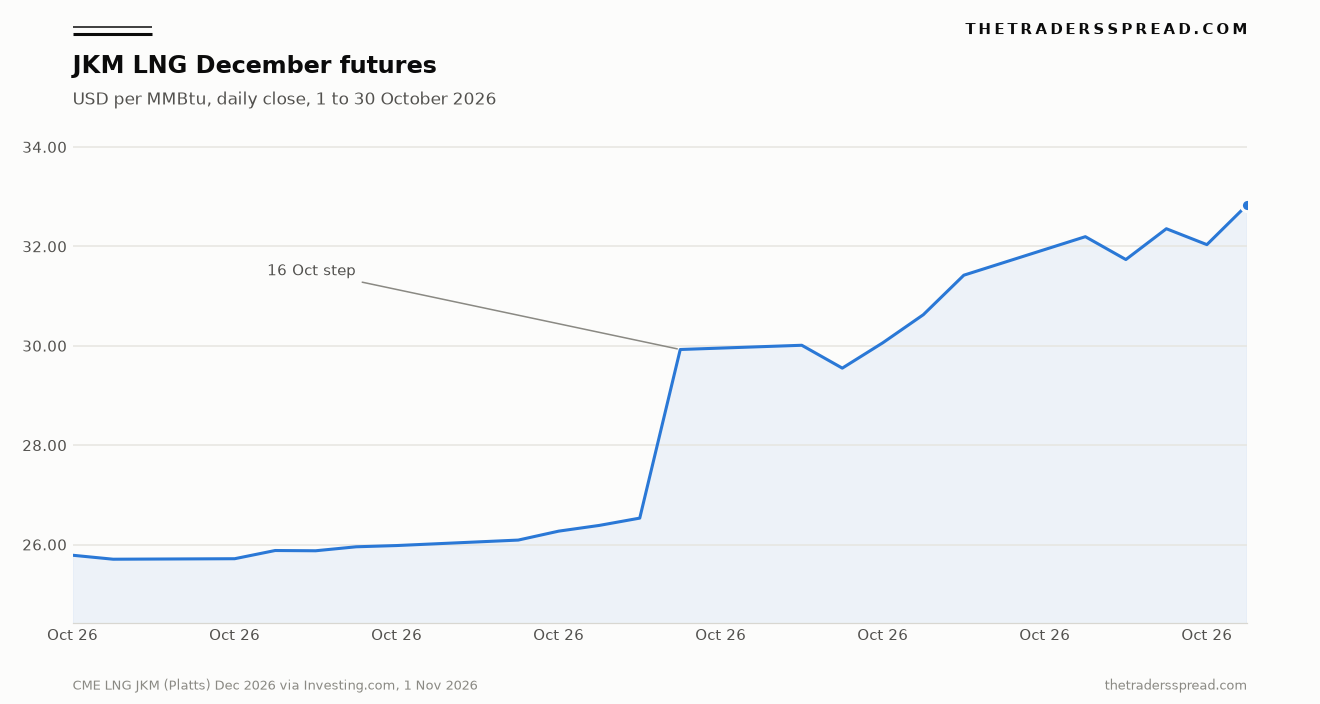
Friday is a late step on a longer climb. The same page's 1 October close is 25.785. From that close to 32.840 the rise is 7.055 dollars, or 27.36 percent, a calculation on those two prints. The page's own summary for 1 October through 1 November lists a change of 27.584 percent, an average of 28.587, a high of 32.840, a low of 25.705 and a high-low difference of 7.135. Those two percentage figures start from different points, so they stay side by side. The largest day in the window is 16 October, when the close moved from 26.532 to 29.925 and the table prints a gain of 12.79 percent.
A second page sets Friday against other fuels. Energy Trend, updated at 07:15 on 1 November 2026 and sourced there to ICE and public market data, lists the JKM LNG price at 32.84 dollars per MMBtu for 30 October, up 0.81 dollars, or 2.51 percent. For the same price date, TTF natural gas is 103.94 euros per megawatt-hour, up 5.36 euros, or 5.43 percent, Brent is 117.64 dollars a barrel, up 2.40 percent, and WTI is 104.12 dollars a barrel, up 2.08 percent. The Asian LNG futures day-move sat with the crude marks. The European gas mark, in euros, moved by a larger percentage. Dollar-yen on the page was 157.80. Multiplying 32.84 by 157.80 gives about 5,182 yen per MMBtu, a same-day calculation.
Key facts
- The CME LNG Japan/Korea Marker (Platts) December 2026 future, JKMc1, closed at 32.840 dollars per MMBtu on 30 October 2026, up 0.805 dollars, or 2.51 percent, from 32.035. Source: Investing.com historical page, retrieved 1 November 2026.
- For 1 October to 1 November 2026 the page lists a high of 32.840, a low of 25.705, an average of 28.587 and a change of 27.584 percent. Source: Investing.com historical page, retrieved 1 November 2026.
- The 16 October close was 29.925, up 12.79 percent from 26.532 on 15 October, the largest one-day change in the window. Source: Investing.com historical page, retrieved 1 November 2026.
- Energy Trend lists JKM at 32.84 dollars per MMBtu on 30 October, a 7-day average of 31.89 and a 30-day average of 27.87, with the page updated at 07:15 on 1 November 2026. Source: Energy Trend fuel-market page, 1 November 2026.
- Japan's LNG inventories for power generation were 2.54 million tonnes as of 18 October, down 0.10 million tonnes from the prior week, announced 21 October. Source: Global LNG Hub weekly note, 29 October 2026, drawing on JOGMEC updated 26 October 2026.
- The Northeast Asian assessed spot price for December delivery stood in the high USD 31s per MMBtu on 23 October, up from the high USD 29s on 16 October. Source: Global LNG Hub, 29 October 2026.
A slow grind through the mid-25s
From 1 October through 15 October the December future edged higher in small daily steps. The close started at 25.785, touched the window low of 25.705 on 2 October, and finished that stretch at 26.532 on 15 October. Daily changes ran from a 0.31 percent dip on 2 October to a 0.69 percent rise on 13 October. The rise across the stretch is 0.747 dollars, or 2.90 percent, a calculation on the first and last of those closes. The page already labels the history as the December 2026 contract, so the grind is one future being marked higher a few cents at a time.
The assessed spot market was on a November delivery month for the early part of that fortnight. Global LNG Hub's 21 October note, updated from a JOGMEC series dated 19 October, says the Northeast Asian assessed spot price rose to the high USD 29s per MMBtu on 16 October, December delivery, from the low USD 26s on 9 October, November delivery. The futures close of 25.980 on 9 October sits in that low-USD-26s description. A futures close and an assessed spot price can rhyme in level and still be different instruments. The hub says the assessment reached the low USD 29s on 13 October, then eased on 14 and 15 October as Japanese spot demand stayed weak.
Where the curve jumped
On 16 October the assessed delivery month rolled to December and the hub's price rose to the high USD 29s. The futures table shows the same date as a break. JKMc1 closed at 29.925, up 3.393 dollars from 26.532, the 12.79 percent the page prints. That session added more dollars than the prior fortnight's 0.747 dollar rise, and more than the later stretch from 29.925 to 32.840, which is 2.915 dollars, or 9.74 percent. Friday's 2.51 percent is a later increment on a level the contract had already reset.
METI announced on 14 October that Japan's LNG inventories for power generation stood at 2.64 million tonnes as of 11 October, up 0.07 million tonnes from the previous week. The stock build was announced two days before the futures jump. The inventory figure is a physical balance for power generators, and 29.925 is a futures mark.
In the same hub note, TTF for November delivery rose to 28.9 dollars per MMBtu on 16 October from 26.7 on 9 October, while Henry Hub for November delivery fell to 3.1 from 3.2. EU storage on AGSI+ was 74.3 percent on 16 October, up from 73.5 percent the previous weekend, 10.9 percent below a year earlier and 16.5 percent below the five-year average. EIA stocks as of 9 October were 3,567 billion cubic feet, up 67 billion cubic feet, 3.9 percent below a year earlier and 1.3 percent above the five-year average. The US benchmark was soft while the Asian marks were resetting higher.
High 31s, then a pause
After the step the futures closes kept climbing, with one down day that left the contract above 29. The path was 30.010 on 19 October, up 0.28 percent, 29.550 on 20 October, down 1.53 percent, 30.060 on 21 October, up 1.73 percent, 30.625 on 22 October, up 1.88 percent, and 31.420 on 23 October, up 2.60 percent. By 23 October the contract was 1.495 dollars above the 16 October close.
Giovanni Staunovo posted, on 22 October, a headline that Asia was entering the winter LNG demand season with JKM at a four-year high amid uncertainties. The post falls after the 16 October step and before Friday's settlement, and it relays a news headline rather than a price target of its own.
Asia enters winter LNG demand season just as JKM hits four-year high amid uncertainties https://t.co/WDahe9v5s0
— Giovanni Staunovo🛢 (@staunovo) October 22, 2026
The hub's later note, bylined David Callanan on 29 October and updated from JOGMEC on 26 October, covers 19 to 23 October. The Northeast Asian assessed price for December delivery rose to the high USD 31s per MMBtu on 23 October from the high USD 29s on 16 October. It climbed above 30 dollars early in the week on Middle East supply risk and forecasts of a colder-than-normal European winter, was flat to slightly lower on 20 and 21 October as Northeast Asian winter procurement slowed, then rose on stronger prompt demand from China, South Korea and India. The futures close of 31.420 on 23 October sits inside that high-USD-31s band.
METI's next stock figure, announced 21 October, put LNG inventories for power generation at 2.54 million tonnes as of 18 October, down 0.10 million tonnes. Against the 2.64 million tonnes dated 11 October, the draw matches the announcement. Reported generator stocks fell in a week when the futures price rose.
TTF for November delivery rose to 30.8 dollars per MMBtu on 23 October from 28.9 on 16 October, after a dip below 28 on 20 October and a rebound the hub ties to Norway's Troll and Asgard fields, colder forecasts and renewed Middle East tension. EU storage was 74.6 percent on 23 October, 10.6 percent below a year earlier and 16.6 percent below the five-year average. The first net withdrawal of the winter season was recorded on 20 October. Henry Hub for November delivery fell to 2.6 dollars per MMBtu on 23 October from 3.1, about 15 percent lower on the hub's wording. EIA stocks as of 16 October were 3,644 billion cubic feet, up 77 billion cubic feet, 4.0 percent below a year earlier and 1.0 percent above the five-year average.
Friday's settlement in dollars
The last four sessions carried the contract through 32 and back to the high of the window. Closes were 32.195 on 26 October, up 2.47 percent, 31.735 on 27 October, down 1.43 percent, 32.355 on 28 October, up 1.95 percent, 32.035 on 29 October, down 0.99 percent, and 32.840 on 30 October, up 2.51 percent. From 31.420 on 23 October to 32.840 the rise is 1.420 dollars, or 4.52 percent, a calculation on those two prints. Two of those four sessions were down days, and the contract still finished at the window high.
Energy Trend's averages put Friday above both recent means. The 7-day average is 31.89, so 32.84 sits 0.95 dollars above it. The 30-day average is 27.87, so the same close sits 4.97 dollars above it. Both gaps are calculations from the page's averages and the 32.84 print. The short mean says the last week was already high. The long mean says the month itself was the climb.
| Date | Close, USD/MMBtu | Day change | What the level lines up with |
|---|---|---|---|
| 1 Oct 2026 | 25.785 | +0.17% | Start of the futures window |
| 16 Oct 2026 | 29.925 | +12.79% | Hub: high USD 29s, December delivery |
| 23 Oct 2026 | 31.420 | +2.60% | Hub: high USD 31s on the assessment |
| 29 Oct 2026 | 32.035 | −0.99% | Prior close before Friday |
| 30 Oct 2026 | 32.840 | +2.51% | Window high, and the top of the printed 52-week range |
The table uses the JKMc1 closes on the Investing.com historical page retrieved 1 November 2026, with hub comparisons from the 21 October and 29 October notes, which credit JOGMEC. The 52-week range on the futures page runs from 9.455 to 32.840, so Friday's close equals the top of that published range. The distance between those ends is 23.385 dollars, and the futures page's long lookback, as opened, is that 52-week span.
Related$5.00 Bull and $3.80 Bear Frame the Manganese Call
Every October row shows a blank volume cell, and the page's volume answer reads 0. Open, high, low and close are identical on 30 October, the pattern of a settlement-style mark with traded volume left empty. Fusion Media's notice says the site's prices can come from market makers and can differ from an exchange print, so the series is indicative. The CME daily bulletin was unreachable in this session. The 32.840 figure is the December futures close on the opened page, not a Platts LNG Daily assessment.
Cargoes, stocks, and the European gap
What the settlement changes is the reference a winter cargo is marked against when a desk uses this futures close as a public proxy. The contract finished October at 32.840 after spending 1 to 15 October between 25.705 and 26.532, a gap of 6.308 dollars from the top of that early band. A monthly average would include the quiet first half. A late-month mark would use 32.840. The futures page calls the contract December 2026 throughout, while the assessed spot series rolled from November to December delivery on 16 October, the same date as the futures step.
Japanese generator stocks run only through 18 October in the notes opened here. Inventories rose by 0.07 million tonnes to 2.64 million tonnes as of 11 October, then fell by 0.10 million tonnes to 2.54 million tonnes as of 18 October. That later print predates the futures closes from 26 October through 32.840. The draw is a weekly swing in power-sector LNG in Japan. It lines up with a tighter tone that week, and it stops too early to size the move from 31.420 to 32.840. Prompt demand from China, South Korea and India stays where the hub put it, as reported support for the assessment into 23 October.
Europe's Friday parallel is larger in percentage terms and lives in a different unit. TTF at 103.94 euros per megawatt-hour, up 5.43 percent, is a euro gas price. The hub's TTF path through 23 October is in dollars per MMBtu and ends at 30.8, up from 28.9 on 16 October. The desk's separate European TTF forecast is the page for that benchmark. EU storage at 74.6 percent on 23 October, with the first net withdrawal dated 20 October, is the storage context the hub supplies.
Henry Hub at 2.6 dollars per MMBtu on 23 October, down from 3.1 on 16 October, is the last US gas level in those notes, beside EIA working gas of 3,644 billion cubic feet as of 16 October. The desk's US Henry Hub forecast covers that benchmark on its own page. An Asian settlement at 32.840 and a US price last recorded here at 2.6 are two markets that spent mid-October moving apart. Another winter fuel on this desk is propane's 19.5 percent rise over a month as US stocks fell from a record, a separate commodity from JKM LNG.
At 157.80 yen per dollar on 30 October, the 32.84 dollar close is about 5,182 yen per MMBtu. Cargoes booked in yen meet that settlement in local currency when the screen price is quoted in dollars.
What to watch
- The next METI power-generation LNG stock figure after 2.54 million tonnes as of 18 October, announced 21 October.
- Later December futures closes relative to the high-USD 31s band the hub recorded for the 23 October assessment, with 32.840 the latest futures close in this record.
- The next same-day percentage gap between the JKM futures mark and the euro TTF mark on a public fuel page. On 30 October those moves were 2.51 percent and 5.43 percent, in different units.
- EU storage after the 74.6 percent AGSI+ reading on 23 October, following a first net withdrawal dated 20 October.
- Screen volume on the JKMc1 page. It read 0 on the retrieval of 1 November, beside a 30 October range that equalled the close at 32.840.
- The CME settlement sheet, once a public copy is in hand, set beside this indicative futures series and Fusion Media's market-maker caveat.
Market commentary of this kind is not investment advice.