

I opened the January 2027 Robusta coffee contract on ICE Futures Europe before the London open on 5 November 2026, and the board still carried the prior session: 3,225 dollars a tonne at 17:29 GMT on 4 November, with 8,825 lots through it. November 2026, the expiring month, showed 3,227 dollars and two lots at 16:04 GMT. January is the contract with the volume a desk can actually read.
That print sits in the wrong unit to park beside Arabica. Coffee C, the New York arabica future, is quoted in cents per pound, while London Robusta is quoted in dollars per metric tonne. A reader who sets 3,225 next to a cents print is setting a tonne against a pound. The International Coffee Organization puts both markets into US cents per pound, as averages of the second and third positions, and only then talks about the gap. In September 2026 that pair was 154.28 cents for London and 280.68 cents for New York, and the arbitrage the ICO prints between them was 126.40 cents, 13.2% narrower than August.
The same September report had London certified Robusta stocks rising while New York arabica stocks stayed near the floor of a long range. One January lot at the 3,225 print is 32,250 dollars of coffee, and the arabica lot is a different mass in a different unit, so a one-for-one hedge misses the comparison.
Updated 5 November 2026
Key facts
- January 2027 Robusta last traded at 3,225 dollars a tonne at 17:29 GMT on 4 November 2026, volume 8,825. The board’s last update was 21:35 GMT, delayed at least 15 minutes. ICE Futures Europe Robusta data page, retrieved 5 November 2026.
- The Robusta lot is ten tonnes, symbol RC, quoted in US dollars per metric tonne, with a one-dollar tick worth 10 dollars a lot. ICE Futures Europe contract specification, retrieved 5 November 2026.
- Coffee C is 37,500 pounds, symbol KC, quoted in US cents per pound, with a minimum fluctuation of 5/100 of a cent, or 18.75 dollars a contract. ICE Futures US product page, retrieved 5 November 2026.
- The ICO’s London Robusta average was 154.28 US cents per pound in September 2026, down 8.0% from August, against a New York arabica average of 280.68 cents. ICO Coffee Market Report, September 2026.
- London certified Robusta stocks were 0.87 million bags at end-September 2026, up from 0.83 million at end-August. US certified arabica stocks were 0.27 million bags, up from 0.24 million. ICO Coffee Market Report, September 2026.
- Robusta production for coffee year 2025/26 is estimated at 79.2 million 60-kilogram bags, arabica at 104.4 million, total production 183.6 million. ICO Coffee Market Report, September 2026, Table 3.
- On a London clock the Robusta screen runs 09:00 to 17:30 and Coffee C runs 09:15 to 18:30. ICE product pages, retrieved 5 November 2026.
Two screens, two units
The claim that travels around a blended book is simple. Robusta is Arabica with a cheaper sticker, so the two boards can be read as one market and the difference is quality. The contract pages are duller, and they are the pages that still matter in six months.
Robusta, symbol RC, is listed on ICE Futures Europe. The product page and the specification PDF dated 5 November 2026 describe a ten-tonne lot, a quote in US dollars per metric tonne, and a one-dollar tick worth 10 dollars a lot. Settlement is physical delivery into an exchange-nominated warehouse in Europe or the United States, and the origin can be any Robusta freely available for export. Class 1 is deliverable at the contract price. Other qualities pass at set premiums and discounts. The daily price limit field is filled with “None”. Months run January, March, May, July, September and November, ten delivery months out. First notice day is the fourth business day before the first business day of the delivery month. Last trading day is the fourth business day before the last business day of the delivery month, at 12:30.
Coffee C, symbol KC, is the arabica benchmark on ICE Futures US. The Coffee C page opened the same morning sets the lot at 37,500 pounds and the quote in cents and hundredths of a cent, with a tick of 5/100 of a cent per pound worth 18.75 dollars a contract. Months are March, May, July, September and December. First notice falls seven business days before the delivery month, and last trading day is one business day before last notice day. Growths are named, with a par group, a 1,000 point premium on Colombia, Costa Rica and Kenya, and a 600 point discount on Brazil. From the May 2027 expiry Vietnam joins at that same 600 point discount, still inside the arabica contract, so a London Robusta warrant leaves the New York growth schedule alone.
Inside Coffee C the port already moves the invoice: New York District and Virginia at par, New Orleans, Miami and Houston at a 0.50 cent discount, and Bremen/Hamburg, Antwerp and Barcelona at 1.25 cents. Robusta is wider on origin and quieter on place, which is why the two coffees produce two invoices.
What the contract actually fixes
The useful comparison is the specification, read across, with the hours taken from the same product pages.
| Robusta, RC | Arabica, KC | |
|---|---|---|
| Exchange | ICE Futures Europe | ICE Futures US |
| Lot | 10 tonnes | 37,500 pounds |
| Quote | US dollars per metric tonne | US cents per pound |
| Tick | 1 dollar a tonne, 10 dollars a lot | 0.05 cent a pound, 18.75 dollars a lot |
| Months | Jan, Mar, May, Jul, Sep, Nov | Mar, May, Jul, Sep, Dec |
| London trading hours | 09:00 to 17:30 | 09:15 to 18:30 |
| Delivery | Nominated warehouse in Europe or the US; any freely exportable origin | Licensed warehouses at named ports; named growths with premiums and discounts |
Sources: ICE Futures Europe Robusta specification and product page, and the ICE Futures US Coffee C product page, both retrieved 5 November 2026. The London hours are the trading ranges those pages print for the London clock.
The quiet-market claim
A second claim says Robusta sits still while Arabica does the moving, so a volatility budget can ignore London. September 2026, in the ICO Coffee Market Report, answers with ordinary numbers: the Robustas group indicator at 8.8%, London futures at 9.7%, New York futures at 13.4%, and the ICO composite at 10.0% against 13.7% in August.
August had the same shape with a wider gap: London futures at 13.2%, New York at 19.9%, and the Robustas indicator unchanged at 11.0% from July. Arabica’s screen was the jumpy one in both months. London still re-priced, and an arabica option covers the New York variance rather than the London one.
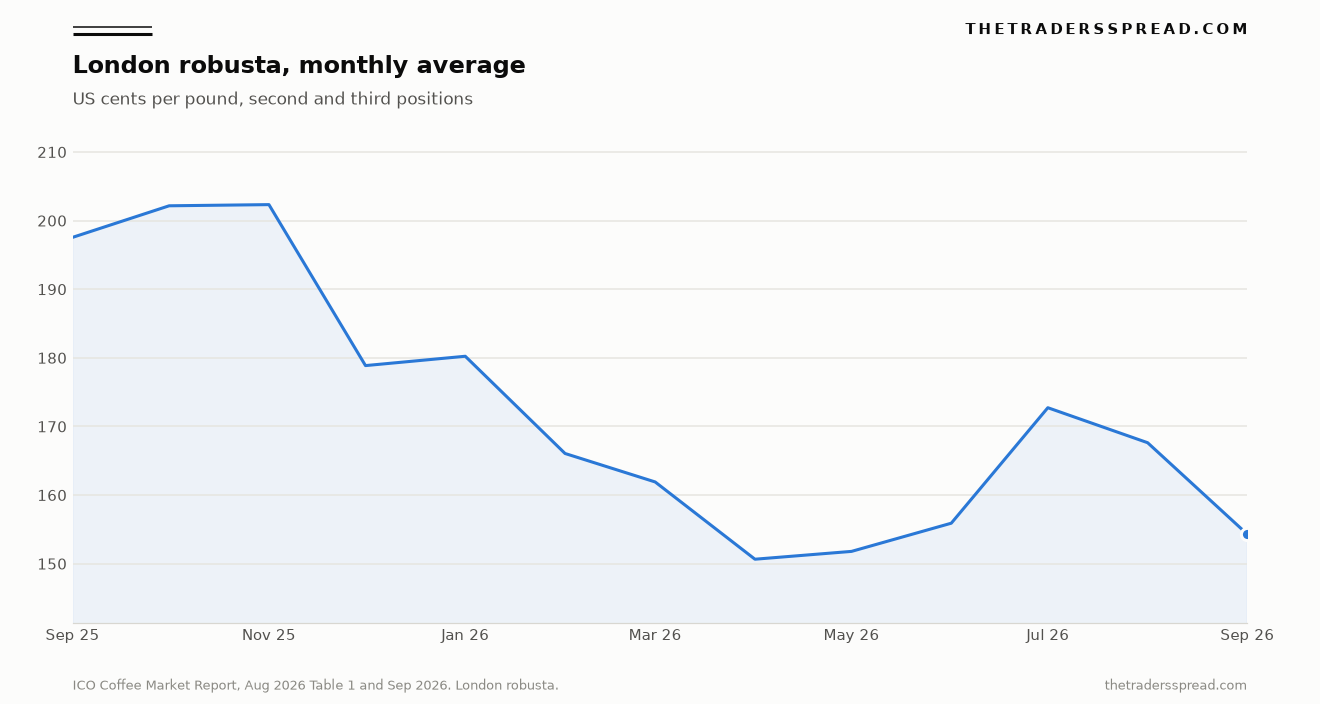
The chart is that London average. It runs from 197.56 cents in September 2025 to 202.33 in November 2025, down to 150.65 in April 2026, back to 172.73 in July and 154.28 in September 2026, an 8.0% fall from August’s 167.63. The August price table supplies the earlier months and the September report supplies the last point. It will disagree with the January settlement I opened, because one figure is a month of two deferred positions in cents and the other is one afternoon in dollars a tonne.
Certified stocks moved apart
The third claim treats certified stocks as one coffee number, so a thin New York warehouse is supposed to mean London is thin too. The ICO’s end-month tables split that story cleanly.
Table 5 of the August 2026 report puts New York at 0.24 million bags and London at 0.83 million. The narrative says London stocks rose 19.5% from July to a nine-month high, while US certified arabica stocks fell to 0.24 million bags, the lowest since 1999 and about 68% under a year earlier. The same paragraph also cites 223,976 arabica bags on 31 August, so the bag count and the million-bag line both stand as printed.
September then lifts both piles by very different amounts. London certified Robusta stocks rose to a 10-month high of 0.87 million bags, from 0.83 million. US certified arabica stocks rose to 0.27 million bags from 0.24 million. Inside the month the report records 217,646 arabica bags on 15 September, again the lowest since 1999, and 260,654 bags by 30 September. Low arabica stocks supported nearby prices, while a narrower backwardation reduced the incentive to deliver, so heavy physical exports could sit beside a thin certified stock.
Robusta certified stock rebuilt through late summer while arabica certified stock stayed near a multi-decade low. Origin arrivals and the exchange certificate are different objects on cocoa as well: one is still on the road, the other is a graded lot in a named warehouse.
Vietnam carries the tape, and Brazil’s conilon is in it
The origin claim is the one a weather note loves: Robusta is a Vietnam market, so a Central Highlands forecast is the whole book. Coffee year 2025/26, Table 3 of the September report, puts Robusta production at 79.2 million 60-kilogram bags and arabica at 104.4 million, inside total production of 183.6 million and consumption of 180.6 million. The report calls that a 3.0 million bag surplus after four deficit years, less than a week of global consumption, and it estimates Robusta’s share of world output at 43.1%, against a 41.7% average across 2023/24 and 2024/25.
August green-bean exports show where the extra tonnes went. Robusta shipments were 4.36 million bags, up 22.4% on August 2025, and the October-to-August total was 45.59 million bags, up 11.8%. Vietnam and Brazil drove the month. Vietnam’s Robusta exports jumped 69.2% to 1.78 million bags. Brazil’s jumped 54.9% to 0.96 million bags. The report ties Brazil’s flow to the 2026/27 crop-year harvest, estimated at a record 25.1 million bags of Robusta, up 11.1%, with Brazil’s coffee-year-to-date Robusta exports at 5.29 million bags.
The coffee note already on this desk follows the private Brazil forecasts. Vietnam was still the largest Robusta shipper in the August cut, with all-forms exports up 48.0% to 2.24 million bags and a coffee-year-to-date total up 19.5% at 30.34 million. The FAS Vietnam annual returned an access error when I tried it on 5 November, so the farm-level area forecast stays out. The ICO had already flagged the export mix, as supply rather than a price call, when the May factsheet came out.
Our May 2026 Monthly Coffee Factsheet is out and here are the highlights:
— International Coffee Organization (ICO) (@ICOCoffeeOrg) June 24, 2026
Global exports reached 12.1 million bags in April; 2026 Robusta is on the rise: up 10.3% compared to last year
Want to dig deeper into the numbers? Visit https://t.co/GrXvd3WP4v pic.twitter.com/71Jpc9bWhw
Arabica’s share of green-bean exports for the first 11 months of 2025/26 fell to 59.6% from 63.5%, which the report calls the first time that share has sat under 60% for that slice of a coffee year. A book fixed only on the Central Highlands misses Brazil’s second harvest.
RelatedWhat Moves the Shanghai Steel Rebar Price Each Month
A spread with a definition
Subtract the two front-month screens and, on the popular telling, you hold the arabica-Robusta spread. The ICO’s arbitrage is New York minus London, each an average of the second and third positions in US cents per pound, which is why that telling fails. August’s gap was 145.56 cents, beside New York at 313.20 and London at 167.63. September’s was 126.40 cents, 13.2% narrower, and 280.68 minus 154.28 lands on that figure exactly. New York fell 10.4% and London fell 8.0%, while the Robustas group indicator, a physical series, fell 7.3% to 167.49 cents. Arabica fell faster on a scale the ICO had already made comparable.
The curve I opened still sloped down from January at 3,225 dollars to November 2027 at 3,148, a 77 dollar gap, with volume fading from 8,825 lots to 136. March, May, July and September printed 3,205, 3,197, 3,188 and 3,172. The September report had called the backwardation narrower, which reduced the incentive to tender, and this 4 November board is only a later snapshot of that shape, last updated at 21:35 GMT.
The close is an hour apart
The last easy claim says both coffees trade the London day, so a hedge can be worked whenever either screen is open. The product pages print three clocks, and the clocks miss each other at the finish.
Robusta, on the ICE Futures Europe page retrieved 5 November 2026, runs 4:00am to 12:30pm New York, 9:00am to 5:30pm London, and 5:00pm to 1:30am Singapore. The Singapore line carries an asterisk the specification leaves unexplained. Coffee C runs 4:15am to 1:30pm New York, 9:15am to 6:30pm London, and 5:15pm to 2:30am Singapore, plus a post-close pre-open from 2:00pm to 6:00pm New York on the prior business day.
On a London clock, Robusta stops at 17:30 and arabica runs on to 18:30, so the last hour of the arabica screen has no live Robusta leg. Raw sugar is the other soft on this desk where the contract unit and the clock do the work before the price argument starts.
Verdict
After the certified-stock figures and the crop figures, four differences still do the work.
The unit and the lot survive: dollars per tonne on ten tonnes of Robusta, cents per pound on 37,500 pounds of arabica, with September’s 154.28 against 280.68 as the pair that shares a scale. The 3,225 dollar January print remains the London screen from 4 November 2026.
The stock split survives beside it. London finished September at 0.87 million certified Robusta bags, after 0.83 million in August, against New York arabica at 0.27 million and a mid-month low of 217,646 bags. The crop split is narrower and still real. Robusta is 79.2 million bags of a 183.6 million bag year, 43.1% of output, and the single-origin story fails once Brazil’s 0.96 million August bags sit beside Vietnam’s 1.78 million.
The hours survive with the volatility gap. London Robusta closes an hour before arabica on the same city clock, and September futures volatility was 9.7% in London against 13.4% in New York. The quiet-market claim fails on the first number. The same-market claim fails on the gap, and on warehouses that moved apart while the crop got bigger. The 126.40 cent arbitrage stays a September average of the second and third positions, while the January print is a later object in dollars a tonne, and the two stay different objects.
Figures above are reference prints from the ICE pages and the ICO reports named in the text. Nothing here is a recommendation to trade Robusta, Arabica, or the spread between them.