

We put graphite on two lines of the desk because the US Geological Survey's estimated 2025 flake import unit value is $1,000 a metric ton at foreign ports, while Syrah Resources booked Balama concentrate at $583 a tonne CIF in the quarter to 30 September 2026. The two figures share a commodity name and describe different parcels, different bases and different calendars. One is an annual customs average for crystalline flake. The other is a realised sales price on a book that Syrah's 29 October 2026 quarterly presentation describes as 90 percent fine and 10 percent coarse, with that CIF average down 21 percent on the change in sales mix from the June quarter.
A search for a graphite price still returns a single noun, and the invoices come back as a stack. Natural flake is mined, sized, and sold against a carbon grade and a mesh. Synthetic graphite is manufactured, usually from petroleum coke, and then graphitised in a furnace. Battery anodes tie the two demand stories together because cell makers blend them, which is why the demand file looks unified and the price file stays several markets. Fastmarkets, in an article dated 16 June 2026, assessed graphite flake of 94 percent carbon, minus 100 mesh, cif US ports, at $770 to $820 a tonne on 4 June, steady from 7 May and $20 a tonne above the $750 to $800 range assessed on 2 April. GrafTech International, in the exhibit to its Form 8-K filed on 23 October 2026, reported a weighted-average realised price of approximately $3,900 per metric ton for graphite electrodes in the third quarter. Customs flake, a weekly fines assessment, a mine's realised concentrate and a steel electrode are four contracts with four dates.
Updated 30 October 2026
The Survey's own chapter already splits a share that sounds singular. The narrative estimates that China produced 82 percent of world natural graphite in 2025. The production table on the same sheet lists China at 1.4 million metric tons against a rounded world total of 1.8 million. Both figures are printed, and any arithmetic that would turn one into the other stays off the page. A buyer who needs one number for Chinese graphite still has to choose which statement the contract follows.
What the two products are actually scored on
A head-to-head only works if the axes stay identical and the cells stay specific. A shared label such as battery grade is how the single-price habit survives. The matrix uses the USGS Mineral Commodity Summaries 2026 graphite chapter, Syrah's 29 October presentation, GrafTech's 23 October exhibit, the Fastmarkets article of 16 June, Xinhua's 9 October 2025 dispatch, Hong Kong's Trade and Industry Department circular of 17 October 2025, and the Chinese commerce ministry notice of 7 November 2025.
| Axis | Natural flake | Synthetic graphite |
|---|---|---|
| Price unit | Dollars per metric ton of mined product, with the incoterm choosing the dollar. USGS prints flake at $1,000 a metric ton at foreign ports on the 2025 estimate, after $1,330 in 2021, $1,200 in 2022, $1,080 in 2023 and $1,050 in 2024. Syrah prints CIF and, in a footnote, implied FOB at Nacala or Pemba. | Dollars per metric ton of manufactured carbon. The synthetic dollar these pages print is GrafTech's electrode realisation, about $3,900 per metric ton, down 7 percent from a year earlier and flat on the prior quarter. Anode powder is a further product, and the Fastmarkets article leaves that powder beside an empty cell next to the flake range. |
| Contract | Spot parcels and offtakes defined by size and carbon. Syrah sold 18,000 tonnes in the September quarter on a 90 percent fine mix, and it tied the 21 percent CIF decline to that mix rather than to a move in one benchmark. | Mill supply agreements for electrodes, or qualification contracts for anode powder. GrafTech sold 28.8 thousand metric tons, flat on the year, and produced 27.0 thousand at 64 percent utilisation. The release says the realised price still reflected earlier commitments. |
| Who produces it | Mines produce it. The 2025 estimate puts world output at 1.8 million metric tons, with China at 1.4 million, Madagascar 80,000, Tanzania 75,000, Brazil 65,000 and Mozambique 60,000. US mine production is a dash. Flake was last recorded in Texas in 1979. Balama produced 19,000 tonnes in the quarter at 88 percent recovery and 95 percent carbon. | Kilns and graphitisation furnaces produce it. GrafTech has said it will wind down Monterrey and shift that electrode book to Calais and Pamplona, taking stated capacity toward about 127,000 metric tons a year. Battery synthetic sits in a separate industry, and Beijing listed anode powder, blends and the equipment to make them on their own control notice. |
| Who buys it | Anode plants buy fines for spheronising, refractory users buy coarser flake, and friction buyers take amorphous graphite, a third natural product. US natural imports in the 2025 estimate were 79,000 tons: 73.4 percent flake and high-purity, 26.2 percent amorphous, 0.4 percent lump and chip. Apparent consumption was 71,000 tons, valued at $128 million. | Steel mills buy electrodes and cell makers buy anode material, often blended with natural fines. US imports of graphite battery anode material, natural and synthetic together, were 43,400 tons in the first eight months of 2025, against 28,100 tons a year earlier, led by China at 55 percent, Indonesia at 31 percent and Korea at 14 percent. |
| What a supply shock does | A restart adds concentrate of a given size split. USGS says an Australian company restarted Balama in June 2025 after a suspension since late 2024, and Mozambican output is estimated at 60,000 tons for 2025 against 39,000 in 2024. Syrah's later quarter raised tonnes and lowered the CIF average because fines were 90 percent of sales. | A licence or a plant closure hits a manufactured specification and can leave the flake customs value untouched. Xinhua said synthetic graphite anode materials would need approval from 8 November 2025. Announcement 70, dated 7 November 2025, then suspended announcement 58 through 10 November 2026. The shock was permission to ship powder. |
Read across a row and the comparison is real. Flake and synthetic meet in the anode as specifications a buyer chooses, under contracts that price a mesh or a furnace campaign.
Five prints, and the history inside the flake line
The bar chart puts five point values on one axis so the spread is visible, and the shared axis is the trap. Every bar is in US dollars per metric ton, and every bar is a different product on a different date. The Fastmarkets range of $770 to $820 stays off the bars, because collapsing a range to a midpoint would invent a print the assessment kept as two ends.
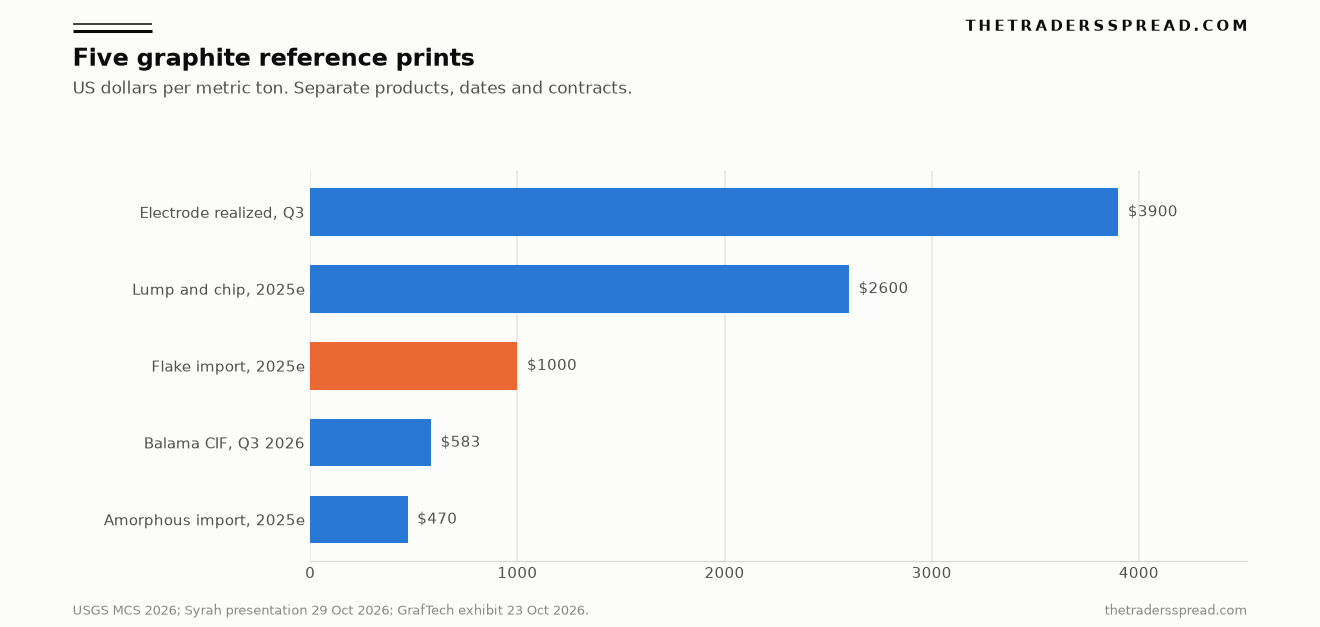
| Figure | Date on the page | What it measures | |
|---|---|---|---|
| USGS flake import unit value | $1,000 per metric ton at foreign ports | 2025 estimate, Mineral Commodity Summaries 2026 | Annual customs average for flake across sizes and origins |
| USGS amorphous import unit value | $470 per metric ton | 2025 estimate, same chapter | The same statistical basis on a different natural product |
| USGS lump and chip, Sri Lanka | $2,600 per metric ton | 2025 estimate, same chapter | Vein lump, a few tenths of a percent of US imports |
| Fastmarkets flake, 94% C, minus 100 mesh, cif US ports | $770 to $820 per tonne | Assessed 4 June 2026; article 16 June 2026 | One mesh, one carbon spec, one incoterm, as a range |
| Syrah Balama third-party sales | $583 per tonne CIF; implied FOB $507 | Quarter to 30 September 2026; slides 29 October 2026 | Realised sales, 90 percent fine, plus a load-port footnote |
| GrafTech graphite electrodes | about $3,900 per metric ton | Quarter to 30 September 2026; exhibit 23 October 2026 | Weighted-average realised price on 28.8 thousand metric tons |
Foreign-port flake unit values run $1,330, $1,200, $1,080, $1,050 and $1,000 from 2021 through the 2025 estimate. Amorphous runs $629, $563, $607, $535 and $470. Lump and chip runs $2,010, $2,590, $2,380, $2,810 and $2,600. Flake's customs average fell at each step while lump finished the window far above where it started, so an average of the three series would be a number nobody was invoiced. Apparent US consumption of 71,000 tons, valued at $128 million, is a worse candidate for a price: the chapter defines it as imports minus exports, and the $128 million mixes flake, lump and amorphous that the price rows keep apart. The 2025 estimate prints 79,000 tons of imports and 8,400 tons of exports beside that consumption line, with net import reliance at 100 percent.
The incoterm is part of the price
Syrah's footnote is the cleanest demonstration on a producer page. Average sales were $583 a tonne CIF, destination port. Implied sales FOB Nacala or Pemba were $507. Both numbers cover the same quarter, and the $76 gap is the basis. Operating cost, FOB, was $581 a tonne in the operating periods. Setting the CIF sales price beside that FOB cost makes the pair look like a two-dollar margin, which is a basis error. The two FOB lines, $507 of sales and $581 of cost, differ by $74 a tonne. Cash flow from operations was an outflow of $19 million, and cash at 30 September was $76 million, of which $55 million was restricted. A mine can ship 18,000 tonnes and still report an operating outflow.
Subtracting the middle of the June Fastmarkets range from the USGS $1,000 would repeat the basis error across publishers. An annual customs blend of all flake and a June assessment of one mesh are different baskets on different clocks. The $20 move inside the Fastmarkets specification is the sort of change a contract can reference. The tariff book splits the drum earlier: the chapter's normal-trade-relations column, dated 31 December 2025, lists crystalline flake, powder and other natural graphite on separate lines, each at a free rate. Over 2021–24 the import book was led by China, including Hong Kong, at 46 percent.
Who digs, who bakes, who is allowed to sign
The 2025 mine table is a China story with a widening bench, which is why a restart outside China can change a sales mix while a Chinese mesh assessment stays quiet. Tanzania is estimated at 75,000 tons after 27,000 in 2024. Mozambique's recovery, from 39,000 tons to an estimated 60,000, is tied to a new Chinese mine in Niassa and to the Australian restart at Balama.
Syrah's slides add the operating texture. Campaign mining at Balama is described as continuing into 2027, with a medium-term aim of 200,000 to 240,000 tonnes a year at a C1 cost of $480 to $520 a tonne FOB, under the $581 operating-period cost of the September quarter. Vidalia, in Louisiana, is producing active anode material while qualification gates sales, on a stated nameplate of 11.25 thousand tonnes a year. Syrah calls it the only commercial-scale natural graphite anode facility in the United States. The Survey, using different nouns, says two companies produced spherical purified graphite in Illinois and Louisiana, and that an Alabama company commissioned a qualification line at Kellyton, which Fastmarkets identifies with Westwater Resources. The March release names Tesla and Lucid for Vidalia anode material, and POSCO Future M, NextSource and Westwater for Balama concentrate.
Shaun Verner, managing director of Syrah, said in the 13 March 2026 release: "Whilst we are disappointed in the final negative determination from the ITC, Syrah remains committed to the ramp up of its Vidalia AAM facility which is the only domestic producer of AAM in the United States." Syrah wrote that the commission's final finding reversed a preliminary affirmative indication from January 2025, and that Commerce's final aggregate antidumping and countervailing rates, between 160 and 170 percent, would stay off the import entries. The USGS chapter still records the earlier stage: preliminary antidumping of 93.50 percent and countervailing duties from 11.58 percent to 721.03 percent, after a December 2024 petition. The file holds several official numbers, and on the producer's account the duty stayed off the entries.
A paused licence beside a restarted pit
The control list and the Mozambican campaign get flattened into one graphite shock, and they move different tonnes. Xinhua's dispatch of 9 October 2025 said that from 8 November, exports of synthetic graphite anode materials, with listed battery items, would require approval. Hong Kong's circular of 17 October 2025 identifies the instrument as Notice 58 of 2025, issued on 9 October and effective 8 November, covering lithium batteries and artificial graphite anode materials. Announcement 70, published on 7 November 2025 on the commerce ministry's own site, suspends announcements 55, 56, 57 and 58, plus ministry announcements 61 and 62, from that day through 10 November 2026. The licence rule was written, dated, and paused for a year on the day before it was due to bind.
Natural flake statistics over the same season describe a flow, not a pause. China exported 115,000 tons of natural graphite in the first nine months of 2025, 6 percent above 109,000 tons a year earlier, and 37,400 tons of spherical purified graphite, 29 percent above 29,100 tons. Natural graphite went first to Japan and spherical purified graphite first to Korea, and USGS links a rise in Indonesian shipments to a Chinese company's new plant in Central Java. An Indonesian tonne on a US import line can be Chinese process capacity under another origin, which keeps the licence calendar and the Indonesia share of anode-material imports as separate price facts.
GrafTech's quarter sits on a third cycle. Volume flat, realised price down 7 percent on the year, production a little under sales, and a company statement that newer commitments should lift the fourth-quarter realisation by a mid-single-digit percentage, with 2027 pricing described as higher because much of the 2026 book was struck earlier. That sentence is about steel-mill electrodes. USGS, over a different window, recorded anode-material imports rising from 28,100 tons to 43,400 tons. Electrode tonnes flat, anode-material tonnes up. On 25 October 2026 Syrah posted that Twigg Exploration and Mining would receive a further $15 million from the US International Development Finance Corporation before 31 October, for working and sustaining capital at Balama. The money keeps one campaign pit funded and leaves the mesh assessment, the customs average and the electrode book on their own clocks.
RelatedDoes Feed Barley Clear Apart From the Malt Market?
Syrah's subsidiary, Twigg Exploration and Mining Limitada, will receive a further US$15M DFC loan disbursement before 31 October 2026 to fund working and sustaining capital for Syrah’s Balama #Graphite Operation in Mozambique.https://t.co/V1ji6pCfpF $SYR pic.twitter.com/r03Ym2f5Uu
— Syrah Resources (@SyrahResources) October 25, 2026
The anode blend keeps the prices apart
Jon Jacobs, chief commercial officer of Westwater Resources, told Fastmarkets in an interview dated 4 June 2026 that natural graphite takes about four times less electricity than the synthetic route, and that the gap had historically left natural somewhere between 50 and 100 percent cheaper than artificial graphite. He said Chinese overcapacity had brought the two to roughly the same price. A nickel-cobalt-manganese cathode, he said, tended toward half natural and half synthetic, while a lithium-iron-phosphate cathode typically took about 70 percent synthetic and 30 percent natural. He expected the LFP mix to take more natural material as consistency improved, and he doubted those cells would drop artificial graphite altogether. The article also states that imported graphite then carried a 25 percent Section 301 tariff.
The same piece prints $770 to $820 for one natural specification and leaves a synthetic anode dollar, with its own spec and date, off the page. Jacobs' parity claim is a commercial reading from a company building a US natural chain, offered on the assessment day. "Roughly the same" still needs a named synthetic specification, an incoterm and a date before anyone can hedge it. A cell maker who then moves an LFP recipe toward the even split of an NCM cell changes the tonnes of fines and the tonnes of anode powder the plant calls for, and the print in one market stays a different object from the print in the other. Lithium carbonate has a Guangzhou Futures Exchange contract that can show a paperwork stall as a settlement. Copper has an exchange settlement a desk can argue with. Iron ore ships as fines and lump and still has a futures reference when the grade split moves. Flake has the assessments and the producer realisations. The single screen that would make graphite one hedgeable noun is the piece this stack lacks.
The Survey lists synthetic powder, machining scrap and calcined petroleum coke as substitutes in iron and steel, and synthetic powder in batteries. When anode powder is cheap beside fines, an LFP recipe can stay synthetic-heavy. When graphitisation costs reassert themselves, the natural share Jacobs expects can rise, which is why those four prints can each carry a date and still leave the purchase order open.
What the two markets leave open
A flake seller can name the mesh, the carbon, the port and the quarter. An electrode seller can name the plant and the commitment date still governing the invoice. An anode buyer can name this year's blend and rewrite it. The commerce ministry can suspend a powder licence until 10 November 2026, the date on the notice opened here, while natural flake exports keep moving on another statistical line. A development-finance cheque can keep one pit in campaign mode. Each of those acts leaves the marginal tonne unnamed.
Which contract should a battery buyer treat as graphite when the blend can change, the licence can sit paused, and a fine-heavy shipment can lower a realised CIF price while the customs average for all flake only grinds from $1,330 in 2021 toward the $1,000 estimate for 2025? Flake publishes one set of prints and synthetic publishes another. The anode sits between them and withholds the denominator.
Analysis and information only. This is not investment advice, and nothing here is a recommendation to transact in graphite, related equities or any derivative. Commodity markets carry substantial risk, and capital is at risk.