

“Until there is a credible path to safer, cheaper transit through the Gulf, oil is likely to remain supported on dips and prone to sharp moves on any escalation headlines,” KCM Trade chief analyst Tim Waterer said on Thursday, in remarks quoted by Reuters and carried by OilPrice.com, and Murban crude is the barrel that puts his sentence under the most strain.
The Platts assessment of Murban stood at $95.89 a barrel on 5 November, down $5.00, or 4.96%, on the day, according to the OilPrice.com price board read at about 06:06 UTC on 6 November. The same series printed $118.70 on 30 October. Four sessions took 19.2% off ADNOC's flagship grade and left it at its lowest assessment since 31 August, when it sat at $95.11.
The easy version of the week writes itself. Democrats took both houses of Congress on 3 November, the White House tied the defeat to the Iran war, and on 4 November front-month Brent fell 8.67% to $94.62 while WTI fell 8.29% to $88.12, on the OilPrice.com futures series read the same morning. On that reading the war premium walked out with the vote count.
Murban's own numbers argue for a slower, older story. On Monday 2 November, a full day before polls opened, Brent fell 7.6% to $104.77 after Iran's state news agency reported that the Supreme Leader had approved talks with Washington, as PetrolPrices.co.uk reported on 3 November, and Murban lost 11.3% that day to $105.30. The bigger point sits further back. Our calculation from the two OilPrice.com daily series puts Murban's average premium to Brent at $12.74 a barrel in September, $5.07 in the first half of October and $1.11 across 16 to 30 October. The grade's Hormuz-bypass premium, the part of its price that belonged to the war, had mostly drained away by Halloween. The midterm hit the outright level that Murban shares with every crude.
That distinction decides how the next shock lands. A grade carrying a $12 or $20 scarcity premium falls harder than Brent on a peace deal and rises harder on a closure. A grade within about a dollar of Brent trades like ordinary light crude, so its next big move rides on Brent and Dubai.
Key facts
- Murban (Platts) was assessed at $95.89 a barrel on 5 November, down $5.00 or 4.96% on the day. Source: OilPrice.com price board, read 6 November 2026.
- From $118.70 on 30 October, the grade fell 19.2% in four sessions, including an 11.3% drop on 2 November. Source: OilPrice.com Murban (Platts) series, 6 November 2026.
- Front-month Brent fell 8.67% to $94.62 on 4 November and WTI fell 8.29% to $88.12. Source: OilPrice.com futures series, 6 November 2026.
- Murban's average premium to Brent was $12.74 in September and $1.11 from 16 to 30 October. Source: Traders Spread calculation from OilPrice.com series, 6 November 2026.
- ADNOC set its November official selling price for Murban at $11 a barrel against Dubai quotes. Source: Reuters via The Daily Guardian, 8 October 2026.
- Gulf exports of crude, condensate and products averaged 17.1 million barrels a day in October, down from 18.9 million in September. Source: Vortexa via OilPrice.com, 4 November 2026.
Four sessions on two clocks
The week opened with diplomacy rather than ballots. Iranian President Masoud Pezeshkian said on Monday that the Supreme Leader had granted the government “certain authorities” over peace talks, according to state media, and Foreign Minister Abbas Araghchi said negotiators in Qatar were working on a proposal that could reopen the Strait of Hormuz in as little as two days if Washington met a list of conditions, OilPrice.com reported on 2 November. Brent was trading $7.85 lower at $105.60 that afternoon. Tehran's list included an end to the US naval blockade of its ports and the lifting of oil sanctions.
Tuesday was quiet in price and loud in politics. Brent eased to $103.60 and Murban to $102.16. Rystad Energy, in a report summarised by OilPrice.com on 3 November, said a limited US-Iran agreement could arrive by the middle of 2027. The same note estimated Persian Gulf crude exports at nearly 12 million barrels a day across September and the first 20 days of October, against roughly 18 million before the war.
Wednesday brought the vote reaction. Brent fell $8.94, or 8.6%, to $94.66 by 1:06 p.m. Eastern time, after President Donald Trump told Fox News “I think it's the gasoline price” when explaining the Republican defeat and Vice President JD Vance wrote that the war was the reason for the losses, according to OilPrice.com on 4 November. WTI was down $8.01 at $88.08 at the same hour. Enverus' Carl Larry warned that an escalation in Iran could come before a resolution.
Thursday split the benchmarks apart. Brent rose for the first time in four sessions, gaining nearly 4% to around $98 a barrel, according to Trading Economics. Iran's Islamic Revolutionary Guard Corps said two oil tankers and a tugboat had caught fire in the Strait, and UK Maritime Trade Operations reported a tanker hit by two projectiles off Qatar, OilPrice.com reported on 5 November. Murban went the other way and printed its 4.96% fall.
Most of that split is a clock effect. Platts assesses Murban during Asian trading, and the series behaves like it. The 4 November print of $100.89 sat $6.27 above that day's Brent settlement because Wednesday's New York sell-off came after it was struck. The 5 November print then caught the sell-off, while Brent's 5 November close caught Thursday's tanker headlines. Day by day the spread whips between a $6 premium and a $2 discount, and across the four sessions the two grades lost similar ground.
| Date | Murban (Platts), $/bbl | Brent front month, $/bbl | WTI front month, $/bbl | Murban minus Brent | What moved the tape |
|---|---|---|---|---|---|
| 30 Oct | 118.70 | 113.43 | 104.12 | +5.27 | Brent ends October near a six-month high |
| 2 Nov | 105.30 | 104.77 | 96.46 | +0.53 | Tehran approves talks; Qatar draft circulates |
| 3 Nov | 102.16 | 103.60 | 96.09 | -1.44 | US votes; Rystad sees a limited deal by mid-2027 |
| 4 Nov | 100.89 | 94.62 | 88.12 | +6.27 | Democratic sweep read as de-escalation |
| 5 Nov | 95.89 | 98.29 | 90.52 | -2.40 | Tanker fires in Hormuz; Brent rebounds |
Sources: OilPrice.com Murban (Platts), Brent and WTI daily series, retrieved 6 November 2026 at about 06:12 UTC. 5 November Brent and WTI are implied by the board at 06:06 UTC on 6 November: Brent $99.73, up $1.44; WTI $91.57, up $1.05.
The premium left in October
September explains why the vote mattered less for Murban than the headlines suggest. Murban loads at Fujairah, outside the Strait of Hormuz, and it traded at record premiums during the Gulf crisis, Gulf News noted on 26 October, citing a mid-September price above $127 while Brent was above $107. The OilPrice.com series shows the peak on 16 September at $128.00, against a Brent settlement of $105.83 that day. That $22.17 gap, the widest in the five months of data we pulled, is what a scarcity barrel looks like: Asian refiners paying up for crude that leaves the Gulf on the open side of the chokepoint.
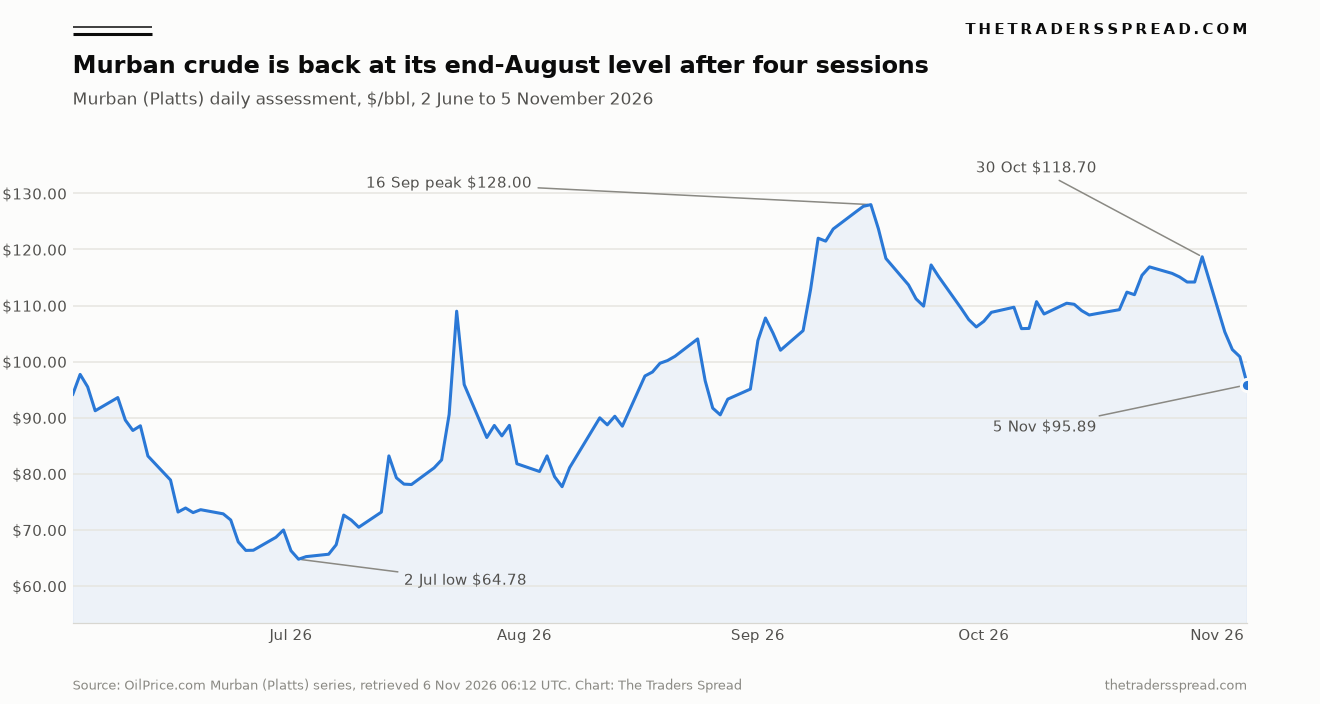
Then the scarcity eased, slowly, through channels that rarely made a headline the size of an election. Gulf producers accelerated shuttle shipping through Hormuz and ship-to-ship transfers in the Gulf of Oman once tankers had cleared the chokepoint. By the start of this week the November Dubai contract traded at about a $2 discount to December, a contango structure that OilPrice.com, citing traders and brokers on 3 November, called the first sign since July that prompt supply in the Middle East is abundant. The premium of Oman over Dubai, a measure of regional physical strength, slumped to its lowest since the end of July in the same report.
Murban's premium is a bet on route scarcity. Once Hormuz barrels find their way out by other means, the reason to pay extra for a Fujairah loading shrinks, and the premium bleeds.
| Period | Murban average, $/bbl | Brent average, $/bbl | Murban minus Brent, $/bbl | Trading days |
|---|---|---|---|---|
| June | 79.90 | 83.93 | -4.04 | 21 |
| July | 79.46 | 83.88 | -4.42 | 23 |
| August | 91.36 | 88.03 | +3.33 | 20 |
| September | 114.51 | 101.77 | +12.74 | 22 |
| 1 to 15 October | 108.62 | 103.54 | +5.07 | 11 |
| 16 to 30 October | 113.86 | 112.75 | +1.11 | 11 |
| 2 to 5 November | 101.06 | 100.32 | +0.74 | 4 |
Source: Traders Spread calculation from OilPrice.com Murban (Platts) and Brent front-month daily series, retrieved 6 November 2026. Averages use dates where both series printed.
The June and July rows carry the uncomfortable part of the record. In those months, which included the three-week US-Iran ceasefire in early July, Murban averaged about $4 a barrel below Brent. Strip out the war premium and the grade spent the summer at a discount. By the last two weeks of the campaign, very little bypass value was left in Murban. The midterm finished a trade that Gulf shipping had been unwinding since mid-September.
Freight is the second, costlier reason the premium shrank, because a refiner compares delivered costs across grades. The International Energy Agency flagged record tanker rates on 21 October, and the post matters here because a bigger tanker bill compresses what a buyer can pay for the crude itself.
The price of oil is only part of what determines the cost to supply the world with fuel.
— International Energy Agency (@IEA) October 21, 2026
With tanker rates at historic highs amid disruptions in the Middle East, rising shipping costs are adding further pressure to global oil markets.
Read more 👉 https://t.co/bHl85JhsUL pic.twitter.com/7HKvixZBCn
Trading Economics wrote on 6 November that Gulf crude exports had recovered to near pre-war levels while transportation costs stay elevated, two facts that both lean on Murban's premium.
What this changes
The first change concerns ADNOC's own price for term buyers. ADNOC set its November official selling price for Murban at $11 a barrel against Dubai quotes, according to a Reuters item syndicated by The Daily Guardian on 8 October. That differential was fixed in early October, when Murban still carried a premium of about $5 over Brent. A month later, spot Murban trades within about a dollar of Brent. Term buyers loading in November are paying a differential set in a tighter market, and the December figure will show whether ADNOC reads the last five weeks the way the screen does.
The second change is to the shape of risk. While Murban carried a double-digit premium, a reopening of Hormuz threatened it twice: once through Brent and again through the spread. With the spread near zero, a peace deal mainly works through the outright price. Goldman Sachs estimates that a geopolitical risk premium of about $27 a barrel accounts for most of the October rally, and the bank's Daan Struyven said the premium would come off quickly only with “a diplomatic solution that market participants see as sustainable,” according to OilPrice.com's 2 November report. Goldman raised its December Brent forecast to $105 from $90, ANZ sees $105 and UBS $110 for year-end. Those are Brent views, and Murban now rides them more closely than at any point since August.
RelatedHow Methanol Inventories Set a 3,920 or 3,198 Path
The third change is the one the easy reading skips. The vote shifted Washington's politics, and the war sits in Tehran and the Gulf as much as in Congress. Supreme Leader Mojtaba Khamenei said in a written statement that US hostility would persist whichever party holds power. FXPro senior market analyst Alex Kuptsikevich pointed to 2006, when Democrats took Congress and US policy in Iraq carried on under President George W. Bush, in remarks carried by OilPrice.com on 6 November. ING's commodity analysts framed the base case as a slow give-back: “In the absence of escalation, the oil market is likely to continue to slowly give back the risk premium it built in recent months, with oil flows from the Persian Gulf holding up well.”
Physical data still leans tight. US crude inventories fell 900,000 barrels to 409.8 million in the week to 30 October, 4% below the five-year average, and distillate stocks dropped 3.6 million barrels to 13% below it, the Energy Information Administration reported, according to OilPrice.com. That tightness favours a light, distillate-rich grade like Murban, and our naphtha record from 23 October shows how crude and freight fed the product chain at the top of the run.
| Signal | Latest reading | Source and date | Pressure on Murban |
|---|---|---|---|
| Murban premium to Brent | +$1.11 average, 16 to 30 Oct | Traders Spread calculation, OilPrice.com series, 6 Nov | Bypass value largely spent |
| Dubai November vs December | About $2 contango | OilPrice.com, 3 Nov | Softer: prompt Gulf supply ample |
| Gulf exports, crude, condensate and products | 17.1m b/d in Oct, from 18.9m in Sep | Vortexa via OilPrice.com, 4 Nov | Firmer: flows dipped in October |
| Gulf crude exports vs pre-war | About 12m b/d vs about 18m b/d | Rystad Energy via OilPrice.com, 3 Nov | Firmer: still below pre-war |
| Geopolitical premium in Brent | About $27/bbl | Goldman Sachs via OilPrice.com, 2 Nov | Softer if a deal holds |
| Vessel incidents in the Persian Gulf | At least five since 1 Nov | Reuters via OilPrice.com, 6 Nov | Firmer on escalation |
| US distillate stocks | 13% below five-year average | EIA via OilPrice.com, 4 Nov | Firmer for light grades |
| ADNOC November OSP | $11/bbl over Dubai quotes | Reuters via The Daily Guardian, 8 Oct | Sets the term-buyer reference |
The two export estimates measure different things: Vortexa's 17.1 million barrels a day counts crude, condensate and products, Rystad's 12 million counts crude alone. Both put the Gulf well below its pre-war pace, the strongest argument that Murban's bypass value could return fast if attacks reach the shuttle routes that rebuilt the flow. For the strait itself, our Strait of Hormuz market page tracks the transit odds, and the Kharg Island page covers the Iranian export terminal that sits at the other end of the same war. The benchmark legs sit on our Brent scenario page and the September WTI rally record.
Questions on Murban
What is Murban crude?
Murban is the flagship crude grade of the Abu Dhabi National Oil Company and the largest export stream from the United Arab Emirates. Gulf News describes it as light, with an API gravity of roughly 39.9 to 40 degrees, and technically sour, with sulfur around 0.7% to 0.8% by weight. It yields high volumes of gasoline, naphtha and middle distillates, which makes it a popular feed for Asian refiners.
Why did Murban trade above Brent this autumn?
Murban loads at Fujairah, outside the Strait of Hormuz, so it can reach buyers while tankers inside the Gulf face attack. That route made it a scarcity barrel. On OilPrice.com's series, its premium to Brent averaged $12.74 in September and peaked at $22.17 on 16 September. The premium shrank as Gulf producers rebuilt exports through shuttle shipping and ship-to-ship transfers.
Did the US midterm result cause the Murban fall?
The result drove the sharpest single day, with Brent down 8.67% on 4 November. Murban had already dropped 11.3% on 2 November, after Tehran approved talks, and its premium to Brent had narrowed to about $1.11 in the second half of October. The vote moved the shared outright price. The grade's war-specific premium had mostly gone beforehand.
How does ADNOC set the Murban selling price?
ADNOC publishes a monthly official selling price for term cargoes. For November loadings, it set Murban at $11 a barrel against Dubai quotes, according to a Reuters report dated 8 October. That differential was fixed when Murban still traded about $5 above Brent, so the December figure will show how ADNOC prices the narrower spread.
Why did Murban fall on 5 November while Brent rose?
The two prices are struck at different hours. The Platts Murban assessment behaves like an Asian-hours print, so the 5 November value captured Wednesday's New York sell-off. Brent's 5 November close captured Thursday's tanker attacks in Hormuz and rose nearly 4%. Over the four sessions from 30 October, the two grades lost similar ground once that timing is netted out.
Waterer's line about dips and escalation headlines describes Brent well enough. For Murban the harder question is about the spread rather than the price. If the next tanker attack lands on the shuttle routes that refilled Gulf exports this autumn, does the bypass premium rebuild toward September's $12, or has Asian buying already learned to wait for the Gulf to clear?
This record draws on pages and data feeds opened on 6 November 2026, including third-party price series and analyst notes quoted by news outlets. It is market information only and is not a recommendation to trade crude oil or any related instrument.