

Naphtha is 78.81 percent higher than a year ago, and the 23 October reference still added 26.55 dollars to finish at 942.76 dollars a tonne. That 2.90 percent rise, from a previous close of 916.21, is the print on the Trading Economics naphtha page opened 24 October 2026 and last updated the same day. West Texas Intermediate crude rose 3.82 percent to 103.27 dollars a barrel on that board, and Brent rose 3.14 percent to 116.72. The light cut refiners pull from crude rose by a smaller percentage than either benchmark it is made from.
Over the month before Friday the order had run the other way. Naphtha's monthly gain was 12.43 percent, against 9.49 percent for Brent and 9.15 percent for WTI, so the session was a crude-led day laid on a month in which the light cut had been outrunning the barrel. Over twelve months the 78.81 percent naphtha gain sat almost on Brent's 79.02 percent and well ahead of WTI's 67.92 percent. The longer alignment held, and only the daily ranking changed.
A second split sat on the same table. The US natural-gas reference fell 5.58 percent to 2.64 dollars, so a gas-linked feedstock marker and oil-linked naphtha moved in opposite directions while crude did the lifting. Gasoline rose 1.11 percent to 3.2116 dollars a gallon, and heating oil rose 1.06 percent. Naphtha outpaced those two products and lagged both crudes. Flat price, crack against crude, and gasoline pull were three stories on one screen.
The 942.76 figure is a third-party contract-for-difference and over-the-counter reference, each contract sized at 1,000 metric tons. Trading Economics presents it as a reference and leaves verification of the feed with the supplier. It is the screen price for a dated record. A Platts CFR Japan assessment or an Argus Mediterranean quote is a different object, and those cargo markets are what Sparta Commodities described the same afternoon.
Key facts
- Naphtha reference 942.76 dollars a tonne on 23 October 2026, up 26.55 dollars, or 2.90 percent, from 916.21. Source: Trading Economics, page opened 24 October 2026, series last updated 24 October 2026.
- Same session: Brent 116.72 dollars a barrel, up 3.55 or 3.14 percent; WTI 103.27, up 3.80 or 3.82 percent. Source: Trading Economics commodity table, 23 October 2026.
- Monthly naphtha change 12.43 percent, yearly change 78.81 percent, all-time high 1,180.47 dollars a tonne in July 2008. Source: Trading Economics, updated 24 October 2026.
- Gasoline-naphtha spread, the gas-nap, around 140 dollars a tonne after opening October above 280. Source: Sparta Commodities, Jorge Molinero, 23 October 2026, 11:57.
- TC5 freight, Arabian Gulf to Japan, at a fresh record near 250 dollars a tonne. Source: Sparta Commodities deep dive, 23 October 2026, 13:33.
- LG Chem restarted its 800,000 metric-tonne-a-year Number 2 naphtha cracker at Yeosu after a seven-month halt. Source: Quantum Commodity Intelligence headline and visible lede, 14 October 2026.
- The same 942.76 print is stamped 24 October on a parallel table, inside a 52-week range of 488.37 to 995.66. Source: FX Editorial, updated 24 October 2026 at 04:15 BST.
1) A 26.55 dollar session
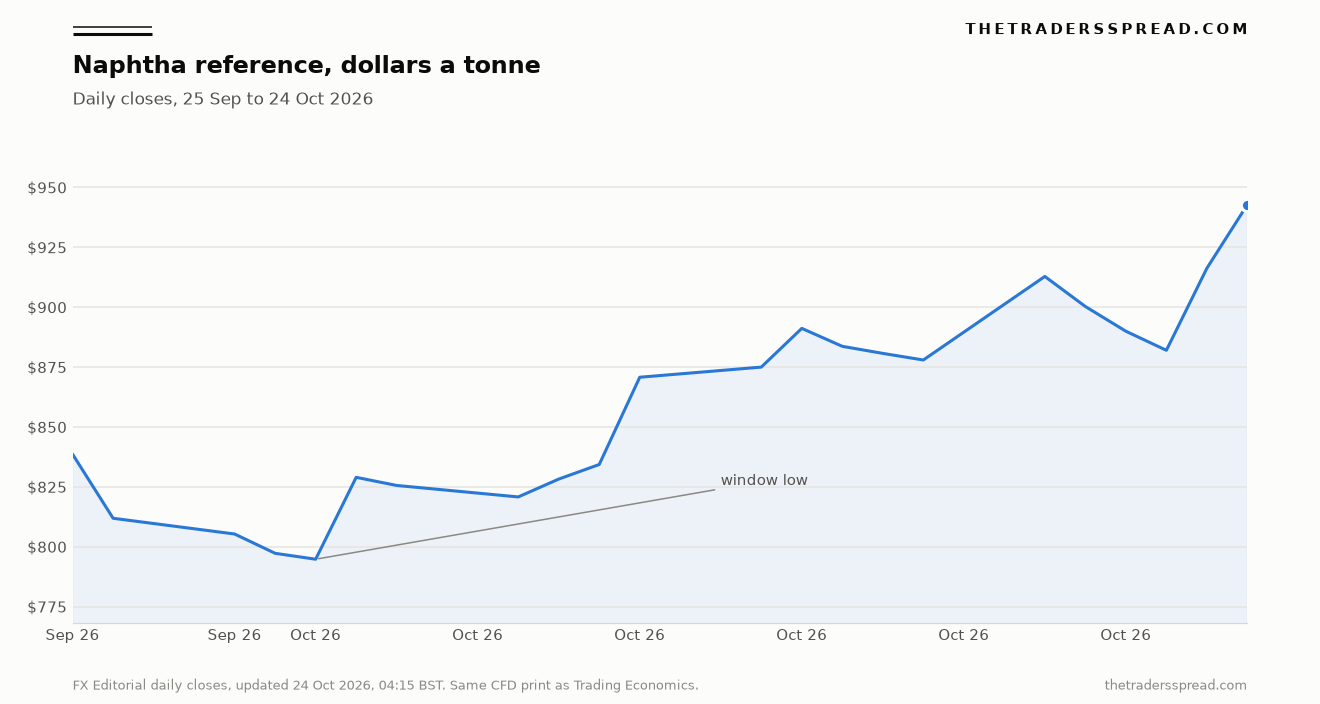
Add 916.21 and 26.55 and the sum is 942.76. Divide the dollar change by the previous close and the result rounds to the 2.90 percent printed beside it, dated 23 October by Trading Economics. FX Editorial, updated at 04:15 BST on 24 October, carries the same pair one day later, 942.76 on 24 October and 916.21 on 23 October, with 881.95 on the row before. The chart below follows those FX Editorial dates, and the headline follows the Trading Economics session, because both are one CFD-style reference kept apart from a cargo deal.
In that window the low is 794.74 on 1 October, and the climb from there to 942.76 is 148.02 dollars, or 18.6 percent, on the two opened prints. The prior row was already a 3.88 percent rise, after a 4.37 percent day on 9 October and a 3.97 percent day on 19 October, then a drift lower into 22 October. The latest close still sits 237.71 dollars under the July 2008 high of 1,180.47. FX Editorial's 52-week band runs from 488.37 to 995.66, about 90 percent of the way through, with a seven-day gain of 64.86 dollars, or 7.39 percent, and a thirty-day gain of 109.17 dollars, or 13.10 percent, beside the 12.43 percent monthly window on the other page and a one-year dollar gain of 415.53.
2) Crude supplied the impulse
The lead item on the Brent news stream called Friday an over-four-year high above 116 dollars a barrel, and a companion item called it the highest since June 2022, past the peak recorded at the start of the war. The table prints 116.72, up 3.55 dollars, or 3.14 percent. The weekly gain is above 6 percent in the lead item and near 5 percent, a third consecutive weekly advance, in the companion. That stream ties the move to possible renewed US strikes on Iran, Houthi attacks in Saudi Arabia, non-essential US personnel ordered to leave, and Saudi Aramco staff told to evacuate the Dhahran headquarters and work remotely.
Reuters posted the evacuation on 22 October, the operational fact under the Friday crude bid.
Saudi Aramco tells staff to evacuate Dhahran headquarters, sources say https://t.co/ZGB4ZDGIsr https://t.co/ZGB4ZDGIsr
— Reuters (@Reuters) October 22, 2026
Crude context already on this desk sits in the note on WTI after strikes on Iran resumed and in the Brent range built around a bull case and a bear case. Naphtha is the light cut taken off that crude, and Friday's percentage gain lagged both benchmarks while the flat price rose. Jorge Molinero, commodity owner for light ends and gasoline at Sparta Commodities, had Brent at 114 dollars in a deep dive timestamped 13:33 on 23 October, with Iran hitting more ships than at any point since the war began and aiming at engine rooms. The later 116.72 is the same rally on a later clock. Crude was leaving the Gulf near pre-war volumes by most accounts, while a damaged engine room means months in a yard, and clean product inherits that constraint.
3) The crack moved the other way
Molinero's deep dive puts the split in one pass. Mean of Platts Japan and Northwest Europe timespreads made fresh seasonal highs, Asian cash differentials stayed firm, cracks softened as crude skyrocketed, and the east-west spread gave back part of the prior week's record before rebounding. His 11:57 brief put the gas-nap around 140 dollars a tonne, halved from above 280 at the start of October, with EBOB prompt spreads the weakest since May, ARA blending margins negative, the ARA-to-New York route shut, Houston the cheapest origin across most of the Americas, and Latin America closed to Europe for November delivery.
A strong gasoline market pulls naphtha into the mogas pool, and a collapsed gas-nap leaves the cracker bid to carry the cut. The US gasoline CFD still rose 1.11 percent to 3.2116, a different market from European EBOB. An earlier desk note on US gasoline at 4.478 dollars when Midwest runs fell belongs to another episode and only shows how hard runs can tug the light cut. Quantum's light-ends lede, opened 24 October, said softer seasonal demand and high runs were weighing on naphtha values, the physical price remaining behind the register wall. The CFD and that lede can both stand, because they describe different layers of the same afternoon.
4) Freight still prices scarcity
TC5, the Arabian Gulf to Japan clean route, was a fresh record near 250 dollars a tonne on 23 October, so a delivered Gulf barrel costs more than at any earlier point in the conflict, whatever the free-on-board offer says. TC15 had eased off a spike and stayed expensive. Timespreads at fresh highs plus that freight, in Molinero's summary, price scarcity through the rest of the year, and attacks aimed at ships rather than at the barrels leave the eastbound cost slow to ease. Qatar, Kuwait and Indian Oil were offering more November and December naphtha, a step up from the summer, while the curve priced full Gulf normalisation only into the first quarter. Asia paid up for Western barrels, the arbitrage had yet to deliver higher eastbound volumes.
Propane rose 4.04 percent to 1.17 dollars on the same board, a sharper daily move than naphtha, with a 31.58 percent monthly gain. The desk has already recorded propane's 19.5 percent monthly rise as US stocks fell from a record. Sparta still had US propane stocks at record seasonal levels, October exports to Asia rising, and Arabian Gulf LPG exports far below their historical average, India taking the largest hit. Naphtha is tight because freight blocks the eastbound arbitrage, LPG is tight east of Suez, and propane is long in US tanks.
5) Crackers out, and one back on
LG Chem restarted its 800,000 metric-tonne-a-year Number 2 naphtha cracker at Yeosu after a seven-month halt, on Quantum Commodity Intelligence's 14 October headline and the visible sentence under it, which is as far as that item goes before the register wall. A unit of that size coming back is a buyer returning in the region that sets the marginal bid. Wanhua's Number 2 cracker is offline through the fourth quarter for an ethane retrofit, and SCG takes the Map Ta Phut cracker down in November. Molinero wrote that neither outage breaks the tight picture, and that both argue for a less aggressive stance than a fortnight earlier.
China's October fuel-export plan runs well below September, with around two thirds of the annual quota used, and regional refinery outages add support on that account. Valero at Port Arthur and Citgo at Corpus Christi had suspended multiple crude and vacuum units, on a Quantum lede opened 24 October that states the halt and leaves any naphtha volume off the visible page. Yeosu is buying again, Wanhua is offline, Map Ta Phut is heading into a turnaround, and Texas distillation is halted, all against Gulf offers that still face a TC5 rate near 250 dollars a tonne.
6) What this changes
Screen replacement cost is 26.55 dollars a tonne higher, at 942.76. The crack moved the other way, because both crudes beat the product on the day, so a refiner selling the light cut against a crude purchase gave up margin as the product price rose, and a cracker paid more for feed while Europe's gasoline support had already halved from above 280 dollars a tonne to around 140.
Javier Blas, the Bloomberg energy and commodities columnist, wrote on 22 October that the Dhahran evacuation left production unchanged and signalled a greater Houthi risk. A headquarters evacuation is a security step, while a production cut would take a barrel off the tower, and the rally priced that second risk.
Saudi state owned oil giant Saudi Aramco has told employees to evacuate its headquarters campus in Dhahran and work remotely. Unclear for how long. Oil production remains unchanged, but clearly the kingdom sees a greater Houthi risk. https://t.co/y9jUvxVbpg
RelatedEthanol Price Prediction: $2.22 Bull Case vs $1.79 Bear
— Javier Blas (@JavierBlas) October 22, 2026
A November stem from Qatar, Kuwait or Indian Oil cools an Asian bid only once freight lets the ship sail at a rate the cracker will pay, so delivered cost can rise while the free-on-board offer looks ample. That is how seasonal-high timespreads coexist with a softer crack against Brent. The twelve-month link with Brent stayed in place: one session of divergence inside a year when naphtha tracked Brent much more closely than it tracked WTI.
Questions the session leaves open
What does the 942.76 dollar print actually measure? It is the Trading Economics naphtha reference for 23 October 2026, up 26.55 dollars on the day, from a third-party contract-for-difference and over-the-counter feed, with each contract sized at 1,000 metric tons. The publisher calls it a reference and leaves verification with the supplier. Sparta's same-day notes on timespreads and TC5 describe the cargo market. On this session the screen rose while that research had the crack against crude softening.
Why did the product lag crude when both rose? The 23 October percentages differ: naphtha 2.90, Brent 3.14, WTI 3.82. Sparta's afternoon note said cracks softened as crude skyrocketed, even as Japan and Northwest Europe timespreads made fresh seasonal highs. Gasoline support had already faded, with the gas-nap around 140 dollars a tonne against more than 280 at the start of October. The flat price followed crude, and the margin against crude gave ground.
Which plants and routes offset the flat-price rise? LG Chem's 800,000 tonne-a-year Number 2 cracker at Yeosu was back on the 14 October Quantum lede, returning a buyer. Wanhua's Number 2 unit is offline through the fourth quarter for an ethane retrofit, and SCG's Map Ta Phut cracker is due down in November, both from Sparta on 23 October. TC5 near 250 dollars a tonne decides whether November and December offers from Qatar, Kuwait and Indian Oil reach those plants.
7) The supply question
The rise reverses on the supply side only if offered barrels arrive and the crude premium leaves with them. November and December stems from Qatar, Kuwait and Indian Oil are already offers, on Sparta's account, and they reach Asia only if TC5 comes off the record near 250 dollars a tonne and TC15 stops pricing Mediterranean barrels out. That note prices full Gulf normalisation only in the first quarter, which leaves the offers waiting on ships.
Friday's work was the crude half. Production was reported unchanged while Dhahran emptied, and the high since June 2022 priced strikes, ship attacks and Houthi risk. Giving the flat price back would mean fewer ships removed, staff back because the threat had eased, and flows at the pre-war volumes already described. Port Arthur and Corpus Christi units suspended on the Quantum lede withhold naphtha until they return. LG Chem's restart is a buyer who can outlast the headline, while Wanhua and Map Ta Phut remove buyers and leave the offer side where Friday found it.
Do the Gulf cargoes show up at Asian ports, and does TC5 fall far enough to make the voyage pay, while the attacks and the evacuation stop feeding the crude mark naphtha is priced against? If offers stay on the sheet, freight holds the record, and the premium stays in the barrel, Friday's reference has a supply-side path to remain. Same-day physical notes already sketch it: tight timespreads, a softer crack, a gasoline pull cut in half, and freight at a record.
The record relies on pages opened for it, including third-party feeds and research notes, and it is not a recommendation to trade naphtha, crude, or any related instrument.