

"Snowflake delivered another strong quarter, with product revenue of $1.49 billion, up 37% year-over-year," Sridhar Ramaswamy, chief executive of Snowflake, said in the results release dated 2 September 2026. The sentence is built to travel. The audit starts underneath it, on the page that prints product revenue in thousands, sets professional services beside it, and then reports a GAAP loss.
On the Form 10-Q for the quarter ended 31 July 2026, filed 4 September 2026, product revenue is $1,491.861 million. Remaining performance obligations move the other way across the two dates a reader is tempted to glue together: $9,771.5 million as of 31 January 2026, then $9,004.3 million as of 31 July 2026. Product revenue for the quarter ended 31 January 2026 was $1,226.6 million. We read that pair before any story about a backlog feeding the next print, because the contract stack fell while the consumption line rose.
Updated 14 November 2026 with reference figures from that 2 September release and that 10-Q, which a later quarterly report replaces. Snowflake's fiscal year ends 31 January, so the quarter ended 31 July 2026 is the second quarter of fiscal 2027.
Key facts from the quarter ended 31 July 2026
- Product revenue was $1,491.861 million for the three months ended 31 July 2026, against $1,090.496 million a year earlier, and it was 96% of total revenue of $1,546.793 million. Source: Snowflake Form 10-Q, filed 4 September 2026.
- Remaining performance obligations were $9,004.3 million as of 31 July 2026, compared with $6,931.7 million a year earlier and $9,771.5 million as of 31 January 2026. Source: Snowflake Form 10-Q key business metrics, filed 4 September 2026.
- GAAP operating loss was $262.967 million and GAAP net loss attributable to Snowflake Inc. was $191.720 million, or $0.55 a share on 349.257 million weighted-average shares. Source: Snowflake Exhibit 99.1, dated 2 September 2026.
- GAAP product gross profit was $1,057.443 million. The release's rounded summary prints a 70.9% product gross margin on product revenue of $1,491.9 million. Source: Snowflake GAAP to non-GAAP reconciliation, 2 September 2026.
- Stock-based compensation in the quarter was $423.582 million. Unvested awards not yet recognized were about $3.8 billion as of 31 July 2026, over a weighted-average 2.6 years. Source: Snowflake Form 10-Q MD&A, filed 4 September 2026.
- Current deferred revenue was $2,568.489 million as of 31 July 2026, down from $3,346.997 million as of 31 January 2026. Non-current deferred revenue was $27.756 million. Source: Snowflake Form 10-Q balance sheet, filed 4 September 2026.
What the release prints before the tables
The Exhibit 99.1 headline says product revenue of $1.49 billion, 37% year-over-year growth, for the quarter ended 31 July 2026. Total revenue in the same highlights is $1.55 billion, up 35%. Net revenue retention is 126%, beside 828 customers with trailing 12-month product revenue above $1 million and 829 Forbes Global 2000 customers. Remaining performance obligations are printed as $9.00 billion, up 30% year over year. Those rounded marks are the door. The statement of operations, in thousands, is the page we tie to the 10-Q.
Brian Robins, chief financial officer, calls it "our third consecutive quarter of product revenue growth acceleration," driven by the core data platform and "a meaningful step-up in AI revenue," and says full-year product revenue growth guidance is being raised to 36% year over year. The guidance table turns that into $6,070 million for fiscal 2027, up from $5,840 million, or 31%. The statements we opened give no separate dollar line called AI revenue.
Sridhar Ramaswamy posted the product-revenue line on the afternoon of the release, using the same rounded billion the exhibit headline uses.
We are in the midst of a once-in-a-lifetime technology shift, and @Snowflake sits right at the center of the AI revolution.
— sridhar (@RamaswmySridhar) September 2, 2026
Our Q2 results reflect the incredible speed and urgency with which our team is executing:
📈 Product revenue reached $1.49B (+37% YoY)
🤝 692 net customer… pic.twitter.com/tV320Z8LS1
The post also cites 692 net customer adds, matching the release line "Added 692 net new customers in the quarter." Total customers on the 10-Q are a different series: 14,554 as of 31 July 2026, up from 13,245 as of 31 January 2026. We keep the quarter label on the 692.
Consumption comes before the contract term
Snowflake product revenue, as the 10-Q defines it, is recognized when customers consume compute, storage and data transfer resources. It is a consumption total, not the value of contracts signed in the quarter. Capacity customers commit to a volume at specified prices. On-demand customers are charged monthly in arrears. Revenue from on-demand arrangements was about 3% of revenue for the three months ended 31 July 2026, and existing customers under capacity arrangements accounted for about 97%. Those two sentences sit in different paragraphs of the MD&A, and we leave them there rather than inventing a third bucket the filing omits.
Capacity contracts typically run one to four years, and the weighted-average term signed during the quarter was about 2.1 years. Customers can run past the commitment and be billed for the excess, and in many cases they can roll unused capacity forward, generally if they buy more. Recognition follows use, so Snowflake says it lacks the timing visibility of a company that recognizes ratably over the contract term. Professional services stay off the product line: $54.932 million in the quarter, 4% of revenue, against $54.473 million a year earlier.
Deferred revenue fails as a shortcut to the next period's revenue, the company writes, because consumption can run ahead of the commitment or leave capacity unused. We have used a similar split on other reported lines, including the billings line at Palo Alto Networks and the gap between a sales myth and the figure Walmart reports. Here a signed contract and an existing invoice can still leave revenue waiting on compute the customer chooses to run.
Third-party cloud infrastructure, including AI inference and GPUs, was about 75% of cost of product revenue in the quarter, against about 70% a year earlier. GAAP cost of product revenue was $434.418 million. Product gross profit of $1,057.443 million can therefore be large while an operating loss still prints further down, after sales, research and administration.
| Date | Product revenue, quarter ($ millions) | RPO at period end ($ millions) |
|---|---|---|
| 31 July 2026 | 1,491.9 | 9,004.3 |
| 30 April 2026 | 1,334.3 | 9,205.2 |
| 31 January 2026 | 1,226.6 | 9,771.5 |
| 31 October 2025 | 1,158.4 | 7,880.6 |
| 31 July 2025 | 1,090.5 | 6,931.7 |
Product revenue is the flow for the quarter then ended. RPO is the stock of contracted future revenue at that date. Source: Snowflake Form 10-Q key business metrics, filed 4 September 2026. The July 2026 cell rounds the $1,491.861 million on the statement of operations.
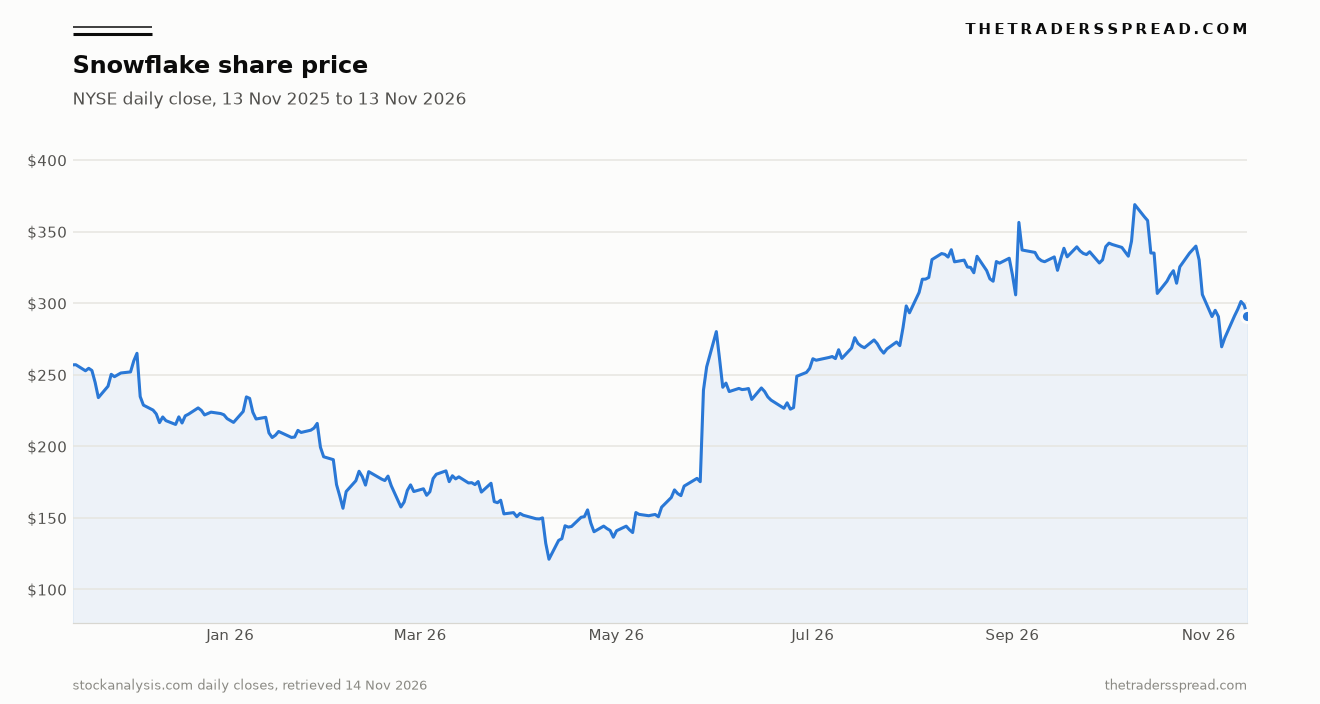
Daily NYSE closes downloaded from stockanalysis.com on 14 November 2026 run from $256.92 on 13 November 2025 to $291.00 on 13 November 2026, the regular-session print timestamped 4:00 pm Eastern on the quote page. The low close in that file is $121.11 on 10 April 2026, and the high close is $368.89 on 9 October 2026.
RPO, then the deferred-revenue lines
Remaining performance obligations are contracted future revenue still unrecognized: deferred revenue, plus non-cancelable amounts to be invoiced later. On-demand arrangements are excluded, because they carry no minimum, and certain time-and-materials contracts billed in arrears are excluded too. The filing says RPO fails as a predictor of product-revenue growth on its own, because it leaves out the timing of consumption and any use above the commitment.
As of 31 July 2026 the metrics table prints RPO of $9,004.3 million. Snowflake expects about 54% of that stack to be recognized as revenue in the 12 months ending 31 July 2027, based on historical consumption, and the same footnote says timing still depends on future use, including rollover of unused capacity. The weighted-average remaining life of capacity contracts was 2.4 years.
Current deferred revenue was $2,568.489 million at 31 July 2026 and non-current deferred revenue was $27.756 million, together $2,596.245 million against RPO of $9,004.3 million. About $6.4 billion of the stack is the uninvoiced piece of the definition. During the quarter the company recognized $1.1 billion of revenue from the deferred-revenue balance at 30 April 2026, which is why current deferred revenue can fall from $3,346.997 million at 31 January 2026 while product revenue is still growing.
Across the half-year the stack shrank by $767.2 million while quarterly product revenue rose from $1,226.6 million to $1,491.9 million. A subscription backlog elsewhere follows a different rule. Our reading of ServiceNow and Salesforce contract backlog is about commitments recognized over time, while Snowflake ties revenue to use.
Where the GAAP loss is earned
The GAAP net loss is an income-statement result, not a reading of the cash balance. For the three months ended 31 July 2026, gross profit was $1,036.718 million on revenue of $1,546.793 million. Operating expenses were $1,299.685 million: sales and marketing $611.615 million, research and development $567.476 million, general and administrative $120.594 million, and the operating loss that follows is $262.967 million. Interest income of $41.996 million, interest expense of $2.081 million and other income of $34.762 million take the pretax loss to $188.290 million. A tax provision of $3.430 million leaves a net loss of $191.720 million, all of it attributable to Snowflake Inc. A year earlier the operating loss was $340.276 million and the net loss attributable to Snowflake was $298.017 million.
As a percentage of revenue, the operating loss was 17% against 30% a year earlier, and the net loss was 12% against 26%. Non-GAAP operating income was $236.985 million, a 15% margin, against $127.572 million and 11% a year earlier. The largest adjustment is stock-based compensation-related charges of $456.363 million, and footnote 3 says those charges included about $23.6 million of employer payroll tax on employee stock transactions. The 10-Q's compensation footnote prints a separate $423.582 million for the quarter. Both lines are on the pages we opened, and we stop short of adding them into a total the filing does not print.
Non-GAAP net income attributable to Snowflake was $235.308 million, or $0.67 basic and $0.62 diluted, against the GAAP loss of $0.55. Diluted non-GAAP shares were 377.878 million, against 349.257 million for the GAAP loss, after the release adds potentially dilutive awards and the if-converted notes and then subtracts the capped calls. The company says those non-GAAP figures are a supplement to be read beside the GAAP statements.
The liquidity section says cash, cash equivalents and short- and long-term investments were about $4.3 billion as of 31 July 2026: cash and cash equivalents of $1,707.187 million, short-term investments of $637.508 million and long-term investments of $1,984.482 million. Net cash from operating activities was $91.357 million, and free cash flow was $83.803 million. Footnote 6 says that free-cash-flow figure leaves out $184.9 million of employee payroll taxes on net share settlement, classified in financing.
Snowflake guides product revenue and non-GAAP margin, then says a GAAP reconciliation of the guidance is unavailable without unreasonable effort. For the third quarter of fiscal 2027 the release expects product revenue of $1,588 million to $1,593 million and a non-GAAP operating margin of 15.5%. For the full year, as of 2 September 2026, it expects product revenue of $6,070 million, a non-GAAP product gross margin of 74.0%, a non-GAAP operating margin of 14.5% after a prior 13.5%, and a non-GAAP adjusted free cash flow margin of 23%.
Ramaswamy posted the same guidance change, from 31% to 36% year-over-year product revenue growth, on the day of the release.
Based on our strong momentum and platform demand, we’re raising our FY27 product revenue outlook from 31% to 36% YoY growth.
AI is compounding Snowflake’s core advantage in three distinct ways 👇RelatedCharter (CHTR) vs a 10.6% Jump After a Debt Tender
— sridhar (@RamaswmySridhar) September 2, 2026
Read the next 10-Q in this order
We open the statement of operations and write down product revenue, professional services, the operating loss and the net loss before we touch a highlight, then match the product line to the revenue note. On this 10-Q both print $1,491.861 million. Geography cuts total revenue: the United States was $1,152.224 million, EMEA $258.747 million, Asia-Pacific and Japan $94.869 million, and other Americas $40.953 million. No country outside the United States was above 10% of revenue, and no customer was 10% or more of revenue or receivables.
Net revenue retention and the customer counts come after that revenue line, each with the definition printed beside it, which is why a 126% retention rate and 37% company-wide growth can move apart. The habit matches a line-by-line reading of Lam Research earnings: the headline percentage is a door, and the statement is the room.
Evidence that would retire a myth
The claim that product revenue equals the quarter's bookings would hold if the company stopped defining the line as consumption of compute, storage and data transfer, and started recognizing committed contract value at signing or ratably. Moving professional services between lines would leave the claim where it is. Until that page exists, a larger RPO print is a contract event, and the revenue event is still consumption.
The claim that RPO is next year's revenue would hold if the filing dropped its warning on consumption timing and usage above commitment, and replaced the "about 54%" expectation with a schedule the company must recognize regardless of use. A sequential rise back through the $9,771.5 million year-end print would leave the claim short, and so would a rollover right that still lets unused capacity move into a renewal. Revenue would still follow whatever customers actually run.
The claim that the GAAP loss is an accounting fiction, or that it is a cash crisis, would take one of two opposite filings. On the pages dated 31 July 2026 the operating loss is smaller than quarterly stock-based compensation, non-GAAP operating income is positive, and the liquidity sentence still says about $4.3 billion. A later 10-Q that breaks one of those three facts is the document that would retire the paired claim.
Questions the statements already answer
Is Snowflake product revenue the same figure as total revenue?
The statement of operations prints both, and they differ by the services line. For the quarter ended 31 July 2026, product revenue was $1,491.861 million and total revenue was $1,546.793 million. Professional services and other revenue were $54.932 million, or 4% of revenue. Product revenue is consumption of compute, storage and data transfer. Services are recognized on time, materials and deliverables, and the company keeps them off the product line.
Does remaining performance obligations equal the next year of product revenue?
RPO and next year's product revenue are different objects on the 10-Q. Remaining performance obligations were $9,004.3 million as of 31 July 2026, and management expected about 54% to be recognized as revenue in the twelve months ending 31 July 2027, using past consumption as the guide. Timing still depends on future use, including rollover of unused capacity. On-demand consumption, about 3% of revenue in the quarter, can add revenue the RPO stack never contained.
How can product gross margin sit near 71% while the company reports a GAAP loss?
GAAP product gross profit was $1,057.443 million, and the release rounds the margin to 70.9%. Operating expenses below that line were $1,299.685 million, so the operating loss was $262.967 million. Stock-based compensation of $423.582 million sits inside those costs, much of it in research and development. The gross margin describes the platform's direct cost. The loss describes what the company spent to sell and build it.
What does the 126% net revenue retention rate measure?
It is a two-year cohort ratio for capacity customers who used the platform in month one of the window, including reseller end-customers. Year-two product revenue is divided by year-one product revenue, and customers who left remain in the math at zero. Company-wide product revenue grew 37% in the quarter ended 31 July 2026, a separate calculation. Snowflake expects the rate to decline over the long term as older customers dominate the base.
Are the $1 million customers 828 separate companies of equal weight?
The count is 828 capacity customers with trailing 12-month product revenue above $1 million as of 31 July 2026, and they represented about 68% of product revenue. A company with several divisions can be counted more than once, and on-demand-only users are excluded. Within the group, 65 customers were above $10 million and 156 were above $5 million. Total customers, a wider count on the same page, were 14,554.
This is market analysis of public filings and a downloaded share-price series. It offers no recommendation to buy, sell or hold any security. Later reports replace these figures. Capital is at risk.