

Intuitive Surgical's customers used its systems for over 10,000 procedures a day, on average, through the quarter ended 30 September 2026. Dave Rosa, chief executive, gave that figure in the earnings release filed on 20 October 2026, and he tied it to adoption across the multi-port, single-port, and Ion platforms. The quarterly report filed the next day puts a ledger under it: about 906,000 da Vinci procedures, instruments and accessories of $1,797.4 million inside $3,048.7 million of revenue, and 291 of 546 da Vinci placements on operating leases.
A search for intuitive surgical stock usually starts with the share chart. The filing starts with procedures, then with the instruments those procedures consume, then with the lease that decides when a new system becomes revenue. Stryker, the device company in the other column, reported $6,520 million of sales for the same quarter and organic growth of 7.7%. Kevin A. Lobo, chair and chief executive, led his 29 October 2026 earnings release with that sales figure. Both companies sell machines into hospitals. Their quarterly reports keep different books.
Updated 11 November 2026, from Intuitive Surgical's quarterly report filed on 21 October 2026, the earnings release filed the day before, Stryker's quarterly report filed on 30 October 2026, and a share-price print timed 10 November 2026.
Two reports, two vocabularies
"Our strong performance this quarter was marked by broad-based adoption across our multi-port, single-port, and Ion platforms, with customers using our systems to perform, on average, over 10,000 procedures per day throughout the period," Rosa said. Lobo, reporting for a company with more than twice the quarterly sales, used a different unit. "We delivered 7.7% organic sales growth and double-digit adjusted earnings growth in the quarter," he said. "While, in absolute terms, this reflected good overall performance, it did fall short of our expectations." One chief executive counts procedures per day, and the other counts organic sales growth.
A reader who wants the habit of moving line by line through a capital-equipment report can use the same approach this desk took with Lam Research earnings. The labels change from firm to firm, and the discipline is to stay inside the document in front of you.
Stryker's quarterly report, signed on 30 October 2026 by Preston W. Wells, vice president and chief financial officer, says where its robot now sits. "Our new Ortho Tech business combines the orthopaedic instruments portfolio from our Instruments business with the Mako and enabling technologies portfolio from our Other Orthopaedics business." Ortho Tech revenue was $754 million against $651 million a year earlier, and the sum mixes Mako with tools and enabling technologies. A separate Mako procedure count is absent.
Intuitive's own account, in a post on 20 May 2026, described one hospital's running total since its first da Vinci system in 2004, a single-site version of the procedure ledger in the quarterly report.
In a celebration marking the 300th anniversary of Guy’s Hospital in the United Kingdom, His Majesty King Charles III joined Professor Ben Challacombe to test drive da Vinci 5 and learn about the impact on patients.
— Intuitive (@IntuitiveSurg) May 20, 2026
Since introducing its first da Vinci system in 2004, Guy’s and…
Procedure growth
The quarterly report Jamie E. Samath signed on 21 October 2026, as executive vice president and chief financial officer, says customers performed approximately 906,000 da Vinci procedures in the third quarter, growth of 14% from approximately 797,000 a year earlier. Percentages use unrounded counts, while the printed table is in thousands. The United States shows 559 against 507, which the company calls about 10%, and markets outside the United States show 347 against 290, about 20%. For the nine months, worldwide da Vinci procedures were about 2,642,000 against 2,305,000, growth of about 15%.
Growth came mainly from general surgery, gynecology, and urology outside the United States. Domestically the filing points to cholecystectomy, hernia repair, and appendectomy, with bariatric procedures, about 2% of worldwide volume, down at a low double-digit rate. It cites strength in Japan, Germany, India, the United Kingdom, and Italy.
Ion, cleared first for lung biopsies, is a second series: about 49,700 procedures, against about 37,900, growth of 31%, mostly in the United States. The release rounds combined da Vinci and Ion growth to about 15%. Dividing the rounded quarterly counts by the 92 days from 1 July through 30 September lands a little above 10,000 a day, which is a check on Rosa's average and uses rounded figures, so his spoken number remains the one to quote.
Samath's report says management believes procedure volume "is an indicator of the rate of adoption of our robotic-assisted medical procedures as well as an indicator of future revenue (including revenue from usage-based operating lease arrangements)." The counts come from system logs plus estimates, so 906,000 is an operating metric. Utilization rose 2%, the installed base was about 12,094 systems, up 12%, and benign cases, more than half the total, tend to bunch in the United States fourth quarter.
System placements
The company placed 546 da Vinci systems, against 427, an increase of 28%, of which 315 were da Vinci 5 systems, against 240. The split was 335 in the United States, 115 in Europe, 78 in Asia, and 18 elsewhere. Trade-ins were involved in 150 placements. The base on 30 September 2026 was about 6,807 systems in the United States, 2,436 in Europe, 2,176 in Asia, and 675 elsewhere, including an early single-port fleet of 487.
Ion placements were 56, against 50, and the Ion base was about 1,152, up 21%. The company estimates Ion has passed the halfway mark of United States lung biopsies, so those customers are using systems already in place. In China, 176 da Vinci systems had been placed under the original 2023 quota of 559 robots, a pool open to rivals, plus 3 under special approval, and the quarter's China placements ran below the company's own anticipation.
The da Vinci average selling price, excluding operating-lease placements, Ion, and specified-price trade-in rights, was about $1.61 million, against about $1.60 million, with mix, including da Vinci 5, partly offset by higher discounts. That price covers systems sold or placed on sales-type leases, and it leaves the operating-lease fleet out on purpose.
Capital-equipment businesses are often read as a cycle in the machine itself, which is the frame of Caterpillar against Deere. Intuitive prints the machine count and then prints the work the machine does after installation. A strong placement quarter can still push revenue into later years. That timing is the lease section.
Instruments and accessories
Instruments and accessories were the largest line, at $1,797.4 million, against $1,518.8 million, an increase the company states as 18%. On the revenue-note dollars that is about 59% of the $3,048.7 million total. Systems were $769.1 million, about 25%, and service was $482.2 million, about 16%. Product revenue on the income statement, $2,566.5 million, is the first two lines added together, and service matches the revenue note. A reader can reconcile the two pages on the printed figures alone.
The release says the instrument increase was driven primarily by 14% da Vinci procedure growth and 31% Ion procedure growth, so the gap between 18% and 14% is partly Ion's faster growth on a smaller base. The catalogue runs to about 70 multi-port instruments, plus stapling, energy, and vision. In March 2026 the FDA cleared longer lives for da Vinci 5 force-feedback instruments, five of six for up to 15 uses and one for up to 10, and the report leaves the revenue effect of that longer life unquantified.
Stryker's nearest labels are a different account. MedSurg Instruments were $996 million, about 15% of sales, and Ortho Tech's blend was about 12%. A knee implant, a power tool, and Mako time can land in three rows, while a da Vinci case lands in a line already tied to procedures. Service rose from $395.9 million to $482.2 million, and its share of revenue stayed near 16%.
The lease book
Since 2013 the company has offered sales-type leases, fixed-payment operating leases, and usage-based operating leases that charge for the system and the service as procedures are performed. Lease placements count in the placement total and in the installed base. Operating-lease revenue, including the usage-based portion, is excluded from da Vinci ASP.
Fixed-payment operating leases were 131 systems, against 116, and usage-based operating leases were 160, against 115. Operating leases together were 291 of 546 placements, the printed 53%, against 54% a year earlier. Sales-type leases added 12 more, so 303 placements were under some lease and 243 sat outside those rows. Ion operating leases were 26 of 56 placements.
Sales and sales-type leases are recognized upfront, fixed-payment operating leases straight-line over the term, and usage-based arrangements as procedures happen. Operating-lease revenue was $275.0 million, against $223.0 million, and $177.8 million of it was variable. A heavier lease mix books less systems revenue than outright sales would have, yet that line still rose to $769.1 million from $590.4 million. Remaining performance obligations were $3.8 billion, about half expected within 12 months.
Stryker's report uses "operating lease" for rent it pays as a tenant, $52 million in the quarter against $48 million, which is a lessee cost beside Intuitive's lessor placement table. Those figures belong in different cells. The gap between a price a customer sees and the revenue a company may recognize is the same reading problem as Novo Nordisk's list price versus reported net sales: ask which clock the revenue line is on.
In October 2026 Stryker agreed to invest approximately $400 million, the figure in a note that states amounts in millions, for CMR Surgical preferred equity and exclusive United States rights to the Versius Plus robot, with closing still subject to regulatory approval. The device peer's robotics item is a distribution agreement, while Intuitive's quarter is a procedure count.
Gross margin, beside a charge
Gross margin is the row both companies score in the same unit. Intuitive's gross profit was $2,084.3 million, stated as 68.4% of revenue, against 66.4% a year earlier, and the income-statement division agrees. Stryker states reported gross margin at 65.2%, on gross profit of $4,248 million, against 63.6%. Three points separate 68.4 from 65.2. A reader who stopped there would call these similar device businesses.
Both GAAP profit lines carry large charges. Intuitive's $450.0 million antitrust settlement is its own operating expense, the release puts the after-tax cost at $347 million or $0.99 a diluted share, and the agreement still awaits court approval. GAAP net income attributable to the company was $522.8 million, or $1.49 a diluted share. Stryker's reported operating margin was 15.9% beside $293 million of impairments. The matrix stays with GAAP gross margin.
RelatedSix Myths About Cameco (CCJ) and the Uranium Price
Six measures, side by side
Four rows are the operating questions a da Vinci report is built to answer: procedures, placements, the instrument line, and the operating-lease share of placements. The fifth asks what share of revenue arrives with use and with service after the box is placed. The sixth is gross margin, the row a conventional device comparison would have led with, and the row where the gap is small.
| Measure | Intuitive Surgical, quarter ended 30 September 2026 | Stryker, same quarter |
|---|---|---|
| Procedure growth | da Vinci procedures about 906,000, up 14 percent; Ion procedures about 49,700, up 31 percent | Procedure count absent from the 10-Q and the earnings release |
| System placements | 546 da Vinci systems, up 28 percent, including 315 da Vinci 5 systems; Ion placements 56 | Placement count absent, with Mako inside Ortho Tech revenue of $754 million |
| Instruments and accessories | $1,797.4 million, about 59 percent of revenue, up 18 percent | A matching line is absent; MedSurg Instruments were $996 million, and Ortho Tech, a blend, was $754 million |
| Operating-lease mix | 291 of 546 da Vinci placements, 53 percent, on operating leases; lease revenue $275.0 million | Lessor placement table absent; lessee operating-lease cost was $52 million |
| Revenue after the placement | Instruments, accessories, and service were $2,279.6 million, about 75 percent of revenue | A recurring-revenue share on that definition is absent from the report |
| Gross margin | 68.4 percent of revenue | 65.2 percent of sales, as stated in the earnings release |
The second table is the dollar build. Intuitive's shares are calculated from the revenue note. Stryker's are calculated from the net-sales table. Stryker's Instruments business is a catalogue, while Intuitive's instruments and accessories are the tools consumed in a counted procedure.
| Line | Intuitive Surgical | Share | Stryker nearest line | Share of Stryker sales |
|---|---|---|---|---|
| Instruments and accessories | $1,797.4 million | 59.0 percent | MedSurg Instruments, $996 million | 15.3 percent |
| Systems, or the robot-and-tools blend | Systems, $769.1 million | 25.2 percent | Ortho Tech, $754 million | 11.6 percent |
| Service | $482.2 million | 15.8 percent | Service folded into the segment totals | Unseparated |
| Rest of the device book | Included in the three lines above | Other MedSurg and Orthopaedics lines | The balance of $6,520 million | |
| Total | $3,048.7 million | 100 percent | $6,520 million | 100 percent |
Down Intuitive's column the company is a procedure franchise that also sells systems. Down Stryker's column it is a broad device franchise whose Ortho Tech blend, at $754 million, grew faster on the printed dollars than knees at $635 million, hips at $453 million, or trauma and extremities at $1,010 million. The speed is in the dollars, and the procedure math that would explain it is what the document leaves out. Cash, short-term investments, and long-term investments were $2,978.1 million, $1,064.4 million, and $2,757.9 million, summing to the release's $6.80 billion, beside $5,676.2 million of property and equipment.
The share price, as reference
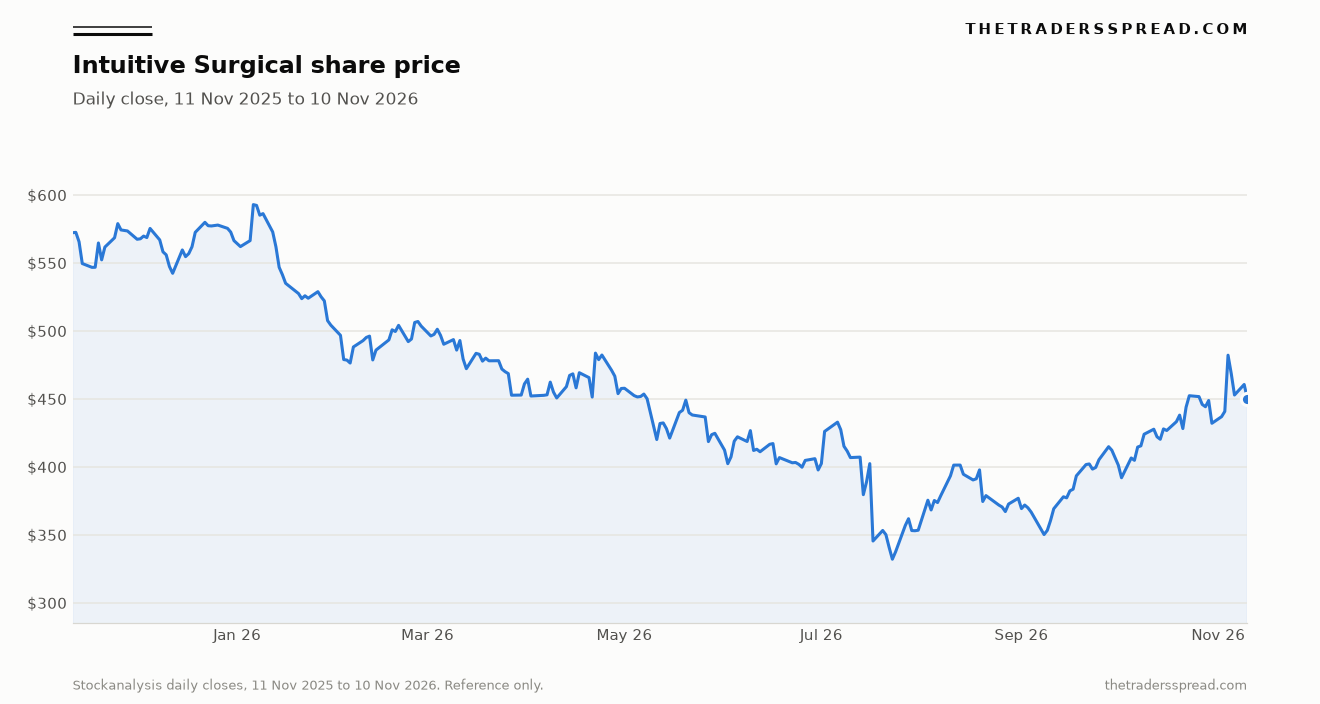
On 10 November 2026 the shares closed at $450.04, a Stockanalysis quote timed 4:00 p.m. Eastern and the last point of the one-year history pulled the next day. The 11 November 2025 close in that series was $572.17, so the later close sits 21.3% lower. The highest close was $592.85 on 6 January 2026, and the lowest was $332.02 on 23 July 2026. Those prints are reference data, and the chart leaves forward levels off.
Questions readers keep asking
What does intuitive surgical stock actually claim?
Intuitive Surgical stock is a claim on a company that places da Vinci and Ion systems and then collects instruments, accessories, service, and lease payments as those systems are used. In the quarter ended 30 September 2026, instruments and accessories were $1,797.4 million of $3,048.7 million in revenue, and customers ran about 906,000 da Vinci procedures. The share price is a separate print from that operating ledger, and the two can move on different news.
Why can placements rise while lease revenue arrives later?
A sale or a sales-type lease is recognized upfront. A fixed-payment operating lease is recognized over the term, and a usage-based lease is recognized as procedures occur. In the quarter, 291 of 546 da Vinci placements were operating leases, and operating-lease revenue was $275.0 million, of which $177.8 million was variable. A quarter full of new leases can show busy placements and a systems line that still reflects the older fleet.
Why put Stryker in the other column at all?
Stryker is a large device company that sells implants, tools, and the Mako robot, now reported inside Ortho Tech. Its third-quarter sales were $6,520 million, with organic growth of 7.7%, and its chief executive led with that figure. The quarterly report gives segment dollars and is silent on procedure counts and system placements. The silence is the comparison, because it shows which lines are peculiar to Intuitive.
How solid are the procedure counts?
The quarterly report says most installed systems are connected, and that procedure counts come from system logs plus estimates for offline systems, changes in treatment, and hospital reporting. Published counts are rounded to thousands, while the percentage changes use unrounded figures. Management treats them as a supplement to GAAP revenue and as a clue to later usage-based lease revenue, with the uncertainty stated in the same section.
What should a reader do with the $450 million charge?
The income statement records a $450.0 million antitrust settlement inside operating expenses for the quarter. GAAP net income attributable to the company was $522.8 million, or $1.49 a diluted share. The earnings release puts the after-tax cost at $347 million, or $0.99 a share, and says court approval is still required. Procedure counts, placements, instrument revenue, and lease revenue sit on other lines, so the charge explains the profit drop and leaves the six measures intact.
Which single line is worth keeping?
Keep the statement, in the quarterly report Samath signed, that procedure volume indicates the pace of adoption and also indicates future revenue, including revenue from usage-based operating leases. Stryker's report, signed the same season by Wells, offers organic sales growth and an Ortho Tech dollar line, and it lacks any parallel sentence tying a procedure count to future revenue. That gap is the split a reader can still check in the filing.
The line that separates the company
The line that separates Intuitive Surgical from a broad device company is the sentence in Samath's quarterly report that treats procedure volume as a guide to future revenue, including revenue from usage-based operating leases. Around it sit 906,000 da Vinci procedures, 546 placements with 291 on operating leases, instruments and accessories of $1,797.4 million, and lease revenue of $275.0 million. Wells's report can show $6,520 million of sales, a 65.2% gross margin, and an Ortho Tech line of $754 million, and it leaves the procedure ledger out. Gross margin, 68.4% against 65.2%, barely separates the companies. The procedure sentence is the one that does.
This article is for information and education only, and it is not a recommendation to buy or sell a security or a forecast of the share price.