

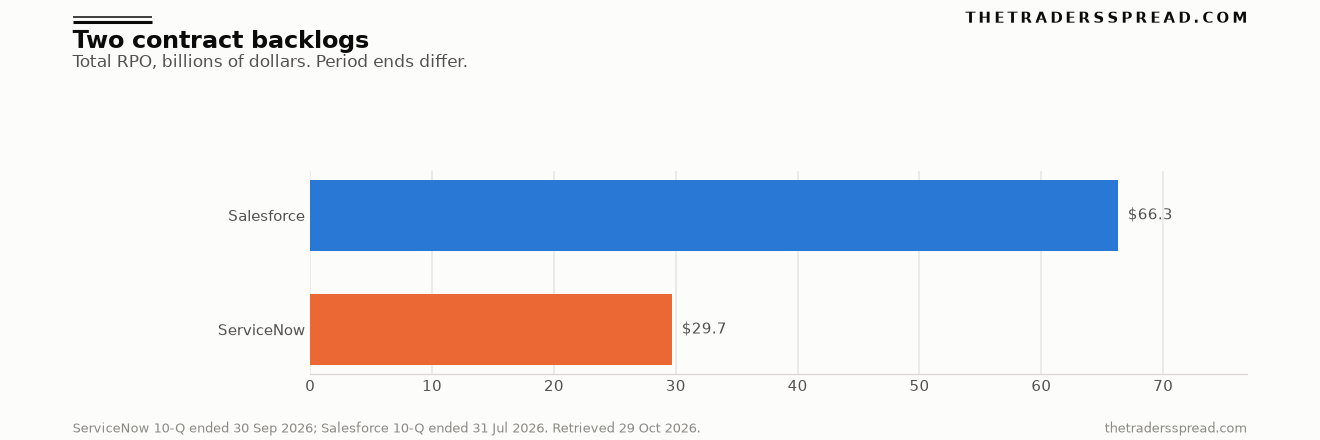
ServiceNow's Form 10-Q for the quarter ended 30 September 2026 states that remaining performance obligations were $29.7 billion. The company expects to recognize revenue on about 46 percent of that balance over the following 12 months. Bill McDermott, Chairman and Chief Executive Officer, said, "AI adoption is accelerating, surging our hybrid business model to $30 billion in RPO, growing 23 percent."
That Exhibit 99.1, dated 28 October 2026, prints remaining performance obligations of $29.7 billion. The increase is 22 percent year over year and 22.5 percent in constant currency. McDermott's 23 percent is a round figure, not the 22 percent printed beside the $29.7 billion in the same exhibit.
Salesforce's Form 10-Q for the quarter ended 31 July 2026 was filed on 27 August 2026. It reports total remaining performance obligation of approximately $66.3 billion, up 11 percent year over year. Current remaining performance obligation was approximately $33.5 billion, up 14 percent. On 31 January 2026 the same note shows $72.4 billion. People who look up servicenow stock and stop at the larger dollar are comparing a 30 September book with a 31 July book. That July total already sits $6.1 billion under the January figure, after the fiscal quarter Salesforce calls its strongest for new business and renewals.
Updated 29 October 2026 from the filings opened for the figures below.
Step 1: Start with the sentence in Note 10
Transaction price allocated to remaining performance obligations represents contracted revenue that has still to be recognized. The figure includes deferred revenue and non-cancellable amounts that will be invoiced and recognized in future periods.
Remaining performance obligation represents contracted revenue still to be recognized. It includes unearned revenue and unbilled amounts. The transaction price allocated to it is based on standalone selling price, and unbilled amounts in foreign currencies are revalued at each period-end rate. The note adds that the balance is subject to future economic risks, including bankruptcies, regulatory changes and other market factors. ServiceNow's Note 10 leaves that shrinkage clause out of its own definition.
ServiceNow's date is 30 September 2026. That quarter is the third of a fiscal year ending 31 December. Salesforce's date is 31 July 2026. That quarter is the second of a fiscal year ending 31 January. Both can be the latest 10-Q on 29 October 2026. Salesforce's next quarter closes on 31 October, and that filing is still ahead.
ServiceNow's quarterly subscription revenue was $3,988 million. Total revenue was $4,106 million, with professional services and other at $118 million. Salesforce's subscription and support revenue was $10,820 million. Professional services and other were $525 million, and total revenue was $11,345 million. Salesforce's quarter of revenue is about 2.8 times ServiceNow's. Its total RPO, $66.3 billion against $29.7 billion, is about 2.2 times.
Separate the next twelve months from the longer contract
Both companies then split the stock into work expected inside twelve months and work expected later. ServiceNow calls the near piece current remaining performance obligations. The 10-Q says cRPO will be recognized as revenue in the next 12 months. Forty-six percent of the $29.7 billion was that piece. Exhibit 99.1 prints it as $13.65 billion, up 20.5 percent year over year and 21 percent in constant currency. Forty-six percent of $29.7 billion is about $13.66 billion, in line with the exhibit's $13.65 billion. The 10-Q rounds that 20.5 percent increase to 20 percent.
A bit over half of ServiceNow's book sits past twelve months. Note 10 says the majority of that noncurrent RPO will be recognized over the next 13 to 36 months. Total RPO grew faster than the current slice. The 10-Q prints 22 percent, the exhibit prints 22.5 percent in constant currency, and cRPO grew 21 percent in constant currency.
Salesforce splits the 31 July total into current $33.5 billion and noncurrent $32.8 billion. The same 13-to-36-month sentence covers the majority of the noncurrent balance. On 31 January 2026 the split was $35.1 billion current and $37.3 billion noncurrent. Year over year the current balance grew 14 percent, as reported and in constant currency, and the total grew 11 percent. The 10-Q says current RPO growth as of 31 July 2026 was minimally changed against constant-currency rates. At Salesforce the near-term book is the faster one. At ServiceNow the total book is slightly faster than its twelve-month slice.
From 31 January to 31 July, noncurrent RPO fell by $4.5 billion and current RPO fell by $1.6 billion. Most of that step-down was beyond twelve months. ServiceNow's September filing gives the 30 September stock and the year-ago rates. A December RPO peak is left out of the document.
The exhibit also prints a forward rate for ServiceNow's current slice alone. Fourth-quarter 2026 cRPO growth is guided at 18.5 percent reported and 18.5 percent in constant currency. Subscription revenue for that quarter is guided at $4,245 million to $4,255 million. That 18.5 percent, dated 28 October 2026, sits under the 21 percent constant-currency growth just reported. The exhibit leaves total RPO unguided.
Step 3: Lift the invoiced dollars off the balance sheet
RPO is larger than deferred revenue because a signature and an invoice are different events. At 30 September 2026 ServiceNow carried a current portion of deferred revenue of $7,600 million and a noncurrent portion of $133 million, together $7,733 million. The invoiced stock is about 26 percent of the $29.7 billion backlog, and the rest is contracted and still unbilled.
Note 10 says revenue recognized from beginning-period deferred revenue was $3.6 billion in the quarter. Total revenue in that quarter was $4,106 million. Most of the quarter's recognized revenue came off invoices that were already on the books on 1 July, and the contracted backlog still closed at $29.7 billion.
Salesforce's 31 July balance sheet shows unearned revenue of $18,787 million, down from $24,317 million at 31 January. The July figure is about 28 percent of the $66.3 billion RPO, within a couple of points of ServiceNow's invoiced share. Over those six months unearned revenue fell by $5,530 million. Total RPO fell by $6.1 billion. Both stocks stepped down through the quieter half of Salesforce's year.
Services revenue is too small to explain the dollar gap. ServiceNow's professional services and other line was $118 million, about 3 percent of the quarter. Salesforce's was $525 million, under 5 percent of $11,345 million, and down from $546 million a year earlier.
| Measure | ServiceNow | Salesforce |
|---|---|---|
| Period end | 30 September 2026 | 31 July 2026 |
| Total RPO | $29.7 billion | $66.3 billion |
| Current RPO | $13.65 billion, about 46 percent | $33.5 billion |
| Beyond 12 months | The balance, majority in months 13 to 36 | $32.8 billion, majority in months 13 to 36 |
| Year-over-year, total | 22 percent reported, 22.5 percent constant currency | 11 percent reported |
| Year-over-year, current | 20.5 percent reported, 21 percent constant currency | 14 percent reported and in constant currency |
| Invoiced balance | Deferred revenue $7,733 million | Unearned revenue $18,787 million |
| Quarterly revenue | $4,106 million | $11,345 million |
Read what each note leaves out of the total
ServiceNow excludes contracts billed in arrears, including certain time-and-materials work, because it applies the right-to-invoice practical expedient. The note gives that rule and withholds the dollar it removes.
A second boundary is self-hosted software. In a minority of cases customers host the product themselves or through a third party. ServiceNow recognizes a portion of that revenue up front on delivery. That portion is excluded from RPO. Salesforce's parallel boundary is the term license. Revenue recognized at a point in time substantially consists of term software licenses, and the timing of those deliveries is one of the factors that move RPO. Once the license is delivered, that slice has left the backlog.
Future-dated subscriptions are included if they are signed by the balance-sheet date. Renewals that arrive early, so a new product can share an end date, or late, after negotiation runs past expiry, change the measured balance. Contract duration changes it as well. The company typically signs multi-year subscriptions. It also reports a rising number of 12-month agreements with the United States federal government. The highest number of them came in the quarter ended 30 September, in line with annual budget expenditures. A twelve-month federal agreement lands in cRPO more readily than a three-year commercial subscription. The filing leaves those dollars inside the $29.7 billion rather than on their own line.
Annual contract value is a separate stack. ServiceNow counted 680 customers with ACV above $5 million at 30 September 2026, against 553 a year earlier. The exhibit reports 19 transactions over $5 million in net new ACV in the quarter, up more than 135 percent. Customer-count growth was about 23 percent. Gina Mastantuono, President and Chief Financial Officer, said in the exhibit, "Our AI momentum continues to build, with AI net new ACV exceeding expectations and enabling us to raise our year-end target for the second time this year, from $1 billion at the start of the year to $1.7 billion now." The $1.7 billion is a target for AI net new annual contract value. The $29.7 billion is unrecognized contracted revenue. A bridge between them is absent from the exhibit and from Note 10.
Salesforce excludes professional-services obligations billed and recognized on a time-and-materials basis. The rest of the note points at seasonality, renewals, term-license deliveries, average contract terms, foreign exchange, and acquisitions. Robin Washington, President and Chief Financial and Operating Officer, spoke on 26 August 2026 about the pace of new orders. "NNAOV growth is the strongest it's been in four years, keeping us on track for second-half organic revenue reacceleration," she said in Exhibit 99.1 to the 26 August 8-K. The same exhibit expands NNAOV, in a line about Slack, as net new annual order value. That is a flow through the quarter rather than the stock left at the end of it.
Step 5: Set the two reporting clocks side by side
Marc Benioff, Chair and Chief Executive Officer, posted Salesforce's cRPO on 26 August 2026, the day of that exhibit. The post leads with the twelve-month figure rather than the $66.3 billion total.
#1 Q2 in Salesforce history.
$11.3B Revenue. +11%
$33.5B cRPO growth. +14%
$5.90 Non-GAAP EPS. +103%
$15.2B TTM Free Cash Flow.
$3.9B Agentforce + Data 360 ARR.
7.0B AWUs delivered all-time.
Raising FY27 guidance to $46.1–$46.4B.
3.2B AWUs in Q2 (+97% q/q)
6x growth in MCP… pic.twitter.com/dpzVdedk6CRelated$210 Bull and $160 Bear Frame the Exxon (XOM) Call
— Marc Benioff (@Benioff) August 26, 2026
The $33.5 billion and the 14 percent match the 10-Q. In the exhibit he said, "We just delivered one of our best quarters ever, outperforming across every key metric." He also said the company was "seeing incredible demand for our AI and data products, with ARR about to cross $4 billion." The same document says Agentforce and Data 360 annual recurring revenue reached nearly $3.9 billion. The chair's "about to cross $4 billion" and the highlight's "nearly $3.9 billion" sit in one filing.
ServiceNow's $29.7 billion is about 7.2 quarters of its $4,106 million revenue quarter. Salesforce's $66.3 billion is about 5.8 quarters of its $11,345 million quarter. On the current slice, ServiceNow's $13.65 billion is about 3.4 quarters of subscription revenue. Salesforce's $33.5 billion is about 3.1 quarters of subscription and support.
The revenue note says acquisitions move remaining performance obligation. The 26 August exhibit says subscription and support revenue of $10.8 billion included $440 million from Informatica. Total revenue of $11.3 billion included $456 million. They are left off any bridge inside the $66.3 billion. The 11 percent is the reported rate on the whole stock.
Two deals in the July 10-Q were still expected to close later. Salesforce agreed in May 2026 to buy Contentful Global for approximately $1.5 billion in cash, net of shares it already held, with a close expected in the quarter ending 31 October 2026. In June 2026 it agreed to buy Intercom, which it calls Fin, for approximately $3.6 billion in cash, on the same timetable, subject to regulatory approvals and other customary conditions. The 31 July RPO predates those expected closes.
Visa and Mastercard diverge once client incentives come out of the revenue line. Novo Nordisk's list price and its net sales are two readings of one product. Lam Research's earnings lines become comparable once each line is tied to the sentence that defines it. The share-price session sits on the Salesforce page about that note.
The filing that would change the comparison
Three later filings would force a rewrite of the comparison above.
The first is Salesforce's Form 10-Q for the quarter ending 31 October 2026. That date would sit one month from ServiceNow's 30 September, in place of a July figure taken below the $72.4 billion printed on 31 January. If total RPO growth there moves up toward the 14 percent pace of current RPO, the duration contrast weakens. Another step-down from the July $66.3 billion would sharpen the seasonal reading. The gap versus $29.7 billion would have to be restated off the new date. The next ServiceNow 10-Q will show whether fourth-quarter cRPO growth lands near the 18.5 percent guide or back near the 21 percent constant-currency rate just reported. It will also print a fresh total RPO that this exhibit left unguided.
The second is a ServiceNow disclosure that prices the two exclusions Note 10 describes and then leaves unmeasured. One is time-and-materials work kept out by the right-to-invoice expedient. The other is the up-front portion of self-hosted software. A line for the twelve-month United States federal agreements that bunch up in the September quarter would show how much of the 46 percent current share is a budget-calendar effect.
The third is a bridge that separates acquired remaining performance obligations from the organic book. The July note says acquisitions affect RPO and prints 11 percent on the reported total. The August exhibit attaches Informatica's $456 million to revenue. The July note describes Contentful at about $1.5 billion and Fin at about $3.6 billion, both then expected to close in the quarter ending 31 October 2026. A later filing that shows how much of the backlog arrived by purchase, rather than by renewal on the existing base, would change the growth rate that sits next to ServiceNow's 22 percent.
Until one of those documents is in the record, the two notes support a narrow comparison. Each is contracted revenue still to be recognized. Each shows an invoiced share in the mid-twenties and a noncurrent majority expected in months 13 to 36. The clocks differ, and so do the exclusion rules.
Figures below are reference data from filings opened on 29 October 2026. They are not a forecast, a price target, or a recommendation to buy or sell ServiceNow or Salesforce shares.