

Jayshree Ullal, chair and chief executive of Arista Networks, said the company had "registered another momentous quarter with the highest year-over-year revenue growth since our IPO and record profitability," and that the momentum ran "across customer sectors." Revenue for the three months ended 30 September 2026 was $3,657.6 million, up 58.5% from $2,308.3 million, and product revenue was $3,190.0 million, up 66.9%. On 4 August the company had set a revenue guide of about $3.3 billion. The print landed $357.6 million above that figure.
Arista stock is often read as a clean pass-through of two cloud capital budgets. The accounts support a narrower statement. The Form 10-K for the year ended 31 December 2025, filed on 17 February 2026, and the Form 10-Q filed on 4 November 2026, put two end customers at 26% and 16% of 2025 revenue. Both filings leave the buyers unnamed, and neither gives a concentration percentage for the nine months of 2026. The 3 November earnings release lists Meta and Microsoft among seven partners on an open Ethernet design. A partner list and a revenue footnote answer different questions.
Chantelle Breithaupt, chief financial officer, called the quarter a "trifecta" of record revenue growth, net income and earnings per share. GAAP diluted earnings were $1.22, against $0.67 a year earlier. Non-GAAP diluted earnings were $1.20, above the August guide of $1.06 to $1.08. A $134.5 million gain on strategic investments is stripped from the non-GAAP line, which is why GAAP earnings per share sit above the non-GAAP figure. GAAP gross margin was 63.6%, one point under the year-earlier quarter. GAAP operating margin rose to 44.9% from 42.4%, because operating expenses grew more slowly than sales.
Updated 9 November 2026, using the Form 10-Q filed on 4 November and the New York close on 6 November.
Two customers, still unnamed
The concentration footnote is easy to over-read. Traders talk as if the Form 10-K had printed two logos beside 26% and 16%. It prints percentages and the words "end customer." Sales to one end customer were 16% of revenue in 2025, 15% in 2024 and 21% in 2023. Sales to the other were 26%, 20% and 18%, and the larger of the two shares changed years, while the filing still withholds both names.
| Year ended 31 December | End customer A | End customer B |
|---|---|---|
| 2023 | 21% | 18% |
| 2024 | 15% | 20% |
| 2025 | 16% | 26% |
Together the two were 42% of 2025 revenue, 35% of 2024 and 39% of 2023. That is a large exposure, and 58% of 2025 sales sat outside it. The 10-Q says Arista expects large purchases by a limited number of customers to remain a substantial part of revenue, and that the timing of those orders has been hard to predict because the orders are complex and because the buyers shift spending between AI projects and the rest of the network.
Microsoft and Meta appear in the 3 November release, inside a list: open rack-scale designs "in partnership with AMD, Arm, Broadcom, d-Matrix, Meta, Microsoft, and Qualcomm." The release names Microsoft and Meta as partners on that architecture, not as the 26% and 16% customers. A reader who wants the legal names of the two end customers has to find them outside the 2025 Form 10-K and the September 2026 Form 10-Q.
Geography leaves the names off the page as well. Third-quarter revenue was $2,975.1 million in the Americas, $381.2 million in Europe, the Middle East and Africa, and $301.3 million in Asia-Pacific. The United States was $2,956.3 million, or 80.8% of the $3,657.6 million total. Non-Americas revenue was 18.6% of the quarter, against 20.2% a year earlier. The 10-Q ties that swing to where large global customers took delivery. Ship-to address is a delivery location, not the customer's headquarters.
Full-year 2025 revenue was $9,005.7 million, up 28.6% from 2024, with product at 84.1% and service at 15.9%. Nine-month 2026 revenue is already $9,402.3 million. The 3 November outlook for the fourth quarter is $3.9 billion to $4.0 billion of revenue, a non-GAAP operating margin of 48% to 49%, and non-GAAP diluted earnings of $1.26 to $1.30. Adding that revenue range to the nine-month total gives $13.30 billion to $13.40 billion, which is 47.7% to 48.8% above 2025 if the range is met. Arista published the inputs and left the sum to the reader.
Ethernet has a shipment number, and a rival stack
A second claim travels with the customer claim. Because Nvidia sells InfiniBand and NVLink with its accelerators, a merchant Ethernet switch is cast as the old front-end network while the training cluster goes elsewhere. The Form 10-K states the competitive fact directly. Ethernet faces InfiniBand and NVLink on back-end AI clusters, and both interconnects are often sold in a vertical package with Nvidia's GPUs. The same report also says the industry is moving from proprietary interconnects such as InfiniBand toward Ethernet, under the Ultra Ethernet Consortium, while Arista's own products still have to win that displacement.
The September quarter is a shipment record. It says something about demand and nothing decisive about who holds the back-end port in three years. Product revenue of $3,190.0 million was 87.2% of the quarter, up from 82.8% a year earlier. The 10-Q says the increase reflects demand for switching and routing platforms across the customer base. Service revenue rose $71.0 million, or 17.9%, to $467.6 million, on new support contracts and renewals. More of the quarter was hardware, which is the mix a margin model has to absorb.
The November release describes a liquid-cooled Etherlink SU-144 layout for up to 144 accelerators in one rack on a single hop, scaling to 1,024 across racks, and a scale-across fabric on the 7800 AI Spine out toward a million accelerators. The 4 August release had introduced 1.6-terabit systems and said linear pluggable optics cut interconnect power by about 60% versus traditional pluggables. Those are product claims in SEC exhibits, and they stay product claims until the revenue line keeps growing.
The annual report says Arista is "primarily reliant" on Broadcom for switching chips, with no written supply guarantee, and that Jabil, Sanmina and Foxconn build mainly in Malaysia, Vietnam and Mexico. The September 10-Q adds that memory and silicon have tightened, that inventory should stay elevated, and that gross margin absorbs costs the company cannot pass on. White-box hardware is listed with Cisco, Dell, Hewlett Packard Enterprise, Huawei, Juniper and Nvidia. The stated counter is one operating system, EOS, across a single reported segment. A weak campus quarter and a weak AI quarter land in the same total.
Where the margin point went
The standing objection to a gross margin above 60% is that hyperscaler pricing, merchant silicon and white-box hardware will compress it. Arista already says the recent margin may not hold. The Form 10-K and the Form 10-Q both warn that gross margins of recent years "may not be sustainable," citing price, a shift toward large customers who pay less, product mix, merchant-silicon cost, tariffs and excess inventory. That sentence was on file when the quarter printed 63.6%.
| Q3 2026 | Q3 2025 | Nine months 2026 | Nine months 2025 | |
|---|---|---|---|---|
| Product revenue | $3,190.0 | $1,911.7 | $8,106.5 | $5,481.2 |
| Service revenue | 467.6 | 396.6 | 1,295.8 | 1,036.7 |
| Total revenue | 3,657.6 | 2,308.3 | 9,402.3 | 6,517.9 |
| GAAP gross margin | 63.6% | 64.6% | 62.9% | 64.5% |
| GAAP operating margin | 44.9% | 42.4% | 44.4% | 43.3% |
| GAAP diluted EPS | $1.22 | $0.67 | $2.98 | $2.00 |
| Non-GAAP diluted EPS | $1.20 | $0.77 | $3.09 | $2.16 |
In the quarter, GAAP gross margin fell from 64.6% to 63.6%. The 10-Q says product gross margin fell by 0.3 of a point on higher product costs, partly offset by supply-chain productivity. From the cost-of-revenue rows, service gross margin was about 83.6% against about 81.7% a year earlier, and product gross margin was about 60.7% against about 61.0%. Product's share of revenue rose by about four points. Across a gap of roughly twenty points between those two margins, a shift of that size accounts for most of the one-point decline in the company-wide figure. The filing's sentence is about cost. The mix sits in the same income statement.
Over nine months, GAAP gross margin was 62.9% against 64.5%, and product gross margin fell 1.5 points on the 10-Q's comparison, again on cost. Full-year gross margin was 64.1% in both 2025 and 2024, so the year-to-date print is the break from that plateau. Non-GAAP gross margin was 64.0% in the quarter and 63.4% for the nine months, after adding back a small amount of stock-based pay and amortisation in cost of sales.
Operating expenses rose 33.5%, to $683.3 million, while revenue rose 58.5%. Research and development was $486.9 million, against $326.0 million, which is 13.3% of revenue against 14.1%. Operating income was $1,642.4 million, against $978.2 million. Over nine months, operating income of $4,178.2 million and net income of $3,796.2 million are already above the 2025 full-year figures of $3,856.1 million and $3,511.4 million. Stock-based compensation in the quarter was $138.1 million.
The non-GAAP earnings comparison has a definition change under it. From the fourth quarter of 2025, Arista changed the tax effect it applies to stock-based awards inside non-GAAP earnings, and the November release recasts 2025. The company says the recast added $0.02 to third-quarter 2025 non-GAAP diluted earnings per share. The $0.77 in the table is that recast figure. An older copy of the 2025 release will disagree with it.
Deferred revenue is two different piles
Deferred revenue was $6,839.5 million at 30 September, up from $5,372.4 million at the end of 2025, split into $5,102.2 million current and $1,737.3 million non-current. Other performance obligations were $1.4 billion, of which $497.1 million was unbilled multi-year support and $943.5 million was binding product agreements. With deferred revenue, the 10-Q puts future revenue at $8.6 billion, about 91% of it inside two years, against $6.1 billion at the end of 2025. That pile is support plus product still to ship or still to accept, which is a different object from a software annuity and from a book of spot orders.
RelatedCan a Reader Parse a Shopify (SHOP) Earnings Report?
| 30 September 2026 | 31 December 2025 | |
|---|---|---|
| Cash and equivalents | $2,288.1 | $1,963.9 |
| Marketable securities | 12,070.9 | 8,779.1 |
| Inventories | 3,209.8 | 2,247.1 |
| Deferred revenue | 6,839.5 | 5,372.4 |
| Remaining performance obligations | 8,600 | 6,100 |
Deferred revenue opened the quarter at $6,865.9 million. Arista recognised $1,715.0 million of that opening balance and deferred a further $1,688.6 million of new activity, so the ending balance barely moved from 1 July. Over nine months the cash-flow statement shows the balance up about $1.5 billion, from product behind acceptance clauses and from post-contract support. New AI Ethernet gear has meant more trials and more contracts that wait on acceptance, so a dollar in the pile can be a support contract or a switch that has left the factory and still awaits acceptance.
About $1.7 billion of the quarter's $3,657.6 million of revenue was the release of the 1 July deferred balance. Purchase orders can still be cut with little notice, and inventory is built from forecasts. Inventory ended at $3,209.8 million, up $962.8 million over nine months. Management expects that stock, and the purchase commitments behind it, to stay high while new products ramp and while memory and silicon lead times move. Gear built and gear accepted are two clocks.
Cash and marketable securities were $14,359.0 million, against $10,743.0 million at the end of 2025, and the condensed balance sheet lists payables, accruals, deferred revenue and other liabilities, with no borrowings line among them. Operating cash flow for the nine months was $3,977.4 million, against $3,110.0 million, after the inventory build. Capital spending was $184.9 million, against $82.5 million, and repurchases were zero, against $983.0 million a year earlier. Diluted weighted-average shares were 1,278.2 million, against 1,276.6 million, so the count barely moved.
The share, from the March low to the October high
For Arista stock, the path over the past year is wide enough that one close misleads. StockAnalysis, retrieved on 9 November 2026, shows a regular-session close of $170.80 on 6 November, timestamped 4:00 p.m. Eastern on that feed, up 7.31% from $159.16. The one-year series starts at a close of $134.02 on 6 November 2025, so the gain to $170.80 is 27.4%. The highest close in the series is $216.74 on 9 October 2026. The lowest is $116.13 on 30 March 2026. The latest close sits 21.2% under that October high. The same feed's 52-week range was $114.52 to $217.41.
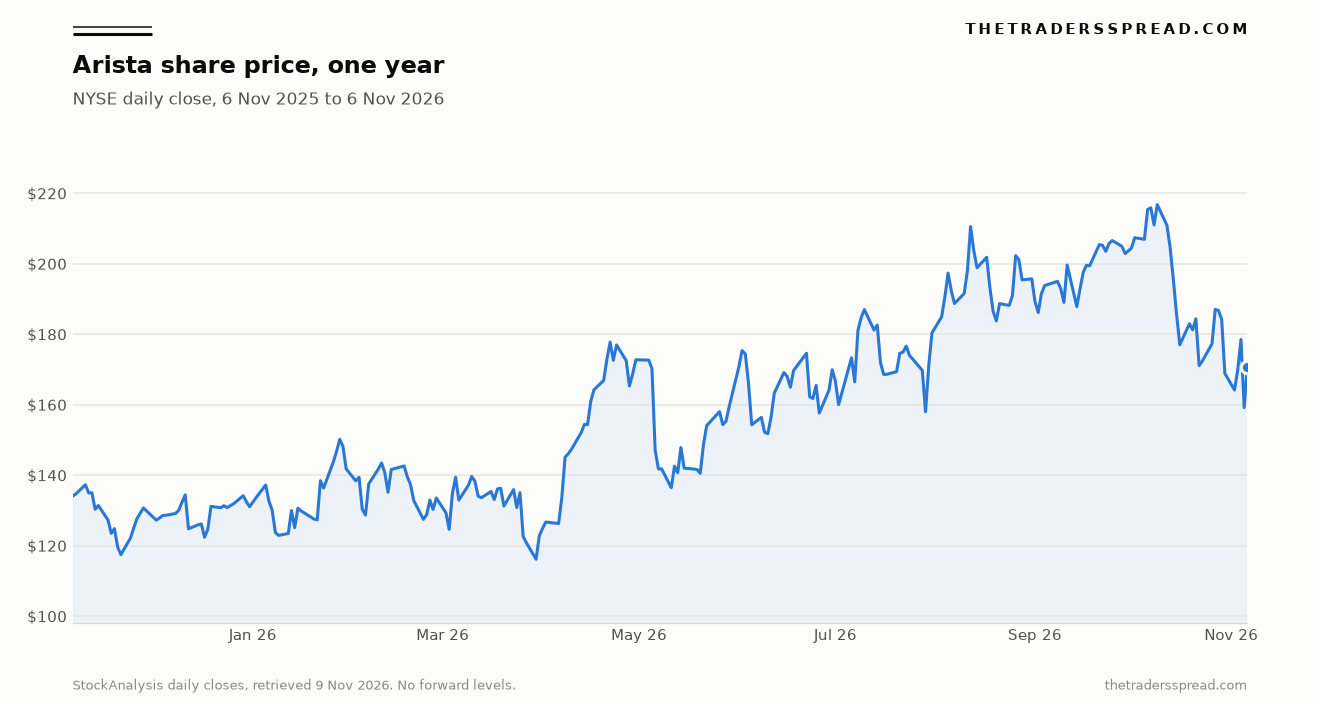
The week of the release shows why a beat and a higher share are separate facts. The daily closes were $164.14 on 2 November, $169.91 on 3 November, when the release came out, $178.48 on 4 November, $159.16 on 5 November and $170.80 on 6 November. Using the 4 November close as the reaction, and using the 5 November close as the reaction, describes two different sessions. The chart is that one-year path, with those sessions inside it, and it draws no line for a later price.
What would change our mind
The reading here is of a switch and routing vendor whose sales remain concentrated, whose gross margin has bent by a point or two, and whose deferred revenue mixes support contracts with product waiting on acceptance. A later Form 10-Q could force a rewrite on any of those three.
A concentration table that names the two end customers, or shows either under 10%, would rewrite the customer section, as would a quarter in which a cancelled programme showed up in the income statement. Product gross margin sliding from the nine-month pace toward the mid-50s would turn the sustainability warning into the operative line. If product margin instead held near 60.7% with product still near 87% of revenue, the one-point company-wide dip would look like mix, and the nine-month 1.5-point product-margin decline would look finished.
On the Ethernet claim, the next product-revenue lines either support a $3.9 billion to $4.0 billion fourth quarter or fall short of it. Deferred revenue released on acceptance would support the shipment story. Deferred revenue falling because orders were cancelled, with inventory still near $3.2 billion, would support the warning already in the 10-Q. The buyback pause, zero against $983.0 million, with $14.4 billion of cash and securities, says only that the capital return stopped.
This is an account of Arista's filings and of a share price with a timestamp, and it is not a recommendation to buy or sell the shares or any other security. Customer mix, acceptance timing and component cost move from quarter to quarter, and capital is at risk.