

The Form 10-K that Palo Alto Networks filed with the Securities and Exchange Commission on 10 September 2026, for the year ended 31 July 2026, is the annual document that still prints remaining performance obligations and leaves the old billings total off the page. Remaining performance obligations were $21.2 billion at that year end, and the revenue note says the company expects to recognize about $9.3 billion of that stock as revenue over the following 12 months. Billings, the flow figure readers still search for, last appears as a company total in the Form 10-K for the year ended 31 July 2024, where Palo Alto Networks defines the line and then says that from the first fiscal quarter of 2025 it would stop treating billings as a key metric and would stop reporting it.
Anyone reconstructing Palo Alto Networks billings for a later year has to respect the word acquired. On the 31 July 2026 balance sheet, current deferred revenue moved from $6,302 million to $7,747 million and long-term deferred revenue moved from $6,450 million to $7,009 million, a combined increase of $2,004 million. The cash-flow statement, in the section for changes in operating assets and liabilities net of acquisitions, shows deferred revenue up $1,202 million. The $802 million gap is mostly the $776 million of deferred revenue assumed in the CyberArk purchase allocation in that same 10-K. Add the raw balance-sheet change to revenue and the worksheet swallows an acquisition liability that the retired definition told the reader to take out.
Updated 12 November 2026
Step 1: Open the 10-K, then the newest 10-Q
Start on EDGAR with Palo Alto Networks, Inc., Central Index Key 0001327567, Commission file number 001-35594, a Delaware corporation whose common stock trades as PANW on Nasdaq. The annual report is accession 0001327567-26-000023, panw-20260731.htm, accepted on 10 September 2026. The quarterly report below is the Form 10-Q for the quarter ended 30 April 2026, panw-20260430.htm. A filing list consulted on 12 November 2026 still showed that April quarter as the latest 10-Q, and no quarterly report yet for the quarter that ends 31 October 2026.
Item 7, on page 45, holds next-generation security annualized recurring revenue and remaining performance obligations. The revenue footnote, on page 74, splits that stock into the next 12 months and the period after. Deferred revenue sits on the balance sheet in current and long-term lines, inside operating cash flow, and, when a deal closes, inside the acquisition note as a liability assumed. Exhibit 99.1 to the Form 8-K filed on 1 September 2026, accession 0001327567-26-000019, is the press release where the growth rates and the outlook ranges are written as sentences. Readers who want the same split between a release and the lines a filing ties out can use a walk-through of a Shopify earnings report. Subscription and support contracts are typically one to five years, and payment is typically due within 30 to 75 days of the invoice.
The definition Palo Alto Networks printed, then dropped
In the Form 10-K for the year ended 31 July 2024, Palo Alto Networks defined billings as total revenue plus the change in total deferred revenue, net of acquired deferred revenue, during the period. Management had treated the line as a key metric, with one limitation named in the same paragraph: variability in payment terms may cause fluctuation in billings. Beginning in the first fiscal quarter of 2025, billings would no longer be a key financial metric and would no longer be reported.
The worked example in that 2024 report is the last official series. Revenue of $8,027.5 million plus a $2,180.6 million change in total deferred revenue, net of acquired deferred revenue, produced billings of $10,208.1 million for the year ended 31 July 2024. The year before, $6,892.7 million plus $2,301.7 million produced $9,194.4 million. The year before that, $5,501.5 million plus $1,970.0 million produced $7,471.5 million. A secondary write-up that quotes a Palo Alto Networks billings total for a year after fiscal 2024 is quoting a reconstruction, or it is quoting this retired series and mislabeling the date.
Deferred revenue inside operating cash flow was $2,180 million for the year ended 31 July 2024, against the $2,180.6 million the billings table added, the same adjustment rounded to the nearest million. After the retirement, that cash-flow line is the practical stand-in for "change in total deferred revenue, net of acquired deferred revenue," because the caption already says the change is net of acquisitions. Billings was a flow, not a stock. Revenue is what the company recognized, and the deferred-revenue change is what advance invoicing added to the balance sheet, or drew down, after stripping deferred revenue that arrived inside a purchase.
Step 2: Rebuild the retired total from two statements
For the year ended 31 July 2026 the income statement shows total revenue of $11,480 million, against $9,221 million and $8,027 million, with year-on-year increases of 24%, 15%, and 16%. Product revenue was $2,280 million and subscription and support was $9,200 million, against $1,802 million and $7,419 million. Product revenue, described as 19.9% of the year, covers hardware including the ML-Powered next-generation firewall plus software licenses, and it is recognized when hardware ships or a license is delivered. Subscription and support revenue is recognized over time. A billings-style sum adds the invoices. The income statement spreads many of them across the contract.
Deferred revenue at 31 July 2026 was $7,747 million current and $7,009 million long-term, against $6,302 million and $6,450 million. Those totals, $14,756 million and $12,752 million, mean the balance sheet rose by $2,004 million. During the year the company recognized about $6.2 billion of revenue from amounts deferred at 31 July 2025, after about $5.5 billion the prior year.
Use the cash-flow line as the addend. Deferred revenue in operating cash flow, net of acquisitions, rose $1,202 million in fiscal 2026, $1,239 million in fiscal 2025, and $2,180 million in fiscal 2024. Revenue plus that line is $11,480 million plus $1,202 million, or $12,682 million, for fiscal 2026, and $9,221 million plus $1,239 million, or $10,460 million, for fiscal 2025. Palo Alto Networks did not publish either sum. The figures are arithmetic on rows the company did publish, so a blog post that invents a billings number can be checked against the same two rows.
The $2,004 million balance-sheet change is the wrong addend. CyberArk Software Ltd. closed on 11 February 2026. Shareholders received $45.00 in cash and 2.2005 Palo Alto Networks shares for each CyberArk share. Total consideration is $21,061 million: cash of $2,308 million, 112 million shares valued at $18,488 million, and replacement awards of $265 million. Preliminary fair values in the purchase allocation include goodwill of $14,800 million, identified intangible assets of $6,279 million, and deferred revenue of $776 million. Chronosphere closed on 29 January 2026 for consideration of $2,951 million. The deferred-revenue liability with its own dollar figure in the notes read here is the CyberArk line. Of the $802 million gap, $776 million has that name, and the residual $26 million stays unnamed, so a reader quotes $776 million and leaves the rest as an unidentified difference.
From the acquisition dates through 31 July 2026, Chronosphere and CyberArk together contributed revenue of $930 million and an operating loss of $797 million. Full-year GAAP operating income was $695 million, against $1,243 million, while remaining performance obligations rose from $15.8 billion to $21.2 billion. Contracted work still to be performed and GAAP operating profit can move apart in the same year, because one line counts unperformed transaction price and the other counts costs, amortization, and deal effects.
Remaining performance obligations in the revenue note
Search the 10-K for Remaining Performance Obligations. The revenue footnote says they were $21.2 billion as of 31 July 2026, of which the company expects to recognize approximately $9.3 billion over the next 12 months and the remainder thereafter. The 30 April 2026 Form 10-Q uses the same sentence one quarter earlier: $18.4 billion, of which approximately $8.3 billion was expected over the next 12 months, sitting in the revenue note after deferred revenue and before the fair-value note. A reader who has never opened a Palo Alto Networks 10-Q can search those four words and land on the stock figure this exercise uses.
From 30 April to 31 July the stock moved by $2.8 billion, a bridge the filings leave without the caption "RPO bookings." The 1 September 2026 release states year-on-year growth of 34%, to $21.2 billion, against $15.8 billion in the prior-year management table. On those rounded billions, 21.2 divided by 15.8 equals 1.34, so the release and the annual table are the same comparison.
Backlog is a third word, kept in the business section. Contract amounts recorded in neither deferred revenue nor revenue are backlog. Orders billed ahead of recognition sit in deferred revenue. Backlog moves with billing and fulfillment timing, including inventory shortages, and the company treats one date's backlog as a weak guide to later results. Remaining performance obligations minus total deferred revenue is $21.2 billion minus $14,756 million, or $6,444 million at 31 July 2026, a cross-check beside the definition rather than a caption the filing prints. The contract-backlog comparison between ServiceNow and Salesforce shows two firms printing a stock of future work under labels that stay local to each report.
Current remaining performance obligations of about $9.3 billion sit beside current deferred revenue of $7,747 million, a gap of about $1,553 million still outside that current line. Long-term remaining performance obligations are $11.9 billion, beside long-term deferred revenue of $7,009 million, a gap of about $4,891 million. Both gaps are reader arithmetic on work the revenue note still counts while the invoice has yet to reach deferred revenue, and an acquisition can move the balance-sheet side without an equal booking on the way a reader might picture it.
Step 3: Set the quarter's release beside the annual lines
The 1 September 2026 release reports fiscal fourth-quarter revenue up 34% to $3.41 billion. Full-year revenue of $11,480 million minus nine-month revenue of $8,070 million is $3,410 million, so the bullet and the statements agree once rounding to the nearest ten million is allowed. Annual growth in the 10-K is 24%. Next-generation security annualized recurring revenue in the release grew 63%, to $9.10 billion. Three rates, three denominators, and a recap that quotes only "growth" has left the line unnamed.
GAAP operating income for the quarter was $172 million, against $497 million a year earlier, while the reconciliation table prints non-GAAP operating income of $1,011 million, against $768 million, and the highlight bullet rounds the quarter to $1.0 billion. Full-year GAAP operating income in that table is $695 million, matching the 10-K, against non-GAAP operating income of $3,356 million and $2,652 million. The GAAP reader and the adjusted reader are using printed numbers to answer different questions. A line-by-line pass through Lam Research earnings is the same habit in another filing.
On the cash-flow statement, net cash from operating activities was $4,553 million and free cash flow, operating cash flow minus purchases of property, equipment, and other assets, was $4,113 million. Dividing $4,113 million by $11,480 million of revenue gives 35.8%, reader arithmetic. The release reports an adjusted free cash flow margin of 38.4% for the same year, because that measure adds back certain headquarters capital spending, acquisition-related payments, and litigation-related payments. Dipak Golechha, chief financial officer of Palo Alto Networks, said the profitable-growth framework supported confidence in a 40% adjusted free cash flow margin in fiscal 2028. The remark is an outlook sentence in the release. Operating cash flow, the billings worksheet, and remaining performance obligations each measure a different object.
NGS ARR sits beside the stock, on its own definition
Next-generation security annualized recurring revenue, from the definition on page 45, is the annualized allocated revenue of all active contracts on the last day of the period for product, subscription, and support, excluding hardware and excluding legacy attached subscriptions, legacy support, and professional services. Palo Alto Networks says to view it independently of revenue, deferred revenue, and remaining performance obligations. Start dates, end dates, and renewal rates can move it. The company presents it as an operating metric rather than a forecast of revenue, and the basket widens when new offerings are classified as next-generation.
The 31 July 2026 table shows $9.1 billion against $5.6 billion, and the release states $9.10 billion with growth of 63%, the same stock at two roundings. Nikesh Arora, chairman and chief executive officer of Palo Alto Networks, said: "We delivered a strong Q4 to close out the year, adding nearly $1 billion of Net New NGS ARR in a single quarter." The same remark points at a $20 billion NGS ARR figure for fiscal 2030. That figure is the chief executive's statement in the release. It is a different object from the $21.2 billion of remaining performance obligations, and a different object again from retired billings, because one figure is a one-day run-rate of a defined portfolio and the other is multi-year transaction price.
RelatedMarvell (MRVL): Six Myths About the Custom Chip Book
Palo Alto Networks posted those quarter figures, revenue, NGS ARR, and remaining performance obligations, from its own account on 1 September 2026.
A strong finish to a record year 📈
— Palo Alto Networks (@PaloAltoNtwks) September 1, 2026
Our fiscal Q4’26 results:
🟧 Revenue +34% YoY to $3.41B
🟧 NGS ARR +63% YoY to $9.10B
🟧 RPO +34% YoY to $21.2B
🟧 Nearly $1B of Net New NGS ARR added in Q4
Read the full results. https://t.co/glG2NFpAgK$PANW pic.twitter.com/NMyNX0g0d7
A guidance range can step down and still show a fast year
On 1 September 2026 the company set fiscal first-quarter 2027 remaining performance obligations at $20.8 billion to $20.9 billion, year-on-year growth of 34% to 35%, beside next-generation security annualized recurring revenue of $9.54 billion to $9.56 billion and revenue of $3.300 billion to $3.310 billion. The dollar range sits below the $21.2 billion stock at 31 July 2026 while the growth rate stays in the mid-30s, because the rate compares with the prior-year quarter and the dollars compare with the July stock. The 10-K business section says the strongest sequential revenue growth generally falls in the fiscal second and fourth quarters, so a softer first-quarter stock sits on that calendar. The ranges are dated 1 September 2026, and a later release replaces them.
For fiscal 2027 the same release expected remaining performance obligations of $25.2 billion to $25.4 billion, growth of 19% to 20%, revenue of $14.10 billion to $14.20 billion, growth of 23% to 24%, and next-generation security annualized recurring revenue of $11.075 billion to $11.175 billion, growth of 22% to 23%. Non-GAAP operating-margin guidance, diluted non-GAAP earnings-per-share guidance, and adjusted free-cash-flow margin guidance stay unreconciled, because Palo Alto Networks withholds the matching GAAP guidance and says the reconciling items cannot be predicted without unreasonable effort. The balance sheet shows 815 million shares issued and outstanding at 31 July 2026 and 668 million a year earlier, with 2,000 million authorized. CyberArk accounts for 112 million of the shares issued in the consideration, and the quarterly outlook uses 837 million to 844 million diluted shares, a different count from the basic shares on the balance sheet.
The share-price chart is a reference print
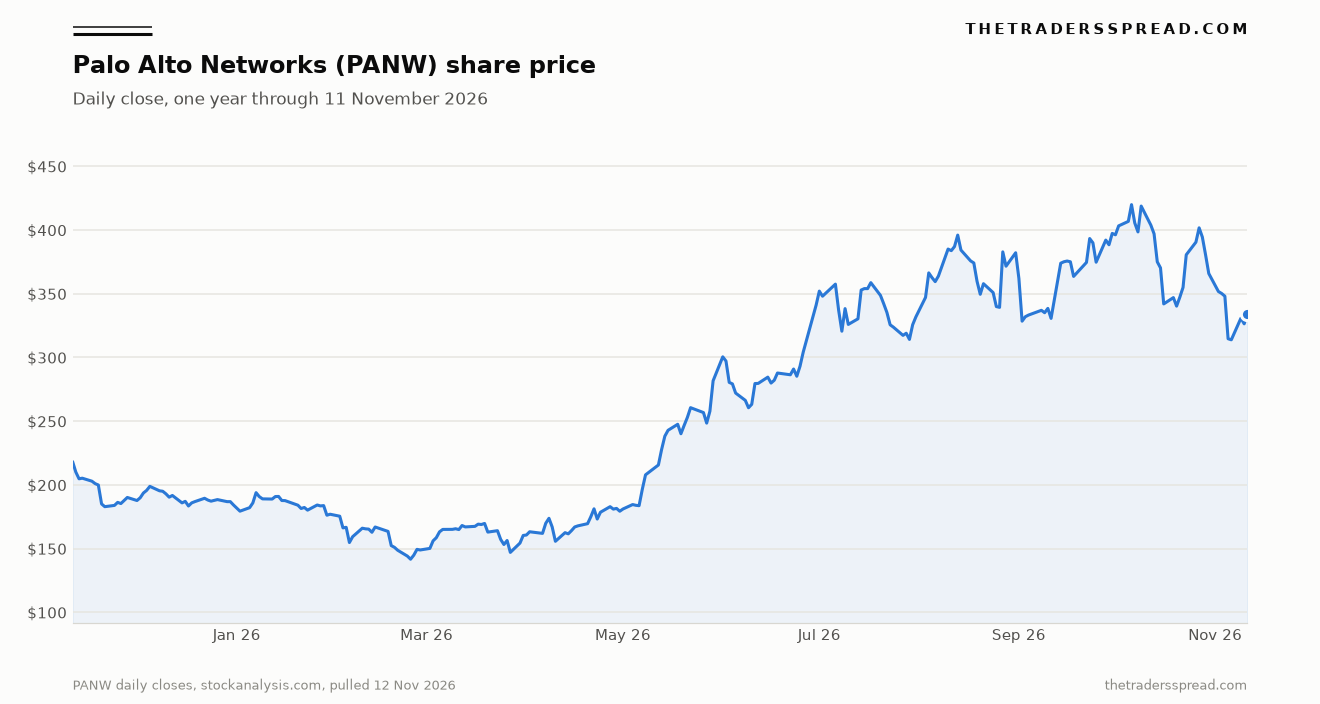
The chart is the daily closing series for PANW from stockanalysis.com, 252 sessions from 11 November 2025 through 11 November 2026. The first close is $218.27 and the last is $334.47, matching the regular-session print for 11 November 2026 at 4:00 p.m. Eastern Time, up $8.11, or 2.48%, from $326.36, on volume of 5,028,512 shares. The lowest close in the file is $141.67 on 24 February 2026 and the highest is $419.91 on 6 October 2026. From the first close to the last the series rose 53.2%. There is no forward path and no bull, base, or bear level. The line records where the shares traded while those filing figures were the ones on the page.
Questions that come up on the same pages
Where is billings in a current Palo Alto Networks 10-Q?
Open the latest Form 10-Q on EDGAR and search the word billings. In the report for the quarter ended 30 April 2026 the billings total is absent, while revenue, deferred revenue, and remaining performance obligations are on the page. The 31 July 2024 Form 10-K said the company would stop reporting billings from the first quarter of fiscal 2025. The replacement lines are revenue, the two deferred-revenue balances, and the deferred-revenue line in operating cash flow.
How does remaining performance obligations differ from deferred revenue?
Remaining performance obligations are the transaction price allocated to work Palo Alto Networks still has to perform. Deferred revenue is the portion already invoiced or paid ahead of recognition. At 31 July 2026 the 10-K showed $21.2 billion of remaining performance obligations and $14,756 million of deferred revenue on the current and long-term lines. The gap is contracted work still waiting to be billed, and the company reports the two amounts separately.
Can next-generation security ARR stand in for the old billings line?
Next-generation security annualized recurring revenue is the annualized allocated revenue of active contracts on the last day, excluding hardware and legacy attached subscriptions, support, and professional services. On 31 July 2026 Palo Alto Networks printed $9.1 billion of it beside $21.2 billion of remaining performance obligations, and it says to view the run-rate apart from revenue, deferred revenue, and that stock. Billings measured invoicing over a period. The run-rate measures a portfolio on one day.
What the billings line is for
The billings line, while Palo Alto Networks still printed it, was the bridge from recognized revenue to invoicing, and remaining performance obligations are the stock of contracted work still to be performed.
Figures in this guide are reference data from Securities and Exchange Commission filings and from a market print retrieved for the chart. They are general information rather than a recommendation to buy or sell Palo Alto Networks shares or any other security. Capital is at risk.