

We have tracked Cloudflare's revenue guidance at every step of 2026, from the first full-year range in February to the fourth one published after the bell on 5 November, and the third-quarter print is the first time this year the company beat its own quarterly range by more than 6%. The shares closed the regular session at $244.51, down 8.28%, then traded at $280.51 in the after-hours tape at 7:59 p.m. EST, a gain of 14.72% on the close, according to the stockanalysis.com quote page we opened on 6 November. The table below is the quarter as filed.
| Metric (Q3 2026) | Reported or guided | Prior reference | Change |
|---|---|---|---|
| Revenue | $782.5m | Guided $736.0m to $737.0m in August | +6.2% vs guide midpoint; +39% year on year |
| Non-GAAP operating income | $137.1m (17.5% of revenue) | Guided $129.0m to $130.0m | Margin up from 15.3% a year earlier |
| Non-GAAP EPS | $0.38 | Guided $0.34 | +$0.11 year on year |
| Q4 revenue guide | $845.0m to $846.0m | Q4 2025 revenue $614.5m | Implies about +37.6% year on year |
| Full-year 2026 revenue guide | $2,963.0m to $2,964.0m | $2,864.0m to $2,870.0m in August | +$96.5m at the midpoint (+3.4%) |
| NET regular close, 5 Nov | $244.51 | $266.58 on 4 Nov | -8.28% |
| NET after-hours print, 5 Nov, 7:59 p.m. EST | $280.51 | $244.51 close | +14.72% |
Sources: Cloudflare Q3 2026 press release, Form 8-K Exhibit 99.1, 5 November 2026; Q2 2026 release, Exhibit 99.1, 6 August 2026; prices from stockanalysis.com, retrieved 6 November 2026, 06:10 UTC.
Read the two price rows together. On 5 November the Invesco QQQ Trust fell 6.49% to $647.05, CrowdStrike lost 9.88%, Zscaler 9.16% and Akamai 9.41%, all at the 4:00 p.m. close on the same stockanalysis.com feed. Cloudflare went down with the group during the day, so the regular close carries no company information at all. After hours the peers barely moved (CrowdStrike +1.25%, Zscaler -0.38%, Akamai +2.76%, QQQ +0.63%) while Cloudflare added 14.72%. That gap of roughly 12 to 15 percentage points against its own peer set is the cleanest measure we have of what the market paid for the report itself, and it is the number our bull and bear cases are built around.
Our working spot for every level in this forecast is the $244.51 regular close. The extended-hours print is thin and can fade by the 9:30 a.m. open on 6 November.
Key facts
- Q3 2026 revenue was $782.5 million, up 39% year on year, against a guided $736.0 million to $737.0 million (Cloudflare 8-K Exhibit 99.1, 5 Nov 2026).
- Full-year 2026 revenue guidance moved to $2,963.0 million to $2,964.0 million from $2,864.0 million to $2,870.0 million (Cloudflare 8-K Exhibit 99.1, 5 Nov 2026).
- Paying customers above $100,000 in annualised revenue reached 5,006, up from 4,009 a year earlier, and dollar-based net retention was 122% (Cloudflare Form 10-Q, 5 Nov 2026).
- GAAP gross margin fell to 71.2% from 74.0% a year earlier, and free cash flow margin slipped to 10% from 13% (Cloudflare 8-K Exhibit 99.1, 5 Nov 2026).
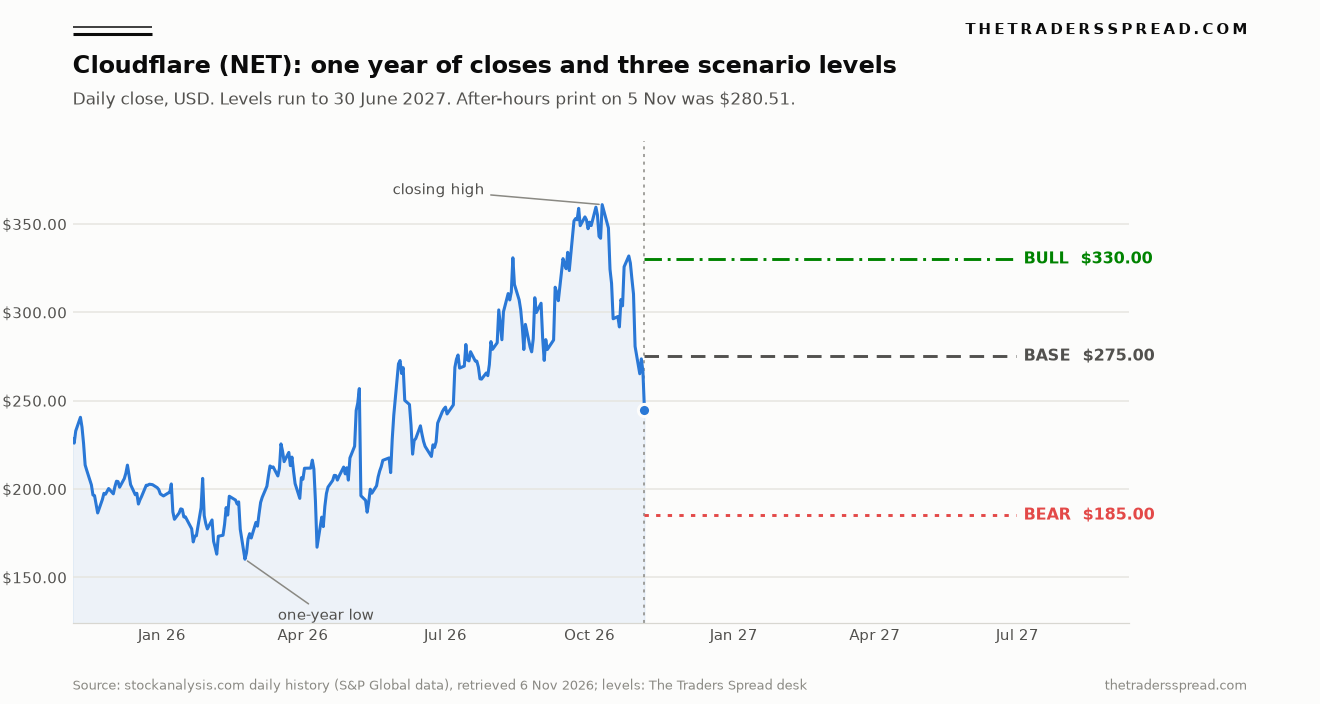
- NET closed at $244.51 on 5 Nov, 32.3% below its $360.93 closing high of 9 Oct, then printed $280.51 after hours (stockanalysis.com, retrieved 6 Nov 2026).
- Christian Smith, formerly chief revenue officer at Splunk, became President of Revenue effective 2 Nov, replacing the retiring Mark Anderson (Cloudflare 8-K Exhibit 99.2, 5 Nov 2026).
How has the guidance ladder moved through 2026?
Cloudflare publishes a narrow quarterly range and a wider full-year range each time it reports. If you line up the four full-year ranges and the three completed quarterly beats, the pattern is plain: the beats got bigger each quarter, and management passed most of each beat through into the annual number.
| Report date | Full-year 2026 revenue guide | Midpoint | Quarter just reported vs its own guide | NET next-session move |
|---|---|---|---|---|
| 10 Feb 2026 | $2,785.0m to $2,795.0m | $2,790.0m | Q4 2025: $614.5m, +34% y/y | +5.2% (179.98 to 189.41) |
| 7 May 2026 | $2,805.0m to $2,813.0m | $2,809.0m | Q1: $639.8m vs $620.0m to $621.0m (+3.1%) | -23.6% (256.79 to 196.13) |
| 6 Aug 2026 | $2,864.0m to $2,870.0m | $2,867.0m | Q2: $696.1m vs $664.0m to $665.0m (+4.8%) | +5.6% (284.43 to 300.27) |
| 5 Nov 2026 | $2,963.0m to $2,964.0m | $2,963.5m | Q3: $782.5m vs $736.0m to $737.0m (+6.2%) | +14.72% after hours (244.51 to 280.51) |
Sources: Cloudflare 8-K Exhibits 99.1 for Q4 2025, Q1 2026, Q2 and Q3 2026; daily closes from stockanalysis.com one-year history, retrieved 6 November 2026.
Three things stand out to us. First, the full-year midpoint has risen $173.5 million since February, or 6.2%, and $96.5 million of that came in this single update. Second, year-on-year growth has climbed from 34% in Q4 2025 and Q1 2026 to 36% in Q2 and 39% in Q3, and the Q4 guide implies roughly 37.6% on our arithmetic against the $614.5 million reported a year earlier. Third, the May row is the warning label. Revenue beat that quarter too, yet the stock lost almost a quarter of its value the next day. The same 7 May date brought a plan that cut about 20% of the workforce, with restructuring charges of up to $165 million, according to the company's Form 10-Q for the third quarter.
So a revenue beat by itself has never guaranteed a positive session for this stock. What has mattered is whether the market reads the quarter as cleaner or messier than the one before.
What did management actually say about the quarter?
Matthew Prince, co-founder and chief executive of Cloudflare, was blunt in the results release: "The third quarter was Cloudflare's best quarter ever." He tied it to crossing $3 billion in annualised revenue. By our arithmetic, $782.5 million times four is $3.13 billion, and the Q4 midpoint of $845.5 million annualises to about $3.38 billion.
The same filing package carried a second release that we think gets less attention than it deserves. Cloudflare appointed Christian Smith as President of Revenue, and the announcement frames his job as scaling the company "to $5 billion in annual recurring revenue and beyond". Smith ran Splunk's go-to-market organisation through its move to cloud and recurring revenue and later oversaw Splunk's commercial business at Cisco. A new head of sales arriving in November means the 2027 plan, territories and quota structure will carry his fingerprints, which is a source of execution risk in the first half of next year as well as upside if the enterprise motion sharpens.
The large-customer numbers explain why management sounds confident. Customers paying more than $100,000 a year rose about 24.9% to 5,006, and the dollar-based net retention rate was 122% for the quarter, per the 10-Q. Remaining performance obligations stood at $2,876.8 million at 30 September, with 65% expected to convert to revenue within twelve months. That is roughly $1.87 billion of contracted revenue lined up for the next year on our arithmetic, and current RPO grew 37%, close to the 39% revenue growth rate. When contracted backlog grows almost as fast as revenue, the guide is resting on signed paper.
On 4 November, the day before the print, Cloudflare's main X account announced tooling for AI agents that act on behalf of users, the traffic category Prince has named in both the Q2 and Q3 releases.
Today, we’re launching new analytics to help you understand how personal agents access your site on behalf of humans, along with more granular access policies to put those decisions into practice. https://t.co/GYNPQMbjXW
— Cloudflare (@Cloudflare) November 4, 2026
Where the margin bill shows up
The bear case lives in the cost lines. GAAP gross margin fell to 71.2% from 74.0% a year earlier; non-GAAP gross margin fell to 72.4% from 75.3%. Free cash flow rose only slightly to $82.1 million and dropped to 10% of revenue from 13%, even as operating cash flow climbed to $215.4 million from $167.1 million. The gap between those two cash lines is capital spending, which absorbed more of the extra operating cash than a year ago.
The GAAP picture is weaker still. Cloudflare reported a GAAP operating loss of $67.9 million, or 8.7% of revenue, against $37.5 million a year earlier, and a GAAP net loss of $34.1 million. Non-GAAP operating income of $137.1 million looks healthy, yet $174.1 million of the $205 million gap between the two figures is stock-based compensation and related payroll tax, up from $119.7 million a year earlier, per the reconciliation in the release.
Then there is the balance sheet. In August Cloudflare priced $2.175 billion of 0% convertible senior notes due 2031, according to its pricing announcement, and the 10-Q puts the initial conversion price at about $496.94 per share. That strike sits a little more than twice the $244.51 close, so dilution from these notes is a distant concern for our horizon. The cash is the nearer point: $5,128.7 million in cash and available-for-sale securities at quarter end gives management room to keep spending on capacity even if a sharper macro slowdown hits customer budgets.
We would weigh the margin slide more heavily if growth were flat. With revenue growth accelerating for two straight quarters, a few points of gross margin traded for capacity reads to us like a company buying volume ahead of demand. The risk is that it reads the other way to a market that is already selling software, as it did on 5 November.
What is already in the share price?
At the $244.51 close, stockanalysis.com put Cloudflare's market value at $87.07 billion and enterprise value at $86.64 billion, on 356.08 million shares outstanding, as shown on its statistics page, last updated 6 November. On the new full-year revenue guide midpoint of $2,963.5 million, the enterprise value works out to roughly 29 times 2026 sales. The after-hours print would lift the market value to about $99.9 billion.
Technical damage is visible too. The same page shows a 50-day moving average of $319.00 and a 200-day of $249.77, so the regular close sat below both, with a relative strength index of 29.42. Short interest is small at 2.24% of shares outstanding, which removes the squeeze argument from both sides of the debate.
Sell-side positioning before the print was wide. Of the 34 analysts that stockanalysis.com tracks through S&P Global, the average one-year target was $345.16 and the median $370, with a low of $160 and a high of $430, per its forecast page, last updated 3 November. The most recent moves listed there were split: Samik Chatterjee at J.P. Morgan upgraded to Buy with a $350 target on 3 November; Saket Kalia at Barclays kept Buy at $400; Joseph Gallo at Jefferies cut his target to $320 from $350 at Hold; Peter Weed at Bernstein held $245 at Hold; and John Difucci at Guggenheim kept a Sell rating with the $160 floor. Consensus 2026 revenue on that page was $2.87 billion and consensus 2026 EPS $1.26; the new guidance of about $2.96 billion and $1.35 sits above both, so estimates are likely to rise into next week.
Our first piece of synthesis is this. The pre-print consensus for 2027 revenue was $3.71 billion. If Cloudflare simply holds a 30% growth rate off its new 2026 guide, 2027 revenue lands near $3.85 billion, which would put the street number about 4% light. Each of the scenarios below is priced on the $3.71 billion figure that existed before the report, which makes every multiple in the table a little conservative.
The three levels and what each one needs
We set the horizon at 30 June 2027, two more earnings reports out. That window includes the Q4 print in February, when the first 2027 guide arrives, and the Q1 report in May, the first full quarter under Smith.
| Scenario | NET level | Move from $244.51 close | Implied market value | Multiple of pre-print 2027 sales consensus ($3.71bn) | Our weight |
|---|---|---|---|---|---|
| Bull | $330 | +35.0% | $117.5bn | 31.7x | 30% |
| Base | $275 | +12.5% | $97.9bn | 26.4x | 45% |
| Bear | $185 | -24.3% | $65.9bn | 17.8x | 25% |
| Reference: after-hours print | $280.51 | +14.7% | $99.9bn | 26.9x | n/a |
Implied values use 356.08 million shares outstanding (stockanalysis.com, 6 November 2026). Multiples are our arithmetic.
The bull level at $330 sits just below where the stock closed on 26 October ($331.86) and well under the $360.93 closing high. It needs two things: a first 2027 revenue guide in February that starts at 30% growth or better, and gross margin that stops falling. A market value near $117 billion at about 32 times the old 2027 consensus is rich, yet it is lower than the multiple the market paid in early October, when the stock traded above $350 on smaller numbers.
Our base case at $275 is close to where the after-hours tape already put the stock. It assumes the guide holds, peers stop falling, and the 50-day average keeps drifting down toward the price. In that world Cloudflare grinds sideways in a $250 to $300 band while the market waits for the February guide.
The bear level at $185 matches the area the stock reached on 12 May ($186.79) after the restructuring sell-off and sits above the $160.19 low of 23 February. It needs a sector de-rating that keeps going, a weak first 2027 guide, or another quarter of falling free-cash-flow margin. At 17.8 times the old 2027 sales consensus it would still be an expensive stock by most software standards, which tells you how much room the multiple has to compress if growth slows.
Related7 Measured Drivers of the Coca-Cola (KO) Share Price
How does Cloudflare compare with other software and infrastructure names we cover?
The 5 November tape was a reminder that NET trades with the high-multiple software basket first and on its own numbers second. We saw a similar pattern when Palantir dropped 7% intraday in a September software sell-off, and the channel-check rally we covered in CrowdStrike's 8.25% October jump showed the same basket can move together on the way up. Our Oracle bull and bear case and the Microsoft forecast use the same three-level framework for two larger cloud names.
What sets Cloudflare apart in that group on 5 November is the pairing of accelerating growth with a falling margin line, and it was the only one of the four names to move by double digits after hours.
FAQ
What is the NET stock forecast after the Q3 2026 report?
Our NET stock forecast runs to 30 June 2027 with a bull level of $330, a base of $275 and a bear of $185, measured from the $244.51 close on 5 November. We weight them 30%, 45% and 25%. The sell-side average one-year target listed on stockanalysis.com before the print was $345.16, with a range from $160 to $430 across 34 analysts.
Why did Cloudflare stock fall 8% on the day it beat?
The 8.28% decline happened during regular trading, before the results came out at the close. It matched a broad software sell-off: QQQ fell 6.49%, CrowdStrike 9.88% and Zscaler 9.16% the same day. The earnings reaction showed up only after hours, when Cloudflare printed $280.51, up 14.72% on the close, while peers were roughly flat.
How much did Cloudflare raise its 2026 guidance?
Cloudflare lifted its full-year 2026 revenue guide to $2,963.0 million to $2,964.0 million from $2,864.0 million to $2,870.0 million in August, an increase of $96.5 million at the midpoint. Since the first range in February, the midpoint has risen $173.5 million, or 6.2%. Full-year non-GAAP EPS guidance moved to $1.35 from $1.25 to $1.26.
What is the biggest risk to the Cloudflare stock forecast?
We see falling margins as the main risk. GAAP gross margin dropped to 71.2% from 74.0%, and free cash flow fell to 10% of revenue from 13% as network spending rose. If the first 2027 guide in February shows slower growth while margins keep falling, the bear level of $185 comes into play.
Who is Christian Smith and why does his hire matter?
Christian Smith became Cloudflare's President of Revenue on 2 November, replacing Mark Anderson, who is retiring at the end of 2026. Smith was chief revenue officer at Splunk and later led Splunk's commercial business at Cisco. He takes over global sales as the company targets $5 billion in annual recurring revenue, so the 2027 sales plan will be his.
Our call on Cloudflare (NET)
Base case, 45%: NET trades around $275 by the end of June 2027, close to the after-hours print. The guide is credible because contracted backlog is growing at 37% and the company has beaten its own quarterly range by a wider margin each quarter this year. The cost side keeps the multiple from expanding.
Bull case, 30%: the February guide opens 2027 at 30% growth or better, gross margin stabilises near 71%, and software multiples recover. That combination takes the stock back to $330, about 35% above the regular close and roughly where it traded in late October.
Bear case, 25%: the 5 November sector sell-off proves to be the start of a deeper software de-rating, the new sales leadership stumbles in its first two quarters, or margin compression accelerates. A retest of the May lows near $185 follows, a fall of about 24%.
On the tts fields we register this as a mild bull bias with an entry reference of $244.51, a $330 target and invalidation at $185, conviction 3 of 5. Three developments would change our view. A first 2027 revenue guide below 28% growth would move us to neutral. A daily close below $185 would invalidate the bull framing entirely. A gross margin back above 73% with growth still near 39% would push us toward raising the bull level, since that would remove the main reason the market has been reluctant to pay October prices.
Disclaimer: The Traders Spread publishes market analysis for information only. Nothing here is investment advice or a recommendation to buy or sell any security. Prices move quickly, and past performance does not predict future results.