

Cameco's third-quarter MD&A, published with the 30 October 2026 results, puts two uranium prices on one row of the uranium segment table. The average price received on pounds delivered that quarter was US$65.78. The average spot price beside it was US$88.56. Anyone treating Cameco stock as a live print of that spot price is reading a different object: an equity, and the StockAnalysis close for CCJ in this session was US$71.30 at 4 pm Eastern on 6 November 2026.
From the 28 January 2026 close of US$134.09 to that 6 November close, CCJ fell 46.8 percent. Over the twelve months to 30 September the average reported spot price rose US$7.00 a pound, to US$89.63, the average of TradeTech and UxC in the same MD&A. The commodity's path is a separate page, the uranium price prediction.
Updated 7 November 2026, from the filings and the share quote opened that day.
Key facts
- Third-quarter 2026 average realized uranium price was US$65.78 a pound, against an average spot price of US$88.56 and an average long-term price of US$96.17. Cameco MD&A, 30 October 2026.
- Deliveries were 5.6 million pounds, production (Cameco's share) 3.5 million pounds, and purchases 1.8 million pounds at C$83.78 (US$60.15). Inventory at 30 September was 8.5 million pounds, average cost C$58.37. Cameco news release and MD&A, 30 October 2026.
- Fuel-services revenue was C$95 million on 2.2 million kgU at C$42.90 per kgU, 13 percent below the prior-year quarter. Cameco MD&A, 30 October 2026.
- Cameco's 49 percent share of Westinghouse was a quarterly net loss of C$24 million and adjusted EBITDA of C$143 million. Nine-month figures were a net loss of C$80 million and adjusted EBITDA of C$427 million. Cameco MD&A, 30 October 2026.
- CCJ closed at US$71.30 on 6 November 2026, up US$2.97 from US$68.33. The high close in the year of history pulled that day was US$134.09 on 28 January 2026. StockAnalysis, retrieved 7 November 2026.
- The 2026 dividend is C$0.24 a share, payable 15 December 2026 to holders of record on 30 November 2026. Contracted deliveries average about 28 million pounds a year from 2026 through 2030. Cameco MD&A, 30 October 2026.
Two clocks on the same Cameco page
On 7 November 2025 the NYSE close was US$92.26. It reached US$134.09 on 28 January 2026 and finished at US$71.30 on 6 November 2026, with volume of 5,341,078 shares.
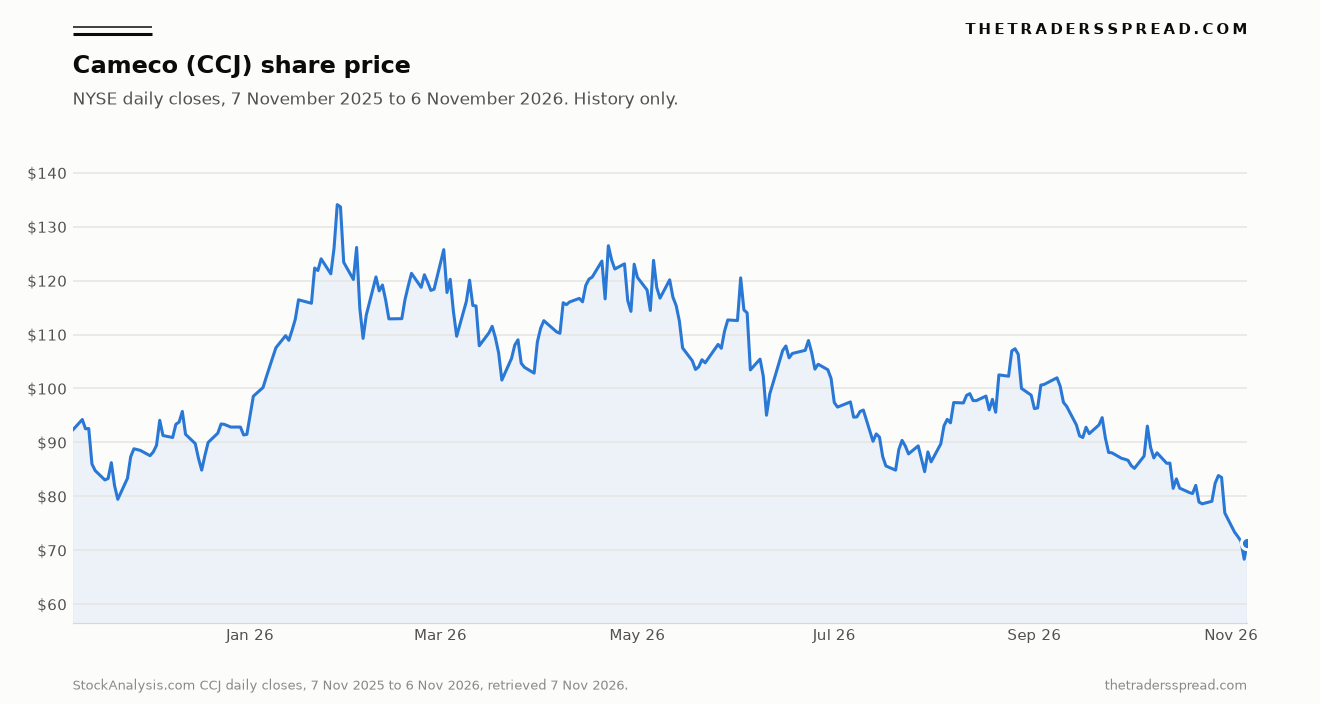
The same morning, cameco.com showed US$71.30 in New York and C$100.65 in Toronto. At 30 September the US dollar was marked at 1.42 Canadian dollars, the quarter averaged 1.40, and 2026 hedges covered US$1.45 billion at 1.37.
Industry prices in the MD&A run on another clock. The average reported spot price finished September at US$89.63, up US$4.63 on the quarter and US$7.00 over twelve months, and the average long-term price finished at US$96.50, up US$13.50 over twelve months. UxC put spot volume near 9 million pounds in the quarter, against about 15 million a year earlier.
The contract book moves slower than the spot print
Uranium-segment revenue was C$518 million on 5.6 million pounds, against 6.1 million a year earlier. The realized price rose to US$65.78, up 6 percent, and to C$91.76, up 8 percent, while the average spot price on that row rose 16 percent. Over nine months spot rose 22 percent and the realized price rose 10 percent, to US$66.64, "reflecting the impact of ceiling prices on market-priced contracts."
Cameco's account, @cameconews, posted the results on the morning of the release. The post is the company's own summary of the quarter, dividend included, and it points at the same pack.
Cameco (TSX: CCO; NYSE: CCJ) reports third quarter 2026 results: year-to-date performance as expected; nuclear industry fundamentals continue to strengthen; disciplined strategy and integrated nuclear exposure support long-term value creation; annual dividend declared. Join our… pic.twitter.com/fksjPGzM7R
— Cameco Corporation (@cameconews) October 30, 2026
Tim Gitzel, chief executive officer of Cameco, said in that release: "We will not advance production, commit capital or pursue growth simply in response to headlines, short-term price movements or market enthusiasm surrounding any single theme."
Grant Isaac, president and chief operating officer of Cameco, described contracts then in discussion: floors in the mid- to high US$70s, escalated, ceilings touching US$160, escalated, and a base-escalated slice the company would fix at three-digit US-dollar prices, on very small volumes. "We will not chase this market for volume. We will demand value from the market."
The sensitivity grid freezes the 30 September 2026 book, holds spot fixed, and models escalation at 2 percent US inflation. A spot of US$80 puts the 2026 cell at US$67. A spot of US$160 puts it at US$69. The 2030 row is US$76 and US$104 on the same two spots. Realized-price guidance for the year is C$91 to C$96 a pound, on a UxC spot of US$89.50, a long-term indicator of US$96.00 and an exchange rate of 1.35, which is a planning case for the book rather than a print of the NYSE close.
5.6 million pounds went out. 3.5 million were mined
Cameco's share of production was 3.5 million pounds, 20 percent below 4.4 million a year earlier, while deliveries were 5.6 million. Purchases of 1.8 million pounds, none from JV Inkai, cost US$60.15 a pound on average. Cash cost of production was C$40.73, 62 percent above the prior-year quarter, on fixed costs, inflation and work on ageing infrastructure.
Heidi Shockey, senior vice-president and chief financial officer, told the call the lower production was a planned Key Lake outage "to modernize the mill there," plus inflation, separate from the mine. Life-of-mine costs cited from the annual information form are C$21.72 a pound at McArthur River/Key Lake and C$23.94 at Cigar Lake. The outage quarter's C$40.73 is a different line from those estimates, and the McArthur figure awaits an updated NI 43-101.
The 2026 production share was narrowed to 19.5 million to 20.5 million pounds, from a top of 21.5 million. Deliveries were narrowed to 29.5 million to 30.5 million pounds. Committed purchases, including Inkai, are 8 million pounds, with market purchases of up to 3 million. Deliveries above mined pounds are how the sales plan is built.
Inventory was 8.5 million pounds at C$58.37 on 30 September, down from 9.7 million pounds at C$61.85 at the end of 2025. JV Inkai, 40 percent owned with Kazatomprom, targets 10.4 million pounds on a 100 percent basis, and Cameco's allocation is 4.2 million. Nine-month Inkai purchases were 0.8 million pounds at spot less 5 percent. Equity earnings were C$23 million, and an April dividend of US$124 million, net of withholdings, covered the 2025 year.
Cameco and Orano bought TEPCO's 5 percent of Cigar Lake in the quarter, taking Cameco to 57.418 percent, up 2.871 points, with results from 2 July 2026 at the new share.
Fuel services sends a different invoice
Fuel services, the MD&A's name for UF6, UO2, UO3 and fuel fabrication, took in C$95 million, up 4 percent, beside C$518 million of uranium revenue. Volume rose 16 percent to 2.2 million kgU and the realized price fell 13 percent to C$42.90 per kgU, which the filing attributes mainly to product mix. Adjusted EBITDA was C$24 million against C$25 million. Nine-month revenue was C$381 million, against uranium revenue of C$1.888 billion.
Conversion prices on the same industry table moved the other way from the uranium pound. The North American spot price for conversion, as UF6, ended the quarter at US$62.00 per kgU, down US$2.50, and the long-term price at US$54.00, down US$1.50, while the uranium spot average rose.
Isaac said a reactor cannot run on a PowerPoint slide or on raw yellowcake, because the material has to become a fuel bundle. Production and deliveries stay guided at 13 million to 14 million kgU, revenue at C$610 million to C$650 million, and unit cost of sales at C$33.50 to C$35.80 per kgU.
Westinghouse has its own quarter
Cameco owns 49 percent of Westinghouse and Brookfield owns 51 percent. Equity accounting keeps the stake outside consolidated uranium revenue. The quarter was a net loss of C$24 million and adjusted EBITDA of C$143 million. Over nine months the share was a net loss of C$80 million and adjusted EBITDA of C$427 million, against earnings of C$32 million and adjusted EBITDA of C$569 million in 2025.
Most of that nine-month gap is one prior-year item. Work at Dukovany, in the Czech Republic, added about US$170 million to Cameco's share of Westinghouse revenue in the second quarter of 2025. Third-quarter adjusted EBITDA was ahead of a year earlier while the share sat far below the January close. A power producer such as Constellation Energy earns from electricity at operating reactors, a different claim from a book of U3O8 deliveries.
Gitzel's release says the interest "extends our participation across the nuclear value chain, providing exposure to reactor services, operating reactors and future deployment opportunities." Isaac, a Westinghouse director, said the company was fully optimistic about US interest in gigawatt-scale reactors, and that the September framework with Korea still needs definitive agreements. The MD&A records the framework as non-binding, up to US$120 billion for as many as eight large US reactors, six of them AP1000s.
He also said Cameco was still about 30 percent below full licensed and permitted production if every asset ran flat out, because contracting had yet to support a higher run rate.
Cash, a 24-cent dividend, and a shelf
Consolidated revenue was C$619 million against C$615 million. Net earnings to equity holders were C$43 million, or C$0.10 a share. Cash from operations was C$3 million in the quarter against C$156 million, and C$112 million over nine months against C$731 million.
Customers choose delivery dates, so the MD&A treats one quarter as a poor guide to the year. Cash at 30 September was C$860 million, debt about C$1.0 billion and net debt about C$137 million, with C$1.0 billion undrawn to 1 October 2030. Unit cost of sales is guided at C$67 to C$70 a pound, and capital spending at C$440 million to C$490 million.
RelatedDuolingo (DUOL) Rose 26% After Daily Users Hit 64.9 Million
The dividend is C$0.24 a share, about C$104.5 million on the 435,532,978 common shares of 28 October 2026, and about 0.24 percent of the C$100.65 Toronto price shown on cameco.com on 7 November. It matches the 2026 target under a 2024 plan to double the annual dividend. Beside a book of about 28 million pounds a year, that yield is a small distribution.
On 5 November 2026 Cameco renewed an at-the-market program for up to US$1 billion of common shares through 5 December 2029, replacing a 12 November 2024 agreement with TD Securities, CIBC World Markets and Scotia Capital. A shelf filed the same day, US registration 333-299849, allows up to US$3 billion over 37 months. @cameconews posted the renewal the next morning, in line with the 5 November release.
Cameco Corporation (TSX: CCO; NYSE: CCJ) announced today the renewal of its at-the-market equity program (the "ATM Program") allowing Cameco to issue up to US$1 billion (or its Canadian dollar equivalent) of common shares (the "Common Shares") from treasury to the public from… pic.twitter.com/JDVoUoEUgz
— Cameco Corporation (@cameconews) November 6, 2026
What the next Cameco filing has to show
Cory Kos, vice-president of investor relations and communications, opened the October call by pointing listeners to the quarterly investor handout on cameco.com. The next MD&A is where these lines get refreshed.
Read realized price in both currencies beside spot and long-term prices, then sales against production, purchases and inventory. The sensitivity grid shows whether the current-year column is still flat. Any sale under the November shelf would show up against the 435,532,978 common shares of 28 October. That line-by-line pass is the same habit as an earnings read on another ticker. Key Lake's commissioning, the new Cigar Lake stake and the Inkai shipments move the ranges, and the unit-cost guide of C$67 to C$70 shows whether C$72.17 is fading.
Questions readers actually ask
Is Cameco stock the same as the uranium price?
Cameco stock is a share in the mines, the contract book, fuel services and a 49 percent Westinghouse stake. In the third quarter of 2026 the realized price was US$65.78 a pound and the average spot price was US$88.56. CCJ closed at US$71.30 on 6 November 2026 after a 28 January close of US$134.09. The equity and the spot print took different paths, so a commodity quote leaves the share unsettled.
Why can the realized price sit below the spot price?
Deliveries follow older contracts, a mix of base-escalated deals and market-related deals with floors and ceilings. In the third quarter the US-dollar realized price rose 6 percent while the average spot price rose 16 percent. On the 30 September grid, a spot fixed at US$80 and one fixed at US$160 produced 2026 cells of US$67 and US$69. Later years of that grid move more. The cells assume the book stays frozen.
Does Cameco sell only what its mines produce?
Third-quarter production, Cameco's share, was 3.5 million pounds and deliveries were 5.6 million, with 1.8 million pounds purchased at US$60.15. Full-year guidance has production at 19.5 million to 20.5 million pounds and deliveries at 29.5 million to 30.5 million, plus 8 million pounds of committed purchases. Inventory was 8.5 million pounds on 30 September. Sales above mined pounds are part of the plan.
How large is fuel services next to the uranium segment?
Fuel-services revenue was C$95 million in the third quarter against C$518 million of uranium revenue, and C$381 million against C$1.888 billion over nine months. Volume rose 16 percent while the realized price fell 13 percent, to C$42.90 per kgU, on product mix. The North American conversion spot price fell US$2.50 per kgU in the same quarter. The segment has its own price and a cost guide of C$33.50 to C$35.80 per kgU.
What does the Westinghouse stake change?
Cameco equity-accounts 49 percent, with Brookfield holding 51 percent, so the stake sits outside uranium revenue. Third-quarter adjusted EBITDA from that share was C$143 million, up from C$124 million. Nine-month adjusted EBITDA fell to C$427 million from C$569 million because 2025 included about US$170 million from Dukovany. The exposure is reactor services and new build, on a clock separate from the spot pound.
Is the dividend why the share trades where it does?
The 2026 dividend is C$0.24 a share, about C$104.5 million on 435,532,978 common shares, and about 0.24 percent of the C$100.65 Toronto price displayed on cameco.com on 7 November 2026. The board ties the amount to a dividend-growth target and reviews it against cash flow and the cycle. Beside a contract book near 28 million pounds a year, the cash yield is small. Operating cash of C$3 million in the quarter is a timing figure.
Analysis and information only. This is not investment advice, and nothing here is a recommendation to buy, sell or hold Cameco shares, uranium, or any related instrument. Markets carry risk, and capital is at risk.