

FedEx did not spend the summer paying down debt. That is what the headline balance-sheet numbers invite you to conclude, and the company's own September prospectus quietly says otherwise. Between 31 May and 14 September 2026 the long-term debt line moved from $23.29bn to a pro-forma $17.64bn, a fall of $5.66bn that reads like the payoff from June's FedEx Freight separation. The money did not come out of FedEx's operating cash flow. It came from a roughly $4.1bn dividend that FedEx Freight paid on its way out of the building, and FedEx Freight walked into its first day as a listed company carrying $4.26bn of long-term debt of its own. FedEx used that cash in July to buy back $4.86bn of its own bonds at about 85 cents on the dollar. Ten weeks later it sold $3.4bn of new ones.
The part that has gone almost unremarked is the coupon. The notes FedEx retired in July carried a weighted average coupon of 4.098% and a weighted average maturity of 2044, calculated from the acceptance table in the company's 10 July Form 8-K. The notes it settled on 14 September carry a weighted average of 4.752% and fall due between 2030 and 2036. Put plainly, FedEx replaced roughly 71 cents of every retired dollar with money that costs about 65 basis points more and matures almost eleven years sooner. The stack is genuinely smaller. The price of the marginal FedEx dollar went up.
Key facts
- FedEx closed a three-tranche note offering on 14 September 2026: €1.1bn of 4.000% notes due 2030, €900m of 4.625% notes due 2034 and $1.1bn of 5.750% notes due 2036 — FedEx Corporation Form 8-K, filed 14 September 2026.
- Net proceeds were €1,982.0m and $1,088.3m, about $3.36bn combined at the 17 September euro rate of 1.1481 — 424B5 prospectus supplements dated 9 September 2026.
- July's tender offers retired about $4.86bn of principal for roughly $4.15bn of cash, or 85.4 cents on the dollar, settled 14 July 2026 — FedEx Form 8-K, filed 10 July 2026.
- Pro-forma long-term debt less current portion: $23,293m actual at 31 May 2026, $14,239m after the spin-off and the tenders, $17,635m after the September notes — 424B5 capitalization table, 9 September 2026.
- Continuing-operations revenue was $82,463m for calendar 2025 with operating income of $4,554m, a 5.5% margin — FedEx recast supplemental financials, Form 8-K of 21 July 2026.
- FDX closed at $305.88 on Thursday 17 September 2026, up 1.38% on the day, against a 12-month spin-adjusted gain of 71.1% — Nasdaq quote API, retrieved 18 September 2026.
- The FOMC raised the target range to 3.75%-4.00% on 16 September 2026 by a 12-0 vote, two days after the notes settled — Federal Reserve statement, 16 September 2026.
Read the capitalization table, not the press release
Three columns sit side by side on page S-11 of the euro prospectus supplement, and they tell the whole story without a word of commentary.
The first column, "Actual", is FedEx as at 31 May 2026: cash and equivalents of $13,311m, short-term borrowings of $745m, the current portion of long-term debt at $1,676m, and long-term debt less that current portion of $23,293m. The second column, "As Adjusted", strips out FedEx Freight and applies the July buyback. Long-term debt drops to $14,239m. Cash falls to $8,910m, because $4.15bn walked out the door to bondholders and another $251.0m of cash left with FedEx Freight. The third column, "As Further Adjusted", adds the September notes back: $1,270m for the 2030s, $1,038m for the 2034s and $1,088m for the dollar 2036s, net of discounts and issuance costs. Long-term debt lands at $17,635m and cash recovers to $12,306m.
Net of cash, the picture does improve. Total debt less cash falls from $12,403m to $7,750m across the sequence, a 37.5% reduction. That is real, and anyone arguing FedEx is more levered today than it was in May is reading the same table badly in the other direction. But the improvement is almost entirely a function of who owns FedEx Freight, not of FedEx repaying borrowings out of earnings. The company itself flags this in its calendar 2026 guidance, where the "utilization of the FedEx Freight spin-off dividend" is named as an item excluded from adjusted diluted earnings per share.
One number in the recast accounts never moves through any of this. Operating lease liabilities on the continuing business stood at $15,074m at 31 December 2025, split between $2,403m current and $12,671m long-term. That is a larger claim on FedEx's future cash than the entire gross debt reduction just described, and it sits outside every sentence written about the summer's deleveraging.
Where the $4.1bn came from
FedEx completed the spin-off of its less-than-truckload business on 1 June 2026. The new company, FedEx Freight Holding Company, began trading on the NYSE under FDXF and filed its own annual report on 5 August 2026 showing $4,264m of long-term debt as at 31 May 2026. The dividend that funded the parent's bond buyback was paid out of a balance sheet that had been prepared to pay it.
The tender itself was run as a capped waterfall, which is where the detail gets interesting. FedEx set an aggregate purchase-price cap of $4,150,000,000 and ranked nineteen series of notes by acceptance priority. Holders tendered far more than the cap. FedEx took the first twelve priority levels in full, prorated the thirteenth at approximately 41.3%, and accepted nothing at all from the bottom six.
Look at what it chose to leave outstanding: the 3.100% notes due 2029, the 5.250% notes due 2050, the 3.400% notes due 2028, the 4.250% notes due 2030, the 4.200% notes due 2028 and the 4.900% notes due 2034. The 5.250% 2050s were the highest-coupon paper in the entire nineteen-series list, and they were ranked fifteenth. A company optimising purely for interest expense would have bought those first. FedEx ranked by something else, and the result was that its most expensive long bond survived while a 2.400% 2031 note, priority level ten, was retired in full.
That ordering makes sense once you treat the tender as a discount-capture exercise rather than an interest-cost exercise. Paper issued at 3.250% and due in 2041 trades a long way below par when ten-year Treasuries are near 4.8%, and buying $4.86bn of face for $4.15bn extinguishes about $707m of principal that FedEx never has to repay. Priority went to the bonds where the discount was deepest, which is also where the coupons were lowest.
The coupon reset, in one table
Set the two transactions next to each other and the trade FedEx made becomes legible.
| Retired, settled 14 July 2026 | Issued, settled 14 September 2026 | |
|---|---|---|
| Principal | $4.86bn | $3.43bn at the 1.1643 prospectus rate, $3.40bn at 17 Sep spot |
| Weighted average coupon | 4.098% | 4.752% |
| Weighted average maturity | 2043.8 | 2033.2 |
| Highest coupon in the block | 5.100% (2044s, 41.3% prorated) | 5.750% (2036s) |
| Lowest coupon in the block | 2.400% (2031s) | 4.000% (2030s) |
| Annual coupon cost | about $199m | about $162m |
| Cash cost | 85.4 cents per dollar of face | net proceeds of $1,088.3m on $1,100m of dollar principal |
Two things fall out of that table. The first is that the 5.750% dollar tranche carries a higher coupon than every single series FedEx accepted for purchase in July, including the 5.100% 2044s that were only partly taken. The second is that the annual coupon bill went down by around $37m while principal went down by $1.43bn, which implies FedEx paid a blended 2.5% for the privilege of retiring that net principal. On paper that is cheap money. In practice it reflects that the retired block was full of pandemic-era paper struck at coupons the company will not see again in this cycle.
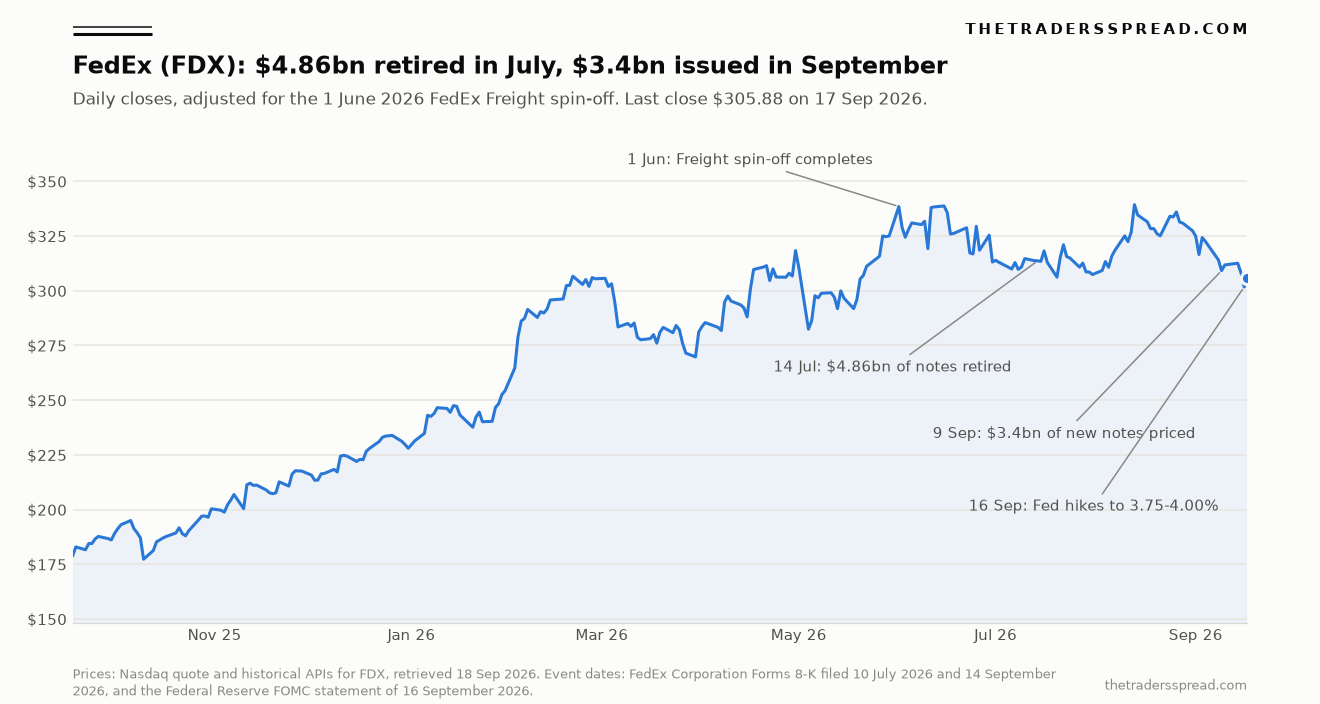
The equity has not treated any of this as news. FDX has traded in a $300 to $340 band since the spin-off completed, closing at $305.88 on 17 September against a 13 August high of $339.35. It is down 1.1% from its close on the day the notes were priced and 9.9% off that August peak. The move that actually shifted the stock in the last week was the Fed's, not the treasurer's: FDX fell 2.12% on 16 September, the day the FOMC raised rates, then recovered 1.38% on the 17th.
Seven days before the Fed moved
The timing here deserves more credit than it has received. FedEx priced all three tranches on 9 September 2026, when the ten-year Treasury closed at 4.83% according to the Federal Reserve's H.15 series. By 16 September that yield had reached 5.01%, and the FOMC raised the target range by a quarter point to 3.75%-4.00% on a unanimous 12-0 vote, stating that inflation "remains elevated" and that the Committee "will deliver price stability". Our coverage of how the September hike odds moved tracked that repricing as it happened.
Eighteen basis points on the benchmark between pricing day and decision day is not, on its own, a large number. What matters is the shape of the sentence the Committee used. A central bank that says it will deliver price stability while inflation is still above target is a central bank telling corporate treasurers that the funding window they are looking at may be the friendlier of the two on offer. FedEx got $3.4bn of ten-year and eight-year term money away before that sentence was published.
The currency split is its own decision. Two thirds of the new principal is denominated in euros, issued by a company whose revenue is predominantly dollar-denominated but whose Express International segment turned over $25,337m in calendar 2025. Euro funding at 4.000% and 4.625% against dollar funding at 5.750% is a spread worth roughly 140 basis points on the ten-year comparison, and the notes are guaranteed by Federal Express Corporation, FedEx Office and Print Services, Federal Express Europe, Federal Express Holdings S.A. and Federal Express International. FedEx also applied to list the euro tranches on the NYSE, which the 8-A12B registration filed on 14 September confirms. Whether that spread stays favourable depends on where the euro trades against the dollar over the next four to eight years, and FedEx has just taken a meaningful position on that question without describing it as one.
What the buyback promise now costs
On 23 June 2026 FedEx told investors what it intends to do with calendar 2026. Revenue growth of about 11% year on year. Diluted earnings from continuing operations of $16.55 to $17.75, or $16.90 to $18.10 on an adjusted basis. A 5% increase in the annual dividend, adjusted for the spin-off. And an intention to "repurchase up to $1 billion worth of shares opportunistically, leveraging continued balance sheet flexibility and free cash flow generation to offset dilution from equity compensation", against the $1.3bn still available under the 2024 authorisation as at 31 May 2026.
"With the successful spin-off of FedEx Freight, we are entering this next chapter positioned to grow while further optimizing our network, lowering our cost to serve, creating meaningful long-term value, and driving robust free cash flow," said Raj Subramaniam, FedEx Corp. president and chief executive officer, in the same release. His interim finance chief was blunter about the mechanics. "Our fourth quarter and full-year results reflect the tenacity of the FedEx team to deliver steady adjusted operating income improvement year-over-year while navigating significant headwinds," said Claude Russ, FedEx Corp. enterprise vice president, finance and interim chief financial officer.
The word doing the work in that guidance is "flexibility". FedEx has $12.3bn of pro-forma cash, a stated intention to spend up to $1bn of it on stock, and it has just raised $3.4bn of term debt whose stated use is "general corporate purposes, which may include the redemption or repayment of outstanding indebtedness". Those two facts are compatible. They are not the same as paying down debt with free cash flow, which is how the summer has generally been described.
At $305.88 the equity trades on 20.9 times calendar 2025 continuing-operations diluted earnings of $14.62, and on about 17.5 times the midpoint of management's adjusted guidance range for this calendar year. The market capitalisation works out at roughly $72.4bn on the 236,581,188 shares outstanding reported on the FY2026 annual report cover. The operating picture underneath is uneven: Express U.S. Domestic earned an 8.1% margin on $54,401m of calendar 2025 revenue, while Express International earned 2.26% on $25,337m. Fuel, one of the few input lines that genuinely fell, dropped from $3,714m to $3,058m year on year, a tailwind that depends on distillate prices staying where they are.
What this changes
It changes the denominator in every leverage argument about FedEx for the next four quarters, and it changes them in a direction that is less flattering than the headline suggests.
RelatedThe VIX at 15: The Formula, the Record, the 30-Day Move
The gross long-term debt reduction is $5.66bn, not $9.05bn. Anyone anchoring on the second figure is measuring the balance sheet at a moment that lasted ten weeks. Net debt did fall by 37.5%, but the mechanism was a dividend financed on a spun-off subsidiary's balance sheet, not cash generated by moving parcels. And the interest line will not fall as far as the principal line, because the weighted average coupon on FedEx's marginal borrowing has reset from 4.098% to 4.752% and the maturity profile has pulled in by almost eleven years, from 2044 to 2033. Refinancing risk that used to sit in the 2040s now sits inside the next decade.
It also changes the reporting calendar, which is a practical matter for anyone modelling the name. FedEx moved its fiscal year end from 31 May to 31 December effective 1 June 2026 and will file a transition report on Form 10-K covering the seven months to 31 December 2026. There is no September fiscal first-quarter release of the kind FedEx published on 18 September 2025 and 19 September 2024. As at the filing cut checked for this piece, no results Form 8-K had been filed for the quarter ended 31 August 2026, and Nasdaq's analyst-date feed carried no scheduled date either. Comparisons against "last year's Q1" are now comparisons against a period FedEx no longer reports on that basis.
What would change the reading here is straightforward to specify. If the transition-period 10-K shows interest expense falling materially faster than the coupon arithmetic implies, then FedEx has retired more short-dated paper outside the tender than the filings currently disclose. If the $1bn buyback is executed in full while cash stays above $12bn, the September issue was pre-funding for equity rather than refinancing. And if a further tender appears before year-end aimed at the 5.250% 2050s that survived July, the July waterfall really was about discount capture, and the interest-cost argument was never the point.
Frequently asked questions
How much debt did FedEx actually raise in September 2026?
Three tranches totalling €2.0bn and $1.1bn of principal: €1.1bn of 4.000% notes due 2030, €900m of 4.625% notes due 2034 and $1.1bn of 5.750% notes due 2036. Both offerings were consummated on 14 September 2026. Net proceeds were €1,982.0m and $1,088.3m, which converts to roughly $3.36bn at the 17 September euro rate of 1.1481.
Did the FedEx Freight spin-off reduce FedEx's debt?
Reported long-term debt fell, but the funding came from a roughly $4.1bn dividend paid by FedEx Freight in connection with the 1 June 2026 separation, together with cash on hand. FedEx Freight itself reported $4,264m of long-term debt at 31 May 2026. On a pro-forma basis long-term debt less the current portion ended at $17,635m against $23,293m actual, a $5.66bn reduction rather than the $9.05bn implied mid-sequence.
Why did FedEx leave its 5.250% 2050 notes outstanding?
The tender was capped at $4.15bn of aggregate purchase price and run as a priority waterfall across nineteen series. The 5.250% 2050s ranked fifteenth and were not reached. Priority appears to have followed the depth of the discount to par rather than the size of the coupon, which is why a 2.400% 2031 note ranked tenth and was retired in full while the highest-coupon long bond survived.
When does FedEx next report results?
FedEx changed its fiscal year end from 31 May to 31 December effective 1 June 2026 and will report the seven-month transition period to 31 December 2026 on Form 10-K, then move to calendar-year reporting from 2027. No results Form 8-K for the quarter ended 31 August 2026 had been filed at the time of writing, and no scheduled date appeared on Nasdaq's vendor feed.
What is FedEx guiding to for calendar 2026?
Revenue growth of about 11% year on year, diluted earnings from continuing operations of $16.55 to $17.75, and adjusted diluted earnings from continuing operations of $16.90 to $18.10, as set out in the 23 June 2026 results release. The adjusted figure excludes retirement-plan mark-to-market accounting, spin-off costs and the utilisation of the FedEx Freight spin-off dividend.
How has FDX performed over the past year?
FDX closed at $305.88 on 17 September 2026, up 1.38% on the session. On Nasdaq's spin-adjusted series the stock is 71.1% higher than its 18 September 2025 close of $178.79, and 9.9% below the 13 August 2026 high of $339.35. Volume on 17 September was 1,252,593 shares. The comparison with Amazon's own logistics build-out remains the structural question for the parcel market.
This article is analysis and information, not investment advice. It does not recommend any course of action in FedEx Corporation securities or any other instrument. Figures are drawn from SEC filings, the Federal Reserve and Nasdaq market data on the dates stated and may change. Capital is at risk.