

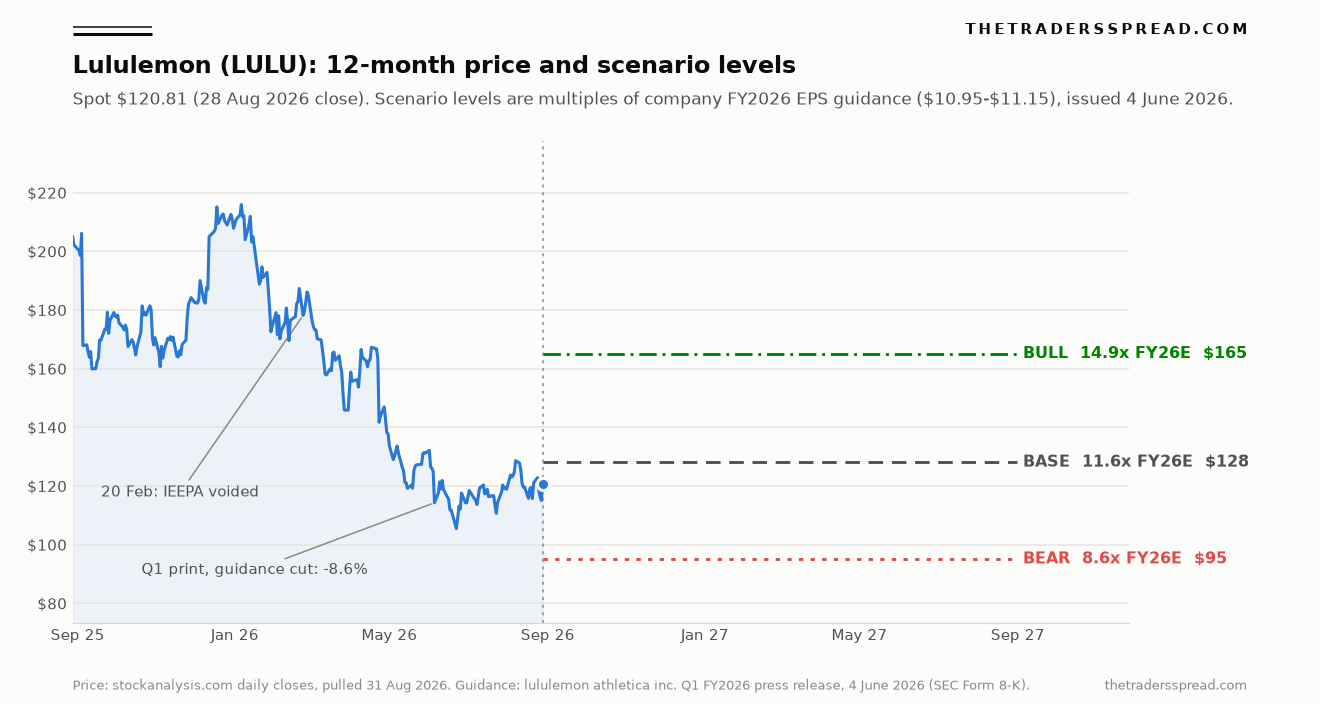
Lululemon's tariff problem did not end on 20 February 2026. That is the date the US Supreme Court struck down the tariffs imposed under the International Emergency Economic Powers Act, and it is the date a great many equity investors filed mentally under "resolved". LULU closed that session at $187.30, up 2.42%. It closed the next session at $178.11, down 4.91%. The stock gave back the relief rally and more within one trading day, and it has not been above $170 since. With the shares at $120.81 and second-quarter results due on 3 September, the market is still arguing about what that ruling actually changed.
Here is what it changed, read from the primary documents rather than the headlines. The Court did not remove the duties on Lululemon's supply chain. It removed the statute. Within hours the administration re-imposed a surcharge under Section 122 of the Trade Act of 1974, and when that authority hit its statutory 150-day ceiling on 24 July 2026, Section 301 duties took over at 12:01 a.m. that same morning. The relay was seamless to the hour. The practical result is the more interesting part, and it cuts both ways: the rate on Lululemon's two largest sourcing countries fell materially, while the duration of the instrument carrying it went from a 150-day clock to roughly a four-year one. The market priced the rate cut. It has been slower to price the fact that the expiry date moved out by three and a half years.
Key facts
- Lululemon sourced approximately 40% of its products from Vietnam and 18% from Cambodia by cost during 2025 — lululemon athletica inc. Form 10-Q for the quarter ended 3 May 2026, filed 4 June 2026.
- Q1 FY2026 gross margin fell 410 basis points to 54.2%, with product margin down 330bp "primarily from higher tariffs" — same 10-Q, Item 2.
- The company paid $230 million of IEEPA tariffs and has "not recognized an asset in relation to IEEPA refund claims" — same 10-Q, Note on Tariffs, 4 June 2026.
- Current Section 301 rates: Vietnam 12.5%, Cambodia 10%, effective 24 July 2026, with no apparel exemption for either — USTR Notice of Actions, 91 FR 47318, published 28 July 2026.
- FY2026 guidance of $11.00bn–$11.15bn revenue and $10.95–$11.15 diluted EPS explicitly "does not reflect any potential IEEPA tariff refunds" — Q1 FY2026 press release, 4 June 2026.
- At $120.81 (28 August 2026 close, stockanalysis.com), LULU trades on 10.9x the midpoint of that guided EPS, against a 12-month decline of 41.1%.
- Heidi O'Neill becomes chief executive on 8 September 2026 — five days after the Q2 print — per the employment agreement disclosed on Form 8-K, 22 April 2026.
The statutory relay, in three documents
The decision is Learning Resources, Inc. v. Trump, No. 24–1287, consolidated with Trump v. V.O.S. Selections, Inc., No. 25–250, decided 20 February 2026 by a 6–3 Court. The syllabus is one sentence long where it matters: "IEEPA does not authorize the President to impose tariffs."
Three presidential documents were signed the same day. Executive Order 14389 revoked the IEEPA duties, directing that they "shall no longer be in effect and, as soon as practicable, shall no longer be collected". Executive Order 14388 kept the suspension of duty-free de minimis treatment in place — a point Lululemon's own filing flags, noting the administration "confirmed that the IEEPA decision does not impact the removal of the de minimis exemption". And Proclamation 11012 imposed a temporary 10% import surcharge under Section 122 of the Trade Act of 1974, effective 24 February 2026.
Section 122 is a bridge, not a destination. The statute caps a surcharge at 15% ad valorem and 150 days absent an Act of Congress, and Proclamation 11012 wrote its own expiry into the text: in effect "through 12:01 a.m. eastern daylight time on July 24, 2026". No extension passed. The authority lapsed on schedule.
What replaced it is the part that matters for a garment made in Ho Chi Minh City. A Presidential Memorandum of 23 July 2026 (91 FR 47717) directed Section 301 action arising from 60 forced-labour investigations opened in March 2026, and the USTR Notice of Actions published 28 July 2026 set the rates. Vietnam: 12.5%. Cambodia: 10%. The duties applied to goods entered "on or after 12:01 a.m. eastern time on July 24, 2026" — the precise hour the Section 122 surcharge died. There is no apparel carve-out for either country; the only textile exemption in the annexes covers CAFTA-DR and Jordanian goods. Traders who have followed our work on how trade policy transmits into industrial pricing will recognise the pattern from the copper market's response to Section 232 action: the instrument changes, the cost does not disappear.
The Court was explicit that it was ruling on power, not on policy. "We claim no special competence in matters of economics or foreign affairs," wrote Chief Justice John Roberts for the Court. "We claim only, as we must, the limited role assigned to us by Article III of the Constitution." Nothing in that sentence promises an importer cheaper goods.
What the company and its shareholders are actually doing
Lululemon's response has been to reset expectations and rebuild the board at the same time. On 4 June 2026 it cut full-year guidance; the shares fell 8.56% the following session to $114.23, and bottomed at a closing low of $105.43 on 22 June.
"More recently, we have been navigating headwinds that have led us to adjust our outlook for the full year," said Meghan Frank, Interim Co-CEO and Chief Financial Officer, in the first-quarter release. "We have assessed the business and are taking additional actions to reposition where needed and further strengthen our product engine."
The governance change is larger than the guidance change. On 26 May 2026 the company signed a cooperation agreement with founder Dennis J. "Chip" Wilson, who owns approximately 8.7% of the shares. It added Laura Gentile, former chief marketing officer of ESPN, and Marc Maurer, former co-chief executive of On, to the board after the June annual meeting; agreed to seat a further apparel-brand director by 1 October 2026; and agreed to recommend Wilson's board-declassification proposal. Chip Bergh, who ran Levi Strauss for thirteen years, joined in March; Esi Eggleston Bracey, formerly of Unilever, in April. The board went from nine seats to eleven inside four months.
"lululemon now has a clear path forward for our incoming CEO, Heidi O'Neill, and our leadership team," said Marti Morfitt, Executive Chair, on 27 May 2026. O'Neill arrives from a 27-year career at Nike, most recently as President, Consumer, Product & Brand. Her start date is 8 September 2026.
Meanwhile the balance sheet has been spending. The company repurchased 2.2 million shares in Q1 for $358.3 million — an average of roughly $163 a share, about 35% above where the stock closed on 28 August. A further 0.9 million shares went between 3 and 29 May at roughly $123. Share count has fallen 5.9% since February 2025, to 109.3 million, leaving a market capitalisation near $13.1 billion. Of a $4.0 billion cumulative authorisation, $1.0 billion remained at quarter-end.
The numbers into 3 September
The bar for the print is set by the company's own June guidance: Q2 revenue of $2.450bn–$2.475bn, a decline of 3% to 2%, and diluted EPS of $1.76–$1.81 on a roughly 30% tax rate. The full-year frame is $11.00bn–$11.15bn of revenue and $10.95–$11.15 of EPS.
The sourcing arithmetic is where the tariff story becomes measurable. Weighting the 10-Q's disclosed mix by the current Section 301 rates, Vietnam and Cambodia together carry about 6.8 percentage points of duty across Lululemon's whole product-cost base, or roughly 11.7% across the 58% of that base they represent. Under the IEEPA reciprocal regime the same two countries carried 20% and 19% — about 11.4 points across the base, or 19.7% across the slice. So roughly 4.6 points of sourcing-weighted relief is real. It is also the entire good news, and it is already in the numbers the company guided to in June.
| Sourcing country | Share of product cost (2025) | Rate under IEEPA reciprocal | Rate under Section 301 (from 24 Jul 2026) |
|---|---|---|---|
| Vietnam | 40% | 20% | 12.5% |
| Cambodia | 18% | 19% | 10% |
| Weighted, those two countries | 58% | 19.7% | 11.7% |
| Authority's remaining life | — | Struck down 20 Feb 2026 | Approx. 4 years (19 U.S.C. 2417(c)) |
Sources: sourcing shares from lululemon athletica inc. Form 10-Q, 4 June 2026; Section 301 rates from USTR Notice of Actions, 91 FR 47318, 28 July 2026; IEEPA reciprocal rates from Executive Order 14257, revoked by Executive Order 14389, 20 February 2026.
Two divergences in the Q1 data deserve attention on the call. Inventories rose 2% in dollars to $1.69 billion but fell 4% on a unit basis — a spread consistent with landed cost inflation rather than a glut. And the segment split is now stark: Americas revenue fell 3% with comparable sales down 5%, while China Mainland revenue rose 30% on comparable sales up 20%. Americas gross margin fell 690 basis points; China Mainland's rose 160. The tariff is a tax on the segment that is already weak. For a comparison of how differently the market treats a guidance reset when the growth engine is intact, our note on Nvidia's Q3 guidance is instructive.
The refund that is on nobody's balance sheet
Lululemon paid $230 million in IEEPA duties. The Court of International Trade has ordered those duties refunded — first in Atmus Filtration, Inc. v. United States on 4 March 2026, directing Customs to liquidate affected entries "without regard to the IEEPA duties", and since April through the test case Euro-Notions Florida, Inc. v. United States, Ct. No. 25-00595. The company has filed claims. It has recognised nothing.
That caution looks well judged. In a notice published 8 July 2026 (91 FR 42207), US Customs and Border Protection put the total IEEPA duties assessed between February 2025 and February 2026 at "an estimated $166 billion, with over 53 million entry summaries requiring processing". Compliance with the CIT order is suspended "to the extent that it requires immediate compliance" while CBP builds a new processing tool inside its Automated Commercial Environment, with a comment period closing 8 September 2026. The CIT, the notice records, "is closely monitoring CBP's progress ... and can lift the suspension of its order at any time". Lululemon's claim is roughly 0.14% of the pile.
There is a second claimant. On 27 March 2026 the company's US operating entity was named in Neuman v. Lululemon USA Inc., No. 2:26-cv-11029 in the Eastern District of Michigan, a purported consumer class action asserting equitable claims over "alleged tariff-related pricing actions and potential governmental tariff reimbursements" — that is, an argument that money refunded by the government belongs to the customers who paid the tariff-inflated prices. The company "intends to defend the matter vigorously". So the $230 million is unrecognised, administratively frozen, and contested. Any of the three could change; none has yet.
Two regulatory dates sit inside the forecast window. USTR told the President that tariff-rate quotas letting a volume of Cambodian, Bangladeshi, Indonesian and Malaysian apparel enter free of Section 301 duty would be "feasible by September 1, 2026"; no notice establishing them had been published as of 31 August. And a separate Section 301 investigation into Vietnam's intellectual property practices, opened 3 June 2026, remains live with no action determined. One is a potential tailwind on 18% of sourcing. The other is a potential second duty on 40% of it. This is the same durable policy-risk premium that has kept a bid under the gold market through 2026: when the legal basis for a cost changes but the cost does not, the uncertainty is repriced rather than removed.
Scenarios into August 2027
All three levels are expressed as multiples of the company's guided FY2026 EPS midpoint of $11.05, so the anchor is Lululemon's own arithmetic rather than ours — the same guided-earnings framing we applied in our Okta stock forecast. Spot is $120.81, or 10.9x.
Base case — $128, 11.6x, 45%. Roughly 6.0% above spot. Q2 lands inside the guided range, the Section 301 rate holds, and no refund is recognised in the period. On flat operating earnings, the buyback alone has been shrinking the share count near 6% a year, which does most of the work. This is the "nothing further breaks" path, and it is not an exciting one.
RelatedCrown Castle (CCI) Rises 15.6% on SpaceX's $8bn Spectrum Buy
Bear case — $95, 8.6x, 30%. Some 21.4% below spot, and below the 12-month closing low of $105.43. The mechanism is a second guidance cut on 3 September, most plausibly from Americas comparable sales deteriorating past the 5% Q1 decline while Section 301 costs annualise. A management team five days from handing over to a new chief executive has unusually little to lose from resetting the bar low, and history says incoming CEOs prefer to inherit one. If the Vietnam IP investigation also produces an action, the sourcing arithmetic gets worse on 40% of the base.
Bull case — $165, 14.9x, 25%. Some 36.6% above spot, and still 27% below the January 2026 high. It requires two of three: Americas comps returning to growth under O'Neill, the Cambodian TRQs arriving and zero-rating a slice of the 18%, and CBP actually paying the $230 million. A re-rating to 15x is not heroic for a brand that spent most of the last decade above 30x — but it needs evidence, and none of the three is scheduled to arrive by 3 September.
What would change our mind. On the bearish side: a Q2 revenue print below $2.45 billion, or Americas comparable sales worse than down 8%, would say the demand problem is not primarily a tariff problem and the multiple has further to fall. On the bullish side: recognition of any part of the IEEPA receivable as an asset, or a published USTR notice establishing the Cambodian TRQ, would each remove a discrete overhang the current price does not credit. A dismissal of Neuman would do the same, more quietly. And if Section 122 were revived — it has 5 percentage points of unused headroom under its 15% cap — the whole rate table above would need rewriting.
Frequently asked questions
Did the Supreme Court ruling remove Lululemon's tariffs?
No. It removed the legal authority they were imposed under. Executive Order 14389 revoked the IEEPA duties on 20 February 2026, but a Section 122 surcharge took effect four days later and Section 301 duties replaced that on 24 July 2026. Lululemon's own 10-Q states that the administration "initiated new tariffs at different rates under alternative legislative powers" immediately after the decision.
What tariff rate does Lululemon face now?
Its two largest sourcing countries face Section 301 duties of 12.5% for Vietnam and 10% for Cambodia, effective 24 July 2026, per the USTR Notice of Actions at 91 FR 47318. There is no apparel exemption for either. Weighted by the 40% and 18% sourcing shares disclosed in the 10-Q, that is about 6.8 percentage points across the total product-cost base.
When does Lululemon report second-quarter results?
3 September 2026, confirmed on the events calendar at corporate.lululemon.com/investors. The company guided in June to Q2 revenue of $2.450bn–$2.475bn and diluted EPS of $1.76–$1.81. Results were not known at the time of writing, and nothing here anticipates them.
Will Lululemon get its $230 million back?
It is unresolved. The Court of International Trade has ordered IEEPA refunds, but CBP's 8 July 2026 notice suspends immediate compliance while it builds processing capacity for over 53 million entry summaries. Lululemon has filed claims and recognised no asset, and its FY2026 guidance explicitly excludes any refund.
Why does the change of chief executive matter to the September print?
Heidi O'Neill takes over on 8 September 2026, five days after results. The quarter will therefore be reported by interim co-CEOs Meghan Frank and André Maestrini. Handover quarters historically carry a wider distribution of guidance outcomes than ordinary ones, which is a reason to expect volatility around the print rather than a reason to predict its direction.
Why is the stock at roughly 10.9x earnings?
At $120.81 against guided FY2026 EPS of $10.95–$11.15, that is the multiple. The market is discounting a durable margin impairment: gross margin has already fallen 410 basis points year on year, Americas comparable sales are negative, and the tariff instrument now carrying the cost runs for approximately four years rather than 150 days.
Disclaimer
This article is analysis and information only. It is not financial advice, not a recommendation, and not an offer or solicitation to transact in any security. The scenarios above are illustrative frameworks derived from public filings, not forecasts of what will happen. Lululemon's second-quarter results had not been published when this was written. Capital is at risk, and past price behaviour does not indicate future results. Readers should conduct their own research and consider seeking independent professional advice.