

Adobe just printed the best quarter in its history, lifted its full-year targets and announced 1 billion monthly active users. Its stock fell anyway. Adobe (ADBE) finished at $250.50 at Wednesday's close, 16 September, which is 12.3% below the $285.75 it closed at on 3 September, the day the company said Anil Chakravarthy would replace Shantanu Narayen as chief executive on 1 December. In between sat a record third quarter: $6.76 billion of revenue, up 13%, and non-GAAP earnings per share of $6.13 against a guided range of $6.05 to $6.10. The shares rose 1.4% the session after that report, reached $265.60 on 14 September, and then surrendered nearly all of it. By Wednesday they were less than 1% above the $248.83 close that preceded the numbers. A stock that ignores a beat-and-raise is telling you it does not believe the raise is what matters. The filings suggest it has a point, and the point is a single number Adobe has not moved since December.
That number is 10.2%. It is Adobe's target for growth in Total Adobe annualised recurring revenue (ARR) over fiscal 2026, first set on 10 December 2025 with the explicit note that it did not include any contribution from Semrush. On 28 April 2026 Adobe closed the $1.87 billion Semrush purchase, and its second-quarter 10-Q put roughly $480 million of ARR on the books from that deal. The target stayed at 10.2% in June and again on 10 September. Hold Semrush at the $480 million Adobe disclosed and the organic growth rate implied by an unchanged headline target is about 8.3%, not 10.2%. Nobody at Adobe has called that a cut. The arithmetic does, and it is the reason a record quarter bought the stock one day.
Key facts
- ADBE closed at $250.50 on 16 September 2026, down 2.82% on the day and 12.3% below the 3 September close of $285.75 — Nasdaq daily closes, read 17 September 2026 06:06 UTC
- Q3 FY2026 revenue was a record $6.76 billion, up 13%, with non-GAAP EPS of $6.13 and Total Adobe ARR of $27.50 billion — Adobe Q3 release (8-K Exhibit 99.1), 10 September 2026
- The fiscal 2026 ending-ARR growth target is 10.2%, the same figure set in December 2025 before Semrush was included — Adobe Q4 FY2025 release, 10 December 2025, and Q3 FY2026 release
- Semrush closed on 28 April 2026 for $1.87 billion and contributed approximately $480 million of ARR — Adobe Form 10-Q for the quarter ended 29 May 2026
- Anil Chakravarthy becomes CEO on 1 December 2026; David Wadhwani leaves his role running the Creativity & Productivity business on 27 September — Adobe 8-K, filed 8 September 2026
- A Form 144 notice covers 125,000 shares held by the Narayen Family Trust with an aggregate market value of $31.44 million, approximate sale date 16 September — SEC Form 144, filed 16 September 2026
- Diluted share count fell to 395 million from 424 million a year earlier, a 6.8% reduction — Adobe Q3 FY2026 income statement
Three leadership headlines, three drops of 6.7% or more
The September slide is not a one-off. Adobe has made four scheduled or leadership announcements in 2026 that moved the shares, and the pattern in the closing prices is hard to miss. On 12 March the company paired its first-quarter results with the news, filed in an 8-K, that Narayen had decided to step back once a successor was found. The next session the stock closed 7.6% lower. On 11 June the second-quarter release carried a note that chief financial officer Dan Durn was leaving on 15 June "to pursue a new professional opportunity", with Steve Day stepping in on an interim basis, per the Q2 release. The following close was 6.8% lower. The Chakravarthy appointment on 3 September was followed by a 6.7% drop into the 4 September close.
Only the 10 September report broke the sequence, and only barely.
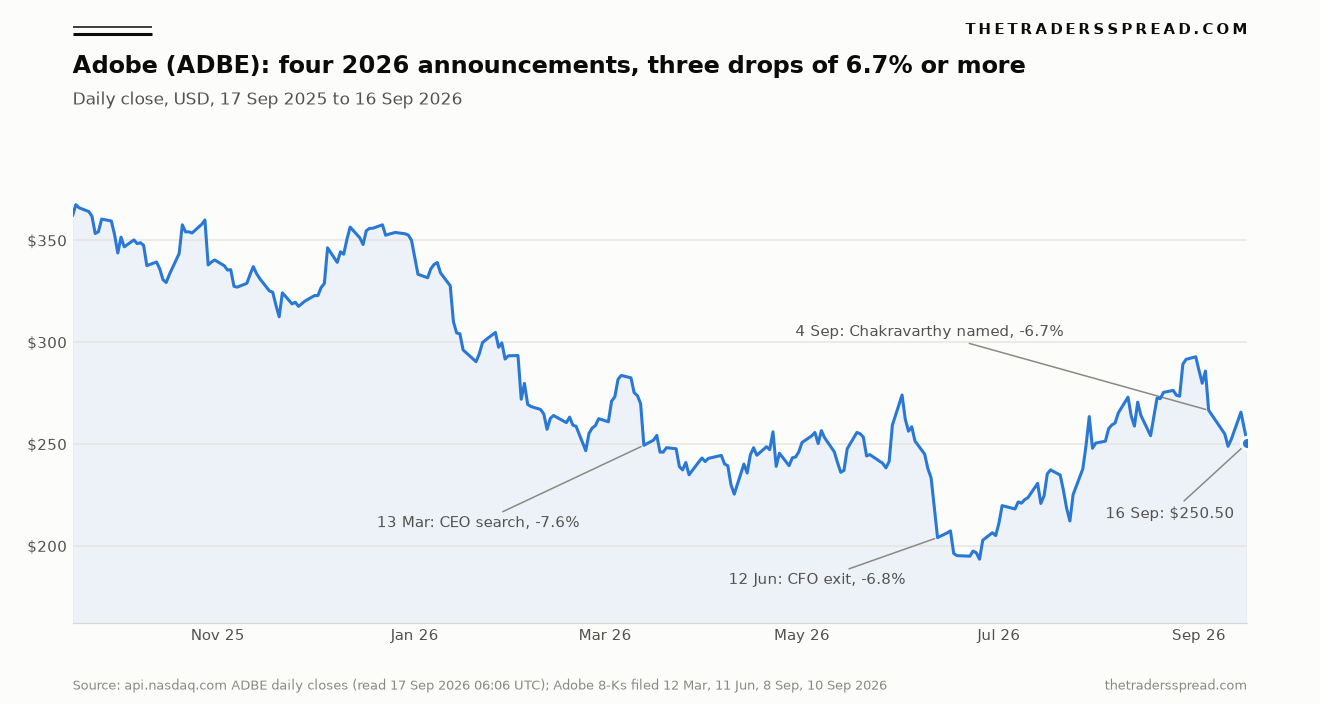
The table below lays the four sessions side by side. Each "before" figure is the close on the day of the announcement and each "after" figure is the next session's close, both from Nasdaq's historical data.
| Announcement | Close on the day | Next close | Change |
|---|---|---|---|
| 12 Mar 2026: Q1 results, Narayen to transition | $269.78 | $249.32 | -7.6% |
| 11 Jun 2026: Q2 results, CFO departure | $218.80 | $204.02 | -6.8% |
| 3 Sep 2026: Chakravarthy named CEO | $285.75 | $266.51 | -6.7% |
| 10 Sep 2026: Q3 results, targets raised | $248.83 | $252.23 | +1.4% |
Context matters for how damning this looks. The stock bottomed at a $193.41 close on 25 June and had rallied 51% to $292.79 by 31 August, so some of the September decline is a crowded rebound unwinding rather than a fresh verdict. Over the same 3 to 16 September window the iShares Expanded Tech-Software Sector ETF (IGV), used here only as a sector proxy, slipped 1.9% and the Invesco QQQ Trust fell 1.8%. Adobe fell 12.3%. That gap is company-specific. Year to date, ADBE is down 28.4% from its $349.99 close on 31 December 2025, while IGV is down 0.7% and QQQ, the tracker behind our Nasdaq-100 forecast, is up 14.7%. Software as a group has had rough days, as our note on Palantir's 7% intraday drop during the early-September software sell-off showed, but it has not had Adobe's year.
What the "raise" actually raised
Adobe's 10 September headline said it was raising full-year revenue and EPS targets. Both claims are true. The size of the revenue raise deserves a slower read.
In June, Adobe guided third-quarter revenue to $6.67 billion to $6.72 billion and fiscal-year revenue to $26.50 billion to $26.60 billion. It delivered $6.76 billion, which is $65 million above the midpoint of its own quarterly range. The new fiscal-year range is $26.576 billion to $26.626 billion, a midpoint of $26.601 billion. That is $51 million above June's midpoint. The full-year number went up by less than the quarter beat.
Run it the other way and the implied fourth quarter fell. First-half revenue was $13.016 billion. Subtract that and June's Q3 midpoint from June's full-year midpoint and the old plan left $6.839 billion for Q4. The new Q4 range, $6.80 billion to $6.85 billion, has a midpoint of $6.825 billion. The trim is small, about $14 million, but the direction is down, and it arrives in the quarter Chakravarthy inherits.
The growth rate tells the same story more loudly. Adobe's fiscal 2025 revenue was $23.769 billion, and nine-month revenue to 29 August 2025 was $17.575 billion, which puts last year's fourth quarter at $6.194 billion. A $6.825 billion Q4 would be 10.2% growth. The third quarter grew 12.9%. That deceleration is guided even though Q4 FY2026 includes Semrush and Q4 FY2025 did not. Adobe beat the top of its revenue range in each of the first three quarters of fiscal 2026, so the real Q4 figure may well come in higher. Even so, a management team confident in acceleration does not usually guide a three-point step down.
Then there is ARR. Adobe revalued its fiscal 2025 exit ARR to $25.66 billion at start-of-year exchange rates. Growth of 10.2% on that base means roughly $28.28 billion by the end of fiscal 2026. Q3 exited at $27.50 billion. That leaves about $780 million of net new ARR to add in a single quarter. Sequential additions this year have run at about $400 million in Q1 (from $25.66 billion to $26.06 billion) and about $400 million in Q3 (from $27.10 billion to $27.50 billion), with Q2's jump to $27.10 billion inflated by the Semrush consolidation. The fourth quarter needs close to double the pace of the third.
Adobe's interim finance chief framed it differently. "Adobe delivered double-digit revenue and EPS growth in Q3 and we're raising full year revenue and EPS targets," said Steve Day, senior vice president and interim CFO at Adobe. "We are expanding our user base through a freemium strategy and deepening engagement with agentic experiences to deliver long-term durable growth." Freemium explains users outrunning ARR. By construction, it grows users before revenue.
Buybacks are doing half the EPS work
Earnings per share looked excellent on 10 September. Non-GAAP EPS rose from $5.31 to $6.13, a 15.4% gain. Non-GAAP net income rose from $2.252 billion to $2.424 billion, which is 7.6%. The difference is the share count: 395 million diluted shares against 424 million a year earlier. Roughly half of the per-share growth came from Adobe owning fewer shares, not from Adobe earning more money. On a GAAP basis the split is starker, with net income up 3.1% and diluted EPS up 10.5%.
The quarter's cash flow statement shows how that was paid for. Adobe spent $2.232 billion on repurchases in Q3 against $2.523 billion of operating cash flow, and retired about 9.5 million shares. Cash and equivalents fell to $4.359 billion from $5.431 billion at the end of fiscal 2025, and $1.597 billion of debt has moved into current liabilities. As of 29 May 2026, $26.78 billion remained under its repurchase authorisations, per the 10-Q, so the programme has room to run.
None of this is a red flag on its own. At $250.50 the shares trade at 10.2 times the $24.475 midpoint of Adobe's fiscal 2026 non-GAAP EPS target, and retiring stock at that multiple is a defensible use of cash. It does change what to watch. If the business grows net income at high single digits and the buyback keeps adding six or seven points, EPS growth in the mid-teens is sustainable for as long as the cash lasts. That is a financial-engineering floor under the stock rather than a growth story, and a 10 times multiple says the market has priced it as a floor. Readers comparing mega-cap software multiples can set that 10.2 times against our Microsoft scenario analysis.
A retiring CEO, a departing product chief and a Form 144
The succession itself was handled in the open. Frank Calderoni, the lead independent director, chaired a special committee from March, and the board picked an insider with public-company CEO experience. "The Board has unanimously determined that Anil is the right leader for Adobe's next chapter of growth," said Frank Calderoni, Lead Independent Director at Adobe. Chakravarthy ran Informatica for four years before joining Adobe in January 2020, and since then has led what is now the Customer Experience Orchestration business and worldwide field operations. He also championed the Workfront and Semrush acquisitions, per the same release.
Two details in the filings sit less comfortably. The first sits in the same 8-K that named Chakravarthy: David Wadhwani, president of the Creativity & Productivity business, told the company on 2 September that he would step down effective 27 September and stay on as a senior advisor for a transition period. According to Adobe's 10-K, Wadhwani ran the Digital Media business across Creative Cloud and Document Cloud from December 2021 to January 2026, the franchise most exposed to the question of whether generative AI tools expand or erode paid seats. The incoming CEO built his Adobe career on the enterprise customer-experience side. Within one quarter, Adobe will have a new CEO, an interim CFO and a new face needed at the head of its creative franchise.
The second is the Form 144 filed on 16 September. It gives notice of a proposed sale of 125,000 shares held by the Narayen Family Trust through UBS Financial Services, with an aggregate market value of $31,437,500 and an approximate sale date of 16 September. That works out to $251.50 a share. The remarks field states that Narayen is the trustee. The form also ticks the box confirming nothing was sold in the previous three months. A Form 144 is a notice rather than a confirmation of execution, and the filing does not say whether the sale sits under a pre-arranged trading plan. The Form 4 that would confirm price and volume was not on EDGAR when we checked on 17 September. Sales after a long tenure are ordinary; the timing still weighs on sentiment.
For balance, Narayen's own framing in the Q3 release was upbeat. "Reaching a landmark of more than one billion monthly active users is a defining moment for Adobe, and I have confidence that Anil will build on this momentum to drive Adobe's next chapter of growth and innovation in the AI era," said Shantanu Narayen, chair and CEO of Adobe.
The bull argument the price is ignoring
A 12% fall after a record quarter can also be an overreaction to three changes at the top. Parts of the Q3 release support that reading.
AI-first ARR grew more than 150% year over year, according to the release, after tripling in Q2 when Adobe said it had passed $500 million. Business Professionals & Consumers subscription revenue, the group that includes Acrobat and the freemium funnel Day referred to, grew 16% to $1.91 billion for the third quarter running at that rate. Remaining performance obligations were $22.16 billion, with 67% current. Operating cash flow was a third-quarter record at $2.52 billion. The non-GAAP operating margin target for the year is still about 45%.
The Semrush maths also has a charitable reading. Adobe may have kept 10.2% because the December target already assumed some conservatism, or because foreign-exchange conventions in its ARR calculation absorb part of the gap. The company has not broken out organic ARR growth, so the 8.3% figure above is an implication from its disclosures, not a number Adobe has published. A December print that clears $28.28 billion comfortably would make the whole argument look like pedantry.
What this changes
The 10 September report was meant to be the clean quarter that let the valuation catch up with the cash flows. It did not, because the numbers that matter now are forward ones, set by a management team in transition. The burden of proof has shifted.
RelatedPTC Inc. Stock Prediction: $205 Bull Case vs $144 Bear
First, the fourth quarter carries more weight than usual. Q4 needs roughly $780 million of net new ARR to hit the unchanged 10.2% target, against about $400 million added in Q3. Adobe reported fiscal 2025 on 10 December 2025; a similar timetable puts the fiscal 2026 report after Chakravarthy takes over on 1 December, so an ARR miss would land in his first weeks as CEO.
Second, the organic-growth question is now explicit. An unchanged ARR target that has absorbed about $480 million of acquired ARR implies organic growth near 8.3%. Until Adobe discloses otherwise, that is the working figure, well below 13% headline revenue growth.
Third, the per-share story leans more on repurchases. With net income growing at 7.6% on a non-GAAP basis and EPS at 15.4%, the pace of buybacks, and the cash balance that funds them, is now part of the investment case rather than a footnote.
What would change this view: a fiscal 2026 ARR print above $28.3 billion with Adobe separating organic from acquired growth; a permanent CFO appointment and a named successor for Wadhwani before year-end; or a Form 4 showing the trust sale was under a plan adopted well before September. Any two of those would weaken the case that the September sell-off was information rather than noise. The level to watch on the chart is the $193.41 June low; the stock is 29.5% above it, which leaves the post-June rebound partially intact.
Frequently asked questions
Why did Adobe stock fall after record Q3 results?
The shares rose 1.4% on 11 September, the session after the report, then declined to $250.50 by 16 September. The filings point to three pressures: a full-year revenue raise smaller than the Q3 beat, an unchanged 10.2% ARR growth target that now includes about $480 million of Semrush ARR, and leadership turnover including the CEO handover and the Creativity & Productivity president's departure.
When does Anil Chakravarthy become Adobe's CEO?
On 1 December 2026, according to Adobe's 8-K filed 8 September 2026. The board appointed him on 2 September and announced it on 3 September. Shantanu Narayen, CEO for eighteen years, becomes executive chair on the same date. Chakravarthy currently runs the Customer Experience Orchestration business and worldwide field operations, and previously spent four years as CEO of Informatica.
What is Adobe's fiscal 2026 guidance after Q3?
Adobe now targets fiscal 2026 revenue of $26.576 billion to $26.626 billion, non-GAAP EPS of $24.45 to $24.50 and GAAP EPS of $18.12 to $18.17, with ending ARR growth of 10.2%. Fourth-quarter targets are $6.80 billion to $6.85 billion of revenue and non-GAAP EPS of $6.30 to $6.35, assuming a non-GAAP operating margin of about 44%.
Did Shantanu Narayen sell Adobe shares?
A Form 144 filed on 16 September 2026 gives notice of a proposed sale of 125,000 shares by the Narayen Family Trust, of which Narayen is trustee, worth about $31.44 million with an approximate sale date of 16 September. A Form 144 is a notice of intent. The executed price and volume appear on a Form 4, which had not been posted on EDGAR when we checked on 17 September.
How much of Adobe's EPS growth comes from buybacks?
About half in Q3 FY2026. Non-GAAP EPS grew 15.4% year over year while non-GAAP net income grew 7.6%, because the diluted share count fell 6.8% to 395 million. Adobe spent $2.232 billion on repurchases in the quarter and had $26.78 billion of authorisation remaining as of 29 May 2026, per its Q2 10-Q.
Disclaimer
This article is analysis and information only, not investment advice or a recommendation to buy or sell any security. Figures are taken from the public filings and market data sources named in the text, as of the dates stated. Share prices move, and past performance does not predict future returns. Trading or investing in equities puts your capital at risk, and you may lose more than you expect. Consider your own circumstances and seek independent advice where appropriate.