

The first time I marked this board, Gadi Eisenkot was worth two cents. Polymarket opened its Israeli next-prime-minister market on 16 November 2025, and the former IDF chief of staff printed 2.15c that day. Two weeks later he was at 0.6c, a half-cent ticket on a man who had walked out of Benny Gantz's party and had none of his own. Benjamin Netanyahu opened at 52.5c and Naftali Bennett at 36.5c. Netanyahu peaked at 63.5c on 3 March 2026.
He is at 29.5c this morning. Eisenkot is at 48.9c.
The crossings are what the price action actually is. Eisenkot passed Bennett on 5 June 2026, and Netanyahu ten days later at 41.3c against 27.5c. He handed the lead back for three days in early July, retook it on the 6th, then topped out at 58.45c on 24 August. Since that peak he has given up 9.55 points while Netanyahu has added three. Ten sessions of drift, with 54 days to the 27 October election.
Here is where I part company with the book. Israel does not elect prime ministers. It elects 120 seats, and the President then hands one member of the Knesset a 28-day mandate to assemble 61 of them. The market prices Eisenkot at 48.9c as though leading the seat count is most of the way there. In 2021 the man who took the chair led a party with seven seats. He is Naftali Bennett, and he is priced at 7.5c.
Key facts
- Eisenkot's Yashar leg trades at 48.9c against my 43% fair value, a 5.9-point premium — Polymarket Gamma API, 3 September 2026
- The 25th Knesset dissolved on 17 July 2026 after a full four-year term, the first to manage that since 1988 — Wikipedia, 2026 Israeli legislative election
- Across 14 polls fielded 26 August to 2 September, Yashar averages 23.4 seats and Likud 23.1, the Netanyahu bloc 49.3 against 61 needed — Wikipedia poll table, 3 September 2026
- Drop the two most leaning houses and that bloc average falls to 46.6 seats, 14.4 short — The Traders Spread calculation, same 14 polls
- Yashar launched on 30 June 2026 in Hod Hasharon, leading with a state commission of inquiry into 7 October — The Times of Israel, 30 June 2026
- Feiglin's leg, priced at 0.15c, did $158,365 of the event's $373,728 24-hour volume; Eisenkot's did $1,308 — Polymarket Gamma API, 3 September 2026
The seat arithmetic
Start with the only number that decides this: 61. The threshold for entering the Knesset is 3.25% of valid votes, roughly four seats, and everything below it is wasted, usually inside one bloc rather than across both.
I averaged those 14 polls party by party. The Netanyahu bloc, meaning Likud, Shas, United Torah Judaism, the Religious Zionist Party and Otzma Yehudit, comes to 49.3 seats. The Zionist opposition, meaning Yashar, Bennett and Yair Lapid's Together, Yair Golan's Democrats and Avigdor Lieberman's Yisrael Beiteinu, comes to 54.1. Ra'am and the Joint List average 12.3. Ofer Winter's new Amcha Yisrael list averages 4.4.
Neither side has 61. That is the whole story of this election.
The opposition's arithmetic is the tighter of the two and the one the market is implicitly buying. At 54.1 seats it is 6.9 short; add Ra'am's 4.7 and it still does not clear, so Eisenkot needs a polling beat or the Joint List's outside support. He has set three conditions for any partner: recognition of Israel as a Jewish and democratic state, endorsement of the Declaration of Independence, and a commitment to national service. As the Arab Center Washington DC noted on 15 July 2026, those conditions leave a door open for Mansour Abbas's Ra'am and close it on the others. The door he needs open is the one he has bolted.
You can read the full board, including resolution language that requires a formal swearing-in and excludes any caretaker, on the Polymarket Israel next-prime-minister event page. Links to Polymarket are affiliate links, from which The Traders Spread may earn a commission at no cost to you.
Fourteen polls, two house effects
Averaging a poll wire without looking at who published it is how people get Israeli elections wrong. Two of my 14 come from houses with a pronounced, measurable lean.
Shlomo Filber's polling for Channel 14 puts Likud at 31 seats in both recent readings. The other ten houses average 20.9. A 10.1-seat house effect on one party drags the bloc total with it: Channel 14 has the government at 59 seats, while Lazar's poll for Maariv on 26 to 27 August has it at 43. Direct Polls for i24 News shows a smaller version of the same tilt. Drop both and the ten remaining surveys, from Kantar for Kan 11, Midgam for Channels 12 and 13, Lazar for Walla and Maariv, Maagar Mochot and Yossi Tatika, put the Netanyahu bloc at 46.6 and the Zionist opposition at 56.9.
What is striking is the number they agree on. Yashar reads 20 to 26 across all 14 polls, and Channel 14, the house that inflates Likud by ten seats, still has Yashar at 23.5. The pollsters are arguing about what Likud takes off Together, not about how big Eisenkot is.
The other variance source cuts against the right. The Religious Zionist Party polls below 3.25% in five of the 14 surveys, and when it misses, roughly four right-wing seats vanish. Amcha Yisrael misses in two. Netanyahu has warned that Winter's list splits the right, and the arithmetic supports him.
People reach for 2015 here, when the final polls had Likud at 21 or 22 and it won 30. The lesson is usually stated as "Israeli polls understate the right", and that is wrong. The 2015 error was a redistribution inside the right bloc: Jewish Home finished four seats below its polling, Yahad missed the threshold, and both sets of votes landed on Likud. The bloc total was close to right. A repeat moves seats into Likud from Otzma and Religious Zionism. It does not conjure the 14 the Netanyahu bloc is missing.
What the tape actually shows
The event has done $34.9m of lifetime volume and carries $2.54m of resting liquidity, which by prediction-market standards is serious. The 24-hour tape is another matter.
Of $373,728 traded in the last day, Moshe Feiglin's leg took $158,365, or 42.4%. He is priced at 0.15c. Gilad Erdan, at 0.25c, took $58,368. Yossi Cohen, at 0.35c, took $36,663. The favourite of the whole board, holding 48.9% of the probability, traded $1,308, or 0.35% of the day. Netanyahu traded $17,388. Two-thirds of yesterday's activity sat in legs the same book calls near-worthless, a pattern I flagged on the 2028 Democratic nominee board, where the deepest resting order book belonged to MrBeast.
Spreads are tight where it matters. Eisenkot quotes 48.7 bid at 49.1 offered; Netanyahu 29 at 30. Sum every offer and you get 101.3%, so the whole board round-trips for 1.3 points, cheap against any sportsbook. Sum the bids and you get 96.5%.
Sum the mids and you get 98.9%.
That is the number I keep returning to. The 19 priced names occupy 98.9% of the space, leaving 1.1% for an "Other" bucket that is unpriced and has traded nothing. Yet a genuinely live outcome sits there: resolution goes to Other if nobody is sworn in by 31 December 2027, and a caretaker does not count.
The 2021 template
Israel has recent experience of both failure modes that tail is meant to cover.
The first is deadlock. Between the Knesset's dissolution in December 2018 and the swearing-in of the 35th government on 17 May 2020, Israel held three elections and went 508 days without a new government. From the first of those elections on 9 April 2019, that is 404 days. Run the same clock from 27 October 2026 and it lands on 5 December 2027, inside this market's backstop by 26 days. A 2019-severity cycle would resolve this market, barely. Anything slower would not.
The second failure mode is the one I think is genuinely mispriced. Under Israel's government-formation rules, set out by Prof. Ofer Kenig of the Israel Democracy Institute, the President's designee gets 28 days, extendable by 14; if he fails a second member gets 28, and after that 61 members can nominate a third for 14. Nothing in that sequence requires the largest party's leader to be sworn in, and Israel has repeatedly declined to make him so. In 2009 Kadima under Tzipi Livni won 28 seats to Likud's 27, and Netanyahu formed the government. In 2021 Lapid took the mandate on 5 May and told the President on 2 June that he had a coalition, then watched Bennett be sworn in first on 13 June by 60 votes to 59, with six of Yamina's seven seats behind him.
Bennett is the only living Israeli politician who has run that play. He is in this race, leads a list averaging 12.6 seats, and Eisenkot cannot reach 61 without him. Rotation is no curiosity here. It is the likeliest single route to this market resolving to someone other than the seat leader, and at 7.5c the book charges nothing for it. The same blindness shows up on the French presidential board and on the Brazilian presidential market, where a polling lead is read as a finished result.
Where I differ from the book
My fair value is built in three steps rather than guessed.
Step one: the probability the Netanyahu bloc reaches 61. It needs 14.4 seats on the house-adjusted average, and a 2015-scale error moves seats within the bloc rather than into it. Winter's list, if it clears, sits on the right but is not committed to him. I have the branch at 27%, of which 25 points are Netanyahu.
Step two: the probability nobody is sworn in before 31 December 2027. Given the 2019 to 2020 precedent fits inside the window with 26 days to spare, this is small but not 1.1%. I carry 5%.
Step three: the remaining 68% is an anti-Netanyahu government. Eisenkot leads the largest list by roughly 11 seats over Bennett, which makes him the overwhelming favourite for the mandate and not a lock for the chair. I put him at 63% of that branch, Bennett at 15%, Lieberman at 5.5%, Golan at 3%, and 13.5% across Lapid, Sa'ar, Gantz and the rest.
RelatedSeptember CPI Odds: The 3.7% Bucket Sits Above Fair
That gives 43% Eisenkot, 25% Netanyahu, 10% Bennett, 4% Lieberman, 2% Golan. It leaves 15.5% for the rest of the field plus the no-government branch, against the 4.2% the market assigns. Every rich leg here is rich for one reason: the tail is empty.
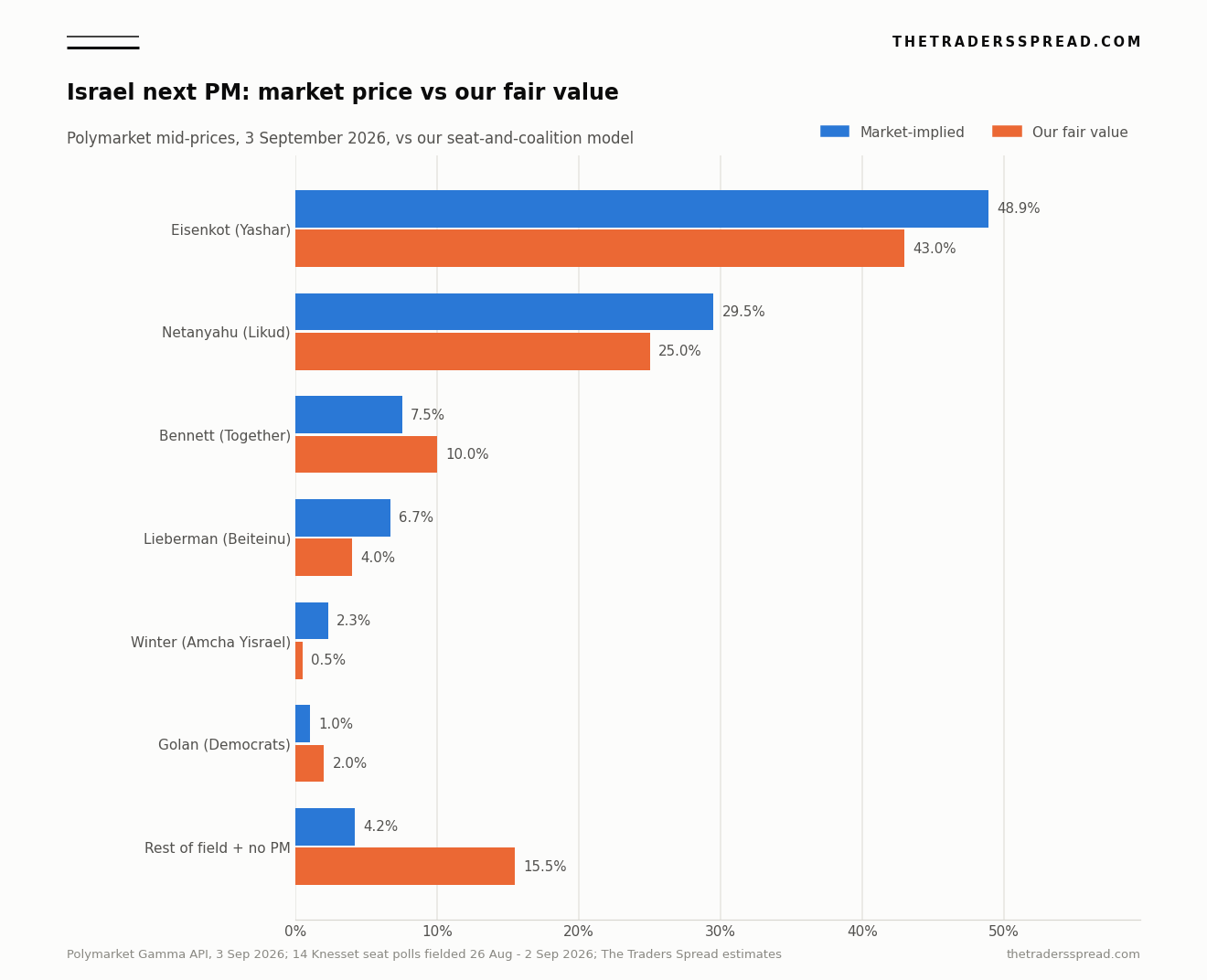
The full board
Every priced leg, with its mid, 24-hour volume and my fair value. The exchange spells the leader Eizenkot, the press Eisenkot. Live depth sits on the Israel next-prime-minister order book.
| Candidate (list) | Market | 24h volume | Our fair value |
|---|---|---|---|
| Gadi Eisenkot (Yashar) | 48.90% | $1,308 | 43.0% |
| Benjamin Netanyahu (Likud) | 29.50% | $17,388 | 25.0% |
| Naftali Bennett (Together) | 7.50% | $2,157 | 10.0% |
| Avigdor Lieberman (Yisrael Beiteinu) | 6.70% | $32,828 | 4.0% |
| Ofer Winter (Amcha Yisrael) | 2.30% | $4,649 | 0.5% |
| Yair Golan (The Democrats) | 0.95% | $3,356 | 2.0% |
| Itamar Ben Gvir (Otzma Yehudit) | 0.45% | $5,105 | 0.5% |
| Yossi Cohen | 0.35% | $36,663 | 0.8% |
| Gideon Sa'ar (Likud) | 0.35% | $16,058 | 1.2% |
| Amir Ohana (Likud) | 0.35% | $1,560 | 0.6% |
| Gilad Erdan | 0.25% | $58,368 | 0.4% |
| Yariv Levin (Likud) | 0.25% | $18,484 | 0.5% |
| Yair Lapid (Together) | 0.15% | $3,756 | 1.5% |
| Benny Gantz (Blue and White) | 0.15% | $2,131 | 0.8% |
| Israel Katz (Likud) | 0.15% | $5,608 | 0.4% |
| Nir Barkat (Likud) | 0.15% | $2,562 | 0.3% |
| Yoaz Hendel | 0.15% | $1,696 | 0.3% |
| Ayelet Shaked | 0.15% | $1,685 | 0.2% |
| Moshe Feiglin | 0.15% | $158,365 | 0.1% |
| Other / no PM by 31 Dec 2027 | unpriced | $0 | 7.9% |
The call
My fair value on the Eisenkot leg is 43%. The market is at 48.9%, a 5.9-point premium, and that is no verdict on his campaign, which by every measurable standard is going well.
Base case, 43%. Yashar finishes first on 22 to 26 seats, Eisenkot takes the mandate in early November, and assembles 61 with Together, the Democrats, Yisrael Beiteinu and Ra'am's outside support. Gayil Talshir, professor of politics at the Hebrew University of Jerusalem, put it to The Times of Israel on 6 July 2026: "Gadi projects everything Netanyahu is not. He projects authenticity, he projects a spine." That is a real asset, and it is why he is favourite.
The upside branch, 25%, is Netanyahu. It needs a 14-seat bloc swing or a defection, and he has built a government from second place before. Pricing him under 25% would be a mistake whatever the averages say.
The branch the book is not paying for, 25% combined, is everything else: Bennett going first in a rotation at 10%, Lieberman as the compromise both big lists can live with at 4%, Golan at 2%, and 9% across Lapid, Sa'ar, Gantz and names not yet on anyone's board.
What would change my mind. A public Eisenkot-Bennett agreement naming Eisenkot first in any rotation removes most of my discount in an afternoon, and I would mark him back toward 50%. A Ra'am collapse below the 3.25% threshold, a live risk on its 4 to 6 seat polling, takes him under 35%. If the Religious Zionist Party clears the threshold in three consecutive polls, Netanyahu's leg deserves to be nearer 30%. And a verdict in his corruption trial, expected to run into 2027 after he ended 98 hearings of testimony in June 2026, reprices the whole board the day it lands. Current quotes sit on Polymarket's Israeli next-PM market.
Questions the desk keeps getting
When does the Israel next PM market resolve?
The election is 27 October 2026, and it settles when a prime minister is formally sworn in, historically 20 to 100 days after polling day. A caretaker does not count. If nobody is sworn in by 31 December 2027 it resolves to "Other", the backstop that 1.1% residual covers.
Why is Eisenkot favourite when Likud polls level with Yashar?
Because seats are half the question. Likud averages 23.1 across the last 14 polls and Yashar 23.4, but Likud's bloc averages 49.3 against the opposition's 54.1. Netanyahu's problem is not his party's size. It is that his partners cannot carry him to 61 without a large polling error.
What is Yashar?
Gadi Eisenkot's own list, launched on 30 June 2026 in Hod Hasharon. He was IDF chief of staff from 2015 to 2019 and joined Benny Gantz's National Unity before leaving to run alone. The platform leads with a state commission of inquiry into the 7 October 2023 failures and a two-term limit on the premiership.
Could Bennett end up prime minister from 7.5c?
It is the branch I price furthest above the market. Bennett did exactly this in 2021, taking the chair first with six of Yamina's seven seats while Lapid, who held the mandate and the larger party, went second. Eisenkot cannot reach 61 without Bennett's 13 seats, which is real leverage over the sequence.
Disclaimer: this article is analysis and information only. It is not investment, trading or betting advice, and not a recommendation to take any position. Prediction-market contracts can lose their full value. Prices came from the Polymarket Gamma API on 3 September 2026 and will have moved; poll averages are our own calculation and carry their own error. Capital is at risk.