

Having read the Maine Senate board's entire price record this morning — all 327 daily prints since it opened on 14 October 2025 — I can tell you the number that matters is not the headline 68.5%. It is 45 days. That is how long it has been since the Democratic leg last closed this low. The board spent the summer recovering from a collapse, spent three weeks parked between 69 and 73, rallied hard on Monday's investigative reporting, and then gave all of it back and more in a single session on Thursday. At 07:37 UTC today the leg printed 0.685 against $1.10m of its own traded volume. That is the bottom of its thirty-day range, and the range has been narrow: five points of high-to-low across the whole month. A board that has moved in a five-point corridor since late August just travelled nine and a half points in one session, and it did so on a Thursday when nothing happened in Maine.
Here is what the tape does not tell you, and what I think the money got wrong. Two polls landed on Thursday pointing in opposite directions, and the market treated them as a contradiction to be split. They are not a contradiction. Their field windows do not overlap by a single day: UMass Lowell/YouGov stopped interviewing on 14 September, and the New York Times/Portland Press Herald/Siena survey started on 15 September. One is a sequel to the other. And neither of them was in the field when the story that caused Monday's rally actually broke. The board has just repriced eight and a half points of probability using evidence that predates the thing it was pricing on Monday. You can see the two live legs on Polymarket's Maine Senate Election Winner board. Links to Polymarket are affiliate links, from which The Traders Spread may earn a commission at no cost to you.
Key facts
- The Democratic leg trades at 68.5% and the Republican leg at 31.5%, on $1,103,113 and $792,254 of per-market volume respectively — gamma-api.polymarket.com, read 25 September 2026 07:37 UTC
- Eleven further legs on the same event carry $0 volume and no prices: ten unnamed "Person A" through "Person J", plus one for a candidate not listed on the board — gamma-api.polymarket.com, 25 September 2026
- The official November ballot for the seat carries exactly two names: Susan M. Collins of Bangor, filed 25 February 2026, and Troy D. Jackson of Allagash, filed 27 July 2026 — Maine Secretary of State, 2026 General Candidate List
- Graham C. Platner won the Democratic primary with 156,084 votes out of 222,405 cast, then withdrew on 10 July 2026 — Maine Secretary of State, US Senate DEM tabulation and post-primary withdrawal list as of 22 September 2026
- Collins reported $16,169,827 in receipts and $11,038,115 of cash on hand through 30 June 2026; Jackson has filed two Statements of Candidacy and no financial report at all — FEC, accessed 25 September 2026
- Republican-aligned groups have spent or reserved close to $165m of Maine advertising this cycle against roughly $123m by Democratic-aligned groups — AdImpact, reported by the Portland Press Herald, 24 September 2026
- Cook Political Report places the seat in its Toss Up column, one of seven, alongside Alaska, Iowa, Michigan, New Hampshire, Ohio and Texas — cookpolitical.com, read 25 September 2026
Read the contract before you read the label
The leg everyone quotes as "Troy Jackson at 68.5%" is not a Troy Jackson contract. Open the market and the question reads: Will the Democrats win the Maine Senate race in 2026? The candidate name is decoration. The rules text says so in as many words: "The candidates may be named in the contract for the convenience of traders. In the event that any named candidate is replaced as the nominee of their respective party prior to election day, the name in the contract will be updated and the market will resolve based on the replacement nominee of the party."
That clause has already fired once this cycle. It is not hypothetical.
The rules also close a door that Maine, of all states, might be expected to leave open. Candidates who run as independents "will not be encompassed by the 'Democrat' or 'Republican' options regardless of any affiliation they may have with the party." In a state that currently sends an independent to the Senate and has elected independent governors, a two-leg board summing to exactly 1.000 ought to be suspicious. I went looking for the leak and could not find one. The Secretary of State's 2026 General Candidate List shows two names for the office and no third. The separate declared write-in list dated 25 August carries six statewide write-ins for the seat, none of whom will be printed on a ballot. The board is complete because the ballot is.
Resolution is a three-key lock. The market settles once the Associated Press, Fox News and NBC have all called the race for the same candidate; failing that, it waits for official certification. Maine runs ranked-choice tabulation for federal general elections, which has delayed calls here before, but with two candidates on the ballot a second round is arithmetically impossible. One of them clears 50% in the first count. This is the kind of detail that decides a position, and it is the reason we read rules text before price history — the same discipline that flagged a stale source sitting under an 82.65% price earlier this month.
Thursday, hour by hour
The sequence is worth laying out precisely, because the order of events is the argument.
ProPublica published "The FBI Anti-Corruption Squad Was Circling Susan Collins — Until Trump Got in the Way" at 09:00 UTC on Tuesday 22 September. The Democratic leg closed that day at 0.700. On Wednesday it closed at 0.735. ProPublica followed with a second piece rebutting the senator's response at 22:34 UTC on Wednesday, and by 07:30 UTC on Thursday the leg touched 0.740, its highest print since 16 September.
Then the polls hit. By 10:10 UTC Thursday the leg was at 0.705. By 11:30 it was 0.665. At 13:00 it bottomed at 0.645, a 9.5-point intraday drawdown from the morning high. It clawed back to 0.695 by 21:20 as the second poll circulated, and opened today at 0.685.
| Date (UTC) | Democratic leg, daily close | What landed |
|---|---|---|
| 22 Sep 2026 | 0.700 | ProPublica investigation published 09:00 |
| 23 Sep 2026 | 0.735 | ProPublica rebuttal piece published 22:34 |
| 24 Sep 2026 | 0.735 (low 0.645) | Siena and UMass Lowell surveys both released |
| 25 Sep 2026 | 0.685 | Lowest close since 11 August |
Nine and a half points of intraday range on a board whose thirty-day high-to-low spread is five points is not a considered revision. It is a crowd being handed two numbers it did not expect and reaching for the average. The Democratic leg's order book carried $93,115 of resting liquidity at 07:57 UTC against $118,198 on the Republican side, thin enough that a determined seller moves it several points without much resistance.
The chart, and what sits behind our number
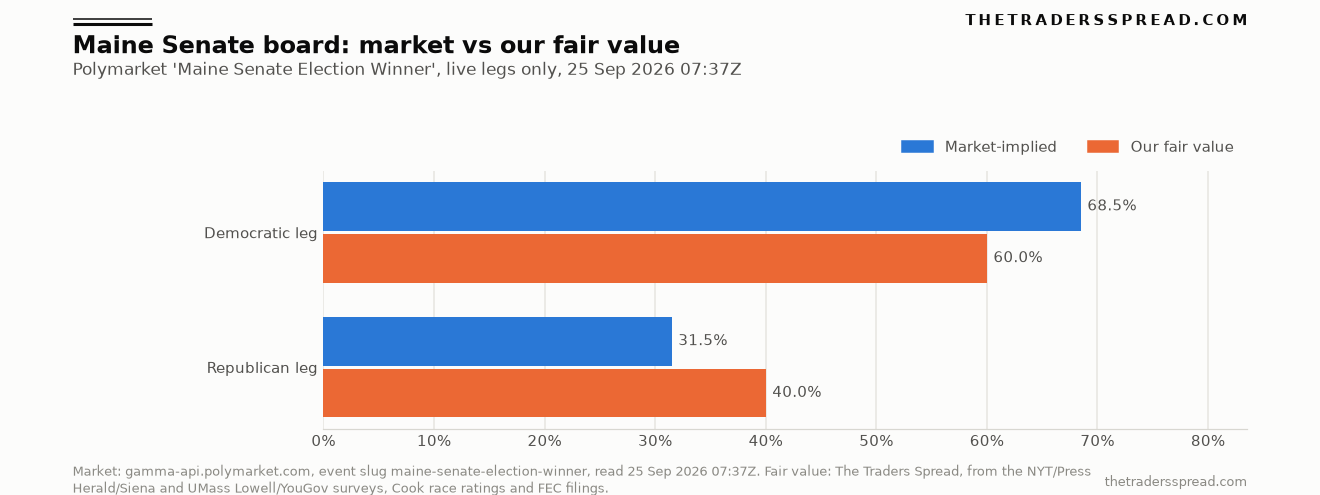
Our fair value for the Democratic leg is 0.60. The market is 8.5 points above it. That gap is not a claim that the polls are wrong; it is a claim that 68.5% is too confident a number to hang on a race that every serious rater has declined to call.
Start with the two surveys, which are the freshest hard evidence anyone has.
| Survey | Field dates | Sample | Result | Margin of error |
|---|---|---|---|---|
| UMass Lowell/YouGov | 28 Aug – 14 Sep 2026 | 650 likely voters | Jackson 48, Collins 43 | ±4.66 |
| NYT/Portland Press Herald/Siena | 15 – 22 Sep 2026 | 619 registered voters | Collins 49, Jackson 46 | ±4.9 |
Average them and you get roughly a one-point Democratic edge. Weight the more recent one and you get a tie or worse. Either way, a coin flip does not support 68.5%, and Cook's rating agrees: Toss Up, no favourite named. We drew the same conclusion about another Senate board trading far from its rater two days ago, and the logic has not changed because the state has.
John Cluverius, director of survey research for the Center for Public Opinion at UMass Lowell and an associate professor of political science, framed his own poll's finding with more caution than the headline number invites. "Susan Collins wins elections in Maine by getting Democrats and independents to vote for her. It's her superpower. But this year, rising prices, an unpopular war and an unpopular president are looking like electoral kryptonite," he said in the university's release. "One potential swing factor to watch for is that poll results show a lot of women respondents are either undecided or not firmly committed to Collins or Jackson."
His colleague Rodrigo Castro Cornejo, associate professor of political science and associate director of the same centre, put the environment in sharper terms in the same release: "A majority of Maine likely voters say it has become harder to afford basic necessities and a majority blame the war in Iran for higher fuel and utility prices. When voters connect economic pressure to government policy, it can have important political consequences, particularly in midterm elections."
Both readings are real. The environment genuinely favours the challenger's party, which is why our fair value sits above 50 rather than at it. Trump's approval in Maine was 37% in the UMass Lowell sample and 32% in Siena's, and 55% of Siena's respondents said they want Democrats to control the chamber. That is the case for the Democratic leg, and it is a good one. It is not a 68.5% case.
One nominee raised $21m. He is not on the ballot
This is the part the price has never properly absorbed.
Platner won the Democratic primary on 9 June with 156,084 votes, more than seventy per cent of everything cast, against Janet Mills, David Costello and a declared write-in. He raised $21,050,419 through 30 June, more than the incumbent. On 10 July he withdrew, three days inside the deadline set by Title 21-A §374-A, which allows a party committee to make a replacement nomination only where the nominee withdraws by 5pm on the second Monday in July. The Maine Democratic Party filed Jackson's replacement nomination on 27 July.
Jackson's own statewide test this cycle went differently. He stood in the Democratic gubernatorial primary on the same June ballot and took 45,959 first choices, third behind Nirav Shah and Hannah Pingree, and was eliminated in the third ranked-choice round. Pingree is the party's nominee for governor. Jackson is the party's nominee for the Senate seat without having faced a Senate primary electorate at all.
Then there is the money, or rather the absence of a number. The Federal Election Commission holds exactly two filings under Jackson's candidate ID, both Form 2 Statements of Candidacy, dated 9 and 31 July. No receipts, no disbursements, no cash position. His first financial disclosure is the October Quarterly. Collins, meanwhile, closed the June quarter with $11,038,115 in the bank, and Republican-aligned outside groups have committed roughly $42m more to Maine airtime than their counterparts.
So the board is pricing a 68.5% probability for a party whose nominee has no published fundraising, arrived by committee rather than by primary, and lost the only statewide nomination contest he entered this year. None of that makes him a loser in November. Maine has elected stranger tickets. It does make 68.5% an expensive way to express the view.
Where I would be wrong
Three things would push our number back toward the market.
The first is the ProPublica story doing damage that no poll has yet measured. Neither survey was fully in the field for it, and a corruption narrative attached to a 30-year incumbent whose entire brand is personal trust could move more than three points. If the next independent poll shows Collins's favourability falling from the 51% Siena recorded, our fair value goes up, not down.
The second is turnout composition. Siena polled registered voters and found Collins ahead; UMass Lowell polled likely voters and found Jackson ahead by five. In a midterm with 92% of Democrats reporting enthusiasm against 88% of Republicans, the likely-voter screen may be the better instrument, and it points the other way.
RelatedECB October Rate Decision: No Change at 90.5 Cents
The third is simply that the ballot is now frozen. Under §374-A(3)(A), a candidate who withdraws 70 days or more before the general election comes off the ballot. That window closed on 25 August. Whatever else happens, the names do not change again, which strips out the substitution risk that took this leg to 0.515 in June. A market that has stopped worrying about the ballot is entitled to a tighter, higher price than one that has not.
The call
Our fair value on the Democratic leg is 0.60 against a market of 0.685, which puts the Republican leg's 31.5% about 8.5 points below where we have it. The board sits above our work, not below it, and the gap is wide enough to matter without being wide enough to suggest the market has lost its mind. This is a disagreement about confidence, not direction. We and the board agree the Democratic leg is the more likely outcome; we disagree about how much more likely.
The number rests on four things: a poll average inside the margin of error, a Toss Up rating from the one outfit whose job is to categorise these races, a roughly $42m advertising deficit on the Democratic side, and a nominee who has filed no financial disclosure six weeks before voting. Against that, a genuinely hostile national environment for the incumbent's party and an unpriced corruption story. Sixty feels like where those forces balance.
Resolution is clean and dated. The two live legs settle once the Associated Press, Fox News and NBC all call the race for the same candidate, or on official certification if they do not converge. Election Day is Tuesday 3 November 2026. With two names on the ballot, there is no ranked-choice second round to wait through and no plausible path for a third party to strand the board.
What would change my mind, in order of how quickly it could happen: an independent poll taken entirely after 22 September showing Collins's favourability below 45%; an October Quarterly FEC report showing Jackson with meaningful cash rather than a standing start; or a Cook move off Toss Up in either direction. The first of those could land within a week. Until one of them does, we think this board is carrying more conviction than the evidence underneath it. The same question sits one level up on the chamber-control board, and Maine is one of the seats that decides it, alongside the races tracked on the House side.
Frequently asked questions
Does the Maine Senate market resolve on the candidate or the party?
On the party. The tradable questions are "Will the Democrats win the Maine Senate race in 2026?" and the Republican equivalent. Candidate names appear on the legs for convenience only, and the rules state that if a named candidate is replaced as their party's nominee before election day, the contract name is updated and the market resolves on the replacement. That clause was used this cycle.
Why do the two legs add up to exactly 100%?
Because the ballot has exactly two names. The Maine Secretary of State's general candidate list for 3 November 2026 shows Susan Collins and Troy Jackson for the office and nobody else. The six declared write-in candidates for the seat will not be printed on any ballot, and the rules explicitly exclude independents from both party legs, so there is no third outcome for the board to price.
What happened to Graham Platner?
He won the Democratic primary on 9 June 2026 with 156,084 votes and withdrew on 10 July amid allegations he denied. Under Maine's replacement statute, a party committee may nominate a substitute only if the nominee withdraws by 5pm on the second Monday in July. The Maine Democratic Party's replacement nomination of Troy Jackson was received by the Secretary of State on 27 July 2026.
Can either name still come off the ballot?
Not in the ordinary course. Title 21-A §374-A(3)(A) removes a withdrawing candidate's name only where the withdrawal comes 70 days or more before the general election, which for 3 November 2026 meant 25 August. After that date a withdrawal leaves the name printed, with narrow exceptions for death or catastrophic incapacity. Ballot substitution risk is effectively closed.
Why did two polls released the same day disagree?
They measured different weeks. UMass Lowell/YouGov interviewed 650 likely voters between 28 August and 14 September. The NYT/Portland Press Herald/Siena survey interviewed 619 registered voters between 15 and 22 September. The windows do not overlap, and the samples differ in screen. Treating them as a contradiction rather than a sequence overstates how much new information Thursday actually contained.
How much real volume sits on this board?
About $1.90m across the two live legs, split $1,103,113 on the Democratic side and $792,254 on the Republican, as of 25 September 2026 07:37 UTC. The other eleven legs are unnamed placeholders with no price and no volume, so any board-wide figure that counts them is describing an empty book.
Disclaimer
This article is analysis and information, not investment or trading advice. Prediction market contracts carry the risk of total loss of the amount committed, and probabilities quoted here are estimates that can be wrong. Prices and market data were captured at the times stated and will have moved since. Anyone acting on this material does so entirely at their own risk and should consider their own circumstances first. Capital is at risk.