

145 minutes. That is how long the Los Angeles mayor market on Polymarket took to react after the Los Angeles Times posted its new Berkeley IGS poll at 3 a.m. Pacific on Wednesday 23 September. The poll had Councilmember Nithya Raman leading Mayor Karen Bass by 39% to 28%. At 10:00 UTC, when the story went up, the Raman contract was at 42.05%. It crept to 42.9% over the next two hours. Then, between 12:25 and 13:00 UTC, it jumped to 57.95% in 35 minutes, the biggest daily move this contract has made since the primary count settled in June. A board with $14.28 million in lifetime volume barely traded until the American East Coast woke up, then priced the whole poll at once. Even after the jump, the price sits below what the evidence supports.
Here is the part the headline numbers leave out. The same pollster had a clear miss in this race four months ago. Its final likely-voter survey before the 2 June primary had Bass ahead of Raman by one point. The certified count had Bass ahead by 5.25. So in June, Berkeley IGS understated the incumbent's lead over Raman by 4.25 points. Take those 4.25 points off Wednesday's 11-point lead and Raman is still up by 6.75. Add the five campaign-aligned polls, each cut back by three points against its sponsor, and our model puts Raman's chance of winning at 63.5%, against the 57.95% Polymarket shows. The poll is not an outlier for the market to discount. Our model had Raman at 46.5% without the IGS poll at all, so the market was already too low on her before Wednesday.
Key facts
- Polymarket priced Nithya Raman at 57.95% and Karen Bass at 41.5% to win the mayoralty — Polymarket gamma-api, read 24 Sep 2026 06:39 UTC
- The Raman contract rose from 42.05% to 57.95% between 10:00 and 13:00 UTC on 23 Sep, and 21.5 points from 36.45% a week earlier — Polymarket CLOB prices-history, read 24 Sep 2026
- Raman 39%, Bass 28%, undecided 33%, among 2,150 likely voters surveyed online from 15 to 20 Sep — Berkeley IGS / Los Angeles Times, 23 Sep 2026
- 63% of Spencer Pratt's primary voters are undecided, while 22% back Bass and 16% back Raman — Berkeley IGS / Los Angeles Times, 23 Sep 2026
- June primary, certified: Bass 292,593 votes (34.27%), Raman 247,781 (29.02%), Pratt 217,977 (25.53%) — LA County Registrar-Recorder, results as of 26 Jun 2026
- The General Municipal Election is on Tuesday 3 November, the county must certify by 3 December, and the new term starts on 14 December — LA City Clerk election calendar, read 24 Sep 2026
A poll that got the order right and the gap wrong
The Bass campaign's response to Wednesday's poll went straight to the pollster's record. "One outlier poll which got the June primary wrong isn't reflective of the energy we see when talking to voters every day and what every other poll indicates -- this is going to be a close race," said Alex Stack, spokesman for the Karen Bass campaign, in a statement reported by NBC Los Angeles on 23 September.
That charge is half right. Berkeley IGS polled the primary from 19 to 24 May. Its likely-voter numbers, reported by Los Angeles Magazine on 29 May, were Bass 26%, Raman 25% and Pratt 22%, with about 10% undecided. The certified county results were Bass 34.27%, Raman 29.02% and Pratt 25.53%. The poll had the three candidates in the right order. It had Bass's lead over Raman at one point when it was really 5.25. Most of the late movement went to the incumbent.
So the pollster did miss in June, and the direction matters. It missed toward Raman. The obvious fix is to take that same 4.25-point error off this week's lead. That gives Raman +6.75, still well outside the survey's stated margin of error of about 3 points.
There is an older Los Angeles comparison, and it points the other way. In late September 2022, the Berkeley IGS registered-voter file for the Bass versus Rick Caruso runoff had Bass on 34%, Caruso on 31% and 31% undecided, according to the published IGS toplines. Bass won the certified runoff by 54.83% to 45.17%. Her lead grew from 3 points to 9.66. The candidate ahead in the September IGS survey won, and the undecided third broke toward her. It is one case, but the closest precedent the city has: same pollster, same stage, a similar undecided pool.
The two precedents point different ways. We apply the June miss, which involves the same two candidates, and ignore the 2022 break toward the leader even though it would favour Raman. That is deliberately cautious.
The 137,000 voters nobody has claimed
The 33% undecided figure is not spread evenly across the city. "It's extraordinarily unusual to see this many undecided voters at this point in the race," said Mark DiCamillo, Director of the Berkeley IGS Poll, speaking to the Los Angeles Times. He put the size of that group down to Spencer Pratt's exit from the race. Among voters who say they backed Pratt in June, 63% have not picked a runoff candidate.
Pratt received 217,977 votes. If the poll's 63% holds across all of them, roughly 137,000 of his voters are uncommitted. Bass's entire primary lead over Raman was 44,812 votes. The group that decides this race is about three times the size of the lead it inherited. Pratt has criticised both finalists and endorsed neither.
The Pratt voters who have chosen lean toward the incumbent, 22% to 16%. We model that lean directly. At November turnout of about a million, Pratt's voters are roughly 22% of the electorate, and 63% of them are undecided. Assume a quarter of those skip the mayoral race, and the rest split in the same 22-to-16 ratio. On those numbers Bass gains about 1.6 points of margin. In the same poll, undecided voters who did not back Pratt sit inside an electorate that, by our arithmetic from the poll's figures, favours Raman by about 35% to 22.5%, which pulls about a point back the other way. We net the two at half a point to Bass.
The age split explains why the incumbent can still win. Raman leads 66% to 4% among likely voters aged 18 to 29, and 64% to 12% among 30 to 39 year olds. Bass leads 41% to 21% among voters 65 and older. November's electorate will be far larger than June's. In 2022 the mayoral vote went from 646,058 in the primary to 929,974 in the runoff, a 44% jump in the electorate between June and November. If the extra voters skew younger, that helps the challenger. But online likely-voter screens are exactly where the Bass campaign says the poll goes wrong.
By region, the San Fernando Valley went 34% Raman, 26% Bass, with 40% undecided, according to the Times. South Los Angeles and the Harbor area, at 37% to 34%, were the only region Bass carried.
How the order book absorbed a 16-point move
The Los Angeles mayoral board on Polymarket shows $14.28 million in lifetime volume. That figure is misleading. More than half of it, $7.86 million, was traded on the Spencer Pratt contract, which has closed. At our 06:39 UTC read on 24 September, the Raman market alone had taken $1,957,506, with $149,952 of resting liquidity and $195,066 traded over the previous day. The Bass market had taken $1,180,491, with $129,309 of liquidity. Links to Polymarket are affiliate links, from which The Traders Spread may earn a commission at no cost to you.
The resting orders are lopsided. At 06:41 UTC, offers worth about $57,800 sat within two cents above Raman's 58-cent best ask. Bids within two cents below her 57.9-cent best bid came to only about $8,900. The Bass contract is the mirror image: about $58,900 of bids within two cents of 41 cents, against $4,300 of offers. Far more resting money is positioned for Raman to ease back than for her to rise further. That doesn't tell you who is right. It does mean a second strong Raman poll would run into a wall of offers, while a good week for Bass could move the price down quickly through a thin spread.
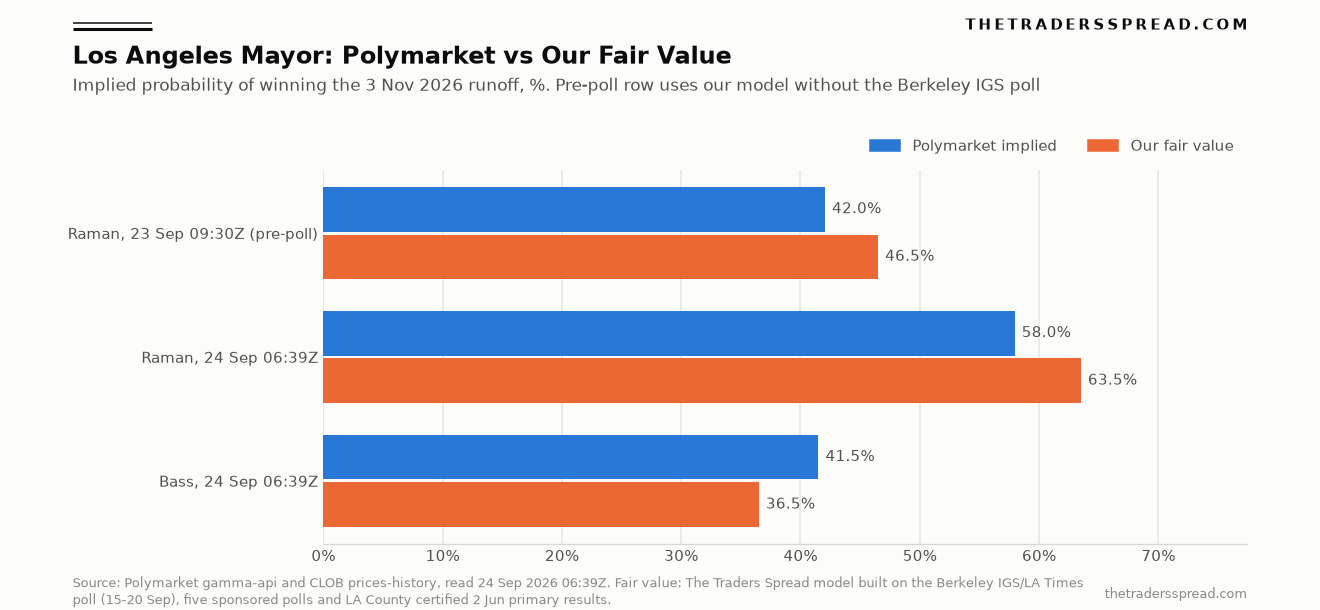
Before the poll, the only runoff surveys were ones paid for by a campaign or an allied group. Our model built from those alone came to 46.5% for Raman, and the market was at 42.05%. After the poll the model says 63.5%, and the market is at 57.95%. The gap stayed at roughly five points while the price jumped sixteen.
| Poll (fieldwork) | Sponsor | Reported margin | Our adjustment | Adjusted margin |
|---|---|---|---|---|
| Berkeley IGS (15-20 Sep) | Los Angeles Times | Raman +11 | 4.25 pts toward Bass (June miss) | Raman +6.75 |
| Hart Research (1-9 Sep) | Raman campaign | Raman +5 | 3 pts toward Bass | Raman +2 |
| Impact Research (28 Aug-3 Sep) | Pro-Raman committee and carpenters' council | Bass +1 | 3 pts toward Bass | Bass +4 |
| Tavern Research (20-25 Aug) | Streets for All PAC (pro-Raman) | Raman +6 | 3 pts toward Bass | Raman +3 |
| David Binder Research (Aug) | Bass campaign | Bass +2 | 3 pts toward Raman | Raman +1 |
| Tulchin Research (Aug) | Neighborhoods for a Better L.A. (pro-Bass) | Bass +6 | 3 pts toward Raman | Bass +3 |
The Hart, Tavern and Tulchin numbers match what the Los Angeles Times reported on 23 September. The Impact and Binder numbers, and the sponsor of each poll, come from the compiled polling record for the race. We could not open either poll at its source. The same record describes the Median Strategies episode in August: a firm published a poll showing Bass 12 points ahead, then admitted the numbers were made up, and the Associated Press found a burst of prediction-market trading in the 15 minutes after its release. It is excluded.
The three-point cut for campaign polls is our assumption, not a published figure: campaigns publish the polls they like. Look at the Bass camp's own August survey: it had the incumbent on 35%, two points ahead. When a sitting mayor's own campaign poll puts her on 35%, the campaign's line that "every other poll" shows a close race is fair, but it is not a reassuring point for Bass.
Is the Bass campaign right about online polling?
The mayor's campaign also says online-only polls miss "working-class families, seniors and non-English speaking communities that turn out on Election Day," according to NBC Los Angeles. That is a real risk, and the June miss partly supports it, which is why we apply the 4.25-point adjustment.
What the argument does not explain is Bass's favourability. In the IGS sample, 63% of likely voters view the mayor unfavourably and 28% favourably. Raman is at 40% favourable and 39% unfavourable. Fifty-six percent rated Bass's response to the January 2025 Palisades fire poor or very poor. Only 14% called it excellent or good. A bias in how the sample is collected can move a topline by a few points. It does not usually turn a popular incumbent into one with a 35-point net negative rating.
Raman has a hard case to make too. The Los Angeles chapter of the Democratic Socialists of America endorsed her on 2 September, and the Bass campaign is attacking what Stack called her "out-of-step views on allowing encampments near schools". Dan Schnur disagrees about what is driving her vote. "She's running because she represents dramatic change," said Dan Schnur, Professor at the University of Southern California, speaking to NBC Los Angeles. He added that she is not winning because she is further left than Bass. Raman said much the same on Wednesday: "Angelenos are ready for change."
If the Pratt group decides the race on ideology, the DSA label is Raman's biggest weakness with Pratt's voters. If they decide on incumbency, it is Bass's 63% unfavourable rating. The poll can't yet say which. That uncertainty is why our fair value is 63.5% and not 80%.
How the market resolves, and when
The contract's own rules say it resolves to "the candidate that wins the election," based on "a consensus of credible reporting". Official information from the City of Los Angeles decides only if the reporting is ambiguous. That matters for timing. The runoff is on Tuesday 3 November, the date we use as the resolution date. It is not necessarily when the market pays out. California counts mail ballots slowly. In June, according to the compiled race record, the fight for second place between Raman and Pratt was not settled until 8 June, six days after polling day. Countywide, 81.8% of June ballots came by mail. Mail ballots go out from 1 October, according to local election officials quoted by the Times. In a close runoff, a consensus call could take a week or more. The county's certification deadline is 3 December.
Every other named candidate's leg on the board, from Pratt and Rick Caruso to Austin Beutner, is closed, and the placeholder legs show no trades. This is now a two-candidate market, and the two live prices add up to 99.45 cents.
RelatedSeptember CPI Odds: The 3.7% Bucket Sits Above Fair
The Bass contract is the other side of the same pair, with about $58,900 of bids stacked within two cents of its price at our read.
We have looked at other races on the same ballot. Our Alaska Senate breakdown found the market too high on the primary winner. The Senate control call and the US House control analysis cover the chamber-level boards.
The call: fair value 63.5% for Raman against a 57.95% market
Our fair value for the Raman contract is 63.5%, and 36.5% for Bass. The IGS lead, cut by the June miss, is Raman +6.75. The five sponsored polls, each cut by three points against their sponsor, average Bass +0.2. We weight the one independent poll and the five sponsored ones equally, which gives Raman +3.3. We take off half a point for the Pratt lean, leaving an expected margin of Raman +2.8 points. An 8-point standard deviation on that margin, our assumption for six weeks out with a third of voters undecided, turns +2.8 into a 63.5% chance of a Raman win. The market price of 57.95% is 5.55 points lower. On our framework, the market trades below fair value on Raman.
Scenario weights from the same distribution:
- Base, 37.8%: Raman wins by 0 to 8 points. The Pratt group splits close to its current 22-to-16 lean, and the larger November electorate roughly matches the poll's likely-voter screen.
- Bull case for Raman, 25.7%: she wins by more than 8. The IGS lead holds after adjustment, and the 2022 pattern repeats, with undecided voters breaking toward the September leader.
- Bear case for Raman, 36.5%: Bass wins. The June polling miss turns out to be larger in a higher-turnout November electorate, and Pratt's voters come home to the incumbent over the DSA-endorsed challenger.
What would change our view: a second nonpartisan poll with Bass five points ahead would pull our number down to about 49%. A Pratt endorsement of Bass would be worth several points to her, given the size of his remaining vote. Early mail-ballot returns after 1 October skewing strongly toward voters over 65 would also push us down. On the other side, a second independent poll with Raman ten points ahead would lift our figure to about 67%, because it would show the IGS result is not a one-off.
Frequently asked questions
What are the Los Angeles mayor odds on Polymarket right now?
At 06:39 UTC on 24 September 2026, Polymarket priced Nithya Raman at 57.95% and Karen Bass at 41.5%, with every other candidate's contract closed. A week earlier Raman was at 36.45%. Most of the rise came in 35 minutes on 23 September, after the Berkeley IGS and Los Angeles Times poll showed her leading 39% to 28%.
Why do we put Raman above the market price?
Even after cutting her lead by the full 4.25 points the same pollster was out by in June, the independent poll has Raman up 6.75. Combined with five campaign-aligned polls, each cut back against its sponsor, our expected margin is Raman +2.8. With an 8-point standard deviation, that is a 63.5% win probability, above the 57.95% market price.
Who are the undecided voters in the Los Angeles mayor race?
Mostly people who voted for Spencer Pratt in June. In the latest poll, 63% of them had not picked a candidate, and those who had leaned toward Bass by 22% to 16%. Pratt won 217,977 votes. If 63% of those are uncommitted, that is about three times Bass's 44,812-vote primary lead over Raman.
When will the Polymarket Los Angeles mayor market resolve?
The election is on 3 November 2026. The market resolves on a consensus of credible reporting, and falls back to City of Los Angeles figures if that consensus is unclear. Los Angeles counts slowly, so a close race could take days or weeks to call. The county must certify by 3 December, and the winner takes office on 14 December.
Did the Berkeley IGS poll get the June primary wrong?
Partly. Its final likely-voter survey had Bass 26%, Raman 25% and Pratt 22%. The certified result was 34.27%, 29.02% and 25.53%. The order was right. But the poll put Bass's lead over Raman at one point when it was really 5.25. Our fair value takes that 4.25-point miss off the poll's current lead.
Disclaimer: This article is analysis, not financial or betting advice. Prediction-market prices move quickly and every position puts capital at risk, up to the full amount staked. Prices quoted were read from Polymarket's public API and order book between 06:34 and 06:41 UTC on 24 September 2026 and will have changed by the time you read this. Check the market rules and the laws that apply where you live before trading.