

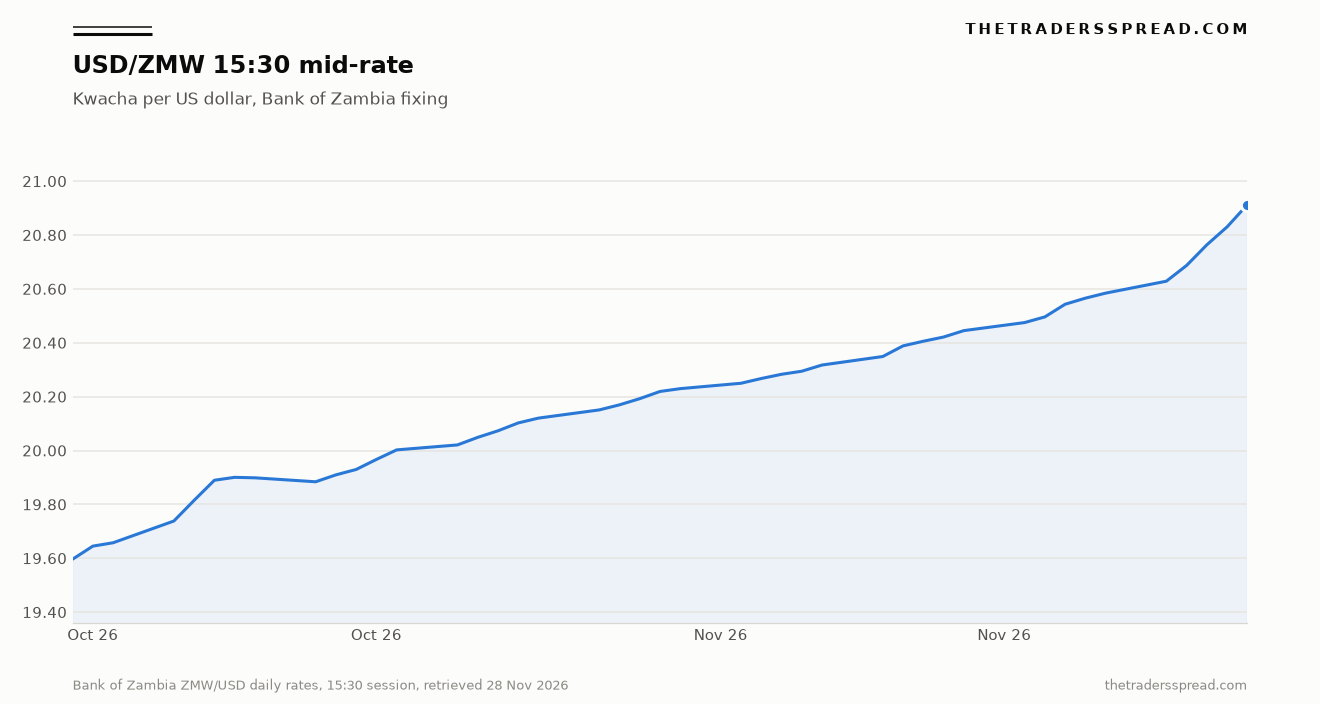
The Bank of Zambia's 15:30 mid-rate rose from 19.5964 kwacha per US dollar on 30 September to 20.9129 on 27 November. We subtracted those two prints on the bank's ZMW/USD fixing page. The difference is 1.3165 kwacha, or 6.718 percent, and 20.9129 is the highest mid in the file we downloaded.
At its meeting on 25-26 November 2026, the Monetary Policy Committee decided to maintain the Monetary Policy Rate at 10.75 percent. Governor Denny Kalyalya issued the statement on 27 November, and the bank's copy carries a created time of 2026-11-27T09:21:45+00:00. The committee said actual and projected inflation remain inside the 6-8 percent target band, with elevated upside risks and a slight increase since the last quarter, and that the current stance is appropriate.
The Monetary Policy Rate (MPR) has been maintained at 10.75%. This decision was arrived at by the Monetary Policy Committee (MPC) at its Meeting held on November 25 - 26, 2026. Governor, Dr. Denny Kalyalya, is currently delivering the #MPCDecision. Watch: https://t.co/VNtmuQlvbp pic.twitter.com/7dmoiNiouN
— Bank of Zambia (@BankofZambia) November 27, 2026
Key facts
- Policy rate: maintained at 10.75 percent after the 25-26 November 2026 meeting, statement issued 27 November.
- Inflation in the statement: 6.4 percent in November, after 6.3 percent in October, inside the 6-8 percent band.
- USD/ZMW 15:30 mid: 20.9129 on 27 November against 20.8304 on 26 November, up 0.0825 kwacha, or 0.396 percent.
- Since the 30 September cut: the 15:30 mid is higher by 1.3165 kwacha, or 6.718 percent, from 19.5964.
- Next dates in the statement: the November Monetary Policy Report by 10 December 2026, and the meeting of 8-9 February 2027.
What the two fixings show
On the decision day we compared the 15:30 session with the previous published 15:30. The page lists three ZMW/USD sessions on an ordinary day, labelled 09:30, 12:30 and 15:30. On 27 November those mids were 20.8627, 20.8949 and 20.9129, and we used the last. Its timestamp is 2026-11-27T13:30:00Z. Buying was 20.8879 and selling was 20.9379. The 26 November 15:30 row is timestamped 2026-11-26T13:30:00Z, mid 20.8304, buying 20.8054, selling 20.8554. Taking 20.8304 from 20.9129 leaves 0.0825 kwacha, which is 0.396 percent of the earlier mid. More kwacha per dollar means the dollar's fixing rose.
The download on 28 November runs from 22 January 2026 through 27 November 2026. We set aside one 27 July row of 2.7486, and among the remaining 533 rows the 27 November mid is the maximum. The 30 September 15:30 row, timestamped 2026-09-30T13:30:00Z, came after the September statement, which says the committee cut the rate by 250 basis points to 10.75 percent at the 28-29 September meeting. The chart shows the 43 sessions at 15:30 from that day through 27 November.
The band, and the risk the bank names
The November statement sets the hold against the inflation band. Inflation fell to 6.1 percent in September from 6.5 percent in June, and the third quarter averaged 6.3 percent, compared with 6.6 percent in the second. In October and November inflation edged up to 6.3 percent and 6.4 percent, which the statement links to higher domestic fuel pump prices and the recent depreciation of the kwacha. From the fourth quarter of 2026 to the third quarter of 2028, the bank still places inflation inside the 6-8 percent band, on a higher path than in September: 6.9 percent in 2026 against a prior 6.7, 6.7 percent in 2027 against a prior 6.0, then 6.4 percent in the first three quarters of 2028.
The statement says the risks stay tilted to the upside. A strengthened El Niño could substantially reduce agricultural output and constrain hydroelectric generation, pushing food and energy prices further up. Continued conflict in the Middle East could keep global crude oil prices elevated and raise domestic fuel pump prices further. Tighter global financial conditions could accelerate capital outflows and add to exchange-rate pressure in emerging markets, including in Zambia.
RelatedAUD/SEK ticks up: 4.9% CPI follows the ECB reference
A fixing read on another central bank is in six facts from the USD/EGP fixing. A neighbouring policy calendar is in eight SARB decisions and the AUD/ZAR move after each one.
What to watch
- The November Monetary Policy Report, which the statement says will be on the Bank of Zambia website by 10 December 2026.
- The next MPC meeting, on 8-9 February 2027.
- Later 15:30 mids, set against 20.8304 on 26 November and 20.9129 on 27 November.
- The upside risks the statement names: a strengthened El Niño, Middle East crude prices, and tighter global financial conditions.
Data as of 28 November 2026. This is analysis, not advice, and capital is at risk.