

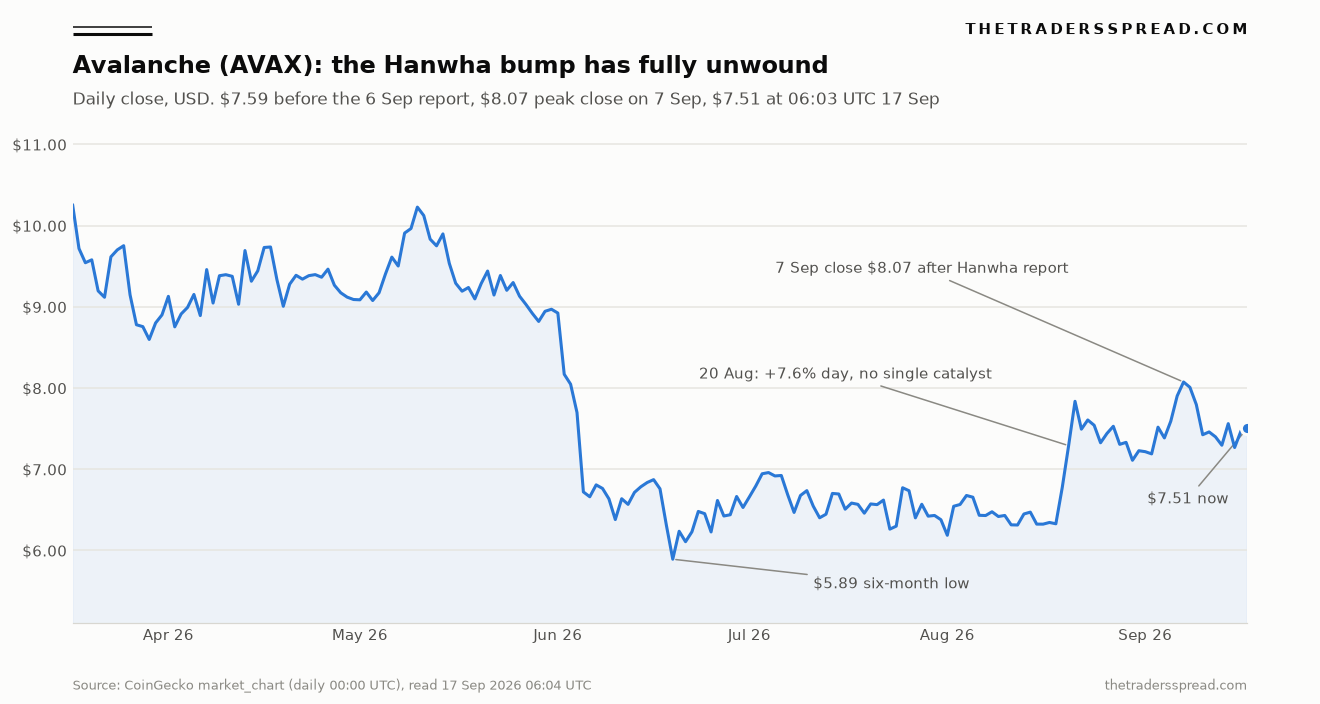
At 15:53 on Sunday 6 September, Seoul time, the Seoul Economic Daily posted a short item under a Yonhap file photo captioned only with the broker's name. Its headline ran to four Korean words: Hanwha Securities builds an Avalanche system. The body said the brokerage had finished a tokenized-securities platform, built with FairSquare Lab, that can run on Avalanche as well as the enterprise chain Hyperledger Besu. That was 06:53 UTC. Avalanche (AVAX) had closed the previous day at $7.59 on CoinGecko's daily series. By the close of Monday 7 September it was $8.07, a 6.4% gain in a stretch when Bitcoin slipped 0.9%. Ten days later the gain is gone. At 06:03 UTC on Thursday 17 September, AVAX traded at $7.51, which means it fell 7.0% from that $8.07 close and now sits 1.1% below where it stood before anyone in Seoul had read the story.
The part the rally skipped is the invoice. Since the Etna upgrade, an institution running its own Avalanche L1 does not stake 2,000 AVAX per validator. It pays a continuous P-Chain fee. The live fee state we pulled from Avalanche's public P-Chain API at 06:10 UTC today read 512 nAVAX per second, the floor set in ACP-77, which the proposal itself translates to about 1.33 AVAX a month per validator. At today's price that is roughly $10. A bank-grade network with ten validators would pay about $100 a month in AVAX. The market added about $208 million of market capitalisation in two days pricing a headline whose direct token draw, on the protocol's own arithmetic, rounds to nothing.
Key facts
- AVAX closed at $8.07 on 7 September, up 6.4% from the $7.59 close on 5 September, the last close before the Hanwha report. It traded at $7.51 at 06:03 UTC on 17 September, 7.0% below that peak close — CoinGecko daily series, read 17 Sep 2026 06:04 UTC
- Hanwha Investment & Securities finished a tokenized-securities platform supporting Avalanche and Hyperledger Besu, developed by FairSquare Lab — Seoul Economic Daily, 6 Sep 2026
- Korea's amended electronic-registration law, which recognises tokenized securities, takes effect on 4 February 2027, opening phase one of a three-phase rollout — Financial Services Commission, 4 Sep 2026
- The P-Chain continuous fee for an L1 validator stood at 512 nAVAX per second (about 1.33 AVAX, or $9.96, per 30 days) with zero excess demand — Avalanche public P-Chain API, read 17 Sep 2026 06:10 UTC
- 597 Avalanche L1 validator records carried a non-zero P-Chain balance, totalling 2,058 AVAX — Avalanche Glacier API, read 17 Sep 2026 06:11 UTC
- DeFi value locked on Avalanche was $480 million, down 77% from $2.10 billion a year earlier — DefiLlama, read 17 Sep 2026
- AVAX is down 76.4% over 365 days, against a 34.4% fall for Bitcoin over the same window — CoinGecko, read 17 Sep 2026
What Hanwha finished, and what nobody has published
Read the original Korean report rather than the English rewrites and the claim is narrower than the headlines that followed it. Seoul Economic Daily cited blockchain-industry sources, not a Hanwha announcement. It said Hanwha Investment & Securities began the build in 2025, has completed it, and designed it to use several networks. What Hanwha added was Avalanche, and the paper was specific about why. Avalanche lets an operator stand up a separate network with a restricted set of participants and validators, which makes it usable as a closed network for financial institutions.
Then came the paragraph that probably mattered more. The Korea Securities Depository (KSD), according to its published distributed-ledger standard-requirements guideline, is building a tokenized-securities platform that can connect to Hyperledger Besu, Hyperledger Fabric and Avalanche. Participants on those ledgers are limited to the depository and registered securities firms. A depository official told the paper that Avalanche was not a choice the KSD made on its own initiative; it was added because several firms, including members of the token-securities consortium, had asked for it.
Eight days later Edaily ran a follow-up on 14 September saying Hanwha had adopted Avalanche and was using it now. Neither outlet gave a chain ID, a validator count or a first product, and we could not find a Hanwha press release describing the platform.
The legal clock is real, though. On 4 September the Financial Services Commission set out a three-phase roadmap. Phase one starts when the amended Act on Electronic Registration of Stocks and Bonds takes effect on 4 February 2027 and covers privately pooled money market funds and bonds for institutional investors, unlisted stocks held through a trust structure, and publicly offered fractional investment securities. Later phases add all publicly offered securities, then stablecoin-linked on-chain payments. The FSC was explicit that phases two and three stay flexible, depending on how phase one goes and on stablecoin legislation that has not passed.
So the verified story is this. A large Korean broker has a finished, multi-chain system; the national depository will connect to Avalanche because the industry asked; nothing can legally be issued under the new regime for another 140 days; and the first products are institutional funds and bonds, not retail flow.
The fee meter runs at 512 nAVAX a second
Adoption headlines move AVAX because of a Subnet-era model: more chains, more AVAX locked. Under the old rules every Subnet validator also staked at least 2,000 AVAX, so ten validators removed 20,000 AVAX from float.
ACP-77 ended that. Its status on GitHub reads "Activated", and the AvalancheGo release notes put the Etna upgrade that carried it live on mainnet on 16 December 2024. The proposal states plainly that L1 validators "do not have the same 2000 $AVAX stake requirement that Subnet validators have" and instead pay a continuous fee drawn from a balance on the P-Chain. The fee floats: it starts at a minimum of 512 nAVAX per second and only rises once more than 10,000 L1 validators are active, with a hard capacity of 20,000. Ava Labs sold the change as an opening, not a toll. "So after this upgrade, we can have a chain with thousands of validators that wasn't possible before," Luigi D’Onorio Demeo, then chief operating officer at Ava Labs, told CoinDesk in November 2024.
We asked the chain directly. Avalanche's public P-Chain endpoint returned a fee price of 512 and an excess of 0 at 06:10:25 UTC today. The meter is sitting on its floor.
| Measure | Value | Source, time |
|---|---|---|
| Fee per L1 validator, per 30 days | 1.327 AVAX (about $9.96) | P-Chain fee state 512 nAVAX/s, 06:10 UTC 17 Sep |
| Fee per L1 validator, per year | 16.15 AVAX (about $121) | Same |
| L1 validators with a non-zero balance | 597 | Glacier API, 06:11 UTC 17 Sep |
| All of them, per year, at today's fee | 9,639 AVAX (about $72,000) | Our arithmetic |
| AVAX 24-hour trading volume | $285.5 million | CoinGecko, 06:05 UTC 17 Sep |
| AVAX circulating supply | 442.85 million | CoinGecko, 06:05 UTC 17 Sep |
Every funded L1 validator on the network combined would pay about 0.002% of the circulating supply in a year. The whole annual bill comes to about 0.025% of a single day's AVAX trading volume.
None of that makes the Hanwha news unimportant. It changes what kind of news it is. A permissioned L1 for Korean funds and bonds is a distribution win for Ava Labs' enterprise business and a credibility win for the network. For the token, the value has to arrive through a different door: issued assets bridging to the public C-Chain, settlement in AVAX-denominated gas on a shared chain, or treasuries and stablecoins parked where DeFi can reach them. Those doors exist. Nobody has said Hanwha intends to walk through any of them, and the KSD guideline, as reported, restricts ledger participants to the depository and securities firms.
The round trip, in closes and in company
Price alone could mislead here, because September has been rough for everything. The Federal Reserve raised the federal funds target range by a quarter point to 3.75% to 4% on 16 September in a 12 to 0 vote, a move worth setting beside our earlier read of Polymarket odds on 2026 rate cuts. So the fair test is relative.
| Window (CoinGecko 00:00 UTC anchors to 06:03 UTC 17 Sep) | AVAX | Bitcoin | Ether |
|---|---|---|---|
| Report reaction: 5 Sep close to 7 Sep close | +6.4% | -0.9% | +0.4% |
| From the 7 Sep close to now | -7.0% | -3.5% | -2.1% |
| From the pre-report 5 Sep close to now | -1.1% | -4.4% | -1.7% |
| FOMC day: 15 Sep close to 16 Sep close | +2.8% | +0.7% | +0.8% |
| From the 17 Aug close to now | +18.3% | +18.4% | +27.5% |
| From the 19 Jun close (AVAX six-month low) to now | +27.4% | +20.2% | +42.6% |
| 365 days | -76.4% | -34.4% | -46.9% |
The Hanwha reaction was idiosyncratic: AVAX gained while Bitcoin fell. So was the unwind, twice as steep as Bitcoin's drift from the same close. The Fed is not the culprit either, since AVAX closed hike day 2.8% above the prior close.
Widen the lens and the whole summer rally reads as beta. From 17 August, AVAX has matched Bitcoin almost to the decimal and trailed Ether by nine points. The sharpest single up-day in that run was 20 August, a 7.6% close-to-close move that we could not tie to a single verified catalyst. The deeper damage sits further back. A slide from above $8.90 in late May to a $5.89 low on 19 June took the token below the range it held for most of the spring, and the chart shows no recovery of that range since. Uniswap's fee-driven spike and fade ran a similar script this month.
What the ledger shows about demand
If institutional interest were already turning into on-chain capital, it would show up in deposits before it showed up in a press cycle. It has not yet.
DefiLlama puts total value locked in Avalanche DeFi at $480 million today. On 18 August it was $418 million, it touched $516 million on 7 September, and a year ago it was $2.10 billion. Stablecoin supply on the chain tells the less flattering half. The dollar-pegged float was $1.67 billion on 18 August, $1.50 billion on 7 September and $1.46 billion today. Money has been leaving the public chain during the exact window in which the market was paying up for an adoption story.
Trading activity moved the other way, which is why the bull case is not empty. Daily DEX volume on Avalanche averaged $99.5 million across the 31 days to 16 September, against $40.1 million in the 31 days before that, per DefiLlama. The single busiest day of the stretch was 7 September at $240 million, the day the Hanwha story spread through English-language crypto media. Volume faded to an average of $80.0 million from 10 to 16 September.
Fees are the tell. Chain-level fees ran at $0.25 million on 6 September, $0.43 million on 8 September and $0.28 million on 16 September. In early August they printed $0.29 to $0.32 million on busier days. Traders churned more volume through the same fee envelope, which fits a speculative rotation better than new structural users.
Compare Solana's rally, backed by $1.06 billion in ETF assets, or NEAR's, which followed a doubling in Intents swaps. A flow metric moved first in both. For Avalanche, the one that matters most for a real-world-asset thesis, stablecoin float, went down.
Where the institutional thesis could still be right
The counter-argument deserves a fair hearing, because it is not foolish. Korea's depository adding Avalanche compatibility at industry request is a genuine structural shift. The KSD sits at the centre of registration for the whole Korean securities market. Once connectivity exists, issuers do not need to argue for Avalanche one by one.
Korea is also not a one-broker story for Ava Labs. When Mirae Asset Global Investments signed a memorandum of understanding on fund tokenization in September 2025, John Nahas, Chief Business Officer at Ava Labs, said "Tokenization is becoming the new standard in global finance," according to Asia Economy. Younghwan Kim, Head of Innovation and Global Management at Mirae Asset Global Investments, said in the same report: "By combining Ava Labs’ blockchain technology with our product and asset management expertise, we will accelerate the tokenization of real-world assets (RWA)." Neither statement names a token-demand mechanism, which is the gap this article is about.
Second, the ACP-77 fee is a floor, not a ceiling. It rises exponentially once the network passes 10,000 active L1 validators. At 597 funded validators that is a distant scenario, but a multi-year enterprise build-out would move toward it, and the fee design is explicitly meant to price scarce P-Chain capacity.
Third, Ava Labs is marketing this story hard and in person this week. Its Avalanche Summit runs 16 and 17 September at Chelsea Industrial on West 28th Street in New York, pitched around onchain finance, tokenized assets and regulated capital markets. If one of them names a Korean issuer, a live chain and a first product date, the Hanwha item stops being a leak and becomes a schedule.
RelatedFetch.ai (FET) Rises 14.67% to $0.2556 in 24 Hours
What would disconfirm our reading? A Hanwha or KSD disclosure that issued securities settle on the public C-Chain, or that AVAX is used for settlement beyond validator fees. A sustained rise in Avalanche stablecoin float back above the $1.67 billion of 18 August. Or a P-Chain fee price above 512, which would mean L1 demand is finally large enough to bite.
What this changes
It changes the timetable for the Avalanche Korea story, not the token's cash-flow math. Before 6 September the market could treat Korean tokenization as a vague 2027 possibility. Now there is a named broker with a completed build, a depository publicly committed to Avalanche connectivity, and a statutory start date of 4 February 2027. That is a firmer set of facts than AVAX had a month ago.
What it does not change is how value reaches the token. Under ACP-77 a permissioned institutional chain pays AVAX by the second, at a rate that today works out to about $10 a validator a month. The 6.4% rally treated the report as if it implied locked supply; the 7.0% fade since then looks like the market doing the arithmetic. Today's $7.51 sits 1.1% below the pre-report close, which is where a headline with no measurable token draw would be expected to settle.
Between now and February, three dated checkpoints matter more than any partnership press. First, whether any Korean issuer names a chain and product for phase one. Second, whether Avalanche's stablecoin float stops shrinking. Third, whether the P-Chain fee price leaves its floor. Each is observable from primary sources: the FSC and KSD for the first, DefiLlama for the second, and the P-Chain API for the third.
One distinction is worth holding. Enterprise-adoption news can be true and still be close to neutral for the token, because Avalanche deliberately made institutional chains cheap to run. A 76.4% one-year decline, against 34.4% for Bitcoin, says the market has already been pricing the gap between the network's commercial wins and the token's share of them. The macro backdrop for crypto as a whole still sets the direction on most days. Hanwha's platform, on the evidence published so far, changes that backdrop for Avalanche by very little.
FAQ
Did Hanwha launch a tokenized securities platform on Avalanche?
According to the Seoul Economic Daily on 6 September 2026, Hanwha Investment & Securities completed a tokenized-securities platform built with FairSquare Lab that supports Avalanche and Hyperledger Besu. Edaily reported on 14 September that Hanwha is using Avalanche. We found no Hanwha press release, and no chain ID or first product has been published. Securities issuance under Korea's new regime cannot start before 4 February 2027.
How much did AVAX move after the Hanwha report?
On CoinGecko's daily series, AVAX closed at $7.59 on 5 September, before the report, and $8.07 on 7 September, a 6.4% rise while Bitcoin fell 0.9%. By 06:03 UTC on 17 September it was $7.51, down 7.0% from that peak close and 1.1% below the pre-report level. Bitcoin fell 3.5% from the same 7 September close.
Does an institutional Avalanche L1 need to stake 2,000 AVAX?
No. ACP-77, activated with the Etna upgrade on mainnet on 16 December 2024, removed the 2,000 AVAX staking requirement for L1 validators. They instead pay a continuous fee from a P-Chain balance. The live fee on 17 September 2026 was 512 nAVAX per second, about 1.33 AVAX per validator every 30 days, or roughly $10 at a $7.51 price.
Did the Fed rate hike cause the AVAX drop?
The daily closes do not support that. The FOMC raised rates by a quarter point to 3.75% to 4% on 16 September 2026, and AVAX's close that day was 2.8% above its 15 September close. Most of the decline from $8.07 happened between 8 and 15 September, before the decision, and AVAX fell twice as far as Bitcoin from the 7 September close.
What would show that Korean tokenization is reaching the AVAX token?
Three observable signals: a Korean issuer or the KSD confirming settlement on Avalanche's public C-Chain rather than a closed L1; Avalanche stablecoin supply recovering above the $1.67 billion recorded on 18 August 2026, per DefiLlama; and the P-Chain L1 validator fee rising above its 512 nAVAX-per-second floor, which only happens once active L1 validators exceed 10,000.
Disclaimer
This article is market analysis and commentary, not investment advice or a recommendation to trade any asset. Cryptoassets are highly volatile and you can lose all of the capital you commit. Figures were retrieved from the named sources at the times stated and may have changed since. Do your own research and consider your own circumstances before making any financial decision.