

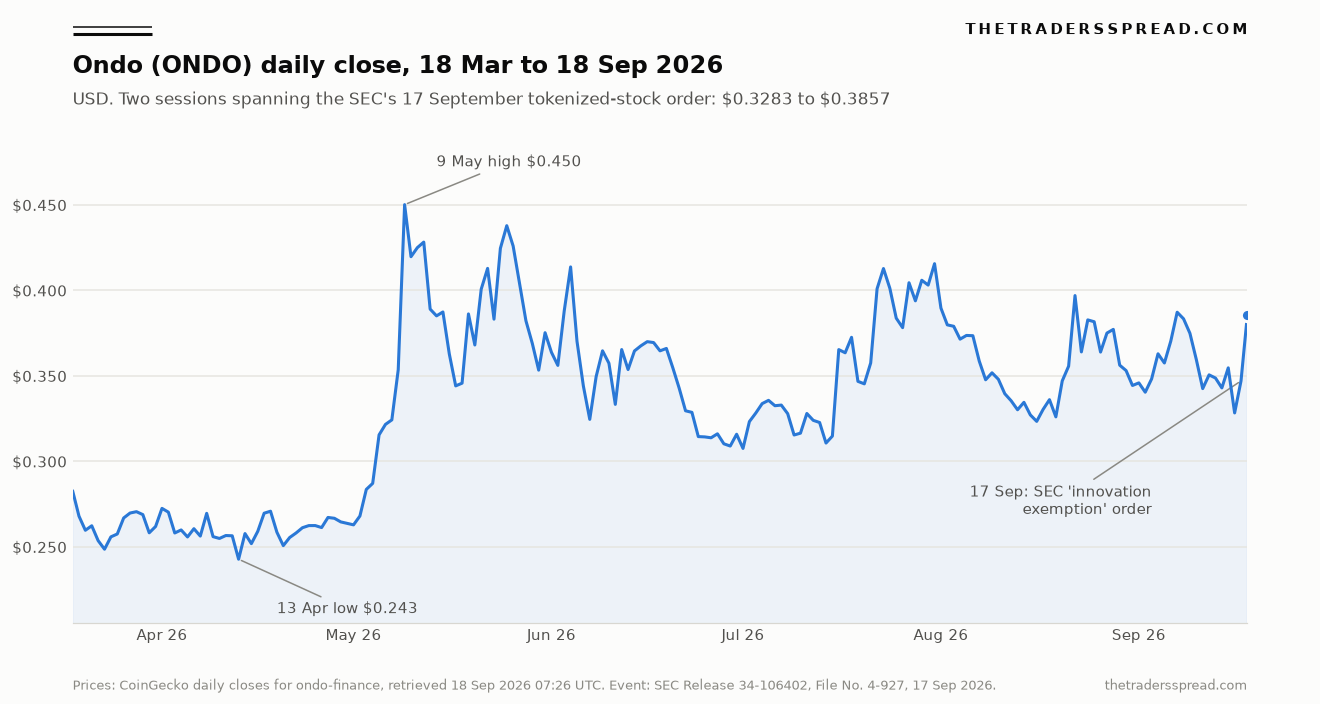
The question the market spent Thursday and Friday pricing in Ondo (ONDO) was a simple one: did Washington just make the company’s business legal in the United States? ONDO changed hands at $0.3471 at 00:00 UTC on 17 September, hours before the Securities and Exchange Commission published the order that traders are calling the innovation exemption. By 07:26 UTC on 18 September it was $0.3857, a gain of 11.1%, and 17.5% above the $0.3283 mark of 00:00 UTC on 16 September (CoinGecko daily closes, retrieved 18 September 2026). That is its biggest two-session gain since 16 July, on a series that has otherwise drifted lower all year. The answer the order actually gives is narrower than the tape suggests, it arrives with numerical limits written into the text, and reading those limits changes what the move is worth. Ondo is the biggest name in tokenized real-world assets, which is exactly why the gap between what the document says and what the price implies is worth measuring.
Here is the part that has not travelled with the headline. The order defines "Tokenized NMS Stock" and then explicitly carves out "securities where a third party issues a crypto asset representing its own security that provides synthetic exposure to an underlying security, such as a tokenized linked security or a tokenized security-based swap." That is a description of the product holding almost all of Ondo's collateral today. Ondo's own December 2025 letter to Chairman Paul Atkins called its Ondo Global Markets line "tokenized notes" sold "to non-U.S. investors," and the issuer named in the disclosures on ondo.finance is Ondo Global Markets (BVI) Limited. The order also requires the trading venue itself to be a U.S. person. The $934.58m of collateral that DefiLlama attributes to Ondo Global Markets sits outside both tests.
Key facts
- ONDO traded at $0.3857 at 07:26 UTC on 18 September 2026, up 11.1% from the $0.3471 mark 31 hours earlier and up 17.5% from $0.3283 on 16 September — CoinGecko daily closes, retrieved 18 September 2026.
- The SEC issued Release 34-106402 (File No. 4-927) on 17 September 2026, granting a conditional exemption from the definition of "exchange" that runs until 17 September 2031 — SEC press release 2026-90, 17 September 2026.
- Tier 1 tokenized stock on an exempt venue may not exceed 75 symbols and 0.25% of the prior month's average daily share volume; Tier 2 is capped at 250 symbols and 2.5% — Order 34-106402, section F.
- Ondo Global Markets held $934.58m of collateral at 07:30 UTC on 18 September, against $919.15m on 16 September and a peak of $1,203.09m on 1 June 2026 — DefiLlama, retrieved 18 September 2026.
- That $934.58m makes it the largest protocol in DefiLlama's RWA category, ahead of Invesco USTB at $518.2m — DefiLlama, 18 September 2026.
- ONDO's market capitalization was $1.88bn on a circulating supply of 4.87bn tokens out of a 10bn maximum, with $255.8m of 24-hour volume — CoinGecko, 07:29 UTC, 18 September 2026.
- Ondo's subsidiary Oasis Pro Markets joined DTCC's Fund/SERV on 16 September 2026, the day before the SEC order — Ondo Finance announcement, 16 September 2026.
What the order actually permits
The Commission created a category it calls a Tokenized Securities Venue, or TSV. A TSV brings buyers and sellers of tokenized NMS stock together by running one or more permissioned automated market maker liquidity pools and by setting the standards for who may trade in them. Such a venue is exempt from the definition of "exchange" in section 3(a)(1) of the Exchange Act. Separately, liquidity providers supplying tokenized stock into those pools with their own capital are exempt from the definition of "dealer" in section 3(a)(5), even where they quote prices to customers or commit capital under agreement.
Both exemptions expire on 17 September 2031.
The conditions are where the design shows. A TSV must be a U.S. person, which the order justifies on sanctions-compliance grounds. It must publish a notice on its own website at least 30 calendar days before it starts operating, and tell the Commission in writing within one business day of publishing. Its smart contracts must be auditable, public, and deployed on a permissionless chain. It must halt trading in a tokenized stock at the same moment the primary listing exchange halts the underlying. And before it lists any stock tokenized by a party unaffiliated with the issuer, it must serve written notice on that issuer and wait 30 calendar days, during which the issuer can simply object and keep its shares off the venue.
Chairman Paul S. Atkins framed it as a first step. "The Innovation Exemption, while temporary, would allow TSVs to trade tokenized NMS stock in a permissioned environment today while the Commission considers the need for additional action to facilitate onchain trading," he said in the Commission's statement. Jamie Selway, Director of the SEC's Division of Trading and Markets, added that "the division stands ready to work with interested parties seeking to operate a TSV and field questions from investors and market participants."
Commissioner Hester M. Peirce, who has pushed harder than any sitting Commissioner for this outcome, was blunter about the scale of it in her own statement the same day: "Its limited nature may cause you to yawn." She also drew a line that matters for anyone reading the order as a blanket blessing of on-chain equity trading. "This order is not about decentralized finance," she wrote. The exemptions, she noted, "are available to U.S. persons, including incumbents and new entrants" — a sentence that puts Nasdaq, Coinbase and a registered broker-dealer on the same starting line as any crypto-native venue.
The caps nobody put in the headline
Section F of the order splits tokenized stock into two tiers, borrowed wholesale from the Limit Up-Limit Down Plan. Tier 1 is the liquid end: the large-cap index constituents and selected exchange-traded products. Tier 2 is everything else with an NMS transaction report.
A venue relying on the exemption may trade no more than 75 Tier 1 symbols, and in each of them no more than 0.25% of the prior month's average daily share volume as reported by the consolidated tape. Tier 2 gets 250 symbols and 2.5%. Affiliated venues must aggregate, so a group cannot split its book across three entities and claim three allowances.
Put a number on that. The names retail traders actually want tokenized — Apple, Nvidia, Tesla, the S&P 500 ETF — are Tier 1. A quarter of one percent of a stock's consolidated average daily volume is not a market; it is a monitored pilot with a meter on it. The Commission says as much: the relief exists so that it "and market participants" can "observe how tokenized NMS stocks are used and traded in different onchain contexts," with the insights feeding durable rulemaking later.
There is a second limit that gets less attention and may bind harder. Because a TSV must verify that the tokenized stock confers "the same rights and privileges" as the ordinary share of that class, and must ensure proxy materials and issuer communications reach token holders at no cost to the issuer or to shareholders, a wrapper that passes through price but not the vote does not qualify. Economic exposure is not enough.
Price against platform
The cleanest way to test whether a token move reflects company news is to put the token next to the thing the company actually operates. Over the window in question, they did not move together.
| Measure | 16 Sep 2026 | 17 Sep 2026 | 18 Sep 2026 | Change, 16–18 Sep |
|---|---|---|---|---|
| ONDO close, USD (CoinGecko) | $0.3283 | $0.3471 | $0.3857 | +17.5% |
| Ondo Global Markets collateral (DefiLlama) | $919.15m | $915.85m | $934.58m | +1.7% |
| Ratio of market cap to collateral (supply held constant) | 1.74x | 1.85x | 2.01x | +0.27x |
On the day the order landed, the collateral backing Ondo's tokenized stocks fell, from $919.15m to $915.85m. It recovered to $934.58m by 07:30 UTC on 18 September. Across the full three marks the platform added 1.7% while the token added 17.5%. The ratio of ONDO's market capitalization to the collateral it is associated with went from 1.74x to 2.01x in 48 hours, holding the 4.87bn circulating supply constant, without a single new dollar of product demand showing up in the series.
Widen the lens and the re-rating looks smaller still. ONDO is 64.2% below its 19 September 2025 price of $1.0784 and 82% below its December 2024 all-time high of $2.14. The platform is 22.3% below the $1,203.09m it held on 1 June 2026. A two-day regulatory bid on a token that has spent a year making lower highs is a repricing of sentiment, not of installed base. The same pattern showed up when Uniswap ran 128% on Robinhood Chain fee expectations and gave back 18%, and again when Avalanche fell 7% on a tokenization report that changed no on-chain number.
There are two Ondos, and the order treats them differently
The offshore business is the one with the assets. Ondo Stocks, renamed from Ondo Global Markets, advertises "450+ Tokenized Stocks and ETFs" across Ethereum, BNB Chain and Solana, splitting $601.55m, $305.52m and $27.51m of collateral respectively as of 18 September. Its own product page carries the words "Not Available in US" in the hero, and its FAQ states that Ondo Stocks "are offered only outside the United States and only to eligible non-U.S. persons." The tokens, the disclosure says, "have not been registered under the US Securities Act of 1933." What a holder receives, in Ondo's own words, is "the same economic exposure as owning the underlying stock with dividends reinvested (net of applicable withholding tax)."
Economic exposure. Not the share, and not the vote.
The onshore business is the one with the licences. Ondo's acquisition of Oasis Pro brought an SEC-registered broker-dealer, an SEC-registered alternative trading system and an SEC-registered transfer agent. On 2 July 2026 the company launched tokenized BlackRock iShares Core S&P 500 (IVV) and Micron (MU) in the United States under a custodial model, with proxy voting and issuer communications routed through Broadridge's ProxyVote.com. "Ondo has built the regulatory, product, and service infrastructure to support all major models within the United States," said Ian De Bode, chief executive of Ondo Finance, in that announcement. On 23 July the company said Oasis Pro Markets had secured FINRA authorizations covering tokenized corporate equities and funds for U.S. investors. On 16 September, one day before the order, Oasis Pro Markets joined DTCC's Fund/SERV as its first tokenization member.
"Ondo's participation in Fund/SERV demonstrates how established industry infrastructure can support the next phase of market evolution by connecting fund innovation with trusted standards, seamless scalability, operational resiliency and industry connectivity," said Talia Klein, Managing Director and Head of Wealth & Investment Solutions at DTCC.
Read those two paragraphs together and the shape of the problem appears. The U.S. stack Ondo has spent 2026 assembling runs through registered intermediaries — a broker-dealer, an ATS, a transfer agent, a proxy agent, a clearing utility. None of that needs an exemption from the definition of "exchange," because a registered ATS already has an answer to that question. The new exemption is built for a different animal: an unregistered venue running an automated market maker. Ondo could build one. It has not said it will.
What the order does not settle
No firm is named anywhere in the 60 pages. The word "Ondo" does not appear in the order. Nor does any competitor's. The Commission has opened a comment file, numbered 4-927, and asked, among other things, whether 75 symbols and 0.25% are the right thresholds at all, which means the caps traders are pricing around today could move in either direction.
Three things remain genuinely unknown. First, whether any venue actually files the 30-day notice; the exemption is an invitation, and an invitation that nobody accepts produces no volume. Second, how issuers behave when the notices start arriving. A large-cap board that does not want its stock quoted in a permissioned liquidity pool has a costless veto and 30 days to exercise it. Third, whether tokenized order flow is additive or simply migrates from existing venues, which is the question that decides whether this is a growth story for the sector or a reallocation. Coinbase faces a version of the same question on its own tape, as its 16.5% monthly gain lagging Bitcoin's 23% showed earlier this month.
The legislative track is a separate variable. A statutory market-structure regime would supersede an exemptive order, and the Senate calendar for that has been thin, and the market has been pricing roughly one-in-eight odds on the CLARITY Act clearing this year. An order that expires in 2031 is a bridge to rules that do not yet exist.
RelatedLayerZero (ZRO) Rises 10.88% to $2.109 in 24 Hours
What this changes
For the tokenized-equity sector, the 17 September order converts a legal grey zone into a narrow, supervised, five-year lane with a meter on it. That is a real change and it is not a small one: a venue can now run an AMM in Apple shares in the United States without first answering whether it is an exchange. For Ondo specifically, the change is more oblique than an 11% move implies. The order does not bless the product that holds the company's collateral, because that product is a note issued by a BVI entity to non-U.S. persons and providing economic exposure — which the order's own definition excludes. It does not grant Ondo anything its registered subsidiaries did not already have. And it creates a lane Ondo has not said it intends to enter.
What it does do is validate the direction of travel Ondo bet on in writing nine months ago. The December 2025 letter to the Commission, signed by then-chief executive Nathan Allman, asked for "broad regulatory relief for tokenization models linked to securities held in DTC" and argued the U.S. was losing ground for want of consensus. The Commission has now moved, in a different direction than Ondo requested, but it has moved. For a company that spent the year buying licences rather than lobbying for exemptions, a regulator that keeps issuing relief is a rising tide.
The honest read of the 11.1% is that it prices the sector, not the balance sheet. Ondo is the largest name in DefiLlama's RWA category and the most liquid way to express a view on tokenized equities reaching U.S. investors, so it catches the bid whether or not the specific document helps it. Whether that holds depends on the next four weeks: notices filed, issuers objecting or not, and whether the collateral series turns up to meet the price. It has not yet.
Frequently asked questions
Does the SEC order make Ondo's tokenized stocks legal in the United States?
No. The order exempts trading venues from the definition of "exchange," not token issuers from registration. Ondo Stocks are issued by Ondo Global Markets (BVI) Limited to non-U.S. persons and are described by Ondo as unregistered under the Securities Act of 1933. Ondo does offer tokenized securities to U.S. investors, but through a separate custodial structure using its registered broker-dealer and transfer agent, which does not rely on this exemption.
How much did ONDO actually move, and over what window?
ONDO's CoinGecko daily close was $0.3283 at 00:00 UTC on 16 September and $0.3471 at 00:00 UTC on 17 September, hours before the order was published. At 07:26 UTC on 18 September it traded at $0.3857. That is +11.1% from the 17 September mark and +17.5% from the 16 September mark. Every figure here was computed from those daily closes rather than taken from a percentage field.
What are the trading caps in the exemption?
Venues relying on the exemption may trade up to 75 Tier 1 symbols and up to 0.25% of each stock's prior-month average daily share volume, or 250 Tier 2 symbols at up to 2.5%. The tiers follow the Limit Up-Limit Down Plan, so the largest and most liquid names fall in Tier 1 with the tighter cap. Affiliated venues must aggregate their volume and symbol counts.
Can a listed company stop its shares trading on one of these venues?
Yes, where the tokenization is done by a third party unaffiliated with the issuer. The venue must serve written notice on the issuer, trading cannot begin for at least 30 calendar days, and an objection filed within that window keeps the stock off the venue. The order gives no cost to the issuer for objecting.
Is Ondo Global Markets the same thing as Ondo Stocks?
It is the same business under a newer name. DefiLlama still tracks it as Ondo Global Markets, where it held $934.58m of collateral at 07:30 UTC on 18 September 2026, split across Ethereum, BNB Chain and Solana. Ondo's own site now brands the product Ondo Stocks and lists more than 450 tokenized stocks and ETFs.
Does holding ONDO give a claim on that collateral?
No. ONDO is a governance token; the collateral backs the individual tokenized securities held by their owners, not the ONDO supply. The ratio of market capitalization to platform collateral used above is a comparison of two series, not a claim on assets. Anyone using it should treat it as a sentiment gauge.
This article is analysis and market commentary, not investment advice. It does not recommend any position in ONDO or any other asset. Figures were retrieved on 18 September 2026 at the timestamps stated and will change. Digital assets are volatile and your capital is at risk.