

Who keeps the GRT when a developer pays The Graph for a query, and which figure on the bill is even the price?
Two pages opened on 14 November 2026 already disagree. Subgraph Studio lists the first 100,000 queries in a month free, then $2 per further 100,000, and the slider shows $4 at 300,000 queries, the paid 200,000 only. The benefits page prints $20 per million, about $0.00002, dated March 2024, then $120 a month at about 3 million queries and $1,200 at about 30 million. Multiply $0.00002 by those volumes and the products are $60 and $600, half the totals on the same table.
Treating either dollar figure as the GRT an indexer receives skips the second price inside a The Graph query fee: the Agora cost model that indexer serves, in GRT, for that query. Later cuts sit on separate pages, and a single multiplied receipt is still missing.
Updated 14 November 2026, from the protocol pages and the explorer opened that day.
- Studio lists 100,000 free queries a month, then $2 per 100,000, and shows $4 at 300,000. Source: Studio pricing, opened 14 November 2026.
- The benefits page prints about $0.00002 per query, dated March 2024, beside $120 near 3 million queries and $1,200 near 30 million. Source: The Graph vs. Self Hosting, opened 14 November 2026.
- Tokenomics says 1% of query fees paid to the network are burned. Source: tokenomics page, opened 14 November 2026.
- Curators receive 10% of query fees pro-rata, and the explorer's Curation Reward parameter is 10%. Source: Curating docs and Graph Explorer, opened 14 November 2026.
- The indexing example keeps 95% of query fee rebates for the indexer and 5% for delegators. Source: Indexing overview, opened 14 November 2026.
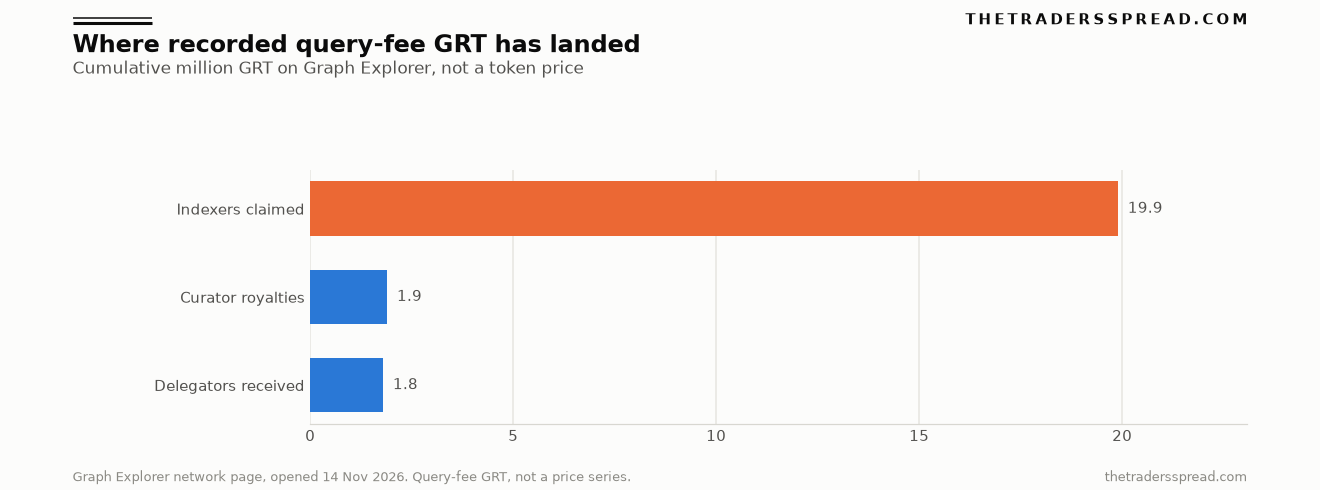
- Explorer totals: indexers claimed 19.9 million GRT of query fees, delegators received 1.8 million, curators hold 1.9 million in royalties. Source: Graph Explorer, opened 14 November 2026.
- That page shows 2.17% issuance, 253.8 million GRT a year, while the indexing overview still says 3% annual inflation. Source: both pages, opened 14 November 2026.
Who names the GRT an indexer will accept for one query?
An indexer is the operator who stakes GRT, indexes a subgraph, and answers the query. The indexing overview sets minimum self-stake at 100,000 GRT. That stake can be slashed, so a gateway treats it as security behind the paid answer.
The named price is an Agora cost model: a flat GRT fee, a fee that changes by subgraph, or a fee that scales with query weight. The indexer service serves it at /cost. The gateway runs each candidate model on the actual request and reads back a GRT amount.
Cheaper clears only with quality held equal. Managing escrow says the gateway maximizes marginal score per unit of fee, and a model above the budget drops out. QUERY_FEES_TARGET is the operator's average fee in US dollars per query. A higher target widens the set. A lower target thins it, and the page says freshness and availability can suffer.
The Indexer Selection Algorithm multiplies four curves: success rate, expected latency, seconds behind chain head, and slashable GRT. The routing page says many eligible indexers become "up to three." A blank weight is 1.0. Gateways set the budget and the weights. The GRT sticker stays on the indexer's model, and the opened pages print no network-wide default.
Is the Studio dollar bill that same price?
Studio's bill is a different object. Opened 14 November 2026, the pricing page is 100,000 free queries, then $2 per 100,000, payable by card or GRT. Billing docs settle GRT invoices at month end on Arbitrum One. Tokenomics prints the Arbitrum GRT contract as 0x9623063377AD1B27544C965cCd7342f7EA7e88C7.
Divide $2 by 100,000 and the paid query is $0.00002, the March 2024 average on the benefits page. On the free plan the consumer pays nothing, and the footnote says indexers are still paid for those queries. The page names the payee and leaves the payer unstated.
vAPI is a resale price on a different bill. The October 2026 review says that marketplace charges $0.01 in USDC on Base per query, across 20 endpoints as of 19 October, on top of The Graph's canonical gateway. The cent is 500 times the $0.00002 average. The same review calls a simpler Studio price a Foundation proposal still measured in months.
| Price | Who sets it | Figure on the page | Opened 14 November 2026 |
|---|---|---|---|
| Studio Growth rate | Studio pricing page | $2 per 100,000 after 100,000 free; $4 at 300,000 | studio-pricing |
| Benefits average | Docs, dated March 2024 | $20 per million, about $0.00002 | The Graph vs. Self Hosting |
| Benefits monthly totals | Same page | $120 near 3 million queries; $1,200 near 30 million | The Graph vs. Self Hosting |
| Gateway fee target | Each gateway operator | QUERY_FEES_TARGET in US dollars, no network value printed | Managing Escrow |
| Indexer Agora model | Each indexer | A GRT fee per query at /cost, no default printed | Managing Escrow, indexing overview |
| vAPI call | vAPI, atop the canonical gateway | $0.01 USDC on Base, as of 19 October | October 2026 review |
Studio, the benefits page, and vAPI are consumer-facing dollars. Only the Agora row is the GRT an indexer posts. The gateway target is a budget between those two kinds of price.
Where does the paid GRT sit before an indexer can claim it?
GraphTally, which older notes call TAP, runs on Horizon on Arbitrum One. The gateway signs a receipt per query. Indexers fold receipts into a receipt aggregate voucher and redeem it against GRT already in escrow. If coverage falls below one-to-one, indexers may stop serving that gateway. The operator funds ETH for gas and GRT for escrow, authorizes a signer, and deposits per indexer. Redeeming the voucher is the indexer's step.
What the indexer keeps is a rebate. A forum post dated 11 September 2023 says GIP-0051 replaced a Cobb-Douglas split with an exponential rebate based on that indexer's stake relative to the fees that indexer generated. A higher ratio returns more of those fees, up to almost all of them, and other indexers' stake drops out of the sum. The post says the older rule burned over 50% of query fees and the expected burn now falls below 7%. Rebate pools are obsolete on that account, and the rebate arrives when the voucher is redeemed.
The GitHub file still says Stage: Draft, last updated 29 March 2023, and it suggests alpha of 1 and lambda of 0.6 without a live contract read. Its 2021 and 2022 illustrations draw a stake-to-fee ratio of 4 as about 90% rebated, 6 as 97%, and 8 as over 99%. The indexing overview says fees follow that rebate and, nearby, calls the function something proposed so slashable stake stays large relative to fees. Horizon, which the overview says is live, sets queryFeeCut and indexingRewardCut per data service. The same URL says rebates are claimable once an allocation closes, and also says Horizon allocations can stay open because indexing rewards no longer require a close.
What share of query fees do curators actually receive?
A curator signals GRT on a subgraph, minting Graph Curation Shares so indexers can see demand. The curating page assigns curators 10% of query fees, pro-rata, subject to governance. The explorer's Curation Reward parameter, opened the same day, is 10%.
Deposit taxes are a different flow. A new signal burns 1%, and auto-migrate burns a further 0.5%. On Arbitrum a withdrawing curator receives the deposited GRT minus tax, with no delegator-style wait, and the page describes only minting and burning. Tokenomics adds a 1% burn on query fees paid to the network. The September 2023 post expected the rebate math to burn under 7%, against the older burn over 50%. Those three burns and the 10% curator share still have no page that orders them on one GRT.
| Cut | Rate in the docs | Applied to | Page |
|---|---|---|---|
| Query-fee burn | 1% | Fees paid to the network | Tokenomics |
| Curator share | 10%, subject to governance | Query fees, pro-rata | Curating; explorer matches |
| Rebate remainder | Expected below 7%, vs a historical burn over 50% | Fees the stake ratio leaves | Forum, 11 September 2023 |
| Example queryFeeCut | 95% indexer, 5% delegators | Rebates when an allocation closes | Indexing overview |
| Delegation tax | 0.5%, burned | GRT at delegation | Tokenomics |
| Curation tax | 1% new signal, 0.5% auto-migrate | Signaled GRT, burned | Curating |
The last two rows come off a deposit. A query fee is a later flow, and folding the curation tax into the fee burn narrates two rows as one number.
On the explorer, 19.9 million, 1.8 million, and 1.9 million GRT sum to 23.6 million. Curators are 1.9 divided by 23.6, or 8.1%, against the 10% parameter. Those tiles omit unclaimed and burned GRT, so the gap is a stock of claims beside a flow rule.
Which slice of a rebate reaches someone who delegated?
Delegation is GRT a holder assigns to an indexer without running a node. Tokenomics caps accepted delegation at 16 times self-stake, and above that the extra GRT sits unused until self-stake rises. The delegation tax is 0.5%, burned. Undelegating waits 28 epochs of 6,646 blocks, about 26 days.
queryFeeCut is in parts per million. setDelegationParameters(950000, 600000, 500) keeps 95% of query fee rebates for the indexer, gives 5% to delegators, sets a 60% indexing-reward cut, and a cooldown of 500 blocks. Horizon chooses both cuts per data service. On 100 GRT of rebate the indexer keeps 95 and the delegator group keeps 5. On 1,000 GRT the split is 950 and 50. The overview calls that base both "query fee rebates" and "query fees earned," and it assigns the 5% to the group. Each holder's weight inside the pool is a later division.
| Rebate being split | Indexer at 95% | Delegators as a group at 5% |
|---|---|---|
| 100 GRT | 95 GRT | 5 GRT |
| 1,000 GRT | 950 GRT | 50 GRT |
Recorded stock is a different ratio. Divide delegators' 1.8 million by 21.7 million, the sum with indexers' 19.9 million, and the share is about 8.3%. The 5% figure is an example an indexer can set. Nothing on the opened pages calls 5% a network average. A Rocket Pool minipool splits rewards between the operator and the pool's ETH stakers, with the percentage a parameter of the pool.
Tokenomics also says most indexers offer 9% to 12% annually, and its example puts 15,000 GRT with an indexer "offering 10%" for about 1,500 GRT a year. That rate mixes indexing rewards with query fees. The 95/5 cut is the share of one rebate, so the two percentages are different dials.
RelatedLombard (BARD) 64.8 Percent Rebound After the Squeeze
The open epoch on that view keeps the pots apart: 15,600 GRT of collected query fees beside 265,900 GRT of indexing rewards, about 17 times the fee line, on blocks 26,407,937 through 26,415,137.
Do indexing rewards come out of the query someone just paid?
Indexing rewards are newly issued GRT, paid so indexers sync subgraphs before fees there are large. The overview calls them 3% annual protocol-wide inflation for proofs of indexing. Tokenomics calls 3% a target on an initial 10 billion GRT and says roughly 1% of supply burns each year from the delegation tax, the curation tax, and the query-fee burn. A successful dispute burns half the epoch's indexing rewards, pays half to the fisherman, and can slash self-stake by 2.5%, half of that burned. The explorer's slashing parameter is 2.5%.
Supply on the explorer is 11.6868 billion GRT, annual issuance 253.8 million, and the printed rate 2.17%. Divide 253.8 by 11,686.8 and the quotient matches that tile, below the 3% the docs still describe. Cumulative burns are 1.5 billion GRT and minted supply is 15.4276 billion. A query fee moves existing GRT. An indexing reward mints new GRT.
The October 2026 review applies that split. The Rewards Eligibility Oracle pays indexing rewards only to indexers that serve queries. The daily bar rose from 1 subgraph to 5 on 6 October and to 10 on 27 October. A qualifying query is HTTP 200, under 5,000 milliseconds, and fewer than 50,000 blocks behind chain head, with 5 online days in a rolling 28-day window. Total issuance stayed at the prior level, and about 667,000 GRT went to a reclaim contract. Daily rewards held near 636,000 GRT against 622,000 before the five-subgraph rule. On 29 October, 47 indexers were eligible, down from 51 on 25 August, and 79.0 million GRT was still delegated to indexers failing the oracle.
The Graph's own account stated the same rule on 5 November 2026: indexing rewards follow indexers that serve queries, after the bar moved from 1 subgraph a day to 5 and then to 10.
Last week, The Graph ecosystem learned more about the first two months of REO. Indexing rewards now go only to Indexers that serve queries, and the bar rose from 1 to 5 to 10 Subgraphs a day.
— The Graph (@graphprotocol) November 5, 2026
That work set a baseline. The next step asks for something new: work that scales with… https://t.co/H1GunojMmz
Lido's daily stETH rebase is an issuance mechanic with its own inputs, and EigenLayer's split between native staking and restaking stacks a second stream on a first. On The Graph the rebate is GRT someone paid, and the indexing reward is new GRT gated by served queries. The open epoch's 15,600 GRT beside 265,900 GRT is that split on one span of blocks.
Can the open pages be multiplied into one fee?
Studio's $2 rate, the benefits page's $0.00002 beside monthly totals twice as large, a gateway dollar budget, and each indexer's Agora model are four prices on one query. After payment, the 2023 forum post calls the exponential rebate live while GitHub still marks GIP-0051 Draft. Curators take 10% on the curating page. Tokenomics burns 1% of query fees, and the forum post expected the rebate math to burn under 7%. queryFeeCut, 95% in the example and set per data service under Horizon, then splits what remains.
Which sequence would one GRT travel through the 1% burn, the 10% curator share, and the exponential rebate, once alpha and lambda are published, before a named delegator receives a slice? The explorer already records 19.9 million, 1.9 million, and 1.8 million GRT of query fees. The next query is an Agora model against a gateway budget. A simpler Studio price is still "months away" in the October review, and the docs' 3% issuance target still sits beside the explorer's 2.17% tile.
Published protocol rules are reference material for readers, and they are not a recommendation to buy, sell, stake, or delegate GRT.