

A Storj storage node earns its storage fee on bytes a satellite has already written to the disk, so the empty remainder of an advertised allocation is spare room waiting for a piece, rather than a balance the operator can invoice. The spare-drive story, in which a disk earns rent simply by staying online, misstates the contract Storj publishes for the satellites it operates.
On the rate card dated 1 September 2026, that work pays $1.35 per terabyte-month of used space, $1.00 per terabyte of client egress, and $1.00 per terabyte of audit and repair traffic. A renter on the public Standard card, read on 19 November 2026, is quoted $7 per terabyte-month of storage and $7 per terabyte of egress. Those two prices meter different things: pieces on a node, and the object a renter uploaded. From the October 2026 payout run the cash leg clears in USDC on Ethereum at one dollar per coin.
Updated 19 November 2026 from the Storj payout page, the held-amount note, the public price card, the glossary, the March 2024 whitepaper, and a CoinGecko series pulled the same morning. Ben Golub and Colby Winegar supply two of the four named sources. The whitepaper of Storj Labs, Inc. and the storj.dev payout pages are the other two, named documents, because the forum account littleskunk (title Storjling) prints no legal name.
1. What the satellite counts as work
Storj's glossary, opened the same day, splits the network into three peer classes. A storage node stores data and gets paid for storage and bandwidth. An uplink is the client software that encrypts, erasure-codes, and retrieves. A satellite keeps the metadata for pieces, audits, and billable bytes. Only satellites Storj Labs operates sit on the published rate card. The payout page says any other satellite can set its own terms.
The unit of customer data is a segment, and the glossary caps a segment on Storj satellites at 64MB. An object at or under that size is one segment, and a larger object is a run of them, then erasure-coded. Any 29 pieces can reconstitute the segment. An uplink asks 35 pieces and stops at 29. The page also calls 35 a repair threshold, then sets the Storj satellite repair threshold at 54. The maximum stored for a segment is 80 pieces, and an uplink attempts uploads to 130 diverse nodes.
A piece is what the node actually stores. The glossary defines it as the concatenation of the erasure shares that share an index across the stripes of one remote segment. A stripe, the slice an audit reads, is where that coding runs, and the bytes on disk are client-side encrypted, so an opened piece is ciphertext. An inline segment stays with the metadata when it is too small for remote bookkeeping, and a node that receives no piece has nothing in that object to invoice.
Ben Golub, then chief executive of Storj, put the recruitment story on the company blog on 30 October 2024, the day he moved to executive chair. He wrote that he had been intrigued by the founders' vision of building "Airbnb for Storage," and, in the next paragraph, "We had to prove that it is possible to build a secure, high-performance network from tens of thousands of independently operated devices around the world." The payout page meters that spare capacity only when users store and retrieve data.
2. What the renter's terabyte buys
A renter on the Standard plan is buying an S3-compatible object, with durability the pricing page describes as designed for 11 nines through erasure coding. The price printed there on 19 November 2026 is $7 per terabyte-month for storage and $7 per terabyte for egress. The Advanced card is a $10 per terabyte licence with the same $7 egress, on U.S. locations carrying a SOC 2 Type 2 claim. A $5 minimum monthly fee applies, and USDC payment waives it. A delete inside the 30-day retention still bills the remaining days.
The legacy pricing page, opened on 19 November 2026, defines a terabyte in base 10, with 1TB equal to 1,000GB. The same paragraph prints "1TB = 1,000GB = 1,000,000 Bytes," and the byte figure conflicts with 1,000GB. A 1TB file kept a full month costs about $4 at $0.004 per GB-month, on uploaded bytes including encryption overhead, against a 720-hour month. Egress on that card is $0.007 per GB, including long-tail bandwidth. Projects created on or after 1 July 2026 use the $7 Standard card.
Colby Winegar, quoted by Blocks and Files on 31 October 2024 as he moved from chief revenue officer to chief executive of Storj, described the demand side in one sentence: "With AI adoption accelerating across industries, enterprises need new solutions to manage skyrocketing amounts of data, while innovating more rapidly, affordably, and sustainably." The line is from October 2024. Antony Savvas's Blocks and Files report is the page that carries it, and the live invoice leaves the 80-piece glossary maximum off the terabyte price.
The whitepaper, Storj Labs, Inc., version 3.1, cover date 7 March 2024, states the constraint in one line. Storage node operators "must be paid fairly, transparently, and be able to make a reasonable profit relative to any marginal costs they incur." The network operator, "currently Storj Labs, Inc.," must keep a profit while charging end users less than public-cloud providers and still sharing margin with node operators. Who keeps the fee after a The Graph query separates a posted price from a worker's price. The whitepaper PDF carries the Storj profit line.
3. From a GB-hour to the rate card
The payout page pays four uses, set out in the table, and stops there. Garbage a client has deleted stays off the invoice until the collector removes it. Power, a chassis, and a static IP sit outside the list.
| Category | What is metered | Published rate | Who is paid |
|---|---|---|---|
| Node storage | GB-hours of pieces on the node | $1.35 per TB-month, from 1 Sep 2026 | Node operator, before withholding |
| Client egress | GB retrieved by uplink clients | $1.00 per TB | Node operator, before withholding |
| Audit and repair | GB the satellite pulls to audit or rebuild | $1.00 per TB | Node operator, before withholding |
| Renter storage, Standard | Monthly storage on the public card | $7 per TB | Invoiced by Storj to the customer |
| Renter egress, Standard | Egress on the public card | $7 per TB, down from $20 | Invoiced by Storj to the customer |
Node rows are the Storj Docs payout table dated 1 September 2026. Renter rows are the storj.io price card read on 19 November 2026. The 20 August 2026 forum post that announced the cut, from the account littleskunk, had shown the prior node rates as $1.50 per terabyte-month of used space and $2.00 per terabyte of egress. It called the combined change an estimated 18 percent reduction in total payout at the traffic mix then on the network, an average rather than a promise for any single node.
A ceiling on the storage leg is arithmetic from the glossary, labelled as such. If a segment sat at 80 stored pieces and any 29 rebuild it, the whitepaper's expansion factor, total pieces divided by pieces required, would be 80/29, about 2.76. At $1.35, that pool is about $3.72 per terabyte-month of segment, against a $7 Standard price. Live counts often sit nearer the repair figure of 54. Repair bandwidth at $1 per terabyte, the satellite, and the held balances sit outside that $3.72 bound.
The legacy egress note matters on the customer side of the same transfer. Because the platform asks more nodes than the 29-piece minimum and then cancels the slow ones, the bytes transferred can exceed the bytes the application receives. The node is paid for bandwidth actually utilised. The renter, on the legacy wording, is billed for downloaded bytes including that long-tail. Both documents were opened on 19 November 2026. Subtracting $1 from $7 and calling the remainder profit skips the expansion, the repair, and the long-tail.
4. The held share, month by month
The held-amount page, read on 19 November 2026, calls the withheld slice a held back amount, and it also uses the word staked. A node begins earning USDC with nothing posted in advance, and the withheld slice is earnings already calculated. During the first nine months a percentage of revenue goes into a holding account. Graceful exit returns the held funds for the satellites the node exits, after the exit completes. An abrupt exit forfeits the held funds for the satellites the node was on, and the page says those funds offset repair.
The schedule on that page is tiered. Months 1 to 3 withhold 75 percent and pay 25 percent. Months 4 to 6 withhold half. Months 7 to 9 withhold 25 percent and pay 75 percent. Months 10 to 15 pay 100 percent of revenue. In month 16, half of the total withheld balance is returned and the other half stays until a graceful exit. That month-16 split is the page's "held indefinitely" remainder. Earnings from month 10 onward stay on the full-pay line.
Take the arithmetic on storage alone, using the $1.35 rate and a node that holds 8TB of pieces for a full month with egress at zero, which produces $10.80 of storage revenue. Months 1 to 3 pay $2.70 and hold $8.10. Months 4 to 6 pay $5.40 and hold $5.40. Months 7 to 9 pay $8.10 and hold $2.70. Nine months of that pattern hold $48.60. Months 10 to 15 pay the full $10.80. Month 16 returns $24.30 and keeps $24.30 until graceful exit. Egress and repair move the dollars on a live node. The percentages are the held-amount page.
The 20 August 2026 forum post distinguishes a standard graceful exit, described there as 30 days, which keeps the held payout, from a fast exit that gives the disk back sooner and forfeits the held amount. The held-amount page is the rule for an abrupt shutdown. An operator who deletes the drive on day one of month two has already received the 25 percent paid so far and has given up the 75 percent still in the holding balance.
5. How the USDC payout clears
Earnings are calculated in dollars and paid at one USDC per dollar on Ethereum, so the payout page says there is no exchange rate to track. Payouts in the STORJ token have ended. The forum announcement of 25 September 2026, from littleskunk, sets the dates. The payout completed on 17 September 2026 was the last in STORJ. USDC payouts start with the October run on 9 October 2026. The post cites STORJ price volatility through the Chapter 11 process, and the wait before a token could be converted. STORJ deposits stopped on 25 September 2026, the 10 percent STORJ deposit discount ended, and a USDC deposit still waives the $5 monthly minimum.
The payout page's minimum is a fee test. Storj withholds a transaction whose fee would exceed 25 percent of the value. The threshold uses the average transaction fee from the previous 12 hours at the start of the payout run. One illustration pairs a $12.50 average fee with a $50 wallet floor, and smaller balances roll forward. A second uses 274 Gwei, 36,508 gas, 0.01 ETH and ether at $1,714, which comes to a $17.14 fee and a $68.56 threshold. Both illustrations were read on the page on 19 November 2026. zkSync Era payouts sunset on 1 September 2026, and the remaining rail is Ethereum layer 1.
Wallets are part of the meter. The payout page wants the same address on every node an operator runs, because the threshold is per wallet. A balance under the threshold waits, and a graceful-exit remainder too small for layer 1 waits for lower fees or for another node on the same wallet, whose private keys the operator holds. An exchange address fails unless the operator controls the key, and an EU resident is barred from one under MiCA source-of-funds checks.
The pricing page carried a banner on 19 November 2026: Storj is selling Valdi.ai, Object Mount, and Storj Object Storage through a court-supervised process. The rate card, the withholding table, and the USDC rail are the documents that describe payment while that process is open. The August post called the rate cut a first step, so the $1.35 card is the rate printed on the payout page as of 1 September 2026.
RelatedTezos baking rewards are not a set protocol coupon
6. A Filecoin pledge is a different contract
Filecoin is a different network, and a Storj holding balance is earnings placed in a holding account after the bytes are stored. The Traders Spread piece on Filecoin's supply cut covers FIL issuance, which is a separate contract from a Storj invoice. Arweave's storage endowment prices a long-dated endowment beside Storj's monthly GB-hour. The operator's bond comes out of earnings after the bytes are stored.
7. The token series beside the wage
Because the wage is now a dollar stablecoin, a chart of the STORJ token shows what the token did while the payout rail was moving off it. CoinGecko's daily closes, retrieved at 06:57 UTC on 19 November 2026, put the 20 November 2025 close at $0.1609 and the 19 November 2026 close at $0.0151. The drop between those two prints is about 90.6 percent. The same payload lists a circulating supply of 424,999,998, a market cap of about $6.42 million, and a spot print of $0.01511, beside an all-time low of $0.01465 on 18 November 2026.
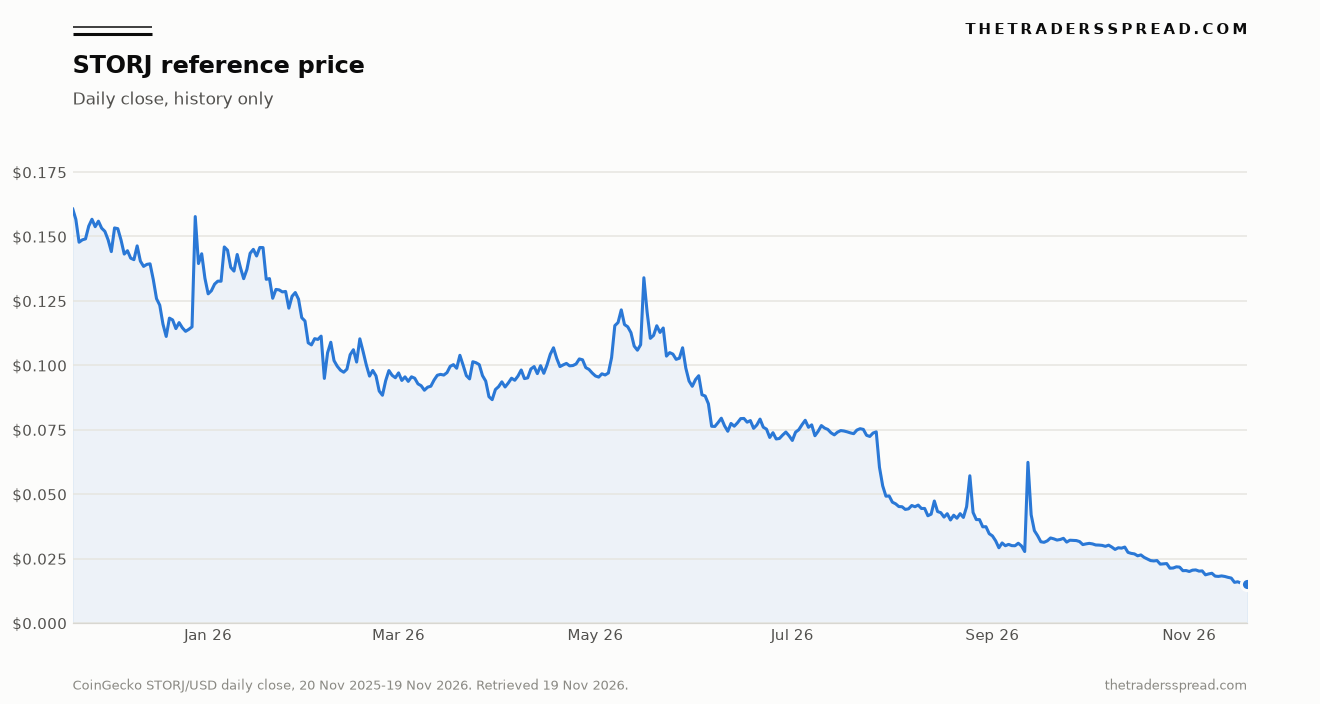
The series is a long decline into the November 2026 low. The September announcement tied the end of token payouts to volatility during the Chapter 11 process, so an operator now paid in USDC takes the $1.35 and $1.00 card, while a holder of the token is still on the series above. The same person can hold both positions, and they remain different contracts.
The August 2026 forum post put the network at roughly 50 percent utilization, with about 66PB of free space after deduplication, and said correctly run nodes were hitting a ceiling because demand was short of the capacity on offer. The whitepaper had wanted new capacity to stay economically attractive. The rate cut pays less per terabyte of used pieces. The post said a node with room to grow was better placed than a full one, and it declined to promise a result.
8. The open question on the spare disk
After the September rate cut, the fast-exit option, and the switch to USDC, the unpaid terabyte is still the centre of the contract. Empty platters are either room a satellite may fill at $1.35, plus egress and repair, or a disk the rate card leaves untouched until a piece arrives. Whether a lower rate on used pieces, and a slow release of the early withheld revenue, leave a reason to keep the empty half of a drive online is the question those documents leave open.
Questions readers ask about Storj node pay
Does free space on a Storj node earn the storage rate?
Free capacity a Storj node advertises stays outside the storage meter until a satellite writes a piece. The payout page, read on 19 November 2026, pays GB-hours of material that Storj Labs satellites and their users have placed on the disk, and it leaves client-deleted data unpaid until the collector removes it. An operator can show a large allocation and still invoice only the filled share. The 20 August 2026 forum post put unused capacity near 66 petabytes after deduplication.
What does a Standard renter pay for a terabyte?
The public Standard card, read on 19 November 2026, lists $7 per terabyte-month of storage and $7 per terabyte of egress, with a $5 monthly minimum that USDC deposits waive. Objects under 50KB are billed as 50KB, and a delete inside 30 days still bills the remaining days. The legacy meter was $0.004 per GB-month, about $4 per terabyte-month in the page's own example. New projects from 1 July 2026 use the simplified card.
When does the operator receive the held balance?
The held-amount page withholds 75 percent in months 1 to 3, half in months 4 to 6, and 25 percent in months 7 to 9, then pays in full through month 15. Month 16 returns half of that withheld balance, and the rest waits for a graceful exit of about 30 days. A faster shutdown, and an abrupt power-off, forfeit the held funds toward repair.
Does Storj still pay node operators in STORJ?
The payout page states that node pay is USDC on Ethereum at one USDC per dollar, and that STORJ-token payouts have ended. The 25 September 2026 forum post dates the last STORJ payout to 17 September 2026 and the first USDC run to 9 October 2026. Deposits moved to USDC on that announcement, and the 10 percent STORJ deposit discount ended. zkSync payouts had closed on 1 September 2026, leaving Ethereum layer 1 as the rail.
Why can 29 pieces rebuild a segment stored as 80?
The glossary sets 29 as the number of pieces that reconstitute a segment and 80 as the maximum stored. An uplink may ask 35 nodes and stop at 29, which cuts the slow tail. The Storj satellite repair threshold on that page is 54, above the rebuild minimum. The node is paid for the bytes of its piece, the stack of erasure shares that share an index. Inline segments stay with the metadata.
Figures on this page are general information drawn from Storj's own documents and a CoinGecko reference series. They are a recommendation neither to buy or sell the STORJ token, nor to sign a storage contract, nor to run a node, and money tied up in hardware or tokens can be lost.