

Thirteen of the nineteen guardian signatures is the bar a message has to clear before Wormhole will wrap it as a Verified Action Approval. Guardians sign apart from one another, the bundle is a 13-of-19 multisignature, and the destination contract checks that bundle. Filing Wormhole and Axelar under one product name skips the only rule that says a message is finished.
Wormhole's guardian documentation, updated 28 October 2026, argues that proof of stake is a weak match for a network that watches many blockchains and runs no contracts of its own. That page describes 19 operators at equal weight, with reputation as the security claim. Axelar's validator page describes validators who create blocks, hold key shares, and vote after staking AXL. Both stacks carry a payload toward a far chain. The artefact that makes the payload count is different on each side.
The bill splits the same way. On 16 November 2026 an Axelarscan estimate for a general message from Ethereum to Avalanche, using a 200,000 gas limit, came back at 0.000035311 ETH, about $0.064 at the $1,816.61 ether price inside that response. Wormhole prices delivery as a signed quote from a relay provider, and the guardian docs keep that quote apart from the signature. Updated 16 November 2026, from the guardian page, the gas-service page, that estimate, and the CoinGecko prints opened the same morning.
1. Thirteen signatures close a Wormhole message
A Wormhole message starts as a log. A source-chain contract calls the core contract, guardians who watch that chain sign what they saw, and 13 signatures plus the body become the VAA. The receiving contract performs the check. The guardian page says the core contract keeps a single rule for every chain: a valid 13-of-19 VAA, including when a smaller subset did the watching.
The set is small on purpose. Verification cost grows with the number of signers, because the scheme is a t-Schnorr multisignature that many chains can check, and 19 is the width they chose. Each guardian carries equal weight, not a vote scaled to tokens. The page calls the arrangement proof of authority: known operators, full nodes, equal stake in the consensus, with W left out of the signature.
Ethereum and Solana are the chains that page names as watched by all 19, and any chain without a delegated configuration falls back to the full set. On a delegated chain a subset runs the full nodes and gossips a signed observation, and the other guardians wait for that quorum before they sign. The final artefact is still 13 of 19. The worked example of a delegated threshold is 7 of 9. Treat that figure as a sample of how a threshold can be written, and read the live map on the dashboard linked from the same page.
A signed observation that anyone can carry to the destination is a different machine from a swap. THORChain moves the asset itself, so the question there is whether the pool settled. LayerZero's own token tape is a third messaging name with a page on this site, and a price move on that page leaves both signature rules untouched.
An integrator can publish the log, wait for the VAA, and submit those bytes with any relayer, including one the application runs. The check looks for 13 of those 19 keys. Below 13, there is no VAA to submit, whatever W did that day.
2. Axelar puts the watchers on its own chain
Axelar's verifiers page, opened 16 November 2026, draws a line that a shared slogan erases. Somebody has to confirm the source-chain event before Axelar approves the message, and the somebody changes with the connection type.
Consensus chains, the EVM connections from before Amplifier, are watched by Axelar validators, so membership means running a validator. The operator picks chains, runs a node for each, registers as a maintainer, and vald votes on events. The overview describes that staked job as block creation, multi-party cryptography, and voting, with consensus-chain verification added on the same machine.
Amplifier chains each keep a verifier set of their own. Verifiers run ampd, vote on source-chain events, and sign outgoing messages for the chains they support. The page allows a verifier to join without also operating an Axelar validator. Entry is a bond in AXL, a registration of chain support, and an authorization. Both kinds of watcher are told to run their own node on every chain they claim. That habit resembles a Wormhole guardian's full node. The membership rule is something else entirely.
The security page states the cross-chain weight in one line: votes equal the square root of stake, and a threshold weighted that way must co-authorize every cross-chain request. Block production stays one token, one vote. The page says it is adapted from an earlier blog post, and read beside the verifiers page the square-root line describes the validator path, while Amplifier adds a per-chain set, a bond, and an authorization step.
Wormhole finishes a message when 13 equal-weight guardians have signed, including on a delegated chain where a smaller group watched. Axelar finishes one when its chain has approved it, through square-root validator votes or the verifier set bonded to that chain, and a destination gateway then accepts the approval.
The Cosmos hub token has its own page because readers sometimes file every interop chain under one ticker. AXL is the asset staked on Axelar's chain, a separate asset from ATOM, and a hub forecast describes a different token from a GMP fee.
| Check | Wormhole | Axelar |
|---|---|---|
| What closes the message | A VAA with 13 of 19 guardian signatures | Approval on Axelar's chain, then the destination gateway |
| Who watches the source chain | All 19 on Ethereum and Solana; a delegated subset elsewhere, then the same 13 signatures | Validators on consensus chains; a separate verifier set on Amplifier chains |
| How a seat is weighted | Equal weight across the 19 | Cross-chain validator votes scale with the square root of AXL stake; block production stays linear |
| What the destination checks | Guardian signatures on the VAA | A gateway approval after the Axelar vote or the verifier signatures |
3. One gas payment, or a quote you accept
Axelar's gas-service page describes one payment meant to cover the source chain, Axelar, and the destination together. The payer sends the source chain's native token to the AxelarGasService contract in the same transaction as the gateway call. Relayers spend that balance to verify, approve, execute, and refund the remainder. With no payment, those relayers leave the message where it is. The sender can add gas later, or relay the execution without them.
The gas-service page allows up to four parts: a base fee that depends on the chain pair, an execution fee equal to the caller's gas limit times destination gas price, an L1 data fee on rollups that post to Ethereum, and an express fee only if the app asks for express. A gas limit under the real _execute cost stops execution and leaves a top-up. Refunds equal gas paid, minus base fee, minus execution cost, minus the refund transaction, and unused gas returns on the source chain in the token that was paid.
The estimate page says to price the fee immediately before sending. On 16 November 2026 the documented Axelarscan call, Ethereum to Avalanche at 200,000 gas with the breakdown requested, returned 35311029578557 wei, or 0.000035311 ETH. Ether was priced at $1,816.61 in that payload, so the total is about $0.064: a base near $0.045, execution after a 1.32 multiplier near $0.019, and a zero express fee because express was unsupported. AVAX was $7.14 inside the same response. The 200,000 limit is the docs' example, and another route will print another total.
Wormhole's guardian page puts the Executor beside the signature, as a permissionless layer of contracts and quotes. The integrator pays a signed quote when delivery is requested, while the 13 signatures stay the check underneath, so the number to read is that quote's price and expiry.
Axelar asks the sender to prepay vote, approval, execution, and refund in one native-token payment. Wormhole asks for source-chain gas on the log and, only if a carrier is hired, for that carrier's quote. A single "bridge fee" pasted over both names has added two bills.
4. What the token is allowed to change
W's cap is 10 billion on the tokenomics post of 7 February 2024, and CoinGecko's wormhole record agrees. That post set initial circulating supply at 1.8 billion and assigned guardians 5.1 percent, 510 million W, locked at the token generation event. The decisions it expected a DAO to take on were chain connections, upgrades, product fees, the guardian set, rate limits, and token design, which sit beside the 13 signatures.
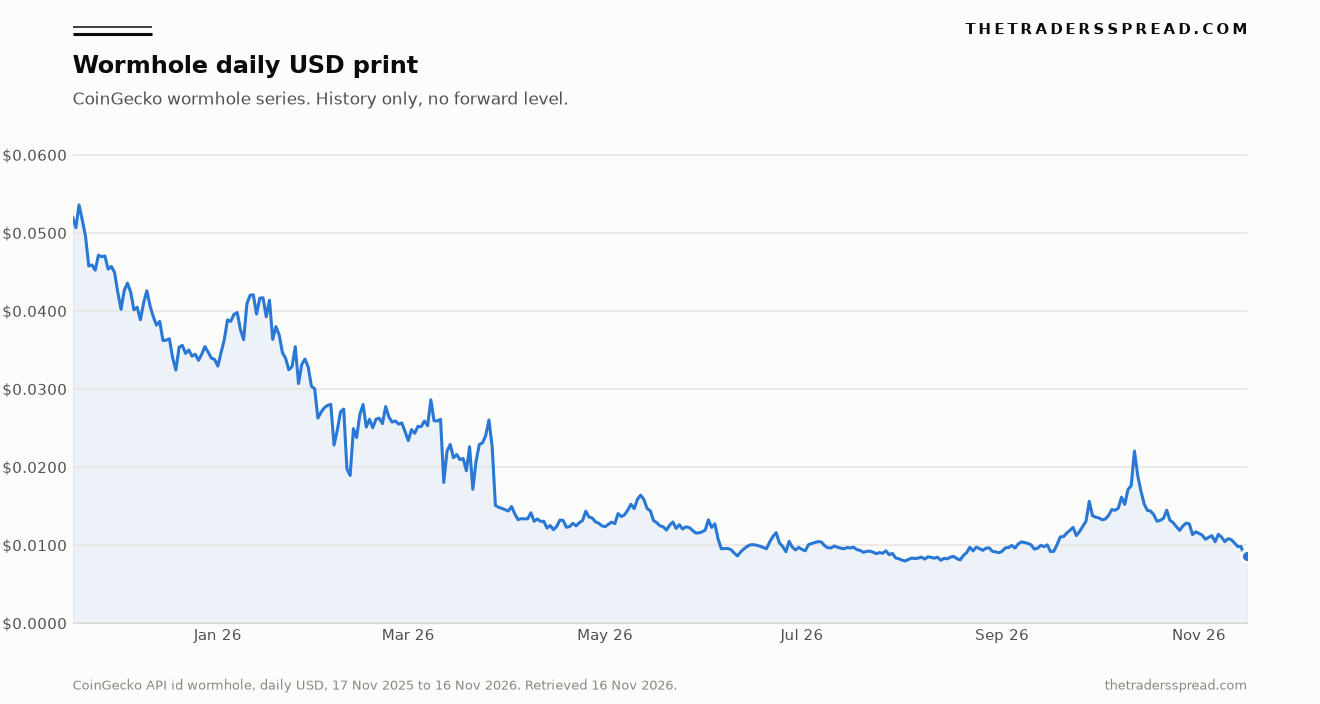
CoinGecko's wormhole page, last updated 2026-11-16T07:03:58Z, showed $0.00859528, market cap $58,425,572, fully diluted value $85,906,713, circulating supply 6,801,048,499, and 24-hour turnover $10,185,905, with total supply on the 10 billion cap. The gap to the fully diluted figure is the uncirculated remainder. The daily series from 17 November 2025 to 16 November 2026 peaked at $0.053571 on 19 November 2025 and bottomed at $0.007949 on 2 August 2026, and the chart is that history with the last point at $0.008611.
Related7 Steps That Walk Through a Maple Finance Credit Pool
W is the governance asset, not the toll a sender posts. The guardian page grounds security in reputation and equal weight among the 19. The 2024 post lists the guardian set among later DAO powers, and it stops short of saying a W balance already casts one of the 13 signatures. A holder of the whole circulating supply still cannot finish a VAA. The operators who can finish it received a locked tranche in that schedule. Whether they later vote their W is a governance question, separate from whether today's message collected 13 signatures.
CoinGecko's axelar page carried the same timestamp at $0.03298121, market cap $41,203,413, fully diluted value $41,359,769, circulating supply 1,255,640,935 against a total of 1,260,405,773, and 24-hour turnover of $2,204,425. No maximum appears on the record, so there is no cap to cite, and the fully diluted figure sits near the market cap because circulating supply is already close to the total on file.
Staking AXL is how a validator joins, and the security page then scales that validator's cross-chain votes with the square root of stake, while Amplifier verifiers bond AXL to enter a chain's set. The GMP sender still pays the source chain's native token. The worked estimate was in ETH, and AXL appeared there only as a reference price of $0.03286, near the CoinGecko print.
Just after 07:00 UTC on 16 November 2026, W was the cheaper token, the larger market cap, and the larger 24-hour turnover. W's documented right is the 2024 governance list. AXL's documented right is stake and a verifier's bond.
| Item | Wormhole | Axelar |
|---|---|---|
| What the sender pays | Source-chain gas to publish the log, plus a signed quote if an Executor delivers | One source-chain native payment to the gas service: base, execution, and any L1 or express part |
| Figure opened 16 November 2026 | Read the quote in hand. The docs give no protocol schedule in W | Ethereum to Avalanche, 200,000 gas: 0.000035311 ETH, about $0.064 |
| What the token does | Governance. Cap of 10 billion W. Signatures stay with the 19 guardians | Staked by validators, bonded by Amplifier verifiers. Cross-chain votes follow the square root of stake |
| CoinGecko, 16 November 2026, 07:03 UTC | $0.00859528, market cap $58,425,572, 6.80 billion of a 10 billion cap | $0.03298121, market cap $41,203,413, 1.26 billion circulating, no maximum listed |
Questions the docs already answer
Are Wormhole and Axelar the same messaging product?
Both aim a payload from a contract on one chain at a contract on another, and both leave a public trace. Wormhole closes the message as a 13-of-19 guardian signature set that the destination checks. Axelar closes it on a proof-of-stake chain, through validators on older consensus links and a bonded verifier set on Amplifier chains. Carrying bytes is where the comparison starts, and the agreement rule is where it has to continue.
Does a sender spend W or AXL to post the message?
A Wormhole sender pays source-chain gas to emit the log, and pays a relay provider only when hiring the Executor. W is the governance token, capped at 10 billion, while the delivery price sits in the provider's quote. An Axelar sender pays the source chain's native token into the gas service. The 16 November estimate for an Avalanche destination was priced in ETH. AXL is what validators stake and what Amplifier verifiers bond.
What shows when a message sits unfinished?
An unpaid Axelar GMP call waits until someone adds source-chain gas or relays the execution. Axelarscan is the screen the gas docs point at, and the estimate should be refreshed before a retry, because $0.064 was one route at one moment. On Wormhole the matching check is whether the VAA carries 13 guardian signatures, and whether a delivery quote expired before the source transaction landed. The price chart answers a different question from either of those screens.
Check these pages before you treat the stacks as twins
Each line is a page or an explorer field. If the live record has moved, the sentence in this comparison that depended on it moves with the record.
- On the Wormhole guardian docs, confirm the quorum is still 13 of 19 and that Ethereum and Solana are still named as full-set chains. The 28 October 2026 page said a delegated chain still ends in that same VAA.
- On the guardian dashboard linked there, read the live set. The 7-of-9 figure in the docs is a sample threshold, so the screen outranks the example.
- On Wormholescan, open one message and count VAA signatures against 13. The W chart is a separate record from that count.
- If an Executor was hired, read the signed quote's price and expiry. That line on the invoice is the delivery, and the guardian signatures are the other line.
- On the verifiers page, see whether the source chain uses validators or an Amplifier verifier set.
- On Axelarscan, read contract call, gas paid, approval, execution, and any refund. An insufficient-fee flag means the prepaid gas ran short.
- Re-run estimateGasFee for the route you actually have. The 16 November 2026 Ethereum-to-Avalanche call at 200,000 gas was 0.000035311 ETH, about $0.064, with express unsupported.
- CoinGecko ids are wormhole and axelar. At 07:03 UTC, W was $0.00859528 and AXL was $0.03298121. Signatures and gas still have to be read on the explorers.
This is analysis of two messaging designs. Fees move with gas, a quote can expire before it is submitted, a verifier set can be rotated, and either token can lose most of its price, as the Wormhole series in this window already did between November 2025 and August 2026. Capital is at risk.