

I have kept a Tezos baker log on this desk since Paris turned issuance into a function of stake, and the figure that still arrives in chat is a single annual percentage. Cycle 1416, the cycle in progress on the morning of 17 November 2026, prints a per-block schedule in place of that coupon. The expected-issuance call on the Ushuaia head returns 1.352040 tez for the fixed baking portion, the same amount budgeted as a baking bonus, 2.704082 tez of attestation reward, and 0.001173 tez for each data-availability shard.
Add the full attestation budget, the full bonus and all 512 shards and the participation pot is 6.008738 tez a block. Ten blocks a minute, across the 525,600 minutes in the issuance year, is 31.58 million tez. Against protocol supply of 1,122,137,627 tez at level 15851122, 07:14:52 UTC, that budget is 2.81 percent. The static term prints 0.64 percent at the 31.18 percent staked ratio on the TzKT pull. The scheduled budget sits on the adaptive-maximum ceiling, not on the static curve.
Updated 17 November 2026, from the Ushuaia constants, the TzKT statistics snapshot at 07:10:22 UTC, and the CoinGecko series pulled the same morning.
Key facts
- Ushuaia, protocol hash PsUshuai9QapM5TGj1JpuVGkdxz5GykdnEvS6Rh8SUVrARvZLCY, is the active protocol at level 15851122, timestamp 17 November 2026, 07:14:52 UTC (block header via the TzKT RPC).
- Cycle 1416 budgets 1.352040 tez a block as the fixed baking portion, 1.352040 tez as the baking bonus, 2.704082 tez as attestation reward, and 0.001173 tez per data-availability shard (expected_issuance RPC, 17 November 2026).
- TzKT statistics at 07:10:22 UTC counted 349,660,557 tez staked against a total supply of 1,121,583,425 tez, a 31.18 percent ratio, with 194 bakers, 3,156 stakers and 137,054 delegators.
- Baking power on that snapshot was 453,528,140 tez and voting power was 663,804,597 tez (TzKT statistics, 17 November 2026).
- A delegate needs baking power of at least 6,000 tez and at least 600 tez of its own stake before it receives rights, and rights for cycle n+3 are drawn at the end of cycle n (Octez baking-power page and the constants RPC, 17 November 2026).
- Voting period 186 is a proposal period. One proposal carries a single upvote worth 22,125.04 tez, against a 5 percent proposal quorum on 666,322,058 tez of voting power (TzKT period 186 and the votes/proposals RPC, 17 November 2026).
- CoinGecko marked Tezos at $0.214933 at 07:08:49 UTC, market value $236,778,877, rank 143, with the daily series running from $0.529415 on 18 November 2025 to $0.214988 on 17 November 2026 (CoinGecko, 17 November 2026).
The coupon the schedule replaced
Quote boards still treat Tezos baking rewards as a published annual coupon. The Octez adaptive-issuance page sets the rate a few cycles later from a static term that falls as the staked ratio rises, and a dynamic term that drifts while the ratio sits outside 48 to 52 percent around a 50 percent target. An adaptive maximum tightens the ceiling as stake approaches that target: 1 percent once the ratio is 50 percent, and near 3 percent at 30 percent.
Own stake of 132,999,314 tez plus external stake of 216,661,243 tez, over TzKT supply, is that ratio. The weights are attestation 10,240, fixed baking 5,120, baking bonus 5,120, data-availability rewards 2,275, and a nonce tip plus a VDF tip of 1 each, summing to 22,757. The cycle-1416 tips are 0.029575 tez each, paid every 112 blocks rather than on every block.
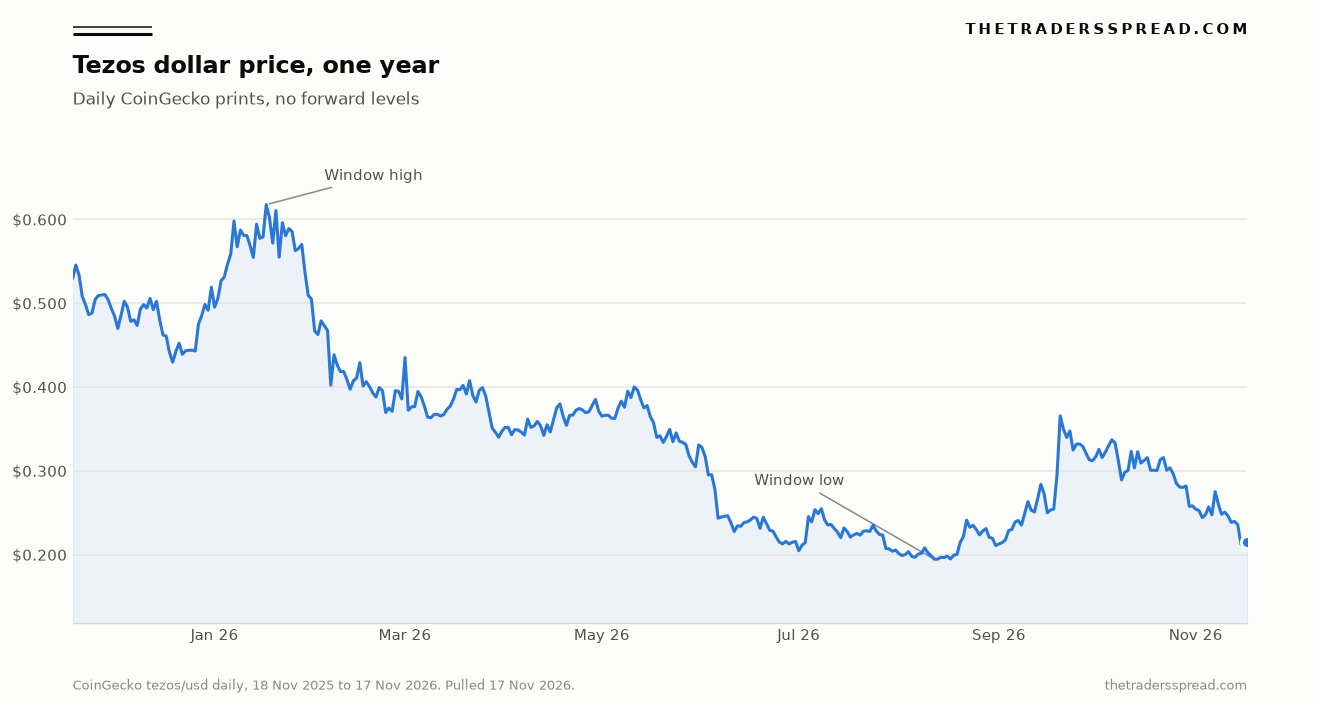
From $0.529415 on 18 November 2025 to $0.214988 on 17 November 2026, the daily dollar price fell 59.4 percent. CoinGecko's coin endpoint at 07:08:49 UTC put the one-year change at minus 61.16 percent, the all-time low at $0.191836 on 12 August 2026 and the all-time high at $9.12 on 3 October 2021, beside $4.29 million of reported 24-hour turnover. The issuance function reads stake and supply, and the dollar series is what a paid reward is worth afterwards.
Stake, delegation, and an edge that defaults to the baker
Staked tez count fully toward baking power, and delegated tez count one third as much because edge_of_staking_over_delegation is 3, while voting power adds the two with equal weight. On the 07:10 UTC TzKT snapshot, 349,660,557 staked plus 314,144,041 delegated equals the reported voting power of 663,804,597, and baking power is 453,528,140. A naive sum of staked tez plus delegated tez divided by three lands about 847,000 tez above that figure, the overstake and overdelegation trim the baking-power page describes.
Rewards follow a staker's fraction of the delegate's staked balance, including stake that has yet to change future rights. edge_of_baking_over_staking runs from 0 to 1 and defaults to 1, so that fraction accrues to the delegate's frozen deposit and the staker remainder is zero. limit_of_staking_over_baking defaults to 0 and refuses external stake until a baker raises it, up to nine times the baker's own stake, and sets an edge below 1. Both parameters apply five cycles later.
Delegated balances stay spendable, and docs.tezos.com routes any delegation reward through a transfer the baker chooses to send, while the protocol pays stakers. Double-baking slashes 5 percent of the delegate's stake, and the denunciation reward is one eleventh of that slash. Overstaked tez stay slashable where the power formula already treats the excess as delegation. The gap between the protocol rate and the amount a holder receives is the split measured on EigenLayer against native staking and in the Hedera filing note.
TzKT counted 3,156 stakers against 137,054 delegators at 07:10 UTC, about 2.3 percent, so most accounts that have chosen a baker sit on the liquid, one-third, baker-paid path. On 9 November 2026 the @tezos account pointed holders at a screen where stake and delegation are two clicks, while the weights behind those clicks remain two different rules.
🔒 Stake or delegate your tez in a few clicks.
— Tezos (@tezos) November 9, 2026
Compare bakers and options ↓https://t.co/8Il04ZEDOS
| Balance | Baking power | Voting power | Who pays | Slashable |
|---|---|---|---|---|
| Own stake | Full, above the 600 and 6,000 tez floors | Full | Protocol, into frozen stake | Yes |
| External stake inside the limit | Full | Full | Protocol, after the edge | Yes, pro rata |
| Stake above the limit | Treated as delegation | Full | Edge still applies | Yes |
| Delegated, unstaked | One third, inside the 9-times cap | Full | Baker's transfer, if any | No |
Rights on a later cycle
Baking power must reach 6,000 tez and the baker's own frozen stake 600 tez, or the delegate is left out of the rights draw. At the end of cycle n the protocol draws rights for cycle n+3, because consensus_rights_delay is 2. A staker behind an active baker is paid from the moment the tez are staked, while a new baker waits on selection and an external staker waits five cycles for a parameter change.
Unstaking waits out the rest of the request's cycle plus unstake_finalization_delay of 3 before anyone may finalize the balance. At 14,400 blocks a cycle and a six-second minimum, that is about three to four days when every block is on time. The bakers summary on docs.tezos.com still prints two cycles, and the constant on the head is the chain rule. delay_increment_per_round of 3 seconds means a missed round stretches the cycle, and the figures here use the round-zero case.
The 50 percent target is still ahead of the stake
The Octez target is 50 percent, the quiet band is 48 to 52 percent, and the adaptive maximum falls to 1 percent at or above the target. Morning staked balances are 31.18 percent of TzKT supply, and frozen balances are 355,225,372 tez, or 31.67 percent of the same supply. Under 48 percent the dynamic rule keeps adding to the dynamic rate, so the adaptive maximum is the binding cap on a 2.81 percent budget with a 0.64 percent static term underneath.
liquidity_baking_subsidy is a second pipe of 5,000,000 mutez, defined on the Octez liquidity-baking page as 5 tez a minute into the constant-product contract since Paris. The head still returns that contract at KT1TxqZ8QtKvLu3V3JH7Gx58n7Co8pgtpQU5. Across 525,600 minutes the constant is 2,628,000 tez a year, 0.23 percent of protocol supply. Bakers can vote it off, and the halt average returned no reading on the context path tried this morning, so 0.23 percent is the size of the constant rather than a confirmed flow. Ethereum Classic runs proof of work on a capped supply, a different answer to new coins.
| Piece | Rule opened 17 November 2026 | Morning figure |
|---|---|---|
| Static rate | 1/1600 over the square of the staked ratio | 0.64 percent at 31.18 percent staked |
| Adaptive maximum | 1 percent at a 50 percent ratio; about 10 percent at 5 percent or below | 2.81 percent at 31.18 percent |
| Cycle 1416 participation budget | Weights summing to 22,757, spread across the block | 6.008738 tez a block if full; 2.81 percent of supply over 525,600 minutes |
| Liquidity-baking subsidy | 5 tez a minute into the CPMM while the toggle stays under the halt line | Constant 5,000,000 mutez; address unchanged; toggle unread |
Five periods, and one upvote
A hash on the proposal board is an upvote inside a five-period machine whose own rules can be amended. Each period lasts 14 cycles, about 14 days at round zero, so five periods run about 70 days. A tie, a missed quorum or a failed supermajority returns the process to a fresh proposal period. Delegates submit at most 20 protocol hashes, and support is voting power snapshotted at the start of the period.
Period 186's proposal quorum is 5 percent. min_proposal_quorum is 500 on the same 10,000 scale that stores the yea/nay caps at 2,000 and 7,000. Exploration and promotion take yea, nay or pass, pass helps only the quorum, and the supermajority requires yea stake above eight tenths of yea plus nay. Cooldown carries no ballot, while adoption's last block stays on the old protocol and the next block runs the new one, and a hash that fails to compile can stall the chain.
Period 186 began at 18:18:13 UTC on 4 November 2026 and is scheduled to end at 21:11:28 UTC on 18 November 2026, with 22,766 blocks left at level 15851122. votes/proposals returned one hash, PtSEBSEBSEBSEBSEBSEBSEBSEBSEBSEBSEBSEBSEBSEBS5VTrmo, carrying 22,125.04 tez from a single upvote. Voting power for the period is 666,322,058 tez, so the 5 percent bar is 33.32 million tez and the upvote is 0.0033 percent of it. The yea/nay quorum sat at 49.98 percent with zero ballots, closed during a proposal period. On 12 November 2026 the @tezos account described those rounds in one post.
🗳️ Who decides what goes into a Tezos upgrade?
Anyone can write a proposal. Bakers vote on it, on-chain, over several rounds. If it passes, the network upgrades itself.
See what's being discussed ↓https://t.co/smalCd3Sjn pic.twitter.com/F42gYeJZAZRelatedWormhole vs Axelar on Message Verification and Fees
— Tezos (@tezos) November 12, 2026
Voting power is the wider number
Baking power is staked tez after the overstake limit, plus delegated tez after the overdelegation limit and divided by three, sampled at the end of an earlier cycle. Voting power is total staked plus total delegated, snapshotted at the start of the voting period, overdelegated funds included. The morning snapshot shows 453,528,140 tez of baking power against 663,804,597 tez of voting power. Period 186 records 201 bakers and the statistics pull counted 194.
FAQ
What does a Tezos baking reward pay?
A baking reward pays a fixed block portion, a bonus tied to included attestations, an attestation share and a data-availability slice. Cycle 1416 prints 1.352040 tez fixed, 1.352040 tez of bonus, 2.704082 tez of attestation reward and 0.001173 tez per shard, on the expected-issuance RPC of 17 November 2026. A full block every six seconds annualises near 2.81 percent of protocol supply, and the baker's edge decides what an external staker keeps.
Do delegated tez earn the same reward as staked tez?
Delegated tez add their full amount to voting power and one third to baking power, and they stay liquid. Staked tez count in full, sit frozen, and share rewards once the edge leaves a remainder. The edge defaults to 1 and the external-stake limit defaults to 0, so an outside staker is unpaid under the defaults. A delegator is paid only if the baker sends a transfer, on the pages read 17 November 2026.
How long do unstaked tez stay frozen?
The constants RPC sets unstake_finalization_delay at 3. The Octez staking page requires the request's cycle to finish before those three full cycles begin, after which anyone may finalize the balance into spendable tez. At 14,400 blocks a cycle and a six-second minimum, the wait is about three to four days when blocks are on time. The bakers summary on docs.tezos.com still prints two cycles, shorter than the constant on the head.
How does a Tezos protocol amendment pass?
Five periods of 14 cycles run in order: proposal, exploration, cooldown, promotion and adoption. Proposal needs a 5 percent quorum and one leading hash. Exploration and promotion each need the yea/nay quorum, 49.98 percent on 17 November 2026, plus yea stake above 80 percent of yea plus nay. Pass ballots help only the quorum. Adoption's last block stays on the old protocol, and the following block runs the new one.
Why is voting power larger than baking power?
Voting power adds staked tez to delegated tez. Baking power counts stake in full and delegation at one third, then drops anything past the overstake limit and the nine-times cap. At 07:10 UTC on 17 November 2026, TzKT showed voting power of 663,804,597 tez and baking power of 453,528,140 tez. Rights use an earlier baking-power sample, while ballots use the voting snapshot taken at the start of the period.
Where does the dollar price enter the baking reward?
The issuance function reads a staked ratio, a set of weights and a supply figure. CoinGecko's daily file shows the dollar price falling from $0.529415 on 18 November 2025 to $0.214988 on 17 November 2026, a 59.4 percent decline, while the cycle-1416 budget annualises near 2.81 percent of supply. The price changes what a paid reward is worth in dollars. Rank that morning was 143, at a market value of $236.8 million.
Whether a staked ratio near 31 percent, under a ceiling already near 2.8 percent, draws more external stake in, or whether bakers leave the limit at zero and the edge at one for the five cycles a parameter change takes, is what the morning numbers leave open, beside a single upvote of 22,125 tez against a 33.32 million tez proposal quorum.
This is analysis for information only, and it is not a recommendation to buy, sell, stake or delegate. Rewards can be missed, slashed or paid on terms a baker sets, and the dollar price can move independently of the issuance budget.