

Akash settled $9,994 of leases in the 24 hours to 07:37 UTC on 15 November 2026, and the mint on that same chain is still set to issue 11.99 million AKT over a year, about $15,559 of new token a day at the live CoinGecko print. The lease cheque and that fresh supply are different objects, and the mint keeps running beside the marketplace.
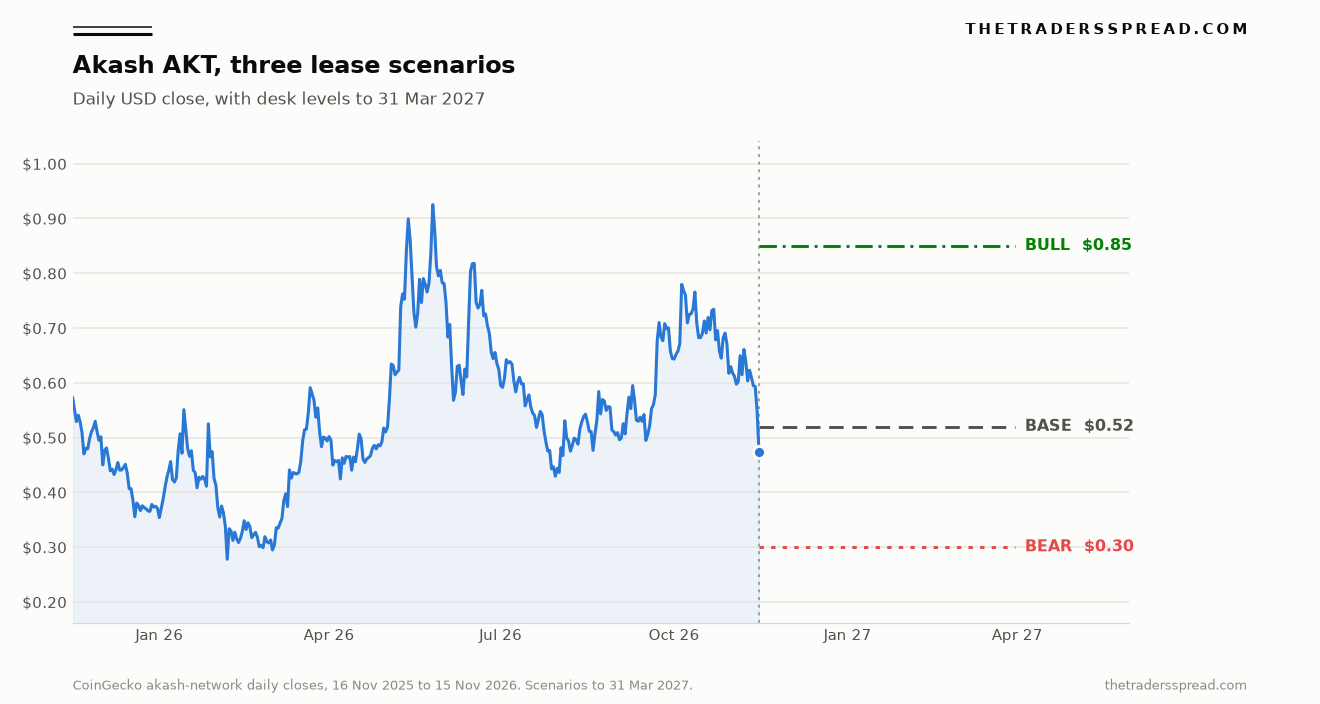
CoinGecko marked AKT at $0.473472 at 07:33 UTC, rounded here to $0.4735, down 9.8% in 24 hours, 24.7% in seven days, 31.9% in thirty days and 18.0% over the year. The 365 daily closes from 16 November 2025 to 15 November 2026 run from $0.2779 on 6 February 2026 to $0.9253 on 26 May 2026, and the median is $0.515. The bear is $0.30, the base is $0.52 and the bull is $0.85.
Anyone searching akash network price prediction is asking whether GPU leases can outrun that mint before 31 March 2027. Completed days from 16 October to 14 November averaged $7,672, against $7,642 in the thirty days before that. The ninety days to 14 November averaged $8,665, 16.8% above the prior ninety at $7,419. A higher quarter still covers about half the daily mint in dollars.
We left the incomplete 15 November calendar bar, about $3,212 on the console's daily series, out of those averages. A morning snapshot counted as a full day would have made a quiet market look like a collapse. The rolling figure of $9,994 at 07:37 UTC is the day we use.
Key facts
- Akash (AKT) last printed $0.473472, market cap $141,976,728, rank 193, with reported 24-hour trading volume of $7,129,178. Source: CoinGecko, 15 November 2026, 07:33 UTC.
- Inflation was exactly 4.0% and annual provisions were 11,994,662 AKT, with 70% of new tokens directed to the community pool and 28.67% of supply bonded. Source: Akash chain via Polkachu REST, 15 November 2026.
- Rolling lease spend was $9,994 in the 24 hours to 07:37 UTC, with 721 leases open and 1,007 new leases that day, against a completed-day average of $7,672 over the prior 30 days. Source: Akash console API dashboard, 15 November 2026.
- The GPU board showed 308 cards allocated out of 459 allocatable. An NVIDIA A100 80GB weighted quote was $1.67 an hour and an H100 80GB weighted quote was $2.73. Source: Akash console API, 15 November 2026, 07:49 UTC.
- Governance proposal 346 passed with 97.3% of votes cast, and the SPL migration portal was live on 12 November 2026, while old-chain inflation ends only at a later cutover. Source: Akash proposal 346 and @akashnet, 2 and 12 November 2026.
- The trailing-year daily low was $0.2779 on 6 February 2026 and the high was $0.9253 on 26 May 2026, median $0.515. Source: CoinGecko market chart, retrieved 15 November 2026.
1. Two clocks, one token
At block height 29,525,257 the chain reported annual provisions of 11,994,662 AKT and inflation of 0.04 exactly. Dividing by 365, the year length implied by 5,256,000 blocks a year, gives 32,862 AKT a day. Times $0.473472, that is $15,559 a day, or $5.68 million over a year at the same price. The 136 days from 15 November 2026 to 31 March 2027 would add about 4.47 million AKT, roughly $2.12 million, if today's provision simply repeated.
Rolling provider payments on the same dashboard were $9,994.43, against $10,011.64 a day earlier. Active leases were 721, from 726, and new leases were 1,007, from 967. Lifetime indexed spend stood at $6.65 million. AKT spent in the rolling window was zero, and the whole $9,994 moved as ACT.
Completed-day spend of $7,672 is 49% of the $15,559 mint, and the rolling day at $9,994 is 64% of it. Snapshots from 15 November 2025 through 14 November 2026 sum to $2.10 million of lease payments, against $5.68 million of annual issuance at the current print.
Distribution parameters set the community tax at 70%, so about 23,003 of each day's 32,862 AKT credit the community pool and about 9,859 reach stakers, and the pool held 4,087,797 AKT at the read. Published staking APR of 4.186% matches 4% inflation, times the 30% that clears the tax, divided by the 28.67% bond ratio. Bonded stake was 85,961,121 AKT against minted supply of 299,866,496. The bonded goal is 67%, the inflation ceiling is 4% and the floor is 3%, and the rate we read sat on the ceiling.
CoinGecko's fully diluted line of $141,977,017 sits on the $141,976,728 market cap because its total-supply field is the minted stock of 299,863,328, while the max field is a separate 388,539,008. From the chain's minted supply to that max is 88.7 million AKT, about 7.4 years of today's provision if the schedule never changed. Proposal 346 says the schedule is supposed to change, and the replacement curve is still unpublished.
What settlement does to the supply
AEP-76 is the rule for the lease clock. Tenants prepay with ACT, a non-transferable dollar credit created by burning AKT. At settlement the protocol burns the ACT and remints AKT to the provider at the price then in force. Appreciation between top-up and payout produces a net burn, because the provider is paid in fewer tokens for the same dollar credit. A decline between those moments remints more AKT than the top-up burned.
Credits bought at a higher AKT price and settled after a 9.8% daily drop, or a 31.9% monthly drop, expand supply on the way out, and credits bought into a rising tape shrink it. Outstanding ACT is a temporary sink: burned tokens stay out until settlement, then return at the new price, scaled to the dollars. Flat is a pass-through, not a retirement of the 32,862 new tokens.
The spec records that this design removed the earlier take rates, and the rolling day settled entirely in ACT. Credit-card payments, on the spec's account, purchase AKT in the market and burn it when the credit is created, so a dollar of console spend is a market bid at top-up.
The dashboard shows the day's ACT flow and leaves the age of the outstanding stock unpublished, so a single net-mint number for 15 November would be a guess. On a down day the spec's sign is expansion. With 1,007 new leases against 721 still open, many credits look short-lived, which would tie the gap to the daily move more than to the monthly one.
Helium is the precedent the AEP names, a network where usage eventually outran emissions. We set the usage cheque beside the emission schedule on Helium (HNT), and on the day we opened Akash the payments were still the smaller clock.
2. The GPU book, priced
At 07:49 UTC the console counted 308 cards allocated out of 459 allocatable, while the price board listed 146 available. Adding those two fields leaves five units unplaced, so they stay separate reads, and fifty-five providers were active on the 07:37 dashboard.
Three NVIDIA lines dominate the quotes. The A100 80GB SXM4 board had 200 cards and 77 available, so 123 were taken, from $1.07 to $1.91 an hour, weighted average $1.67. The H100 80GB SXM5 board had 56 cards and 10 available, so 46 were taken, from $2.55 to $3.16, weighted average $2.73. The RTX PRO 6000 SE 96GB board had 89 cards and 22 available, from $2.04 to $2.53, weighted average $2.27.
One hundred and twenty-three A100s billed for 24 hours at $1.67 would be about $4,930, and forty-six H100s at $2.73 would be about $3,010, together about $7,940. Adding 67 taken PRO 6000 SE cards at $2.27 pushes a naive full day to about $11,590. The chain settled $9,994 for every resource, GPUs included with CPU and storage, so taken cards are idle inside the hour, or accepted bids sit under the weighted quote, or both. We carry the chain figure forward.
Allocated cards near 67% of the board, beside a token down 31.9% in thirty days and a ninety-day spend average 16.8% above the prior quarter, is the AEP-76 split: more leases at a lower price can remint more AKT than the top-up burned.
A portal without a cutover date
Proposal 346 asked stakers to approve a move from akashnet-2 to Solana. Voting ended at 15:02 UTC on 2 November 2026, and the chain records the proposal as passed. Yes votes were 59.98 million AKT, 97.3% of the tokens cast, against a quorum the text set at 33.40% of bonded stake. We report that yes share of votes cast and leave turnout against that week's bond ratio uncomputed.
The yes vote authorizes an SPL token, same ticker, six decimals, through a one-way portal open for two years. Leases, staking and governance on akashnet-2 continue until a separate cutover proposal passes. Staking rewards and old-chain inflation end at cutover, validator income ends at halt 90 days later, and supply is unchanged because AKT leaves the old chain and arrives 1:1, with no path back.
Token launch was described as two to three weeks after the vote, once audits were done. The marketplace still required a provider testnet of at least six weeks with 25 or more operators, a 14-day rehearsal with zero blockers, and then the cutover vote. On 15 November the chain we queried was still akashnet-2, inflation still 4.0%, leases still settling there, so the token portal had opened while the mint was still issuing.
Akash's own account said the quiet part on 12 November 2026: rewards continue on the current chain until a cutover the account marked as still unannounced, and the move is one-way.
The Solana AKT migration portal is live.
— Akash Network (@akashnet) November 12, 2026
→ 1:1, one-way migration. It can't move back
→ Open for 2 years. No need to rush
→ Staking on Solana: to be announced
Staking AKT? Stay put. Rewards continue on the Akash L1 chain until cutover, date TBA.
Link + mint ↓ pic.twitter.com/E2T6ieiNR3
Before that later vote the proposal says four items must be published: how leftover AKT reaches the portal at halt, what happens to tokens that never migrate inside two years, the emissions curve, and the size of a validator continuity payout. The curve decides whether the 4% clock stops or a new clock starts at a rate holders have yet to see, and the four and a half months to 31 March sit in between.
3. Bear, base and bull
The horizon is 31 March 2027 because a six-week testnet, a rehearsal and a second vote can fit inside it, and because today's provision is still a large share of the story if they do not. Bear $0.30 is under the $0.4735 print. Base $0.52 and bull $0.85 are over it.
| Case | Level | What has to be true by 31 March 2027 |
|---|---|---|
| Bear | $0.30 | The 4% mint is still running, completed-day spend stays near or below the recent $7,700, and AKT is often cheaper at settlement than at top-up. The February 2026 series low was $0.2779. |
| Base | $0.52 | Spend holds in the $8,000 to $10,000 band, cutover is either still ahead or arrives with a modest replacement emission, and price drifts to the one-year median near $0.52. |
| Bull | $0.85 | Daily lease dollars rise through the mint's $15,559, or a passed cutover ends the 4% schedule with a small published replacement curve, and AKT is higher at settlement than at top-up. May's series high was $0.9253. |
The bear at $0.30 revisits ground the series already traded this year. A print through $0.30 puts the February low of $0.2779 back in play, and that is where we place invalidation of the base, because a market at $0.30 has left the path that drifts toward $0.52.
The base is the path the tape supports without a new fact. Spend has been $7,600 to $10,000 and the median of the year is $0.515, so a return to that median, with mint and leases still in their recent proportion, is a $0.52 token. A 31.9% decline over thirty days is a lot of trend for a median to erase by March.
The bull at $0.85 needs lease dollars clearing $15,559 a day, or a cutover before the horizon with a published curve smaller than 11.99 million AKT a year, and AKT higher at settlement than at top-up. It sits between the 5 October close of $0.780 and the 26 May close of $0.925, about an 80% move off $0.4735.
CoinGecko's all-time high is $8.07 on 6 April 2021 and the all-time low is $0.165 on 21 November 2022, both outside the three cases. A return to the 2021 high would need a lease book different from the one we opened.
Where the three prices fail
Settlement hinges on the price feed. Akash's 2026 roadmap records the Pyth AKT/USD feed as the price burn-mint equilibrium requires, completed 23 March 2026. A stale feed would change settlement even if lease demand held still. We priced that feed's own token in the Pyth bull and bear, and on this page Pyth is the plumbing under the credit.
RelatedLombard (BARD) 64.8 Percent Rebound After the Squeeze
A real fee beside a larger issuance schedule is the gap we traced in the VeChain staking-issuance case. Closing it on Akash is the arithmetic in the first section, repeated whenever the dashboard is reopened.
Four hours after the portal post, the same account warned holders that staking on Solana is absent at launch. Rewards, for now, are an akashnet-2 fact, and migrated AKT shares a ticker with AKT still paid to bond on the old chain while doing a different job.
Be suspicious of anyone asking you to stake $AKT on Solana.
— Akash Network (@akashnet) November 12, 2026
There is no staking on Solana at launch.
Only use the portal linked from @akashnet. Never share your seed phrase.
Portal: https://t.co/EyTwL6l8xn
A month of completed-day spend above the mint's dollar value would take the $0.30 bear off the downside we would write. A large replacement curve would leave $0.85 standing on lease growth alone. A small curve past the testnet gates would make $0.52 look heavy. Inflation still at 4% with spend near $8,000 in March is the base case on schedule.
The proposal ranks phishing as its top operational threat. A failed provider re-registration would hit the lease clock, and governance can stop the marketplace move until about six hours before cutover.
Questions the tape still leaves open
What does an akash network price prediction have to include?
It has to set a lease figure beside a mint figure, and say what AKT did between the credit purchase and the provider payout. On 15 November 2026 those figures were $9,994 of rolling spend and about $15,559 of daily issuance, with spot at $0.4735. From that pair we carry a $0.52 base, an $0.85 bull and a $0.30 bear to 31 March 2027.
Do GPU leases burn AKT for good?
Creating the credit burns AKT, and settlement remints AKT to the provider at the later oracle price. AEP-76 says a rise between those moments leaves a net burn, because the same dollar credit pays the provider in fewer tokens. A flat price returns about what was burned, and the 4% mint runs on its own schedule until cutover.
When does the 4% inflation end?
Proposal 346, passed on 2 November 2026, says staking rewards and old-chain inflation end at cutover, and the date of that cutover is a later vote. The SPL portal was open by 12 November. On 15 November the chain we read was still issuing at 4.0%, with 11.99 million AKT of annual provisions. The replacement curve was still unpublished.
What is ACT, if the token people trade is AKT?
ACT is the non-transferable credit a tenant spends on a deployment. The console shows dollars and converts the payment into that credit by burning AKT at the oracle price. Settlement burns the credit and remints AKT for the provider. A console balance is a budget for compute, and an AKT balance is the token that burn and remint pass through.
Why is the bull case under the May high?
The 26 May 2026 close reached $0.925 and the 5 October close reached $0.780. An $0.85 bull sits between them, about 80% above the $0.4735 print, on ground the series already traded. Getting there still takes lease dollars that clear the daily mint, or a cutover that retires the 4% schedule before 31 March 2027.
How should a reader use a single day of lease spend?
Set the dollars next to the dollar value of that day's mint, then check whether AKT rose or fell while credits were open. The rolling day to 07:37 UTC on 15 November was $9,994 against about $15,559 of new AKT, and the token was down 9.8% over 24 hours. The thirty completed days before that averaged $7,672, which is the trend beside the single afternoon.
Verdict
The base case is $0.52 if spend stays in the $8,000 to $10,000 band and the 4% mint keeps running or is replaced by a small curve. The bull case is $0.85 if lease dollars clear $15,559 a day or a cutover before 31 March 2027 publishes emissions plainly smaller than 11.99 million AKT a year. The bear case is $0.30 if the token keeps falling while credits are open, spend stays near $7,700, and March arrives with the old mint still on.
The prints that sort them are the console's completed-day spend, the mint module's annual provision, and a cutover proposal that still has to publish an emissions curve. On 15 November 2026 the lease clock was real and the mint clock was larger.
This is market analysis for traders, not a solicitation to buy or sell AKT or any other asset, and the price can travel through every level named above.