

0.5% a year is the storage-cost decline that Arweave storage pricing treats as enough to keep a one-time upload fee paying miners indefinitely, and only while the token's purchasing power stays put. The same protocol page sets the historical decline in the cost of storing a unit of data, hardware plus power plus operations, at about 38.5% a year over the last 50 years. The fee is built on the small number, and the history the project itself cites is the large one.
On 18 November 2026 the public gateway at arweave.net quoted 13,645,813,659,578 winston to accept one gibibyte. That is 13.645813659578 AR, or $34.80 at the $2.55 CoinGecko print timestamped 06:57:49 UTC the same morning. The quote matched, to the winston, a formula in the node source priced off a scheduled rate of 6,197 winston per gibibyte-minute, a replica target of 20, and a decay constant of 0.995. One twenty-first of a paid fee is what the including miner keeps, and twenty twenty-firsts enter the endowment. A slogan that calls this a simple upfront bill is describing a different product from the one the node priced.
Reference figures below were checked for the line updated 18 November 2026, and each one names the source that was open that day.
Key facts for the fee, the pool and the token print.
- Arweave's protocol docs say uploaders pay for 200 years of replicated storage at present prices, and they treat a 0.5% Kryder+ rate as enough to hold the endowment's storage purchasing power level across a year if the token price is unchanged (Arweave protocol docs, retrieved 18 November 2026).
- The same page puts the average decline in storage cost over the last 50 years at about 38.5% a year (Arweave protocol docs, retrieved 18 November 2026).
- arweave.net quoted 13,645,813,659,578 winston, or 13.645813659578 AR, for 1 GiB at 07:02:20 GMT on 18 November 2026, denomination 1, on both /price and /price2 (arweave.net, 18 November 2026).
- At CoinGecko's $2.55 AR print, timestamp 2026-11-18T06:57:49Z, that 1 GiB quote is $34.80, of which about $1.66 is the miner's twenty-first and about $33.14 is the endowment slice (CoinGecko /coins/arweave and arweave.net, 18 November 2026).
- Block 2,044,673, chain time 2026-11-18T06:58:30Z, held a reward pool of 384,296.415 AR, a weave of 393,131,141,669,110 bytes (357.55 TiB), a scheduled price of 6,197 winston per GiB-minute, and a Kryder+ multiplier of 1 (arweave.net /block/current, retrieved 18 November 2026).
- The client source sets the post-2.6 replica target at 20, the miner fee share at 1/21, annual price decay at 995/1000, and the base bytes priced on every transaction at 3,210 (Arweave node source on GitHub master, ar_pricing.hrl and ar.hrl, retrieved 18 November 2026).
What does the Arweave upload fee buy?
The protocol page puts two jobs inside one transaction reward. A placement slice pays the miner to enlarge the dataset, and the rest is an upfront AR contribution to an endowment that pays miners later as they prove replicas, with that later payout supposed to shrink as storage gets cheaper. The project calls that combined decline in hardware, electricity and operations the Kryder+ rate.
The seat is a weak stand-in for a warehouse contract that names an operator and a penalty if a drive dies. The docs leave each miner free to choose which data to store and serve, and the node accepts an optional blacklist, so the fee buys pressure toward replication while the choice of bytes stays with the operator. Who keeps the GRT after a Graph query is priced asks the same custody question of another toll, and Arweave's answer is a client fraction covering the minimum and any tip.
How does Arweave storage turn bytes into winston?
The live calculation is get_tx_fee in ar_pricing.erl, read from master on 18 November 2026. It takes a byte count, a price per gibibyte-minute, a Kryder+ multiplier and the block height, and it prices the payload plus a 3,210-byte base, TX_SIZE_BASE in ar.hrl, so a token transfer still carries storage weight. The first-year figure is that byte count times the gibibyte-minute price times 60 times 24 times 365. A perpetual price then scales by the replica target and the Kryder+ multiplier, and divides by the absolute value of the natural log of 0.995.
The header stores that log as −5,012,541,823,544,286 over 10 to the 18, which is ln(0.995), and one divided by the absolute value is 199.50. A discrete sum of a 0.5% decline is exactly 200, which is the round story in the docs. The client charges the continuous version, then adds a miner share equal to one twentieth of the perpetual price, so the total is 21/20 of the storage cost and the miner's later one twenty-first matches that add-on.
Block 2,044,673, chain time 2026-11-18T06:58:30Z, carried 6,192 winston per gibibyte-minute and a scheduled price of 6,197. /info at 07:02 GMT showed network arweave.N.1 at that height with 251 peers. Feeding 6,197, a multiplier of 1 and 20 replicas reproduced the quotes with a difference of zero: 13,645,813,659,578 winston for one gibibyte at 07:02:20 GMT, 13,366,744,721 winston for one mebibyte at 07:02:13 GMT, and 40,794,658 winston for a zero-byte call at 07:02:28 GMT, the 3,210-byte base on its own. price2 returned denomination 1, matching the block, so the header's 1,000,000,000,000 winston per AR still converts the unit.
At 6,197 winston per gibibyte-minute, one replica of one gibibyte for a year is 0.003257 AR, or 0.83 cents at $2.55, and twenty replicas for that year are about 16.6 cents. The 199.50-year factor turns that present cost into an endowment slice of 12.996 AR, about $33.14, plus a miner twenty-first of 0.650 AR, about $1.66, which is the $34.80 quote. The docs treat network difficulty as an oracle for mining resources and fold in recent operations, a miner-economics input rather than a disk advertisement.
| Upload priced | Winston quoted | AR | Dollars at $2.55 |
|---|---|---|---|
| 0 bytes, the 3,210-byte base only | 40,794,658 | 0.00004079 | $0.000104 |
| 1 MiB (1,048,576 bytes) | 13,366,744,721 | 0.013367 | $0.0341 |
| 1 GiB (1,073,741,824 bytes) | 13,645,813,659,578 | 13.645814 | $34.80 |
Updates land every 50 blocks, PRICE_ADJUSTMENT_FREQUENCY. The header's target block time is 120 seconds, so the design gap is 100 minutes. In the later pricing branch the next scheduled price keeps nine tenths of the previous scheduled price, mixes in one tenth of a fresh estimate, and refuses a step outside half or double. Fresh transactions quote the scheduled figure, which is why 6,197 matched the gateway and the in-force 6,192 missed it.
Who receives the fee after a miner includes it?
distribute_transaction_fees2 gives the including miner one twenty-first of the reward, integer division, and the endowment the rest, including twenty twenty-firsts of any tip. A zero-data transfer pays the 3,210-byte base, and a first payment into an unseen account adds a new-account fee sized like 20,000,000 bytes, the constant NEW_ACCOUNT_FEE_DATA_SIZE_EQUIVALENT, because a fresh account slows block processing. The gateway calls above cover the base and the table, so that adder stays a source constant here.
The minimum comes from the client. How Raydium sets the fee a swap actually pays is the other shape, a published pool parameter aimed at traders rather than at a long stretch of disk. A signer can pay above the minimum, and the surplus still follows the one twenty-first split.
| Input | Value in the client | What it does to the quote |
|---|---|---|
| Replica target after fork 2.6 | 20 (45 from fork 2.5, 10 before that) | Multiplies the perpetual cost |
| Annual price decay | 995/1000, a 0.5% Kryder+ rate | Turns one year of present cost into about 199.5 years |
| Miner share of the paid reward | 1/21 | Paid to the including miner |
| Endowment share of the paid reward | 20/21 | Added to the reward pool |
| Base bytes on every transaction | 3,210 | Prices a token transfer as a small stored file |
| Price adjustment step | Every 50 blocks, move capped at half to double | Stops one noisy estimate from resetting the fee |
| Kryder+ multiplier on block 2,044,673 | 1, with the latch at 0 | The live quote is the base 0.5% case |
What is the storage endowment built to pay?
reward_pool on block 2,044,673 stood at 384,296,415,034,234,242 winston, which is 384,296.415 AR, or $979,956 at $2.55. CoinGecko's same payload put market capitalisation at $167,551,006, rank 175, with 65,652,466 AR circulating and a stated maximum of 66,000,000. Against that maximum the pool is 0.582% of supply. weave_size was 393,131,141,669,110 bytes, 357.55 tebibytes, or 366,131.9 gibibytes. Dividing the pool's dollars by those gibibytes gives $2.68 of endowment per gibibyte already stored, against the $34.80 fee for a new gibibyte the same morning.
The per-block burden is the replica target times weave size times the gibibyte-minute price times the block interval, and the miner's base is inflation plus the fee share. A covered burden leaves the pool untouched. A larger burden withdraws the gap, and a gap bigger than the pool zeros the pool, raises debt_supply by the unpaid remainder, and doubles the Kryder+ multiplier if the latch is open. On this header debt_supply was 0, the multiplier was 1, the latch was 0 and block_size was 0, so that tripwire was quiet. Reopening a fired latch takes a pool above 10,000 AR, and this one sits far above the line.
Sam Williams, the founder of Arweave, pointed readers at a public simulator for this risk model on 3 September 2026, and the balances above are the chain's stock on the November block.
Curious about the endowment model?
— 🐘🔗 sam.arweave.net (@samecwilliams) September 3, 2026
Learn its risk model in-depth and try the simulator: https://t.co/mq0V08ZQxA
Why does a 0.5% decline carry the forever claim?
PRICE_DECAY_ANNUAL, the fraction 995/1000, is the trick the docs state in one breath: pay for 200 years of replicated storage at present prices, and a 0.5% Kryder+ rate sustains the endowment indefinitely when the token price is unchanged, with purchasing power at the end of a year equal to purchasing power at the start. That 200-year sum is the present-value identity of a 0.5% decline carried out forever, so a different decline, or a different token purchasing power, moves the identity.
The 38.5% average is the project's own benchmark for how fast storage cost has fallen, so a fee built on 0.5% asks the buyer to prepay as if disks, power and labour will barely cheapen. Against that history the prepayment is a thick cushion, because the old pace would leave far more tokens in the pool than the burden needs released. The cushion flips to a shortfall if the decline comes in under 0.5%, or if token purchasing power falls faster than storage cheapens.
When a block's expected storage reward exceeds the pool, the multiplier doubles and the next upload prepays twice the present-cost stretch. A 0.25% rate in place of 0.5% turns the 200-year sum into a 400-year sum, and data already stored keeps its claim on the pool and on inflation. In March 2025 Williams framed the endowment as the mechanism that pulls tokens out of circulation on upload. The rates in this section are the 18 November 2026 readings, and the post below is his pointer to the design.
RelatedWormhole vs Axelar on Message Verification and Fees
Waited 7 years for people to realize this about Arweave.
— 🐘🔗 sam.arweave.net (@samecwilliams) March 19, 2025
Endowment-backed storage and token dynamics 101 👇 https://t.co/C2kq79ETAg
What moves the dollar value of a winston fee?
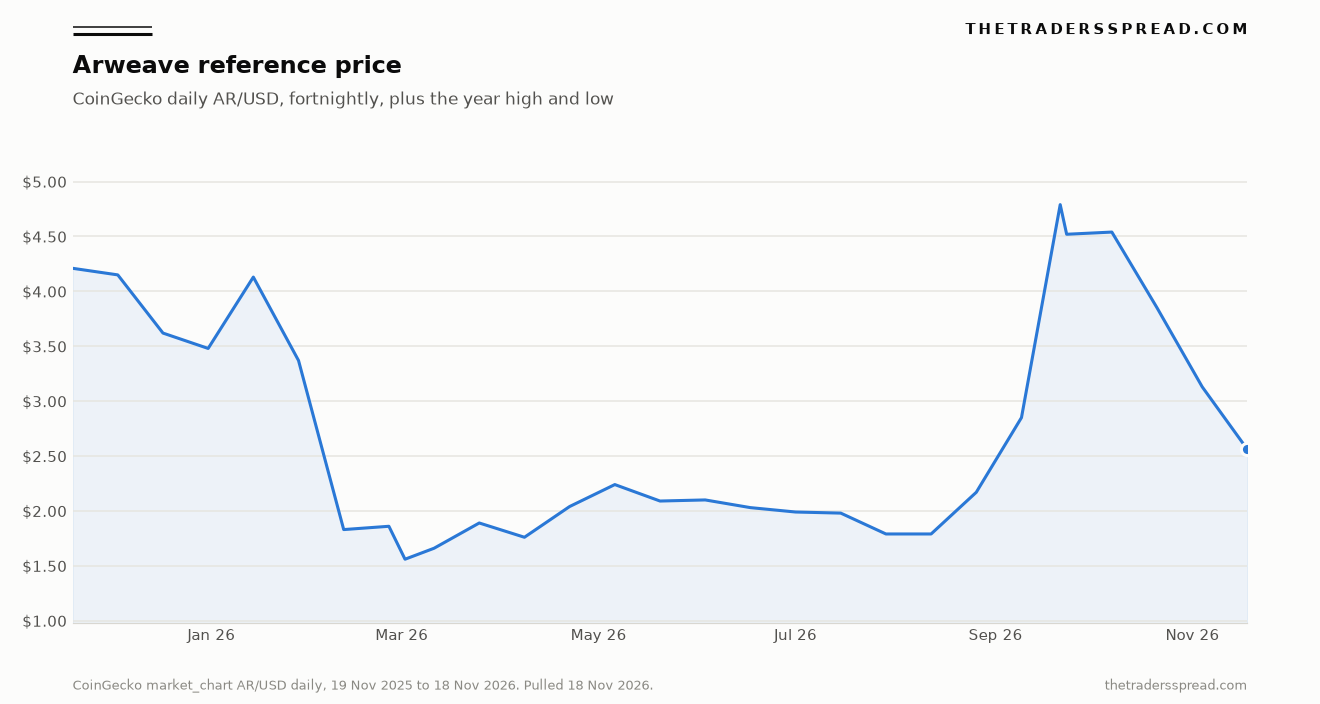
Dollars are a translation after the node is finished. CoinGecko at 2026-11-18T06:57:49Z printed $2.55, against an all-time high of $89.24 on 4 November 2021, down 97.14% from that high, and an all-time low of $0.298788 on 30 January 2020. Gibibytes prepaid while the token was expensive, and serviced later while it is cheap, are a smaller dollar endowment than the winston count alone suggests. A rally does the opposite and lifts the pool's dollar reach with zero new uploads.
Across 366 daily points from 19 November 2025 to 18 November 2026 the series opened at $4.21 and closed at $2.56, with a low of $1.56 on 2 March 2026 and a high of $4.79 on 21 September 2026. The endpoint decline is about 39%, so AR already in the pool lost about that much dollar translation between those stamps. The 0.5% identity assumes the token price stays still, and the docs list token value beside data volume and storage cost as a separate driver.
A storage token and the disks behind it can move on different clocks, the split in the Filecoin supply-cut piece, where a token move and raw capacity were pulling apart. On the Arweave header the pool, the weave and the scheduled winston price are already three series, and the dollar chart is a fourth.
Which costs sit outside the quote?
The formula prices storage minutes, a replica target, a decay curve, 3,210 base bytes and a new-account adder. A popular file's bandwidth bill stays outside the minimum. The overview aims miners at drives around 5 MB/s of read throughput, with a verifiable delay function so faster drives gain little by outreading cheaper ones. End-user retrieval sits with gateways and with whoever seeds the data, a second product with a second bill.
Twenty replicas is a price input with a history: 10 before fork 2.5, 45 from 2.5 until 2.6, and 20 from 2.6, so height 2,044,673 is priced at 20 while older bytes were priced at the target then in force and now share one pool. The $2.68 spot ratio mixes those vintages. Redenomination compares total supply plus debt minus the endowment with 1,000,000 AR. Header TOTAL_SUPPLY of 66,000,015.859 AR, minus the 384,296.415 AR pool and plus zero debt, leaves 65,615,719 AR available, about 66 times the threshold. CoinGecko's 65,652,466 circulating figure is a close cousin from market data. Denomination is 1 and redenomination_height is 0, so a unit-split is unscheduled.
Partitions in the overview are 3.6 TB segments, packed per miner address so one operator's copy is a distinct replica. The gibibyte-minute price is inferred from how those copies show up in hashrate and rewards, then run through a 0.5% decay, 20 replicas and the token print.
If a later block finds the expected storage reward larger than the pool and the multiplier steps from 1 to 2, the next uploader pays for a longer stretch of present cost, while data already in the weave keeps the claim it had. Whose replicas does that doubled fee actually lengthen, and whose replicas are still leaning on a 0.5% decline the original prepayment assumed would be enough?
Analysis and information only, because storage quotes, pool balances and token prints move after the timestamps named above, and a decision to upload or to hold AR needs a separate judgment from the arithmetic here.