

Maple's lender FAQ calls every syrupUSDC, syrupUSDT and syrupUSDG loan overcollateralized, and Maple's open-term default function passes a zero address because the loan contract stores zero collateral tokens.
Those two lines, both on docs.maple.finance, are the map of a Maple credit pool. Yield is interest on loans to approved institutions, plus whatever a side strategy earns. The cushion called collateral sits in a Master Lending Agreement and with a desk that can margin-call a borrower. The loan contract tracks principal, a rate, a payment interval and two service fees. The pool share and the SYRUP governance token are different objects.
On 13 November 2026 the Maple homepage displayed $4.21 billion of assets under management and $19.74 billion borrowed. The transparency page, opened the same day, displayed $4.06 billion of assets and $1.77 billion of deposits. The collateral disclosure names an Open Access feed that returned loansValue of $1,246,974,053, collateralValue of $1,901,216,026 and a collateralRatio of 152.47 percent. Each step below keeps the figure on the page that printed it.
Updated 13 November 2026.
Key facts
- Assets under management $4.21 billion, amount borrowed $19.74 billion, borrowers 100+, loans issued 400+, and a secured-lending card at 5.2 percent APY with pool assets of $646 million and a collateral ratio of 133.6 percent (Maple homepage, maple.finance, 13 November 2026).
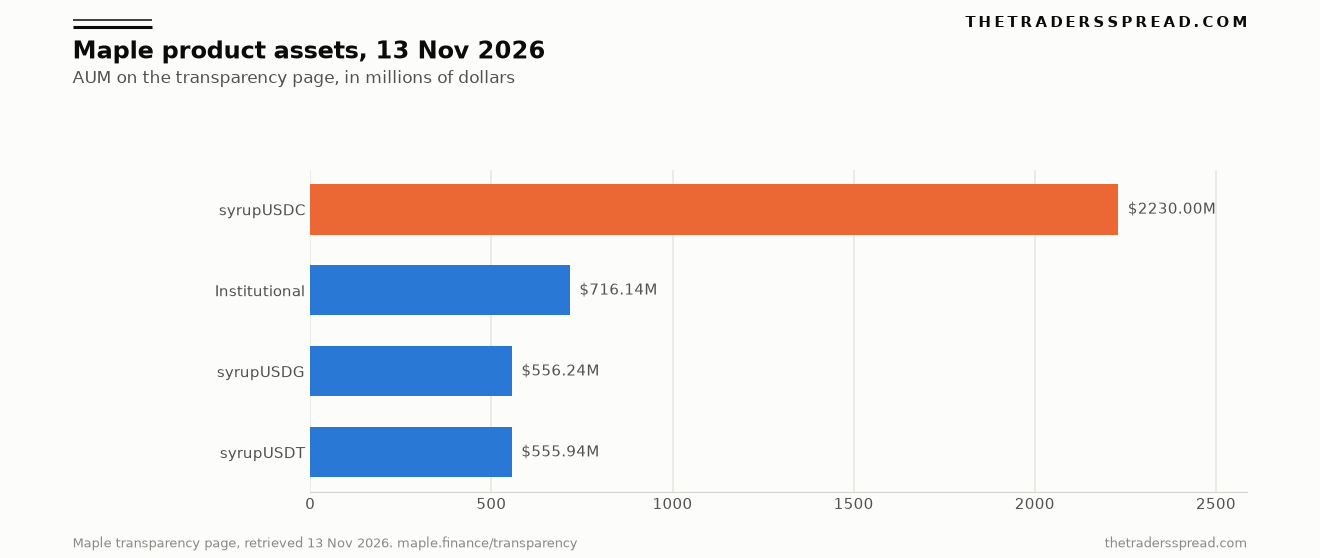
- syrupUSDC assets $2.23 billion at 5.1 percent APY, syrupUSDT $555.94 million at 5.0 percent, syrupUSDG $556.24 million at 4.8 percent, and Maple Institutional $716.14 million at 5.4 percent, summing to $4.06 billion (Maple transparency page, maple.finance/transparency, 13 November 2026).
- Deposits of $1.77 billion, of which overcollateralized lending was $1.56 billion or 87.9 percent, DeFi $138.95 million or 7.8 percent, DEX LP $29.5 million or 1.7 percent, US Treasuries $25 million or 1.4 percent, idle cash $14.28 million or 0.8 percent, and trading $7.11 million or 0.4 percent (Maple transparency page, maple.finance/transparency, 13 November 2026).
- Collateral ratio 152.47 percent, collateral value $1.901 billion, loans value $1.247 billion, and an apy field of 5.048 percent after the documented 30-decimal scale (Maple GraphQL syrupGlobals, api.maple.finance/v2/graphql, 13 November 2026).
- Yearly loansUsd: a low of $1.317 billion on 28 April 2026, a high of $2.513 billion on 6 April 2026, and $1.458 billion on 11 November 2026 (Maple GraphQL aumTimeSeries, api.maple.finance/v2/graphql, retrieved 13 November 2026).
- 1 MPL converts into 100 SYRUP, and the page states an expected supply of 1,267,875,000 SYRUP by September 2026 (Maple SYRUP tokenomics, docs.maple.finance, 13 November 2026).
- MIP-019 sends 25 percent of ongoing protocol revenue to the Syrup Strategic Fund, staking rewards are sunset, and Snapshot votes on maple.eth run for 7 days with both SYRUP and stSYRUP eligible (Maple staking and governance pages, docs.maple.finance, 13 November 2026).
Step 1: Name the two doors before you pick a pool
Open the introduction to SYRUP and you meet two product lines under one governance token. Maple Permissioned, also called institutional, connects approved capital to lending opportunities. Maple Open Access is the other door, and the tokens a DeFi wallet holds there are syrupUSDC, syrupUSDT and syrupUSDG. SYRUP governs both doors, while the deposit receipt is the syrup asset or, on an institutional pool, that pool's own ERC-4626 share.
The legal names are in the risk disclosure opened 13 November 2026. syrupUSDC is issued by Maple International Operations SPC acting for Secured Loan Segregated Portfolio 1. syrupUSDT is issued for Maple USDT Segregated Portfolio 1, and syrupUSDG for Maple USDG Segregated Portfolio 1. Syrup Ltd operates the interface at app.maple.finance/earn. Each segregated portfolio ring-fences its own assets and liabilities, so a loss in one book stays in that book.
Permission differs by door: the institutional lending guide requires KYC and a global allowlist, and a transfer of those shares off the list reverts, while an open-access first deposit needs an authorization signature on the SyrupRouter. On 13 November 2026 the homepage secured-lending card showed $646 million at 133.6 percent collateral, and the transparency row labelled Maple Institutional showed $716.14 million. The API defines AUM as loans plus cash plus strategies plus collateral, so stacking that collateral number on the $4.06 billion transparency total would double-count if the page already includes it.
Step 2: Deposit the asset and hold the share
Follow the institutional guide and the pool contract page in order: confirm the wallet is allowed, approve the pool to spend the asset the first time you lend it, and call deposit. The pool accepts the tokens and issues ERC-4626 shares. Assets behind that share rise when borrowers pay interest and when strategies earn, and they fall when a loss is booked, while the share count in the wallet stays put. What moves is the exchange rate, written on the withdrawal-manager page as total assets minus unrealized losses, divided by total supply.
Lido's stETH changes the token balance itself, which is the mechanism in how Lido sets each daily stETH reward rebase. A Maple lender who watches only the token count misses both the yield and a loss. On the way out, withdraw and requestWithdraw revert with PM:PW:NOT_ENABLED and PM:RW:NOT_ENABLED, so the exit is requestRedeem. The shares move into a queue.
The syrup FAQ calls these tokens liquid yielding dollars from fixed-rate overcollateralized loans. The FAQ records the absence of a formal tie to Circle. The product disclosure adds futures basis trades and DeFi liquidity, with risks distinct from the loans. The FAQ puts normal liquidity at instant, rare cases near 24 hours, and a maximum of 30 days. Section 2.3 of the risk disclosure says recent averages were under 24 hours, declines to guarantee that pace, and withholds any maximum. Both pages were open on 13 November 2026.
Step 3: See where the pool sends the cash
How Maple Works and How Pools Allocate Capital describe one flow. A deposit becomes shares, and the pool funds open-term loans plus shared strategies. A strategy is two contracts: the manager tracks each pool's share, holds zero assets itself, and sends tokens to Aave v3, Sky's sUSDS, or a managed wallet. Total assets equal pool cash, plus the loan manager's assets, plus each strategy's assetsOf for that pool. Lenders receive what remains after the pool delegate, the strategy delegate and MapleTreasury take their fees.
Three caps can block funding if left at the default. strategyCapOf on the pool starts at zero until someone raises it. poolManagerCapOf treats zero as unlimited and the maximum integer as blocked. strategyLiquidityCap spans every pool and blocks funding at zero. The pool delegate sets the limits, liquidity bots move cash inside them, and a bot stops if the strategy reports an impairment. Aave and Sky settle in the same transaction. A managed wallet draws later, inside a deployment cap and a one-hour cooldown.
The chart compares the four asset figures on the transparency page for 13 November 2026, in millions, so syrupUSDC's $2.23 billion prints as $2,230.00 million. Deposits sat below assets in every product: overcollateralized lending was 97.4 percent of syrupUSDC deposits and 54.2 percent of syrupUSDG deposits, where DeFi was another 42.4 percent. On 5 November 2026 the Maple account pointed at that page and listed loans, collateral and strategy addresses under the headline yield.
An APY tells you what a product pays, not what’s underneath it.
— Maple (@maplefinance) November 5, 2026
Maple’s transparency page now shows you:
→ Each product’s allocation
→ Individual loans and their collateral
→ Every strategy behind the yield, with its size and address
→ Onchain data you can check yourself pic.twitter.com/FjhhlaYSvk
The GraphQL yearly loansUsd series, 12 November 2025 through 11 November 2026, bottoms at $1.317 billion on 28 April 2026, peaks at $2.513 billion on 6 April 2026, and prints $1.458 billion on 11 November 2026. The live loansValue field two days later was $1.247 billion, a different field from loansUsd. assetsInStrategiesUsd in that series sits at zero from 20 April 2026 through 11 November 2026. Strategy contracts remain in the docs, so the zero is a reporting fact in the download and a weak basis for claiming the strategies were shut.
Step 4: Read the loan the borrower accepts
On the Open Term Loan page, fund reverts with ML:F:TERMS_NOT_ACCEPTED until the borrower calls acceptLoanTerms. The lender is the loan manager, and the cash token is usually USDC, DAI or USDT. The initializer lists borrower, lender, asset, principal, grace period, notice period, payment interval, interest rate, late fee, late-interest premium and the delegate service-fee rate. The platform fee is read from Globals and refreshed on refinance, and the field list ends at the delegate service-fee rate. Protocols that reprice as a vault fills, the pattern in how an Euler borrow rate comes off the vault curve, work differently: Maple writes the rate into the loan, as principal times rate times time since the later of funding and the last payment, over a 365-day year. makePayment is permissionless, and closing means returning the outstanding principal.
A refinance settles accrued interest and both service fees on the old rates, then starts the next interval on the new ones. The pool delegate can call principal, and the borrower has the notice period. The fees page stores rates as parts of 1,000,000, so 50,000 means 5 percent, and it publishes the formula rather than one universal live rate. Service fees accrue on principal and sit above interest. A management fee is a cut of gross interest, and net interest goes to lenders. The allocation strategy takes its fee on realizeYield, and the net amount vests over the duration that call sets.
The protocol actors page is the cast list. A borrower is an institution the governor or the operational admin has approved. A pool delegate owns exactly one pool manager, and a strategy delegate owns exactly one strategy manager. The governor is a timelocked multisig. The operational admin handles day-to-day approvals and skips the timelock. The security admin pauses and upgrades.
Step 5: Find the collateral outside the loan
The open-term defaults page says a default completes in one transaction, and the pool manager calls triggerDefault with the loan and the zero address. The legal defaults page still says a default sells any collateral and lifts pool value by the proceeds. Both pages are current and describe different layers of one event. Section 1.3 of the risk disclosure puts the cover under Master Lending Agreements, as loans to institutions with posted collateral. Section 2.1 says a default first reduces pool value by outstanding principal and accrued interest, then liquidates posted collateral and returns the proceeds. A shortfall is a net loss shared by every lender in that pool through a lower share value.
The margin-call guide describes three price feeds, round-the-clock monitoring, and 24 hours to restore the initial collateral level. Hitting the liquidation level during that window lets Maple liquidate anyway, preferably through OTC desks, with exchanges as the fallback. The guide calls liquidations rare and says calls over the past year were met within hours. On 30 October 2026 Maple's proof-of-reserves post, naming The Network Firm, put collateral at $2.05 billion against $1.23 billion of loans: syrupUSDC 172.1 percent, syrupUSDT 144.1 percent, syrupUSDG 166.8 percent, held off Binance. That post is a different reading from the 152.47 percent syrupGlobals ratio on 13 November 2026.
Following recent events at Binance, we published an updated proof of reserves, verified by The Network Firm. None of the collateral is held on Binance.
— Maple (@maplefinance) October 30, 2026
Collateral totals $2.05B against $1.23B in outstanding loans:
• syrupUSDC: 172.1%
• syrupUSDT: 144.1%
• syrupUSDG: 166.8%…
A reader still lacks one contract address that holds the collateral during the healthy life of a named loan. The transparency post invites an onchain check, the initializer lists cash terms, and the margin-call guide describes desks plus a 24-hour top-up. Together they fit collateral that lives under the lending agreement and moves after a call fails. They stop short of a custody address a stranger can paste into a block explorer and watch for the life of the loan.
RelatedDo Balancer and PancakeSwap Price a Swap the Same Way?
Step 6: Walk an impairment into a default
Open Impairments first, because the paper loss comes before the formal default. If a borrower looks unable to pay, the pool delegate calls impairLoan. Principal, and interest accrued up to that call, move into unrealizedLosses, further interest stops, and the due date jumps to the earlier of now and the old due date, so a borrower still inside the interval is immediately late. The stated reason is to stop lenders leaving at the old share price. Removal by the delegate or the governor reverses the paper loss. A full payment or a refinance clears it and restarts the interval. A default makes the loss real by cutting principalOut and accounted interest. Calling the loan before impairing it is the usual operational order, and the contracts leave that order unenforced.
A redemption while unrealizedLosses is open takes the lower rate, a lender who leaves locks that gap in, and a fresh deposit during the impairment shares the haircut until a later full repayment. The loan uses the earliest clock that is set. An ordinary due date is the later of funding and the last payment, plus the payment interval, and defaultDate adds the grace period. A call uses dateCalled plus the notice period, with a grace period of zero. An impairment uses dateImpaired plus the grace period. After defaultDate, the pool delegate, the governor or the operational admin may call triggerDefault. Until that call, repossess reverts with ML:R:NOT_IN_DEFAULT, so the clock opens an option and a person still sends the transaction.
The defaults page then drops principalOut by the loan's full principal, which drops total assets by the same amount, and strips that loan's accrued interest. The worked example is a teaching sum in the page's own token units, far from the size of a live pool, and cash is unchanged because the loss is booked before recovery arrives.
| Line | Starting state | After the default |
|---|---|---|
| principalOut | 10,000 | 6,000 |
| Outstanding interest | 200 | 100 |
| Cash | 3,000 | 3,000 |
| unrealizedLosses | 0 | 0 |
| totalAssets | 13,200 | 9,100 |
The example loan was 4,000 of principal and 100 of interest, so total assets fall from 13,200 to 9,100. Recovery pays the platform service fee and management fees first, then the pool up to principal and net interest, and anything left returns to the borrower. The delegate service fee stays off that waterfall. CollateralLiquidationFinished still fires, with the collateral argument at the zero address. Lenders meet the new rate in the withdrawal manager, first in, first out. Cash short of the shares in that call reverts the whole call with WM:PR:LOW_LIQUIDITY, a partial fill keeps the remainder at the front, and the owner can shrink a request. A permitted role can pull a request that would jam the queue, including one a stablecoin issuer has blacklisted. Manual redeem is marked internal so the contracts stay recognisable as ERC-4626.
Step 7: Keep SYRUP off the lender's claim
The SYRUP introduction and the tokenomics page draw the last line. SYRUP governs both doors, while the pool share is a different object, syrupUSDC, syrupUSDT, syrupUSDG or an institutional ERC-4626 token, so yield sits in the share and a vote sits in SYRUP. A deposit treats a governance-token balance as optional. MIP-010 converts 1 MPL into 100 SYRUP: 1,000,000,000 of new supply, 100,000,000 from the first slice of the inflation schedule, and 54,930,000 through 1 October 2024. The page then states an expected supply of 1,267,875,000 by September 2026, and it labels that figure as expected supply.
The staking page says MIP-019 sunset the rewards, that both SYRUP and stSYRUP can vote, and that 25 percent of ongoing protocol revenue goes to the Syrup Strategic Fund for buybacks and the DAO balance sheet. Unstaking is the only action left at app.maple.finance/earn/stake. The contract is described as non-custodial, a holder can unstake at any time, earned rewards stay with that holder, and the lock-up on the way out is zero. Governance runs on Snapshot at maple.eth for 7 days. A proposal passes once quorum is met and the window ends, and the numeric quorum sits on the live proposal rather than on the page opened here.
A protocol token can move on its own tape while the deposit receipt stays quiet, which is the split in Ether.fi's ETHFI against bitcoin. The risk disclosure says upgrades go to DAO-approved versions, says some multisignature signers may sit outside the issuer, names the reviews as Spearbit, Three Sigma and 0xMacro, and illustrates restricted jurisdictions with the United States and Australia, matching the homepage line for investors outside the United States.
What the docs still leave open
A reader can walk a dollar from a wallet, through an allowlist or a router, into an ERC-4626 share, out to an open-term loan or a capped strategy, and back through a first-in-first-out queue whose price includes any paper loss. A default inside the loan contract is an accounting event with a zero collateral address, while the legal and operational pages still speak of selling posted collateral through OTC desks inside a 24-hour margin-call window.
Which contract, if a reader opens one on a block explorer, holds that collateral during the healthy life of a single loan? And which sentence governs the withdrawal clock a lender should plan around: the FAQ's maximum possible time of 30 days, or section 2.3 of the risk disclosure, which states there is no guaranteed maximum withdrawal period?
Depositing into a Maple pool can lose principal if a borrower defaults, if liquidated collateral comes back short of the loan, or if a side strategy loses money, and the pages above are general information about how the contracts are written rather than a recommendation to deposit, to redeem, or to buy SYRUP.