

Which margin is the market paying for when it lines Honeywell up against Emerson: the 21.3% segment margin, or the income-statement profit underneath it? Honeywell Technologies, which continues to trade on Nasdaq as HON, printed that 21.3% for the quarter ended 30 September 2026, equal to segment profit of $1,062 million on segment sales of $4,994 million. Emerson Electric, for its fiscal fourth quarter ended the same calendar day, printed an adjusted segment EBITA margin of 29.1%, equal to $1,511 million on net sales of $5,201 million. Adding Honeywell's three segment profits before the corporate line produces $1,163 million, or 23.3% of segment sales. Adding Emerson's three GAAP segment earnings produces $1,207 million, or 23.2% of Emerson sales. The gap between 21.3% and 29.1% is about eight points. The gap between those two reader divisions is under 0.1 percentage point.
The 21.3% already deducts corporate expense of $101 million. The 29.1% adds back amortization and restructuring and sits above corporate expense.
Updated 15 November 2026
Key facts
- Honeywell segment margin was 21.3% for the quarter ended 30 September 2026, on segment profit of $1,062 million and segment sales of $4,994 million. Source: Honeywell earnings release and Form 10-Q Note 18, 22 October 2026.
- Operating income, as Honeywell defines it in that release, was $740 million, a 14.8% margin on the same sales. Source: Honeywell earnings release reconciliation, 22 October 2026.
- Segment margins were 27.0% in Building Automation, 22.2% in Process Automation and Technology, and 18.4% in Industrial Automation. Source: Honeywell earnings release, 22 October 2026.
- Emerson's adjusted segment EBITA margin was 29.1% on $1,511 million, and its pretax margin was 19.2% on pretax earnings of $997 million, for the quarter ended 30 September 2026. Source: Emerson Exhibit 99.1, 4 November 2026.
- Emerson's GAAP segment margins that quarter were 18.8% in Software and Systems, 26.2% in Intelligent Devices, and 20.7% in Safety and Productivity. Source: Emerson Exhibit 99.1, Table 4, 4 November 2026.
- Honeywell's full-year 2026 segment-margin guide is approximately 20.5%, and the release leaves a reconciliation of that forward figure to operating margin out of the outlook. Source: Honeywell earnings release, 22 October 2026.
- The HON closing price on 13 November 2026 was $222.46, and the EMR closing price the same day was $166.38. Source: stockanalysis.com history pages, retrieved 15 November 2026.
1. The margin the tape repeats
Honeywell's earnings release, furnished on 22 October 2026, puts operating margin at 14.8%, up 640 basis points, and segment margin at 21.3%, up 370 basis points, on sales of $4,994 million against $4,929 million.
Vimal Kapur, Chairman and Chief Executive Officer of Honeywell Technologies, put the quarter in these words.
Continued momentum across all three segments, together with our improving position in high-growth verticals, translated to 7% organic sales growth, above the three-year target set at our June Investor Day. This performance, coupled with continued progress reducing fixed cost, enabled adjusted operating income to increase at more than three times the rate of sales, while adjusted EPS rose 34%, well ahead of our expectations for the quarter.
That remark is in the Exhibit 99 earnings release to the Form 8-K filed on 22 October 2026. Adjusted earnings per share print at $2.27 against $1.70, the 34% change Kapur cites. The organic 7% is reconciled on the same page: reported sales rose 1%, divestitures cut the year-earlier base by 8%, acquisitions added 2%, and the currency line was flat.
How the 21.3% is assembled
Note 18 of the Form 10-Q for the quarter ended 30 September 2026 is the auditable home of segment profit. The note says senior management evaluates segment performance on segment profit, and that the chief operating decision maker is the Chairman and Chief Executive Officer. Vimal Kapur signed the Section 302 certification in that role on 22 October 2026. Michal Stepniak, Senior Vice President and Chief Financial Officer, signed the parallel certification the same day.
Based on my knowledge, the financial statements, and other financial information included in this report, fairly present in all material respects the financial condition, results of operations and cash flows of the registrant as of, and for, the periods presented in this report.
Stepniak's sentence is item 3 of Exhibit 31.2, and Kapur's Exhibit 31.1 uses the same assurance. The table they certified is below: three segment profits, a corporate loss of $101 million, and a total of $1,062 million. The earnings release states the margins on those profits as 27.0%, 22.2%, and 18.4%.
| Honeywell segment | Sales, $m | Segment profit, $m | Margin |
|---|---|---|---|
| Building Automation | 2,020 | 546 | 27.0% |
| Process Automation and Technology | 1,859 | 412 | 22.2% |
| Industrial Automation | 1,115 | 205 | 18.4% |
| Corporate and all other | (101) | ||
| Total segment profit | 4,994 | 1,062 | 21.3% |
Note 18 supplies the sales and profit for the three months ended 30 September 2026, the 22 October 2026 release supplies the margins, and the dollars are in millions.
The climb from operating income to that 21.3% sits in the release reconciliation. Honeywell defines operating income as segment sales less cost of products and services sold, research and development, selling, general and administrative expense, and the two impairment lines. Sales of $4,994 million, less cost of $2,976 million, research and development of $239 million, and selling, general and administrative expense of $1,039 million, leave $740 million, the printed 14.8%. Both impairment lines were zero in the quarter. The reconciliation then adds $322 million: stock compensation $104 million, repositioning and other charges $20 million, pension and other postretirement service costs $13 million, amortization of acquisition-related intangibles $131 million, acquisition-related costs $7 million, divestiture-related costs $2 million on this bridge, enterprise-resource-planning costs $9 million, and trademark licensing income $36 million. Stock compensation and amortization are $235 million of that gap, most of the 6.5 points between 14.8% and 21.3%. Footnote 9 puts the trademark income in segment profit and in other income.
The release prose divides segment profit by net sales. The calculation table labels the denominator segment sales. Both equal $4,994 million this quarter, because Quantinuum sales were zero, and they differ by $10 million of Quantinuum sales across the nine months ended 30 September 2026. Note 18 then takes $1,062 million down to pretax. Off come interest and other financial charges of $143 million, amortization of $131 million, stock compensation of $104 million, repositioning of $17 million, divestiture-related costs of $94 million, and other expense of $68 million. On come interest income of $50 million, pension ongoing income of $90 million, other postretirement income of $2 million, and a $339 million gain on sale of non-strategic businesses. A separate loss-on-Quantinuum line prints a dash. Income from continuing operations before taxes and equity losses is $986 million, and an equity loss of $147 million leaves income before taxes of $839 million. Amortization is added on the way up and comes off on the way down.
3. Emerson's 29.1% leaves corporate below the line
Emerson's quarter ended on 30 September 2026, in Exhibit 99.1 to the Form 8-K furnished on 4 November 2026. Net sales were $5,201 million against $4,855 million, up 7% as reported and 7% on an underlying basis. Pretax earnings were $997 million, a margin of 19.2% against 15.6% a year earlier. Adjusted segment EBITA was $1,511 million, a margin of 29.1% against 27.5%. GAAP earnings per share from continuing operations were $1.33, and adjusted earnings per share were $1.86.
Emerson capped a strong 2026 with fourth quarter sales and profitability exceeding expectations. Underlying orders were up 14%, supported by exceptional long-cycle project activity in our growth verticals. Demand was broad-based, with substantial growth across all business groups and regions.
Lal Karsanbhai, President and Chief Executive Officer, gave that account in the Exhibit 99.1 earnings release. The same exhibit defines adjusted segment EBITA as segment earnings excluding intangibles amortization and restructuring and related expense. Table 4 prints the GAAP earnings and the adjusted column side by side.
| Emerson group, quarter ended 30 Sep 2026 | GAAP earnings, $m | GAAP margin | Adjusted EBITA, $m | Adjusted margin |
|---|---|---|---|---|
| Software and Systems | 323 | 18.8% | 553 | 32.3% |
| Intelligent Devices | 765 | 26.2% | 827 | 28.4% |
| Safety and Productivity | 119 | 20.7% | 131 | 22.9% |
| Adjusted total segment EBITA | 1,511 | 29.1% |
Figures are the quarterly columns of Table 4 in the 4 November 2026 release. Inside Software and Systems, Test and Measurement earned $26 million on a GAAP basis and $141 million of adjusted EBITA, after amortization of $107 million and restructuring of $8 million, so one unit prints 5.6% and 30.3% together. The three GAAP group earnings sum to $1,207 million, or 23.2% of sales of $5,201 million. The $304 million up to $1,511 million matches segment-level amortization and restructuring of $230 million, $62 million, and $12 million.
Below that block, adjusted stock compensation is a cost of $53 million, unallocated pension and postretirement income is $31 million, and adjusted corporate and other is a cost of $81 million. Those lines take $1,511 million to company-level adjusted EBITA of $1,408 million, a 27.1% margin, still before interest expense, net, of $76 million.
What a reader can divide on the statement
Honeywell's cost of products and services sold of $2,976 million taken off sales of $4,994 million leaves $2,018 million, or 40.4% of sales. Emerson's cost of sales of $2,461 million taken off sales of $5,201 million leaves $2,740 million, or 52.7% of sales, before selling, general and administrative expense of $1,393 million. Software and systems sales of $1,712 million sit inside the Emerson total, so the gap is a mix check.
Pretax ratios need their own reading. Emerson prints a 19.2% pretax margin on earnings of $997 million. Honeywell's income before taxes and equity losses is $986 million, or 19.7% of sales on a reader division, and that figure includes a $339 million gain on sale of non-strategic businesses. After an equity loss of $147 million the numerator is $839 million, or 16.8% of sales. Removing the $339 million gain from the $986 million leaves $647 million, or 13.0% of sales.
The nine-month column holds a separate trap. The gain on deconsolidation of a subsidiary prints a dash in the quarter and $6,629 million in the nine months ended 30 September 2026. Nine-month income before taxes of $7,474 million is dominated by that gain on sales of $15,004 million, while nine-month segment profit of $2,991 million on segment sales of $14,994 million is the cleaner continuing line. Emerson's full-year adjusted segment EBITA margin of 28.2% covers twelve months ended the same day.
5. Pair the segments, then stop
Building Automation is Honeywell's widest quarterly rate, at 27.0% on $546 million of profit, after organic sales growth of 8%, split in the release into products up 11% and solutions up 4%. Emerson's Final Control margin was 24.7% on a GAAP basis and 27.2% adjusted, on sales of $1,725 million. Final Control still carries amortization on its GAAP line, while Building Automation's 27.0% already uses Honeywell's segment-profit definition and shares the corporate loss of $101 million.
Process Automation and Technology sales rose 16% as reported and 8% organically, with acquisitions at 8%, and profit rose to $412 million from $389 million while the margin fell 210 basis points to 22.2%. The release calls that contraction expected, from project mix and from dilution tied to Johnson Matthey's Catalyst Technologies business. Industrial Automation shows the mirror image: reported sales down 23% on divestitures, organic sales up 4%, profit of $205 million against $216 million, and a margin up 350 basis points to 18.4% from 14.9%, tied in the release mainly to price and productivity, partly offset by inflation.
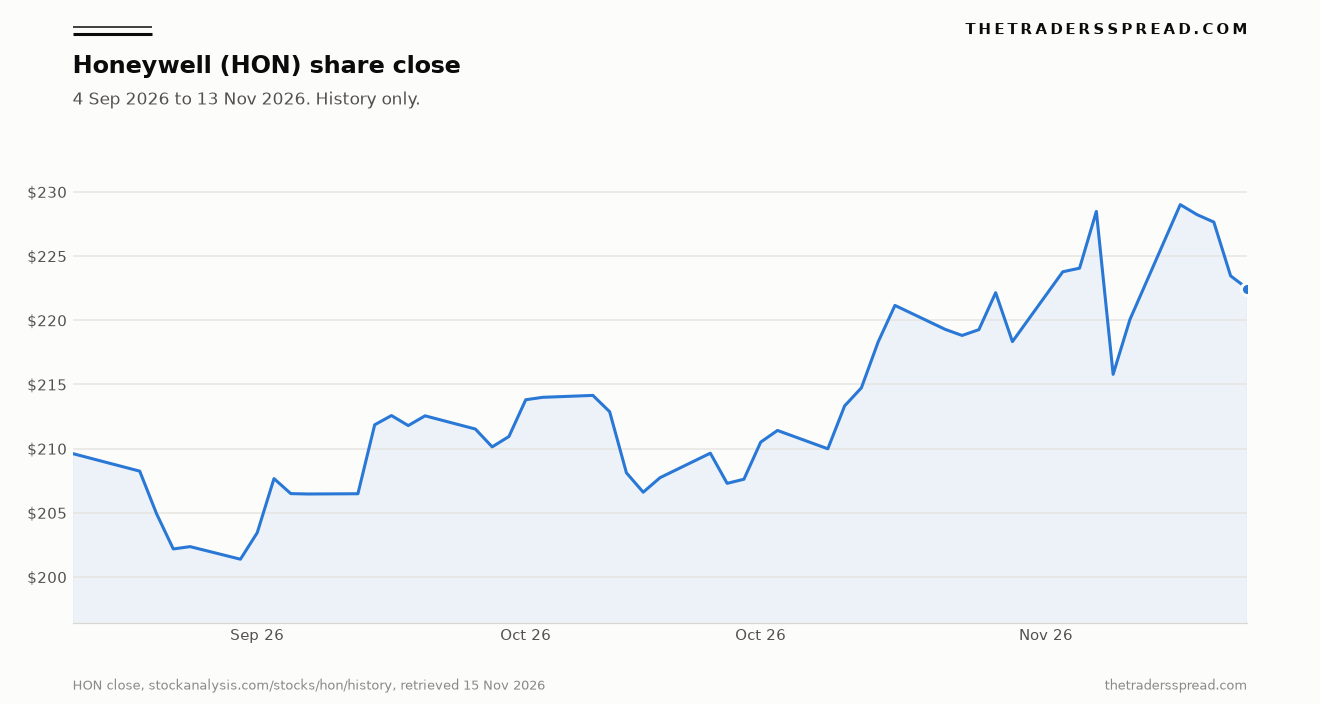
A similar reading problem is in the Caterpillar versus Deere equipment-cycle piece, the Visa versus Mastercard incentive gap, and reading Lam Research line by line. The chart below is Honeywell's series alone, with Emerson's closes for the same dates in the table.
| Close | Honeywell (HON) | Emerson (EMR) |
|---|---|---|
| 4 September 2026 | $209.61 | $152.82 |
| 22 October 2026 | $218.31 | $160.29 |
| 4 November 2026 | $228.47 | $170.44 |
| 13 November 2026 | $222.46 | $166.38 |
Closes are the Close column on the stockanalysis.com history pages for HON and EMR, retrieved 15 November 2026. From 4 September to 13 November, Honeywell rose 6.1%, from $209.61 to $222.46, and Emerson rose 8.9%, from $152.82 to $166.38. The 22 October session is Honeywell's release day, and 4 November is Emerson's.
RelatedCisco (CSCO) $121 AI Revenue Bull vs $88 Margin Bear
Guidance that leaves the bridge out
Honeywell's updated full-year 2026 outlook is sales of $20.0 billion to $20.1 billion, organic growth of 4% to 5%, segment margin of approximately 20.5%, and adjusted earnings per share of $8.40 to $8.45. The margin is the top of the prior range and about 290 basis points of expansion. The release treats the margin and the earnings measure as non-GAAP, and it states that management lacks a reliable prediction of the timing and impact of the excluded items, so the forward segment margin arrives with the reconciliation to operating margin left out.
Emerson's initial 2027 framework is a different gap. Its summary table gives sales growth of about 5%, GAAP earnings per share of about $5.70, adjusted earnings per share of about $7.25, operating cash flow of $4.3 billion to $4.4 billion, and free cash flow of $3.8 billion to $3.9 billion, plus amortization of about $1.41 per share and restructuring of about $0.14 per share. A segment-margin figure is absent from that summary.
Emerson's annual report was certified on 9 November 2026 by S.L. Karsanbhai, President and Chief Executive Officer, and by M.J. Baughman, Executive Vice President, Chief Financial Officer and Chief Accounting Officer, whose certification carries this assurance.
The information contained in the Report fairly presents, in all material respects, the financial condition and results of operations of the Company.
The sentence is item 2 of Exhibit 32 to the Form 10-K for the period ended 30 September 2026, and Karsanbhai signed the same assurance. The 29.1% columns sit in the 4 November earnings release. The certification covers the annual report.
Verdict: audit Note 18, and keep 29.1% on its own bridge
The Honeywell margin a reader can audit is segment profit in Note 18, $1,062 million for the quarter ended 30 September 2026, reconciled there to income before taxes of $839 million after the equity loss, and rebuildable from defined operating income of $740 million plus the published add-backs. The historical 21.3% ties out on that path. The untied forecast is the full-year segment margin of approximately 20.5%, because the 22 October release leaves the reconciliation of that forward measure to operating margin out of the guide.
At Emerson, Table 4's GAAP segment earnings sum to $1,207 million, and the printed amortization and restructuring lift them to adjusted segment EBITA of $1,511 million and a 29.1% margin that ties out as history. Pretax margin of 19.2% is on the face of the same release. The 29.1% remains a different object from Honeywell's 21.3%, struck before corporate expense, with add-backs limited to amortization and restructuring. The pre-corporate reader divisions, 23.3% and 23.2%, are the pair a reader can recompute from the two filings.
Questions readers ask
Why do the headline segment margins differ by about eight points?
Honeywell's 21.3% is segment profit of $1,062 million after corporate expense of $101 million, on sales of $4,994 million, for the quarter ended 30 September 2026. Emerson's 29.1% is adjusted segment EBITA of $1,511 million on sales of $5,201 million, before corporate items, with amortization and restructuring added back. Emerson's three GAAP segment earnings sum to $1,207 million, or 23.2% of sales, beside Honeywell's pre-corporate 23.3%. The gap is mostly construction, as printed on 22 October and 4 November 2026.
Which Honeywell figure sits in the quarterly report?
Note 18 of the Form 10-Q for the quarter ended 30 September 2026 prints segment profit of $546 million, $412 million and $205 million, a corporate loss of $101 million, and a total of $1,062 million, then reconciles that total to pretax income. The 14.8% operating margin is defined in the 22 October 2026 earnings release and matches lines a reader can subtract. The full-year guide of about 20.5% leaves its forward reconciliation out of the outlook.
How can Industrial Automation's margin rise while reported sales fall?
Reported Industrial Automation sales were $1,115 million in the quarter ended 30 September 2026, against $1,450 million a year earlier, a 23% decline the release ties to divestitures, while organic sales growth was 4%. Segment profit was $205 million against $216 million, and the margin rose 350 basis points to 18.4% from 14.9%, a move the 22 October 2026 release attributes mainly to price and productivity, partly offset by inflation.
The figures above are reference data from company filings and from price pages opened on 15 November 2026. They describe past quarters. This article is for information and is not a recommendation to buy or sell any security.