

"We had a great Q3," Duolingo wrote to shareholders on 3 November 2026. The line opens the letter Luis von Ahn signed as chief executive, and the figure under it is the one that reset the tape: daily active users averaged 64.9 million, up 29% from 50.5 million a year earlier, after 23% growth in the second quarter.
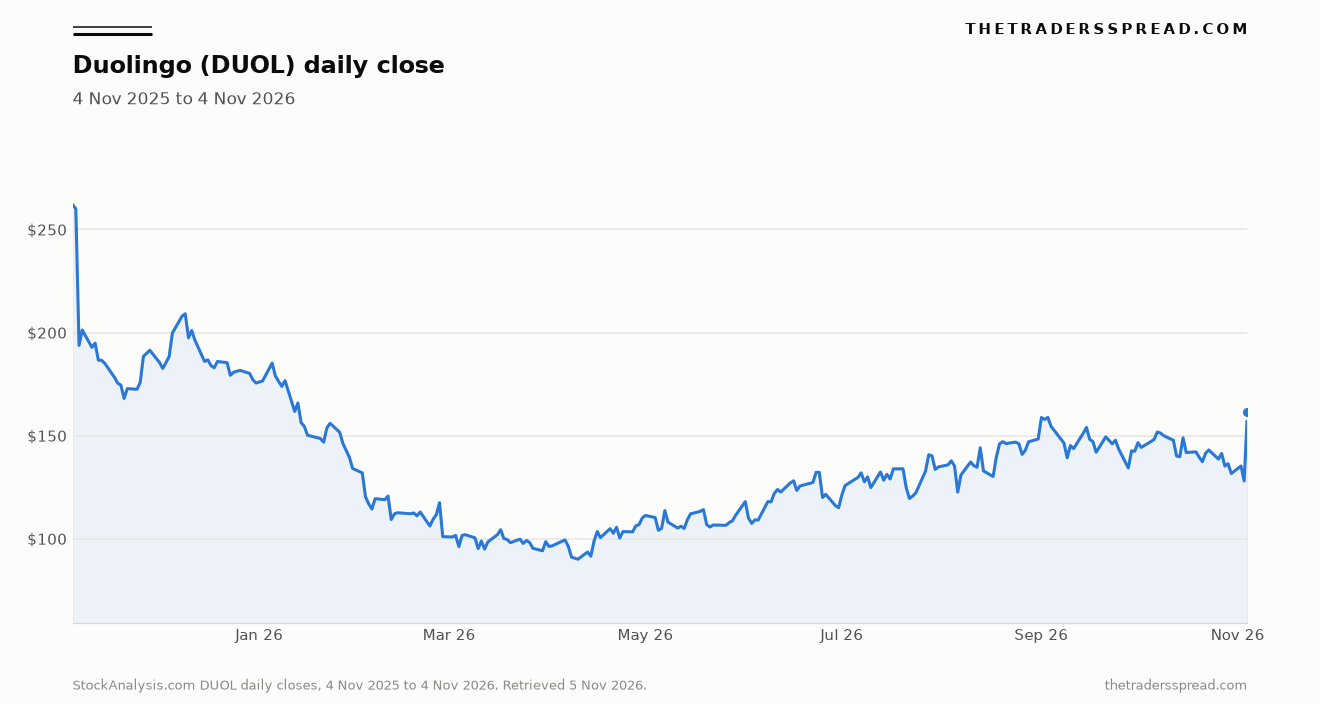
Duolingo stock met that letter on the following session. The Class A share, listed on Nasdaq, closed 3 November at $128.00, down 5.37%, with the webcast still set for 5:00 p.m. ET. On 4 November it opened at $160.00, reached $175.56, and finished at $161.27, up $33.27, or 25.99%. StockAnalysis timestamped that close at 4:00 p.m. EST. A guide beat can travel either way, as Jabil's 10% drop after a fiscal fourth-quarter beat showed.
Profit and daily use moved apart: net income fell to $27.2 million from $292.2 million, and adjusted EBITDA slipped 2% to $78.7 million. Year-earlier net income included a $222.7 million one-time tax benefit, which accounts for most of that gap. Total bookings rose 12% to $316.1 million and subscription bookings rose 16% to $278.4 million, while revenue, recognized over the subscription term, grew a slower 14% to $309.0 million. The share rose with the user reacceleration and the higher outlook, not with the GAAP profit line.
Inside the 3 November letter
The press release furnished with that evening's 8-K is blunter than the greeting. "We had a great Q3, with DAU growth accelerating to 29% year over year, and all of our key financial metrics coming in ahead of expectations," said Luis von Ahn, co-founder and chief executive of Duolingo. In the letter he wrote that the Pittsburgh company is "gradually leaning more into monetization in ways that preserve the quality of our free experience."
Paid subscribers ended at 13.1 million, up 14% from 11.5 million, and monthly active users averaged 153.1 million, up 13%. Daily use grew faster than both the paying base and the monthly audience. Subscription revenue was $270.0 million, up 18%, while in-app purchases fell 38% to $6.9 million.
Unlimited Video Call is on track for every Super subscriber by the end of 2026, so new Max subscriptions stop this month and existing Max individual subscribers move to a Super family plan at the same price. The letter puts a minimal bookings effect inside the fourth-quarter guide.
How the share traded the next day
From the $160 open the share stretched to $175.56, about 37% above the prior close, then settled almost back at the open. It remains 38.5% below the $262.04 close of 4 November 2025.
Key facts
- Daily active users averaged 64.9 million in the quarter ended 30 September 2026, up 29% from 50.5 million. Source: Duolingo shareholder letter, 3 November 2026.
- Total bookings were $316.1 million, up 12%, and revenue was $309.0 million, up 14%, each on a reported and a constant-currency basis. Source: Duolingo shareholder letter, 3 November 2026.
- GAAP net income was $27.2 million, against $292.2 million a year earlier, a quarter that included a $222.7 million tax benefit. Adjusted EBITDA was $78.7 million, down 2%. Source: Duolingo shareholder letter, 3 November 2026.
- The Class A share closed at $161.27 on 4 November 2026, up 25.99% from $128.00, on volume of 9,571,167 shares. Source: StockAnalysis, 4 November 2026, 4:00 p.m. EST.
- Full-year guidance is bookings of $1.296 billion, revenue of $1.221 billion and adjusted EBITDA of $323 million. Source: Duolingo shareholder letter, 3 November 2026.
Bookings moved faster than profit
"Revenue growth moderated from Q2 because subscription revenue is recognized ratably over the subscription term, so it reflects the slower prior-period bookings growth," wrote Gillian Munson, chief financial officer of Duolingo. The same lag between cash collected and revenue recognized is the clock in the ServiceNow and Salesforce contract-backlog comparison.
RelatedNextpower (NXT), the 14.9 Percent Single-Session Jump
GAAP operating expenses rose $39.2 million, or 24%, including an $11.4 million accrual for a company-wide bonus that pays only if fourth-quarter daily-user growth reaches 25% or more. Research and development expense was $107.7 million, against $82.7 million a year earlier, and income from operations fell to $24.2 million from $35.2 million. Gross margin rose to 72.9% from 72.5% on lower feature-based AI costs, while fourth-quarter gross margin is guided to 72.0%.
What to watch
Three dates sit in the letter. November is when Duolingo stops selling new Max subscriptions. The quarter to 31 December 2026 is guided to daily-user growth similar to 29%, bookings of $382 million and revenue of $322 million, with full-year adjusted EBITDA of $323 million, $3 million above the prior guide. February's report, including a 2027 outlook, has no day on the letter.
This article records a filing and a share-price move. It is not a recommendation to buy or sell any security.