

Is USD/CZK at 21.686 pricing a weaker Czech koruna, or only a stronger dollar? The pair is koruna per one US dollar, so a higher number is a weaker koruna, and the climb since the end of 2025 looks like a Prague story. It is mostly a dollar story. The European Central Bank reference for 19 October 2026, the latest date Frankfurter returned on 20 October, set one dollar at 21.686 koruna. On 31 December 2025 the same reference was 20.627. The dollar commands 5.1% more koruna than it did then. The euro does not. EUR/CZK moved from 24.237 to 24.343, a change of 0.4%, while EUR/USD fell from 1.175 to 1.1225. Take the dollar out of the cross and the koruna is almost where it finished last year. That is the question the rate is pricing into 31 December.
Divide the euro cross by the dollar's price in euros and the dollar cross falls out. On 19 October, 24.343 divided by 1.1225 lands on the published USD/CZK reference of 21.686. Since 31 December the euro has lost 4.5% against the dollar and the koruna has lost 0.4% against the euro. Compound those two moves and you are at the 5.1% rise in USD/CZK. The Czech National Bank's minutes for 17 September still described the koruna as strong. On that day EUR/CZK was 24.308, a whisker from December's 24.237, while USD/CZK was already 21.172. The board was talking about the euro. By 19 October EUR/USD was 1.1225 and USD/CZK was 21.686, with EUR/CZK only at 24.343. The dollar leg has to be separated from the local story before anyone reads the EUR/USD rate as a koruna event.
- USD/CZK 21.686 on the ECB reference of 19 October 2026, up from 20.627 on 31 December 2025 — Frankfurter ECB reference feed, retrieved 20 October 2026
- EUR/CZK 24.343 and EUR/USD 1.1225 on 19 October, against 24.237 and 1.175 on 31 December 2025 — same ECB references, retrieved 20 October 2026
- USD/CZK ranged from 20.289 on 28 January 2026 to 21.855 on 7 October 2026 — Frankfurter, ECB references from 20 October 2025 to 19 October 2026
- Two-week repo held at 3.75% on 17 September 2026, discount rate 2.75%, Lombard rate 4.75%, seven votes in favour — Czech National Bank statement, 17 September 2026
- Consumer prices up 2.5% year on year in September and unchanged on the month, after 1.9% in August; fuels and lubricants up 37.5% — Czech Statistical Office, 13 October 2026
- Federal funds target range raised by a quarter point to 3.75% to 4% on 16 September 2026, on a 12–0 vote — Federal Reserve statement, 16 September 2026
The koruna did not do this
The Czech National Bank does not publish a USD/CZK objective. It publishes an inflation target of 2%. The 17 September statement treats the exchange rate as one item on a list that also includes fiscal policy, the labour market, foreign central banks, lending and property prices. The 18 June statement uses the same list.
No line in either document names a koruna level the board will defend. A higher USD/CZK print can still matter, because the board has said it watches the koruna. It does not matter in the way a peg would. The figures here are the ECB reference only. They are not blended with the Czech National Bank's own daily fixing.
From 20 October 2025 to 19 October 2026, EUR/CZK traded between 24.083 on 26 August and 24.555 on 30 March. That band is 2.0% of the low. USD/CZK traded between 20.289 and 21.855, a band of 7.7% of the low. The year's strongest euro print in this sample is 1.1974 on 28 January, the day USD/CZK made its low of 20.289. The year's weakest euro print is 1.1177 on 7 October, the day USD/CZK made its high of 21.855. The koruna's euro price on those two days was 24.294 and 24.427. It did not make the extremes. The dollar did.
From the late-summer trough the pattern is the same, only smaller. On 21 August USD/CZK was 20.614, EUR/USD was 1.1699 and EUR/CZK was 24.116. By 19 October the dollar cross was 5.2% higher, the euro was 4.1% weaker against the dollar, and the koruna was 0.9% weaker against the euro. Since the 7 October high the pair has eased from 21.855 to 21.686, a 0.8% dip, while EUR/USD has recovered from 1.1177 to 1.1225 and EUR/CZK has firmed from 24.427 to 24.343. A straight line from that peak to something above 22 is a bet that the dollar starts a fresh leg, not a description of the last two weeks.
Four dates still on the calendar
On 18 June the Bank Board raised the two-week repo by 0.25 percentage point to 3.75%, and raised the other key rates by the same amount. Six members voted for the increase. One voted to leave rates unchanged. The statement said core inflation had sat just below 3% for six months, and that GDP growth had slowed to 2.2% in the first quarter of 2026 from 2.7% in the fourth quarter of 2025. The risks to the target were judged inflationary overall.
On 17 September the same board held. The repo stays at 3.75%, the discount rate at 2.75%, the Lombard rate at 4.75%. All seven members voted for that decision: Aleš Michl, Eva Zamrazilová, Jan Frait, Karina Kubelková, Jan Kubíček, Jan Procházka and Jakub Seidler. The statement says the June increase has so far produced enough tightening, that longer-term market rates have tightened financial conditions further, and that the commodity-market risk has intensified. At the next meeting the board will choose between leaving rates unchanged and raising them. GDP growth slowed from 2.2% to 1.9% in the second quarter, with domestic demand still the main source.
The minutes, written by Petr Sklenář of the Monetary Department, record that Governor Aleš Michl emphasised the need to remain hawkish. They also record a consensus that the June hike, longer-term rates and the still strong koruna left room to wait. Jan Kubíček regarded the risk of a policy error from holding, at that meeting, as low. Year-on-year average wage growth in the first quarter was revised in September from 8.1% to 6.1%. Eva Zamrazilová noted that real wages had been growing faster than productivity for three years, and that a planned 11% rise in the minimum wage could add pressure without a matching rise in productivity. Jakub Seidler said growth in loans to non-financial corporations had accelerated into double digits even after adjusting for large firms. The vote was still 7–0. That is the argument they walk back into on 5 November.
The Federal Reserve moved the day before Prague did. On 16 September the Federal Open Market Committee raised the funds range by a quarter point to 3.75% to 4%, and the statement was approved 12–0. A quarter-point rise to that range means the previous range was 3.50% to 3.75%. Before the vote, the Czech repo sat at the top of the Fed's range. After it, the floor of the Fed's range and the Czech repo are the same 3.75%, and the ceiling is 4%. The Committee said inflation remains elevated. Its calendar puts the next meetings on 27–28 October and 8–9 December, the December meeting being one that comes with projections.
The CNB calendar puts monetary policy meetings on 5 November and 17 December, with the decision at 2.30 p.m. Prague time. The order through year-end is Fed, CNB, Fed, CNB. The statistical office dates its next inflation flash to 4 November, the day before the Bank Board meets, and the full release to 10 November. November's vote will see a flash, not the full basket. One further Fed quarter-point, if Prague does not follow six days later, would put the entire funds range above the Czech repo. That gap was not there on the morning of 16 September.
Where 21.686 sits
The reference rate is 0.8% under the 7 October high and 6.9% above the 28 January low. It sits in the upper part of the year's range, not outside it. The chart is the ECB dollar reference from 20 October 2025 to 19 October 2026, with three paths drawn to 31 December. Higher is a weaker koruna. The paths are the divisions in the second table, not a fourth price series.
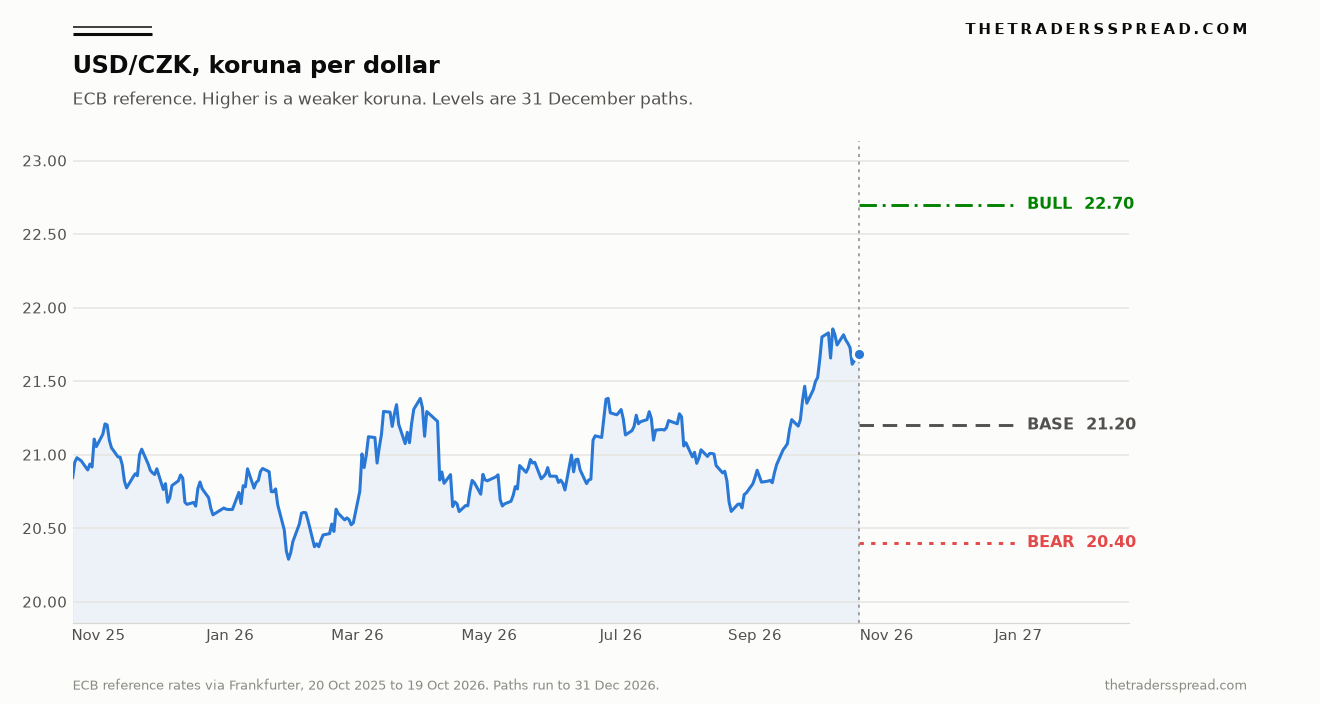
ECB reference rates via Frankfurter, retrieved 20 October 2026. Level labels are 31 December paths, not transactions.
| ECB reference date | USD/CZK | EUR/CZK | EUR/USD |
|---|---|---|---|
| 31 Dec 2025 | 20.627 | 24.237 | 1.175 |
| 28 Jan 2026 | 20.289 | 24.294 | 1.1974 |
| 21 Aug 2026 | 20.614 | 24.116 | 1.1699 |
| 17 Sep 2026 | 21.172 | 24.308 | 1.1481 |
| 7 Oct 2026 | 21.855 | 24.427 | 1.1177 |
| 19 Oct 2026 | 21.686 | 24.343 | 1.1225 |
Each row is an ECB reference from the Frankfurter feed retrieved on 20 October 2026. On these dates USD/CZK matches EUR/CZK divided by EUR/USD. On 17 September, the day the minutes called the koruna strong, the euro cross was 24.308.
| Path to 31 Dec 2026 | EUR/USD | EUR/CZK | USD/CZK | Weight |
|---|---|---|---|---|
| Bear | 1.1814 | 24.10 | 20.40 | 25% |
| Base | 1.1439 | 24.25 | 21.20 | 45% |
| 19 Oct reference | 1.1225 | 24.343 | 21.686 | |
| Bull | 1.0815 | 24.55 | 22.70 | 30% |
The bear, base and bull dollar rates are those euro-cross figures divided by those EUR/USD figures, rounded to two decimals. The weights are this desk's judgements, not implied probabilities from a listed contract. EUR/CZK at 24.10 is near the firm end of this year's band. EUR/CZK at 24.55 is the weak end. Neither path requires the koruna to leave the euro range it has already traded.
A move in USD/PLN can share a dollar leg with USD/CZK and still be a different central bank and a different local cross. The forint cross, set out separately as USD/HUF, is the same kind of reminder. Treating them as one regional trade is how the euro cross gets ignored.
What 22.70 actually requires
"Consumer prices accelerated their year-on-year growth for the third consecutive month and amounted to 2.5% in September. This acceleration was again significantly influenced by prices of fuels," said Pavla Sediva, head of the Consumer Price Statistics Unit at the Czech Statistical Office, in the office's 13 October release. The price level was unchanged on the month. Fuels and lubricants were up 37.5% year on year, after 26.2% in August, and up 8.1% on the month. Transport prices were up 13.2% year on year. Services prices were up 4.6%. Goods prices were up 1.2%.
The same release is also a list of falling prices. Pork was down 15.5% year on year, eggs down 12.6%, butter down 37.3%. Electricity was down 10.6% and natural gas down 4.0%. The twelve-month average inflation rate was 2.0%. Czech harmonised inflation was 2.2% year on year. The office's report of the Eurostat flash put euro-area inflation at 3.8% in September, Germany at 3.3% and Slovakia at 3.1%. The hot price level in that comparison is not the Czech one.
The CNB's comment on the same figures, published the same day, says diesel and petrol now contribute more than 1 percentage point to the headline, and that excise cuts and price caps will not show until October. Its core measure edged up from 3% to 3.1%. "We expect inflation to remain at similar levels of between 2% and 3% for the rest of the year. At the beginning of next year, it is very likely to rise temporarily above 3%," said Jakub Matějů, Deputy Executive Director of the Monetary Department. The minutes had already trailed the point: Kubíček said a move above 3% early next year would be the first in three years, and that the bank would need to call it expected and temporary.
The case for 22.70 needs three things at once, and none of them is a break in EUR/CZK. The Fed tightens again, on 28 October or on 9 December. The CNB holds on 5 November and on 17 December. And EUR/USD goes to about 1.0815, roughly 3.7% below the 19 October reference, while EUR/CZK sits at 24.55. Divide and the result is 22.70, which is 4.7% above 21.686 and above the October high. The koruna only has to stand where it stood in March. The dollar has to go past this year's euro low of 1.1177.
The case fails in the mirror image. A Fed hold, or a hike that the CNB matches six days later, leaves the rate gap looking like the one after 16 September, not a wider one. A dollar that gives back part of the drop from 1.175 to 1.1225 pulls USD/CZK down even if the koruna does nothing against the euro. The fuel spike is real. The services rate is uncomfortable. The euro cross has not confirmed a koruna problem.
RelatedGBP/NZD Forecast: 2.42 Bull Case vs 2.24 Bear Case
Paths to 31 December
The base path is 21.20, weighted at 45%. EUR/USD at 1.1439 gives back part of the fall from 1.175 to 1.1225. EUR/CZK at 24.25 sits between 24.237 at the end of 2025 and 24.343 on 19 October. Divided through, that is 21.20, about 2.2% under the reference of 21.686. It is the path on which the Fed and the CNB do not open a fresh gap. The level that ends it is 22.20, above the 7 October high of 21.855. Through 22.20 the October high has not held, and the bull path is the one that fits. Conviction is moderate. The identity is clear and the four dates are published, but the dollar has been the story for ten months.
The bull path is 22.70, weighted at 30%. The Fed leans tighter at one or both remaining meetings, the CNB waits twice, and the euro falls to about 1.0815 while the koruna sits at 24.55 per euro, near the 30 March weak point of 24.555. That is 4.7% above 21.686, still inside the euro band. Michl's hawkish line, the loan growth Seidler described, and Matějů's warning of a temporary move above 3% are reasons November can go the other way. The bear path is 20.40, weighted at 25%. EUR/USD at 1.1814 retraces part of the way toward 1.1974 on 28 January, and EUR/CZK at 24.10 is close to the 26 August firm point of 24.083. The koruna does little. The dollar gives ground. It fits a Fed that is done for the year and a 4 November flash that keeps the fuel jump inside transport.
What changes the weights is services, not another fuel print. If the 10 November breakdown shows services picking up, rather than fuel simply fading, the postponed hike becomes the decision that fits the board's own test, and the weight on 22.70 comes down. A Fed hold on 28 October would cut that weight further. A CNB hike on 5 November, with EUR/CZK still inside 24.083 to 24.555, would support 21.20. It would not, on its own, deliver 20.40.
Questions the rate leaves open
What does USD/CZK measure?
USD/CZK is the number of Czech koruna per one US dollar. Here the figure is the ECB reference, not the Czech National Bank's daily fixing, and the two are not mixed. A rise means the koruna is weaker against the dollar. On 19 October 2026 the reference was 21.686, against 20.627 on 31 December 2025. EUR/CZK on those dates was 24.343 and 24.237. Only the euro cross is a clean read on the koruna itself.
Is the CNB defending a koruna level?
No. The statements of 18 June and 17 September set the two-week repo, the discount rate and the Lombard rate. They do not name an exchange rate the board will defend. The koruna is one of several things the board says it will watch, alongside wages, fiscal policy and foreign central banks. On 17 September the minutes called it strong when EUR/CZK was 24.308, even though USD/CZK was already 21.172.
When does policy get set again?
The Fed calendar has meetings on 27–28 October and 8–9 December 2026. The CNB calendar has monetary policy meetings on 5 November and 17 December, with the decision at 2.30 p.m. Prague time. The September statement said the next choice was between no change and a rise. The statistical office dates its inflation flash to 4 November and the full release to 10 November, so the November vote comes with a flash rather than the full basket.
Does 2.5% inflation force another hike?
Not by itself. September prices rose 2.5% year on year and were flat on the month, after 1.9% in August, with fuels and lubricants up 37.5% year on year. The CNB's core measure was 3.1%. Jakub Matějů said on 13 October that inflation was likely to stay between 2% and 3% into year-end and to rise temporarily above 3% early next year. The September statement left both a hold and a rise open.
What knocks out the 21.20 base path?
A USD/CZK rate through 22.20. That sits above the 7 October high of 21.855, and it is the invalidation used here. Through that level the October high has not held, and 22.70 is the path that fits a further dollar move with the euro cross still inside this year's band. The base path also loses weight if the Fed lifts the funds range again while the CNB holds and EUR/USD heads toward 1.08.
Disclaimer
This is analysis, not advice. It does not recommend a transaction in the koruna, the dollar, or any contract for difference. Foreign exchange prices move, and capital put to work in these markets can be lost. The bull, base and bear figures are scenarios for 31 December 2026, built from ECB reference rates retrieved on 20 October 2026. They are not orders, and the weights attached to them are judgements.